
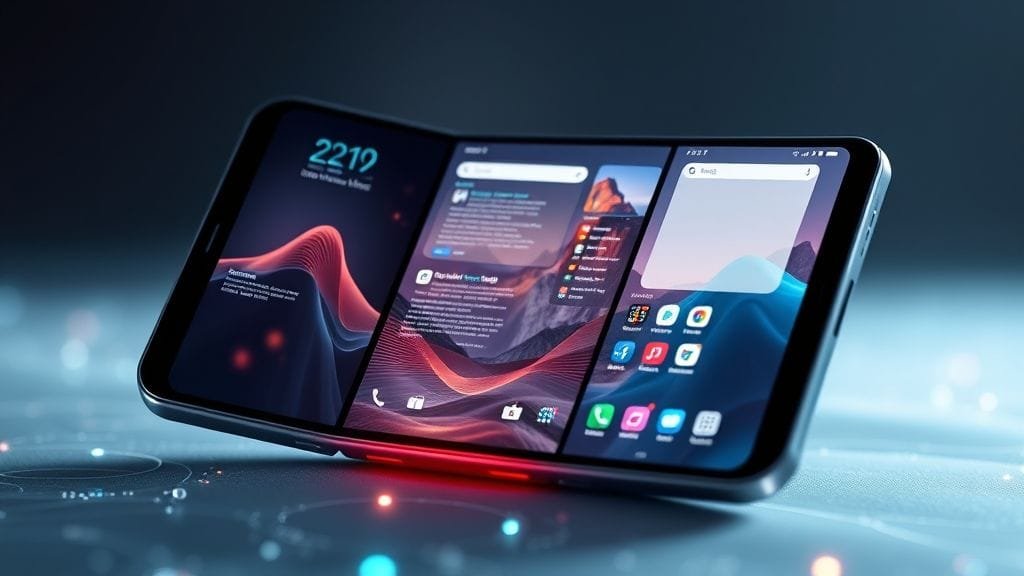
The tri-fold smartphone evolution now redefines mobile versatility, marking a significant leap in mobile technology. Indeed, manufacturers consistently push innovation innovation boundaries. For years, the industry pursued thinner profiles and larger displays. However, foldable smartphones brought a new paradigm, offering tablet-sized screens in pocketable forms. These devices revolutionized digital interaction. Furthermore, this evolution extends beyond a single hinge. It embraces multiple folding sections, fundamentally rethinking device functionality. Consequently, users gain even more expansive screens and enhanced multitasking capabilities.

The Relentless Pursuit of Larger Screens and Ultimate Portability in Tri-Fold Smartphone Evolution
The desire for larger screens is deeply ingrained in smartphone history, from the iPhone’s debut to the rise of phablets. This preference often clashed with portability. Early foldable phones offered a compromise, folding compact while providing a larger screen. Yet, initial foldables felt limited, not offering true tablet-level productivity or immersive entertainment. This unmet demand persists, and the advancement of advanced multi-fold designs now promises to bridge this gap with advanced triple-fold devices.
The Current Foldable Landscape: Setting the Stage for Next-Gen Foldables
Understanding the current foldable market is crucial before discussing advanced multi-fold phones. Foldables debuted commercially a few years ago, steadily gaining traction. Samsung, Huawei, OPPO, and Motorola offer devices like the Galaxy Z Fold/Flip. These existing devices showcase the technology’s viability, typically using a single hinge to fold in half—either vertically (clamshell) or horizontally (book style).
These first-generation foldables appeal due to their transformation ability, from compact flip phones opening into standard smartphones, to thick devices unfolding into small tablets. This versatility has captivated tech enthusiasts and early adopters. Challenges like high costs, durability concerns, and software optimization persist. Yet, the market continues to grow, paving the way for advanced designs in the mobile sector. Triple-fold devices, for instance, are complex designs pushing mobile boundaries and addressing predecessor screen size limits.
What Exactly is a Tri-Fold Smartphone? Defining the Form Factor and Its Core Promise within Tri-Fold Smartphone Evolution
A triple-fold device, or tri-fold smartphone, is fundamentally a unique mobile device, featuring two hinges. These hinges allow the device to fold into three distinct sections. Existing foldables usually fold in half; in contrast, these devices offer an additional fold, which enables a much larger display when fully unfolded. Consider, for instance, a conventional tablet that can be neatly folded twice; thus, its footprint reduces to that of a traditional smartphone. This innovative design allows for significantly more screen real estate, often reaching between 10 to 10.2 inches, or even larger.

The core promise of the tri-fold is multifaceted:
- Expansive Display: It provides a genuinely immersive screen for multimedia, gaming, and productivity tasks, rivaling smaller tablets.
- Enhanced Portability: Despite the larger unfolded screen, the device aims to maintain a compact and pocketable form factor when fully folded, striking an improved balance between screen size and convenience.
- Versatile Configurations: The two hinges allow for various usage modes, from a compact smartphone to a single larger display, or even a laptop-like setup with one section acting as a virtual keyboard.
This design directly responds to persistent market demand, as consumers crave larger screens yet simultaneously desire portability. Therefore, this innovation pushes flexible display and hinge technology boundaries, aiming to deliver a truly versatile device that defines the future of mobile computing. This device can truly serve as a smartphone, a small tablet, and a mini-laptop, all within one package. Certainly, the complexities involved are considerable; however, the potential benefits for users are equally compelling from these triple-fold devices.
The Pioneers and Innovators: Who’s Leading the Tri-Fold Smartphone Evolution Charge?
This development undeniably proves persistent innovation in consumer electronics. Although nascent, major players are investing heavily in the research, development, and commercialization of these devices. Their efforts shape mobile form factors and drive technological advancements necessary to make triple-fold devices a reality.

Huawei’s Bold Leap: The Mate XT and its “Tiangong” Hinge in the Tri-Fold Smartphone Evolution
Chinese technology giant Huawei currently leads the commercial triple-fold device charge. Huawei launched its first commercial tri-fold model, the Mate XT, in China, setting a precedent. This device showcased a sophisticated dual-hinge “Z-fold” design, a hallmark of multi-fold phones. The “Z-fold” mechanism allows it to fold like an accordion, presenting a compact form factor when closed and an expansive display when fully opened.
The Mate XT offered more than a folding mechanism; it introduced Huawei’s proprietary “Tiangong” dual-hinge system. This system uses advanced materials like Ultra-Thin Glass (UTG) for the internal screen and a non-Newtonian fluid for the external panel. Huawei claims these innovations enhance durability and improve impact resistance by up to 30% compared to traditional book-type foldables—crucial for consumer trust. Priced at $3,600-$4,000, the Mate XT is ultra-premium, reflecting both company ambition and cutting-edge technology costs. Despite early screen and hinge issues, its launch marked Huawei as a pioneer in this advanced foldable segment and the broader foldable phone future.
Samsung’s Strategic Entry: From Flex Prototypes to the Anticipated Galaxy Z Tri Fold within the Tri-Fold Smartphone Evolution
Samsung, a long-standing leader in the foldable market, is moreover poised to bolster the next-gen foldable segment. The company has a history of showcasing innovative foldable concepts; therefore, its foray into triple-fold devices is highly anticipated. Samsung consistently demonstrates commitment to multi-fold designs, as evidenced through various prototypes. For example, at MWC 2024, Samsung unveiled the Flex G and Flex S concepts. These prototypes explored different folding mechanisms, including inward and zigzag folds, which indicates Samsung’s extensive research into optimal multi-fold phones architectures.
However, the anticipated Samsung Galaxy Z Tri Fold launch creates the biggest buzz. It is expected, moreover, to debut in late October or early November 2025. This device is rumored to have a substantial 9.96-inch display, which, when fully unfolded, will offer a true tablet-like experience. Analysts and experts, therefore, consider the Galaxy Z Tri Fold critical for Samsung, as it will reinforce its dominance and innovation in the foldable market. Initial shipments, however, are expected to be limited, estimated at around 50,000 units, suggesting a cautious yet strategic entry into this ultra-premium niche. Samsung’s involvement often acts as a catalyst, transitioning niche technology into a competitive product race, which fundamentally advances this segment and the wider foldable phone future.
Other Players on the Horizon for Tri-Fold Smartphone Evolution: OPPO, Tecno, and the Apple Rumors
Tri-fold designs are gaining momentum beyond Huawei and Samsung, signaling broader industry interest. For example, OPPO and Tecno have actively showcased tri-folding concepts, further driving this segment’s development. These public demonstrations highlight a shared industry belief in the potential of these multi-fold phones to capture future market share. While their prototypes are not yet commercialized, they nevertheless contribute to collective knowledge and also aid in technology development. Consequently, they push the boundaries of what is possible, including flexible displays and intricate hinge systems.
Apple is perhaps the most significant potential entrant to the foldable, and possibly tri-fold, market. Rumors, however, persist about Apple developing a foldable iPhone, with a launch potentially happening as early as 2026. Despite scarce details, a triple-fold device from Apple could be a game-changer. Apple, notably, holds significant market influence; historically, its entry legitimizes new tech categories and also accelerates mainstream adoption of next-gen foldables. Therefore, if Apple releases such a device, it will undoubtedly ignite consumer interest and, furthermore, intensify the competitive landscape within this emerging market. This could potentially drive down costs and likewise improve product refinement across the industry.
Engineering Marvels: The Technologies Powering Tri-Fold Smartphone Evolution Designs
The development of these advanced form factors is more than merely a design concept; instead, it represents a complex engineering challenge for next-gen foldables that requires continuous breakthroughs. Several key technological areas are involved, as the very existence of these multi-fold phones truly relies on cutting-edge fields. These include materials science, mechanical engineering, and software development. Without these foundational advancements, the promise of an expansive, portable device would simply remain a promise.
Dual-Hinge Systems: Beyond the Book-Fold – Z-Folds, G-Folds, and Durability in Multi-Fold Phones
Advances in hinge mechanisms are crucial for triple-fold devices; in fact, this is arguably their most critical enabler. A single hinge system is simpler; however, dual-hinge systems significantly increase mechanical complexity. New hinge designs, therefore, must be robust, enduring thousands of folds over the device’s lifespan, and also maintaining structural integrity. Smooth operation is likewise essential. Challenges, moreover, include preventing dust and debris ingress, ensuring precise panel alignment, and furthermore, minimizing the visible crease on the flexible display.

Manufacturers are exploring various multi-hinge architectures:
- Z-folds: As seen in Huawei’s Mate XT, this design allows the device to fold like an accordion, with sections folding in opposite directions. This often results in a relatively flat profile when folded.
- G-folds (or in-and-out folds): These designs might feature a combination of inward and outward folds, offering different screen configurations depending on the user’s needs. Samsung’s Flex S prototype showcased such versatility.
Advanced hinge systems often utilize sophisticated gear assemblies and also incorporate durable alloys, while proprietary dampening mechanisms are likewise common. For example, Huawei’s “Tiangong” dual-hinge system is notable as it highlights the industry’s focus on innovative engineering, which consequently enhances both durability and user experience. Therefore, the quality of these hinges is vital, directly impacting device longevity and also affecting the perceived premium feel. Thus, hinges are a central pillar of this technological advancement and crucial for the foldable phone future.
Flexible Display Breakthroughs: UTG, OLED/AMOLED, and Visual Fidelity in Triple-Fold Devices
The flexible display is, undeniably, central to every foldable and triple-fold device. Multi-fold phones, in particular, demand larger, more resilient, and visually stunning flexible panels. Organic Light-Emitting Diode (OLED) and Active-Matrix OLED (AMOLED) displays are, consequently, dominant here. These technologies are inherently flexible because they do not require a rigid backlight; as a result, they can be manufactured on bendable substrates.

Recent innovations crucial for the development of triple-fold devices include:
- Ultra-Thin Glass (UTG): This material is a game-changer. Instead of plastic, UTG provides a glass-like feel, enhanced scratch resistance, and superior optical clarity while still being flexible enough to fold. It’s significantly more durable than early plastic-based foldable screens.
- Durable Polymers and Adhesives: Alongside UTG, advancements in flexible polymer layers and specialized adhesives ensure that the multiple display sections can withstand repeated bending without delamination or pixel damage.
- Panel Manufacturing Techniques: Companies like BOE are at the forefront of developing advanced flexible folding display technology. Their contributions, including refined waterdrop hinge designs that allow for a tighter fold radius and reduced crease visibility, are vital.
These display innovations offer more than mere flexibility; they also aim for vibrant colors, high contrast ratios, and fast refresh rates. This, therefore, ensures an uncompromising visual experience, which holds true regardless of the device’s folded or unfolded state. Such continuous improvements in display technologies are key drivers, impacting both the feasibility and appeal of these advanced form factors and future next-gen foldables.
Software: The Unsung Hero: Optimizing the User Experience Across Multiple Screens for Next-Gen Foldables
While hardware innovations often capture attention, software optimization is, in fact, the true force behind triple-fold devices. These devices, with their multiple screens and unique folding modes, consequently present significant challenges for operating systems and applications. Without intelligent software, therefore, the advanced hardware risks becoming little more than a novelty; ultimately, it is the software that unlocks the device’s full potential and prevents these innovative devices from being just a clever gimmick.
Crucial software advancements begin with dynamic UI scaling. The operating system, for instance, must effortlessly adapt its interface across various screen configurations. This means presenting a standard smartphone UI when folded, a split-screen view when partially unfolded, and efficiently utilizing the expansive, fully unfolded display with tablet-optimized layouts. Equally vital is app continuity, ensuring that an application seamlessly transitions as these multi-fold phones fold or unfold. For example, a video playing on one screen section should expand smoothly to the full display without interruption, or offer multi-window options when the device changes form.
Enhancing Productivity and Interaction with Tri-Fold Smartphone Evolution
With such a large and flexible canvas, triple-fold devices are consequently ideal for advanced multi-window multitasking and enhanced productivity modes. Users, for example, should have the capability to run three or even four applications simultaneously, intuitively resize windows, and easily drag-and-drop content between them. This functionality is, therefore, indispensable for professionals and power users alike, demonstrating the true potential of these advanced foldables.

Software Ecosystem Fragmentation: Ensuring Seamless App Experiences for Tri-Fold Smartphone Evolution
Triple-fold device hardware innovations are quickly advancing, often outpacing the software ecosystem’s readiness. This creates a significant challenge for seamless functionality, especially across diverse screen configurations. Without robust, adaptive software, the advanced hardware risks becoming a mere novelty. Ultimately, software truly unlocks the multi-fold phones‘ full potential, pushing the boundaries of the foldable phone future.
In conclusion, a robust and adaptive software layer is absolutely critical for this advanced foldable segment. Without it, the inherent advantages of tri-fold hardware could be undermined, leading to a fragmented and inconsistent user experience. Therefore, close collaboration between hardware manufacturers and software platforms like Android is essential.
Market Dynamics and Future Projections: Where Do Tri-Folds Fit in the Foldable Phone Future? for Tri-Fold Smartphone Evolution
While the foldable smartphone market grows overall, it nevertheless remains a small fraction (1.5-1.6%) of the total. Triple-fold devices, however, will likely remain an ultra-premium, niche product for the foreseeable future. They primarily appeal to tech enthusiasts, early adopters, and specific professionals who consequently justify high costs and prioritize the cutting-edge functionality offered by these next-gen foldables.

The foldable market, furthermore, projects significant expansion, expected to grow from USD 31.30 billion in 2025 to USD 118.87 billion by 2030. Still, multi-fold phones will be a smaller sub-segment. Mass adoption, however, depends on overcoming challenges, including price, durability, and bulk. Until devices become more affordable and robust, they will remain symbolic, showcasing technological prowess rather than dominating sales. This limited market reach is, therefore, an inherent challenge for these advanced designs, impacting the wider foldable phone future.
The Tri-Fold Smartphone Evolution: A Symbolic Product Driving Innovation
The global foldable smartphone market shows robust growth, albeit from a small base. Shipments are projected to hit nearly 20 million units by 2025. Analysts forecast a surge to USD 118.87 billion by 2030 (CAGR of 30.59%). This expansion reflects increasing investment in flexible form factors, including next-gen foldables.
Despite a temporary slowdown in 2024-2025, significant growth is expected from 2026 onwards, fueled by continued innovation in multi-fold designs like triple-fold devices. The entry of major players such as Apple could further accelerate mainstream adoption of multi-fold phones. Thus, this form factor is positioned to contribute and benefit from broader market expansion.
Industry analysts believe Samsung’s entry into this advanced form factor segment is a critical moment, signaling maturity for the form factor and transitioning multi-fold phones from prototypes into a competitive product race. Similarly, Apple’s potential entry, particularly with a rumored triple-fold device, would be a massive catalyst. Apple’s brand power can popularize new technologies; if it releases a next-gen foldable, it will undoubtedly ignite consumer interest and intensify the competitive landscape within this segment’s development, potentially driving down costs and improving product refinement across the industry.
The Road Ahead: Accelerating the Tri-Fold Smartphone Evolution
Consumer interest in foldables remains high, which consequently suggests a receptive audience for innovative form factors like next-gen foldables. For instance, 59% of smartphone owners are interested in a foldable for their next device, with this interest particularly strong among younger demographics, as 83% of 18-29 year olds would consider a foldable. This robust interest, therefore, bodes well for these advanced devices.

However, two major concerns temper this interest: affordability (69%) and durability (67%). Triple-fold devices, as discussed previously, amplify these challenges due to their inherent complexity and cutting-edge nature. Manufacturers, consequently, must address these core concerns, needing accessible pricing and proven long-term reliability. Until then, widespread adoption of these advanced form factors will remain steep, and interest and purchasing intent will narrow only when fundamental barriers are overcome.
The Road Ahead: Charting the Tri-Fold Smartphone Evolution for Widespread Success
In many ways, triple-fold devices are currently “symbolic products.” They represent mobile innovation’s cutting edge and also signal the foldable phone future; moreover, they demonstrate a manufacturer’s technological prowess. While their immediate sales volumes may be limited due to high prices and niche appeal, their very existence, however, revitalizes the smartphone market overall.
The industry’s design language has largely stagnated, revolving primarily around the ‘slab’ form factor. Foldables, particularly multi-fold phones, therefore inject excitement and novelty. They offer a vision of future mobile computing and also stimulate research and development across sectors, ranging from flexible display manufacturing to hinge mechanics, with software optimization likewise included, defining next-gen foldables. Therefore, this advanced segment is not just about unit sales; its success also lies in driving the entire mobile technology landscape forward.
The Road Ahead: What’s Needed for Widespread Tri-Fold Success?
The journey of these advanced form factors from premium niche to widely adopted form factor is challenging, yet it brims with potential. For these innovative triple-fold devices to succeed and transform the mobile landscape, manufacturers, software developers, and the industry must consequently address key areas strategically. The path forward, therefore, requires concentrated effort, which will refine technology, enhance user experience, and make these advanced next-gen foldables more accessible.
Addressing the Core Challenges: Price, Durability, Battery
To drive adoption of these advanced devices, immediate steps must address fundamental hurdles, starting with price reduction. Manufacturers need to significantly lower production costs through scaled-up manufacturing, optimized supply chains, and increased competition among component suppliers. This will boost production volumes, leveraging economies of scale to reduce exorbitant price tags and make triple-fold devices competitive with high-end smartphones and existing foldables.
Alongside cost, enhancing durability is non-negotiable. This requires continuous research into robust flexible display materials, resilient hinge mechanisms, and improved dust/water resistance. Transparent communication and real-world testing will build consumer trust and dispel fragility concerns. Concurrently, improving battery life is vital; multi-fold phones need innovative battery technologies, power-efficient chipsets, and aggressive software optimization for multi-screen management to achieve competitive all-day performance, ensuring practicality for daily use without constant recharging.
Successfully addressing these three core challenges will be the most significant determinant, as it will decide whether these devices can move beyond their ultra-premium segment.
Demonstrating Practical Utility: Beyond the Wow Factor
The “wow factor” of a device that unfolds into a tablet is powerful, yet sustained adoption requires demonstrating clear, practical utility. This utility must justify both its cost and complexity. Manufacturers need to articulate and showcase how triple-fold devices genuinely improve users’ lives in tangible ways that traditional smartphones cannot.
To achieve this, they must highlight specific use cases where the expansive screen and multi-fold phone capabilities offer unique advantages, like enhanced remote work or immersive learning. Devices must also integrate seamlessly into existing digital workflows, with effortless transitions between phone and tablet modes. Furthermore, fostering developer collaboration to create “killer apps” optimized for this unique form factor will be crucial, much as early applications defined smartphone success.
Moving beyond novelty to undeniable utility will consequently be crucial, as it will convince consumers that a tri-fold is not just a technological marvel but a valuable tool. This, in turn, fuels further advancements in this area.
Evolving the Software Experience: Making It Intuitive and Powerful
The ultimate success of triple-fold devices depends heavily on their powering software. To deliver an exceptionally refined, intuitive, and powerful user experience, operating system developers must establish robust, standardized APIs. These are crucial for app developers to create applications that flawlessly adapt to various folding states, screen sizes, and aspect ratios. Additionally, the user interface needs intelligent adaptation, anticipating user needs by automatically switching between single, dual, or multi-panel layouts, potentially leveraging AI for contextual awareness. Beyond foundational adaptability, next-gen foldable software requires sophisticated multi-window management. This builds upon existing features, offering advanced, intuitive controls for managing multiple applications concurrently, including easy resizing, snapping, and inter-app communication.
Crucially, the software should also provide dedicated productivity or desktop modes. These optimize the fully unfolded screen of these multi-fold phones for intensive tasks like word processing, spreadsheet management, or graphic design, complemented by features such as virtual keyboards or stylus support. A truly cohesive and optimized software ecosystem is indispensable. Without it, the hardware’s potential will remain untapped, which consequently hinders the progress of this innovative segment. The future success of these devices, therefore, relies heavily on a harmonious synergy, including cutting-edge hardware and brilliantly engineered software.
Frequently Asked Questions
Q1: What is the main difference between a tri-fold smartphone and a regular foldable phone?
A1: The main difference is in the number of hinges and folding sections. Regular foldable phones, for instance, typically have one hinge, which allows them to fold into two sections (either a clamshell or a book-style fold). In contrast, triple-fold devices, or tri-fold smartphones, feature two hinges, which enable folding into three sections. Consequently, this allows for a significantly larger display when fully unfolded, often exceeding 10 inches, defining these next-gen foldables.
Q2: Which companies are currently developing or have launched tri-fold smartphones?
A2: Huawei has already launched a commercial tri-fold model, the Mate XT, in China, spearheading the tri-fold smartphone evolution. Samsung is also poised for a launch, with its Galaxy Z Tri Fold expected in late 2025. Samsung has also showcased prototypes such as the Flex G and Flex S. Furthermore, other companies like OPPO and Tecno have demonstrated tri-folding concepts, and Apple is also rumored to be developing a foldable iPhone, which might potentially include a multi-fold phone design.
Q3: What are the biggest advantages of a tri-fold smartphone?
A3: Triple-fold devices offer several main advantages, driving the foldable phone future. They feature a much larger, expansive screen when unfolded, which is often tablet-sized (10+ inches). Furthermore, they provide enhanced multitasking and productivity due to the increased screen real estate. Users also get a truly immersive entertainment experience. Despite the large unfolded screen, these devices aim for compactness when folded, ensuring portability.
Q4: What are the main challenges facing tri-fold smartphone adoption?
A4: Several significant challenges face tri-fold smartphone evolution adoption. These include their very high cost (often $3,000+), and there are also concerns about the durability and longevity of multiple hinges and flexible displays, which is likewise an issue. Compared to standard smartphones, they show increased bulk and weight. Furthermore, substantial battery life is needed for multiple large screens in multi-fold phones, and software optimization for various screen configurations also presents a key challenge for next-gen foldables.
Q5: Will tri-fold smartphones replace traditional smartphones and tablets?
A5: In the near future, triple-fold devices will remain a niche, ultra-premium product. They primarily appeal to tech enthusiasts and professionals. Although they aim to bridge the smartphone-tablet gap, their high cost and complexity are significant factors, meaning they are unlikely to replace traditional devices for the mass market anytime soon. Instead, they will likely coexist, serving a segment that prioritizes cutting-edge versatility offered by the tri-fold smartphone evolution, and moreover, expansive screen real estate.