
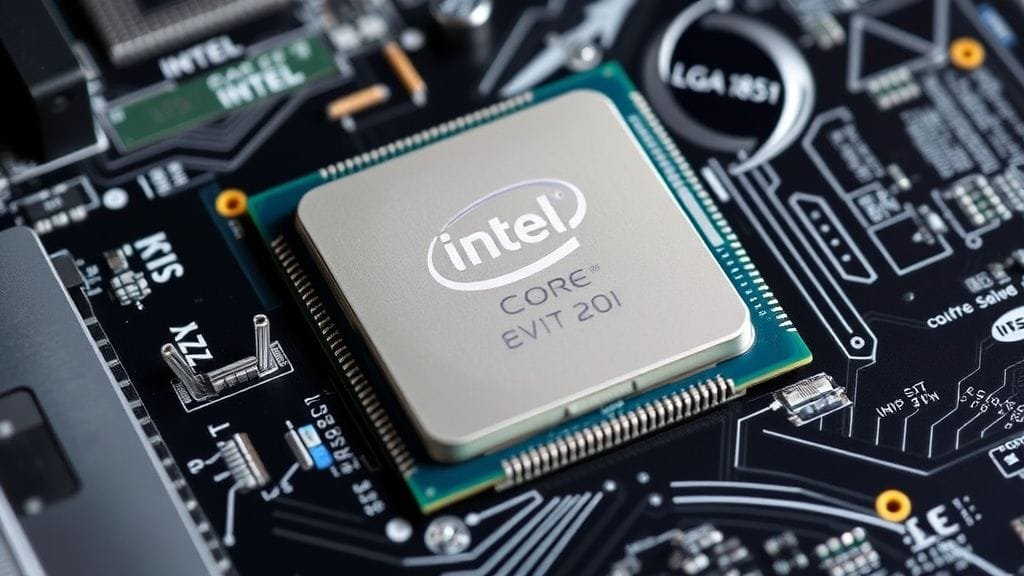
First, a new era for Intel processors is dawning. Indeed, it brings a fresh wave of motherboards. These boards, consequently, power the next generation of computing. If you’re considering an upgrade or building a new PC, then, understanding these new offerings is crucial. Specifically, the Intel 800 series chipsets are key, including Z890, B860, and H810. Ultimately, they will redefine possibilities with Intel’s latest Core Ultra Processors (Series 2), codenamed “Arrow Lake-S.”

This comprehensive guide first covers each chipset’s nuances, ranging from flagship features to budget-friendly compromises. Moreover, we’ll explore release dates, pricing, performance gains, and intricate feature sets. Ultimately, these details distinguish each model. Thus, you’ll gain the “hard-won wisdom” needed to make an informed decision for your next build.
The Dawn of a New Era: Intel’s Core Ultra 200 Series & LGA 1851
Intel’s latest innovations bring Core Ultra Processors (Series 2), also known as “Arrow Lake-S.” Evidently, they represent a significant leap forward in CPU technology. These new processors are not just faster; rather, they are fundamentally different. Specifically, they boast next-gen P-cores and E-cores. Furthermore, an integrated Neural Processing Unit (NPU) handles dedicated AI tasks. Xe LPG graphics are also included. This architecture thus ushers in the “AI PC” era. On-device AI acceleration consequently becomes standard, boosting productivity and enabling new experiences.
Why a New Socket? The Necessity of LGA 1851
First, you might wonder why Intel frequently introduces new CPU sockets. Specifically, they moved from LGA 1700 to the brand-new LGA 1851. However, this change is not arbitrary. Instead, it directly stems from the Core Ultra 200 series processors’ advanced requirements. Indeed, “Arrow Lake-S” CPUs demand more power delivery. They also need higher data bandwidth. A greater number of pins therefore support their enhanced capabilities. For example, these include PCIe 5.0 for storage and advanced connectivity. Consequently, a new socket becomes an unavoidable necessity for true next-gen performance. For users, therefore, upgrading to an “Arrow Lake-S” CPU absolutely requires a new motherboard equipped with one of the new Intel 800 series chipsets.
Navigating the Intel 800 Series Chipsets: Z890, B860, and H810
Broadly, the Intel 800 series chipsets offer a spectrum of choices. Indeed, they cater to different user needs and budgets. From the top-tier enthusiast to the practical budget builder, therefore, a motherboard exists for you. Initially, understanding their release timelines and pricing is the first step. Ultimately, plan your upgrade based on this.
When Can You Get Them? Release Dates and Availability
Initially, the rollout of these new motherboards began with the high-end Z890 chipset. Specifically, flagship Z890 motherboards likely arrived earlier. This coincided with the expected launch of Core Ultra 200 “Arrow Lake-S” desktop processors, namely, around October 24, 2024. This strategy thus allows enthusiasts to get the latest and greatest without delay.
Conversely, mainstream B860 and budget-friendly H810 chipsets had a later announcement. Indeed, their official announcement was at CES 2025 on January 6-7. Motherboards featuring these chipsets then became available shortly after. Subsequently, sales started January 13, 2025. This staggered release therefore ensures a broad range of options. Moreover, it brings them to market over time. Ultimately, this caters to various segments of the PC building community.
Understanding the Price Tag: What to Expect
Generally, pricing for motherboards equipped with the new Intel 800 series chipsets varies significantly. Specifically, it reflects their feature sets and target audiences. Thus, you’ll find options spanning a wide range. Indeed, prices go from under $100 to over $900. Below, here’s a general breakdown:
- H810 motherboards: These entry-level boards are anticipated to start around $99. Clearly, they offer the most basic features. Furthermore, this makes them ideal for users with minimal demands.
- B860 motherboards: Stepping up to the mid-range, B860 motherboards are expected to begin at approximately $129. Consequently, they strike a balance between features and affordability. Thus, they are suitable for most mainstream users.
- Z890 motherboards: As the high-end, enthusiast-grade option, Z890 motherboards command significantly higher prices. Indeed, models like the Gigabyte Z890 AORUS MASTER may start around $399.99. Premium offerings, such as the ASUS ROG MAXIMUS Z890 EXTREME, can exceed $900.
Moreover, it’s important to note a general trend of increasing motherboard prices across the industry. Indeed, this applies to both Intel 800/900 series and AMD 800 series platforms. Specifically, several factors contribute to this escalation. These include rising raw material costs, especially for high-purity copper. Increased labor expenses are also a factor. The integration of advanced technologies like PCIe 5.0 and USB4 further contributes.
Performance Prowess: Core Ultra Processors and the 800 Series Foundation
Ultimately, the true power of the new Intel 800 series chipsets is realized. Indeed, this happens when paired with the Core Ultra Processors (Series 2). These CPUs further deliver robust performance. Therefore, they handle intensive productivity tasks. Moreover, they also excel at creative content production and demanding gaming.
AI, Productivity, and Gaming: A New Benchmark
Indeed, next-generation P-cores and E-cores are at the heart of “Arrow Lake-S” processors. Furthermore, they are meticulously designed for efficiency and raw power. Moreover, the integrated Neural Processing Unit (NPU) is a standout feature. Specifically, it offloads AI tasks from the CPU and GPU. This specialized hardware thereby accelerates AI-driven applications. Ultimately, it paves the way for a smoother, more responsive “AI PC” experience.
Initial benchmarks indeed reveal impressive gains. Specifically, this is particularly true in multi-threaded performance. For instance, Cinebench R23 tests show a substantial ~25% boost, especially when compared to the Core i9-14900K. Single-threaded performance gains might be more modest; in fact, some scenarios may even show slight regressions. Nevertheless, optimized clock and interconnect speeds help. Intel’s Application Optimisation (APO) technology also contributes. Ultimately, they promise noticeable improvements in targeted workloads, meaning your applications will feel snappier and your workflows more fluid.

A comparative bar chart showing the multi-threaded performance (Cinebench R23 score) of Intel Core Ultra 200 series processors against previous generation Core i9-14900K.
Unlocking Potential: Overclocking Capabilities by Chipset
Indeed, for many enthusiasts, pushing hardware beyond stock limits is key. Consequently, the Intel 800 series chipsets offer varying degrees of overclocking support. Choosing the right board is thus essential if you plan to tweak frequencies.
- Z890: The Overclocker’s Dream. The Z890 chipset stands alone. Indeed, it is the sole option enabling full processor overclocking. Therefore, you can adjust core multipliers, voltage, and clock speeds. Ultimately, this extracts maximum performance from your Core Ultra 200 series CPU.
- B860: Memory Overclocking Only. B860 chipsets do not support CPU overclocking. However, they offer robust memory overclocking. Thus, this includes full support for Intel’s XMP profiles. Therefore, you can easily run high-speed DDR5 memory at its rated specifications.
- H810: No Overclocking Support. The budget-friendly H810 chipset provides no overclocking support. Specifically, this includes both CPU and memory overclocking, even XMP profiles. Consequently, this limits its appeal for performance seekers. However, it keeps the cost down for basic systems.
Advanced CPU Overclocking and Default Power Profiles
Intel’s Core Ultra desktop processors (Series 2) also feature enhanced overclocking controls. For example, these include new Multi-Chip Package (MCP) designs. Specifically, they facilitate die-to-die interface overclocking. Furthermore, finer ratio granularity allows precise tuning. Dual Base Clock (BCLK) tuning is also present. These advanced features ultimately give power users unprecedented control. Therefore, they can fine-tune system performance.
Interestingly, Intel reportedly encourages motherboard partners to ship Z890 boards with an “Intel Default Power Profile.” This profile, consequently, would be enabled out of the box. Indeed, it is more conservative with power limits compared to the “Performance Power Profile” seen on previous Z690/Z790 boards. Therefore, this may improve stability and efficiency. Nevertheless, enthusiasts might manually adjust settings to unleash maximum performance from their unlocked CPUs.
Feature Set Deep Dive: What Each 800 Series Chipset Offers
Furthermore, beyond raw performance, your motherboard’s feature set is vital. In fact, it significantly impacts your system’s capabilities, including connectivity, expansion options, and overall flexibility. Consequently, the Intel 800 series chipsets present distinct profiles. Thus, each is tailored for different user requirements.
Common Ground: DDR5, PCIe 5.0, and Connectivity Basics
First, before discussing individual differences, let’s cover common advancements. Indeed, all Intel 800 series chipsets broadly support DDR5 memory. Officially, this is up to 6400 MT/s. However, some B860 boards can push memory speeds further, up to 8800 MT/s via overclocking. Furthermore, every chipset features a PCIe 5.0 x16 slot. Specifically, it is dedicated to your graphics card. Thus, this ensures maximum bandwidth for future GPUs. All platforms also expect to support Thunderbolt 4/USB4 ports. Consequently, this provides versatile, high-speed connectivity.
Moreover, from the B860 chipset and up, you’ll find another feature. Specifically, a dedicated CPU-provided PCIe 5.0 x4 interface is included. Typically, it is likely for a blazing-fast M.2 SSD. This thereby ensures that even mid-range builds can use the fastest storage solutions.

Z890: The Enthusiast’s Command Center
The Z890 chipset is indeed the pinnacle of the Intel 800 series chipsets. Consequently, it offers a comprehensive suite of features for demanding users.
- I/O & Connectivity: This flagship chipset boasts 8 DMI 4.0 lanes. Consequently, this provides ample bandwidth between the CPU and chipset. Furthermore, you’ll find up to 24 chipset PCIe 4.0 lanes, which allow extensive expansion options. Moreover, USB connectivity is robust. Specifically, it includes up to 5 USB 3.2 Gen 2×2 (20Gb/s) ports, among a total of 14 USB ports directly from the chipset. Additionally, it supports up to 8 SATA 3.0 ports. Indeed, various RAID configurations are available (PCIe 0/1/5/10, SATA 0/1/5/10). Ultimately, this is perfect for complex storage arrays. Integrated Wi-Fi 7 and 2.5Gb/10Gb Ethernet are common, thus ensuring top-tier networking.
- Memory: In terms of memory, Z890 boards typically feature 4 DIMM slots. Thus, this allows for substantial memory capacity. Furthermore, they fully support memory overclocking, including XMP profiles.

B860: The Mid-Range Sweet Spot
Overall, the B860 chipset is an excellent choice. Indeed, it suits most users seeking a balance, including performance, features, and cost. Therefore, it is a great option within the Intel 800 series chipsets.
- I/O & Connectivity: The B860 offers 4 DMI 4.0 lanes and up to 14 chipset PCIe 4.0 lanes. Indeed, this is ample for most setups. Notably, it includes a dedicated CPU-provided PCIe 5.0 x4 interface, specifically for M.2 SSDs. However, it does not support PCIe 5.0 x16 lane splitting; rather, this feature for multiple graphics cards is reserved for Z890. USB I/O also includes up to 2 USB 3.2 Gen 2×2 (20Gb/s) ports, alongside a total of 6 USB 3.2 ports from the chipset. Additionally, these are complemented by 12 USB 2.0 ports. Finally, you’ll find 4 SATA 3.0 ports.
- Memory: B860 boards support DDR5-6400 MT/s. Indeed, some premium models support up to 8800 MT/s (OC). Moreover, they generally allow for two DIMMs per channel. Thus, this typically results in up to four DIMM slots. Consequently, this provides good memory capacity and flexibility.
- Network: Regarding network, common networking features include Wi-Fi 6/6E and 1Gb Ethernet. Ultimately, these offer reliable and fast network access for most users.

H810: The Budget Builder’s Entry Point
Initially, the H810 chipset is the most basic option. It is specifically among the new Intel 800 series chipsets. Furthermore, it is designed for cost-conscious builds. Maximum features and performance are thus not primary goals.
- I/O & Connectivity: It features 4 DMI 4.0 lanes and 8 chipset PCIe 4.0 lanes. Clearly, this is suitable for essential components. In addition, it offers a PCIe 5.0 x16 slot for your graphics card. However, it crucially lacks CPU-provided PCIe 4.0 x4 and PCIe 5.0 x4 SSD interfaces. Instead, any M.2 slots are routed through the chipset, potentially using fewer lanes and impacting SSD speeds. Furthermore, USB connectivity is limited. Specifically, it offers up to 2 USB 3.2 Gen 2×1 (10Gb/s) ports among a total of 4 USB 3.2 ports from the chipset. It also has 10 USB 2.0 ports. Crucially, it does not support 20Gbps ports. Finally, you’ll find 4 SATA 3.0 ports.
- Memory: Regarding memory, H810 boards support DDR5-6400 MT/s. However, they are restricted to one DIMM per channel. Consequently, this typically allows a maximum of two memory slots. This thus limits total memory capacity and flexibility. Moreover, future upgrades are also affected.
- Graphics: Finally, motherboards with H810 chipsets have a limitation. Specifically, they support a maximum of three display outputs from integrated graphics. In contrast, other chipsets support four. Therefore, this might matter for users planning multi-monitor setups, especially those without a dedicated GPU.

Beyond the Specs: A Holistic Perspective on Intel’s Strategy
Furthermore, understanding the technical specifications of the Intel 800 series chipsets is important. However, it’s equally crucial to consider Intel’s broader strategy. This, therefore, includes implications for consumers.
The Socket Dilemma: Intel vs. AMD
First, a recurring critique against Intel involves frequent CPU socket changes. For instance, the Core Ultra 200 series moved from LGA 1700 to LGA 1851. This again forces users to buy new motherboards. Indeed, each major CPU upgrade brings this necessity. This approach conversely contrasts sharply with AMD’s strategy. AMD often maintains socket compatibility across multiple CPU generations. For many consumers, therefore, this is a source of frustration, especially for those on a budget. This frequent upgrade requirement thus adds significant cost to a new CPU purchase. While this is necessary for new technologies, its economic impact is undeniable. Ultimately, you’ll definitely want to weigh your upgrade path carefully when choosing a platform.
Balancing Cost and Innovation
Overall, motherboard costs are rising. Indeed, factors like raw material prices and advanced features drive this. Consequently, this poses a significant challenge for consumers. Specifically, the Intel 800 series chipsets bring forward-looking technologies, including PCIe 5.0 and DDR5. However, the financial barrier to entry is higher than ever. For instance, the H810 chipset is budget-friendly. Nevertheless, it comes with substantial compromises that affect connectivity, expansion, and overclocking. Therefore, it’s truly suitable only for the most basic builds. For many, however, stretching the budget for a B860 board offers better value. It balances features and longevity, ultimately saving money over time.
The “AI PC” Revolution: A Strategic Shift
Furthermore, one compelling aspect of the new Core Ultra processors is their platform. Specifically, Intel strongly emphasizes “AI PC” capabilities with the 800 series. Indeed, dedicated NPUs mark a significant strategic direction for Intel. Consequently, these new systems are at the forefront of AI-driven applications. This focus primarily aims to differentiate Intel’s offerings. Moreover, it provides a tangible benefit for users. These users typically engage with AI tools for productivity, content creation, or gaming. Therefore, the future of computing is increasingly AI-centric. These new Intel 800 series chipsets are thus foundational to that vision. For example, imagine more efficient video editing with AI upscaling. Similarly, quicker content generation right on your desktop is possible. Ultimately, this is the promise of the “AI PC.”

Making Your Choice: Which Intel 800 Series Chipset is Right for You?
Indeed, choosing the right motherboard is a pivotal decision. Furthermore, it impacts your PC’s performance, expandability, and long-term value. With the new Intel 800 series chipsets, therefore, you have distinct options.
Tailoring Your System: Chipset Recommendations
- For the Enthusiast & Overclocker: Do you demand the absolute best performance, plan to heavily overclock your CPU, and require extensive connectivity (including multiple high-speed NVMe drives, Thunderbolt, and numerous USB ports)? If so, the Z890 is your only choice. However, prepare to invest accordingly, as these boards are premium.
- For the Mainstream User & Gamer: Are you building a solid gaming rig or powerful workstation that doesn’t need CPU overclocking but benefits from high-speed memory and ample I/O? If so, the B860 chipset offers an excellent balance. Specifically, it provides access to PCIe 5.0 storage, fast DDR5, and strong connectivity. Crucially, all this comes without the Z890’s price tag. Therefore, this chipset represents the sweet spot for many.
- For the Budget Builder & Basic User: Are your needs minimal, such as a simple office PC, a basic media consumption machine, or a low-cost entry-level system? If so, the H810 can get the job done. However, be aware of its limitations. These, for example, include expansion, overclocking, and potentially slower M.2 SSD performance due to chipset routing. Ultimately, consider if the long-term compromises are worth the initial savings.
Ultimately, your ideal Intel 800 series chipset hinges on several factors: your budget, performance expectations, and specific usage scenarios. Therefore, understanding the distinct features and capabilities of Z890, B860, and H810 means you are now well-equipped to make a choice. This choice will consequently serve you well for years to come.
Now, what features of the new Intel 800 series chipsets excite you most? Furthermore, which chipset offers the best value for your next build? Ultimately, share your thoughts in the comments below!
 for Core Ultra 200 series. Learn about features, pricing, and performance for your next PC build.)