The gaming and computing world constantly advances. Naturally, rumors of an RTX 5000 Super VRAM upgrade have sparked significant excitement. Indeed, NVIDIA’s forthcoming series remains highly anticipated by enthusiasts and professionals alike. A potential 50% boost in VRAM across various models is consistently rumored. Consequently, this substantial memory increase will undoubtedly reshape expectations for future gaming and AI workloads. Therefore, we will explore what this truly means, dissect conflicting release date rumors, and examine broader implications for the competitive GPU landscape.

The Defining Feature: The RTX 5000 Super VRAM Upgrade
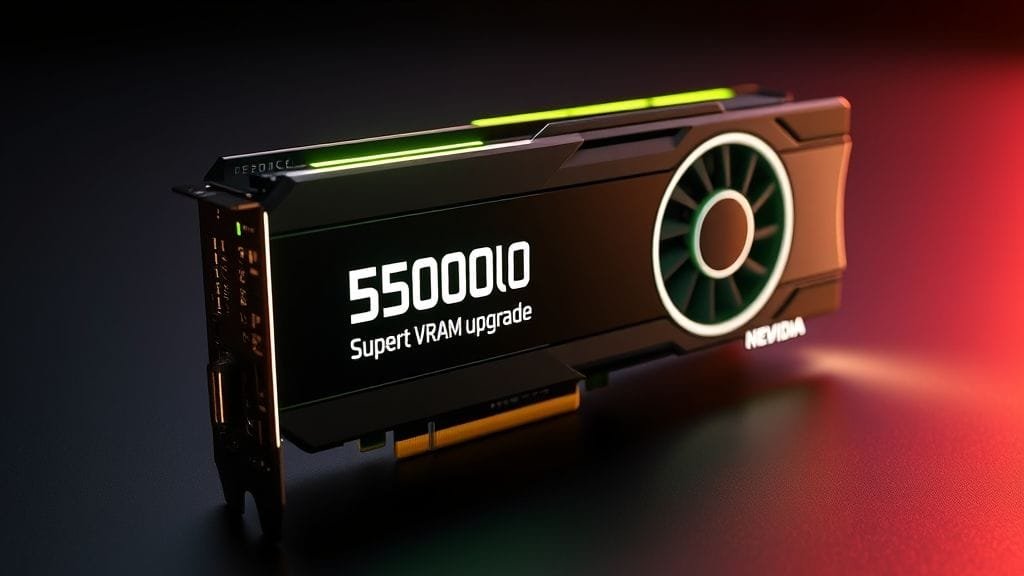
Anticipation for the RTX 5000 Super series centers on a pivotal feature: the RTX 5000 Super VRAM upgrade. This is a dramatic increase in video random access memory (VRAM). Indeed, reports consistently suggest a substantial 50% boost over their non-Super counterparts. Therefore, this VRAM expansion marks a crucial evolution in NVIDIA’s graphics card design. Furthermore, this VRAM expansion is more than a spec sheet number. Instead, it directly responds to modern digital demands and strategically future-proofs the next generation of GPUs with significant Blackwell Super VRAM.
Why Super Series Memory Increase Matters: Fueling Modern Gaming and Beyond
To truly understand the value of a 50% Super series memory increase, you must appreciate VRAM’s role. VRAM serves as the dedicated, ultra-fast memory for your graphics processing unit (GPU). It stores all visual data for image rendering, including textures, frame buffers, Z-buffers, and shadows. Moreover, as games grow more graphically intensive and resolutions increase, abundant VRAM, like the NVIDIA 5000 Super memory promises, becomes critical.
Modern gaming, for instance, at 1440p, 4K, or even 8K, consumes a lot of VRAM. This is especially true with maxed-out texture settings and features like ray tracing. High-resolution textures, in fact, can consume gigabytes of memory alone. Consequently, without enough VRAM, the GPU must offload data to slower system RAM. This causes performance bottlenecks, stuttering, and a poor gaming experience that the GeForce RTX VRAM boost aims to prevent.

Therefore, NVIDIA’s strategy to bolster VRAM clearly acknowledges these evolving demands. It aims to eliminate potential memory constraints for years ahead.
The “50% Boost” of the NVIDIA 5000 Super Memory Explained: From 2GB to 3GB GDDR7 Modules
The impressive 50% Super series memory increase is not arbitrary. Instead, it comes from a fundamental hardware change: the adoption of 3GB GDDR7 memory modules. Currently, most high-end GPUs use 2GB GDDR6 or GDDR6X modules. However, by transitioning to larger 3GB GDDR7 modules, NVIDIA significantly increases total VRAM without drastically altering the memory bus width. Consequently, this offers a more efficient memory upgrade path. Indeed, this shift is a key enabler for the Super series’ projected memory capacities.
For example, a GPU using eight 2GB modules previously had 16GB VRAM. Now, with the same eight memory chips, it can boast 24GB. This is achieved simply by swapping to 3GB GDDR7 modules. This elegant solution allows for a substantial Blackwell Super VRAM uplift. Furthermore, it optimizes manufacturing and design processes. Ultimately, it represents a forward-thinking design choice, preparing the Blackwell architecture for increasingly memory-hungry applications and solidifying the NVIDIA 5000 Super memory advantage.

Breaking Down the Rumored Blackwell Super VRAM Capacities
The rumored RTX 5000 Super series anticipates specific VRAM increases. Indeed, these varied capacities highlight NVIDIA’s strategy to deliver a compelling Super series memory increase. The goal is to offer ample Blackwell Super VRAM across all performance levels, catering to diverse user needs.
Projected Super Series Memory Increase Capacities for the RTX 5000 Super VRAM Upgrade
The flagship RTX 5080 Super should feature 24GB of GDDR7 VRAM. This is a significant leap from the standard RTX 5080’s expected 16GB. Therefore, this 24GB buffer, a core part of the Super series memory increase, suits top-tier gamers at 4K ultra-settings. Additionally, it benefits professionals handling intensive compute tasks. Ultimately, it positions the 5080 Super as a formidable workstation GPU, ideal for complex AI models and large datasets thanks to this substantial NVIDIA 5000 Super memory.
Intriguingly, the RTX 5070 Ti Super might also boast 24GB of GDDR7 VRAM. Its non-Super counterpart’s VRAM is currently unspecified. However, 24GB for a 70-series card is truly remarkable, clearly indicating NVIDIA’s aggressive push for high memory capacities with this next-gen RTX VRAM approach. Thus, the RTX 5070 Ti Super could become a compelling option, offering immense VRAM without requiring the absolute highest-end model. In essence, it provides premium next-gen RTX VRAM at a more accessible price point.
In contrast, the mid-to-high range RTX 5070 Super expects 18GB of GDDR7 VRAM. This is a healthy bump from the standard RTX 5070’s rumored 12GB. For most gamers at 1440p, or even entry-level 4K, 18GB of Blackwell Super VRAM is more than sufficient. Consequently, this ensures the 5070 Super remains competitive and future-proofed for upcoming games and high-res texture packs, offering strong overall value thanks to this strategic Super series memory increase.

GDDR7: The New Memory Frontier for Next-Gen RTX VRAM
Beyond increased VRAM capacity, the memory type is also critical. The integration of GDDR7 memory marks a pivotal technological leap. Therefore, it perfectly complements the expanded memory pools achieved by this memory enhancement. This new generation of graphics memory promises significant performance improvements over its predecessors, forming the backbone of next-gen RTX VRAM.
GDDR7 is the successor to GDDR6 and GDDR6X. It delivers substantial improvements in bandwidth, efficiency, and potentially lower latency. While official JEDEC standards are pending, early manufacturer specifications indicate raw speeds up to 32 Gbps per pin. This is a significant jump from GDDR6X’s typical 21 Gbps. Consequently, this increased data rate ensures the GPU receives information much faster, crucial for high frame rates and complex graphics, supporting the GeForce RTX VRAM boost.
How GDDR7 Elevates Data Transfer with GeForce RTX VRAM Boost
Pulse Amplitude Modulation 3-level (PAM3) signaling is a key GDDR7 innovation. Unlike previous generations, PAM3 transmits three bits of data per clock cycle across two channels. This efficient encoding significantly boosts GDDR7’s bandwidth. Therefore, it enables more data transfer with improved power efficiency. Ultimately, this means greater performance per watt, better managing thermals and power consumption in high-end graphics cards featuring the GeForce RTX VRAM boost.
GDDR7’s raw speed and expanded VRAM will profoundly impact the RTX 5000 Super series’ performance. GPUs will store and process complex visual assets at unprecedented speeds, a direct benefit of this VRAM enhancement. For gamers, this means smoother gameplay, even at high resolutions. Faster data access reduces system RAM reliance, leading to fewer stutters and consistent frame rates. Furthermore, memory-intensive tasks like ray tracing will see enhanced performance and more intricate scenes. Professionals also benefit from accelerated AI and compute workloads, as GDDR7 enables faster training/inference for AI models, quicker 3D rendering, and improved scientific applications, defining the new Blackwell Super VRAM standard.
Ultimately, the 3GB GDDR7 module transition forms a foundational shift. It underpins the performance promises of the RTX 5000 Super series. Thus, these new cards, with their significant Super series memory increase, are robustly equipped for future technological challenges and opportunities.
Navigating the Release Date Maze for the RTX 5000 Super VRAM Upgrade
The promise of enhanced VRAM and GDDR7 memory is exciting. However, the actual availability of the RTX 5000 Super series remains uncertain. Initial rumors sparked hope for a late 2025 launch. Nevertheless, more recent information suggests a likely delay for the next-gen RTX VRAM refresh. Understanding these conflicting reports is crucial for anyone awaiting NVIDIA’s next-gen RTX VRAM refresh.
Initial Hype vs. Current Realities: The Q4 2025 to 2026 Shift for Blackwell Super VRAM
Early whispers, notably around July 2025, fueled optimism for a Q4 2025 RTX 5000 Super series release. This would have aligned with the lucrative holiday shopping season. Furthermore, this timing was consistent with NVIDIA’s historical mid-cycle refresh patterns for a Super series memory increase. However, as 2025 progressed, newer reports emerged in late September. These sources indicated a probable delay for the Blackwell Super VRAM generation. The release window now likely pushes to between March and May 2026. This shift from a firm 2025 expectation to early-to-mid 2026 suggests changes in NVIDIA’s internal planning or external market conditions impacting the Super series memory increase.

The AIC Partner Perspective: Why Delays Occur for the Super Series Memory Increase
A compelling reason for the potential delay comes from add-in card (AIC) partners. These companies, such as ASUS, MSI, and Gigabyte, design, manufacture, and market NVIDIA’s GPUs under their own brands. Critically, reports state these partners had not received official project notifications for the RTX 5000 Super series by late 2025. This lack of communication is a significant red flag for the impending Super series memory increase.
GPU manufacturing is a complex process. It involves extensive design, prototyping, testing, and mass production. AIC partners, therefore, need several months of lead time to prepare for a Super series memory increase. This allows them to prepare custom board designs, cooling solutions, and marketing materials. Without official notification and specifications from NVIDIA, they cannot begin this work. Consequently, the absence of these communications strongly indicates a Q4 2025 launch was logistically impossible, lending significant credibility to the Q1/Q2 2026 delay for the NVIDIA 5000 Super memory products. Importantly, NVIDIA tightly controls its product launches. Thus, AIC partners are usually informed well in advance of public announcements.
CES 2026: A Likely Announcement Platform for the Next-Gen RTX VRAM
The launch window potentially shifts to early 2026. Therefore, many industry observers now point to CES 2026. This Consumer Electronics Show is a highly plausible platform for the official RTX 5000 Super series announcement. CES, held annually in Las Vegas in early January, serves as a premier global stage for technology unveilings. Indeed, NVIDIA often uses CES to introduce new consumer-focused GPUs and technologies, including previous GeForce RTX VRAM boost products.
An announcement at CES 2026 would provide NVIDIA with maximum media exposure for these next-gen RTX VRAM products. It would also allow for a build-up of hype before a retail launch in March, April, or May. This timing, moreover, would give AIC partners additional months post-announcement to finalize products and distribution channels. Additionally, it would set the stage for NVIDIA to dominate the tech news cycle early in the year, preempting competitors with their impressive next-gen RTX VRAM offerings.
NVIDIA’s Strategic Play: Blackwell Ultra vs. Consumer Super Series GeForce RTX VRAM Boost
NVIDIA’s broader product strategy adds another layer of complexity to the launch timeline. The company confirmed its Blackwell Ultra GPUs (B300-series) are on track for late 2025. These are mid-cycle refresh products. Importantly, they target data center and AI segments. However, it’s crucial to understand these differ from the consumer-focused RTX 5000 Super series, which features the anticipated next-gen RTX VRAM.
NVIDIA is experiencing an unprecedented boom in its data center division. This is driven by insatiable demand for AI accelerators. Consequently, this segment generates immense revenue and is likely NVIDIA’s top priority. Therefore, resources and focus might heavily weigh towards Blackwell Ultra’s timely deployment for enterprise customers. This could indirectly defer the consumer Super series and its GeForce RTX VRAM boost. It allows NVIDIA to fully capitalize on data center momentum first. While the underlying Blackwell architecture is shared, product lines serve different markets and have distinct rollout schedules. Misinterpreting B300-series information as applying to consumer GPUs could lead to incorrect launch date expectations for the Blackwell Super VRAM consumer cards.
Implications of Delay for the RTX 5000 Super VRAM Upgrade
A delay in the RTX 5000 Super series launch carries several implications:
- For Gamers and Enthusiasts: Those awaiting the Super series memory increase face a longer wait. This might prompt some to consider current-gen (RTX 40 series) or competitor offerings. However, it also provides more time to save for a premium product offering a substantial Super series memory increase.
- For Competitors (AMD): A delayed NVIDIA launch presents an opportunity for AMD. They could capitalize with upcoming GPU releases. If new Radeon GPUs launch earlier in 2026, AMD could capture market share. Indeed, timing is everything in this fierce market, especially when anticipating the next-gen RTX VRAM.
- For NVIDIA: While a delay isn’t ideal, a polished product and smoother launch could ultimately benefit its reputation. Moreover, it allows clearing existing RTX 40 series inventory, a strategy supported by recent price adjustments. This paves the way for the GeForce RTX VRAM boost models.
In summary, the Q4 2025 RTX 5000 Super series target was rumored. However, practical indicators like AIC partner readiness and NVIDIA’s data center focus now strongly suggest an early-to-mid 2026 launch. CES 2026 is a likely announcement venue. Consequently, patience is key for those anticipating this significant Super series memory increase.
Beyond the RTX 5000 Super VRAM Upgrade: Performance, Power, and the Blackwell Architecture
The substantial VRAM increase is undoubtedly the RTX 5000 Super series’ headline feature. However, it’s crucial to look beyond memory alone. These cards will build upon NVIDIA’s Blackwell architecture. Therefore, their overall performance, including this memory enhancement, will combine VRAM, core count, clock speeds, and power delivery. Understanding these factors provides a more complete picture, helping to clarify what to expect from this mid-cycle refresh and its Blackwell Super VRAM.
Performance Expectations with NVIDIA 5000 Super Memory: Modest Gains, Targeted Improvements
The RTX 5000 series, including Super variants, will build on NVIDIA’s next-generation Blackwell architecture. While this summary focuses on “Super” refresh aspects, this new architecture forms their capability’s bedrock. Blackwell expects advancements in several areas, including improved streaming multiprocessors (SMs), enhanced RT Cores for ray tracing, and faster Tensor Cores for AI/ML tasks. Furthermore, memory subsystem optimizations will leverage GDDR7, defining the new next-gen RTX VRAM standard.
The “Super” moniker, in fact, implies a refresh of an existing architectural generation. Therefore, it will likely optimize and enhance the base Blackwell design. This is not a complete architectural overhaul mid-generation. Instead, it involves fine-tuning and boosting key specifications. VRAM, notably, is the most prominent element of the VRAM enhancement and a key driver of the NVIDIA 5000 Super memory strategy.
Ray Tracing and AI Performance: How the Super Series Memory Increase Might Enhance These with Next-Gen RTX VRAM with its Blackwell Super VRAM
Performance boosts across new Super models will differ. Some cards will see more significant upgrades than others. This aligns with typical “Super” refreshes. These often target specific performance gaps or boost market competitiveness with a strategic Super series memory increase.
For higher-end RTX 5080 Super and RTX 5070 Ti Super, raw rasterization gains may be modest. Research suggests these cards might not see significant CUDA core increases or VRAM speed beyond GDDR7 benefits. Instead, their primary advantage will stem from expanded VRAM capacity. This strategy, moreover, targets memory-bound scenarios. These include 4K/8K gaming, ultra-high-res texture packs, or demanding features like path tracing. More VRAM directly supports these intensive graphical demands, signifying a true GeForce RTX VRAM boost.
Furthermore, this substantial VRAM increase critically benefits professional tasks. These include large language model (LLM) inference, 3D rendering, and scientific simulations. Loading larger datasets or models into memory often outweighs raw compute speed in these applications. Thus, this memory boost ensures robust performance for professional users benefiting from. Moreover, by providing ample VRAM, NVIDIA future-proofs these cards. Super series users will find their cards capable longer. Conversely, non-Super variants might hit VRAM limits sooner, making Super models a more lasting investment in Blackwell Super VRAM.
Future-Proofing for AI Workloads with the RTX 5000 Super VRAM Upgrade
In contrast, the RTX 5070 Super is rumored to offer a balanced and comprehensive upgrade. It provides a significant 18GB VRAM boost from the original 12GB. Additionally, it expects a modest increase in CUDA cores, reportedly around 4% more than the base RTX 5070. Therefore, this combination signals a more rounded performance jump, directly impacting this memory upgrade.
This blend of increased VRAM and a slightly higher core count could deliver a noticeable performance uplift. Potentially, this is around 10% over the non-Super RTX 5070. Consequently, such an upgrade positions the RTX 5070 Super as a compelling choice for a broader user base, largely due to its enhanced NVIDIA 5000 Super memory.
The 10% performance gain, coupled with generous VRAM, makes it highly suitable for 1440p gaming at high refresh rates. It also offers capable entry-level 4K gaming. Moreover, this model provides both essential memory headroom and a tangible boost in raw compute power. This marks a significant improvement over the standard variant, driven by the overall Super series memory increase.
Q5: The Strategic Reasoning Behind the GeForce RTX VRAM Boost in the 5000 Super Series: Highlighting the Next-Gen RTX VRAM with its Blackwell Super VRAM
Higher performance typically demands more power. This is true particularly from increased core counts, faster clock speeds, and quicker memory. The upcoming RTX 5000 Super series appears to follow this trend, driven by this VRAM boost. Current rumors, therefore, suggest a rise in Total Graphics Power (TGP) figures.
For instance, the RTX 5080 Super expects a TGP of 415W. This marks a significant 55W increase over the non-Super RTX 5080’s estimated 360W. This substantial jump indicates NVIDIA is likely pushing core clocks aggressively. It also potentially activates more Blackwell silicon, contributing to the overall GeForce RTX VRAM boost. Consequently, users eyeing this top-tier card will need a robust power supply unit (PSU). A range of 850W to 1000W is probable, ensuring stable operation and ample headroom for other system components supporting the Blackwell Super VRAM.
Meanwhile, the RTX 5070 Super anticipates drawing 275W. This is up from its non-Super counterpart’s estimated 250W. This more modest 25W increase aligns with a balanced performance boost. Thus, for systems built around the RTX 5070 Super, a 650W to 750W PSU should prove sufficient to support the demands of the next-gen RTX VRAM.
Q5: Why is NVIDIA increasing VRAM so much with the RTX 5000 Super VRAM Upgrade? and its Next-Gen RTX VRAM for the RTX 5000 Super VRAM Upgrade
Upgrading to an RTX 5000 Super series card featuring this significant VRAM enhancement demands careful system review to ensure optimal performance.
- Power Supply Unit (PSU): Higher TGPs (e.g., 415W for 5080 Super) demand robust PSUs. Review your current PSU’s wattage and PCIe connectors. Top-tier cards, benefiting from the GeForce RTX VRAM boost, will likely need 12VHPWR/PCIe Gen 5. Therefore, a high-wattage PSU is a critical investment.
- Cooling Solutions and Case Airflow: Increased power consumption, a natural outcome of the Super series memory increase, generates more heat. Ensure excellent PC case airflow with sufficient fans. Also, upgrade a minimal CPU cooler. GPUs dump heat, causing throttling and reduced performance.
- Monitor: To fully appreciate the RTX 5000 Super series and its next-gen RTX VRAM, a high-resolution, high-refresh-rate monitor is essential. A 1080p 60Hz display won’t utilize full capabilities. Thus, consider a 1440p or 4K (144Hz+) monitor for full visual fidelity.
- CPU Pairing: GPUs impact gaming most. However, a powerful CPU is needed to avoid bottlenecks, especially at lower resolutions or in CPU-intensive games. Ensure your CPU is modern and capable to feed data efficiently to the cards with Blackwell Super VRAM.

Should You Wait for the RTX 5000 Super VRAM Upgrade? Current Hardware vs. Future Promise with GeForce RTX VRAM Boost
NVIDIA consistently pushes the boundaries of real-time ray tracing and AI-powered features like DLSS. The Super series, with its Blackwell architecture, increased VRAM, and GDDR7 speeds, will further enhance these capabilities, all driven by the significant GeForce RTX VRAM boost:
- Ray Tracing: Expanded VRAM, a core component of this memory expansion, allows more detailed ray-traced environments and textures. Meanwhile, faster GDDR7 memory and potentially improved RT Cores will accelerate complex calculations. Thus, this could lead to a visually richer and smoother ray-traced experience with next-gen RTX VRAM.
- AI Performance (DLSS, Frame Generation, AI workloads): The Blackwell architecture is AI-designed, and the Super series benefits. Faster Tensor Cores (if upgraded) combined with massive VRAM and bandwidth will likely lead to more effective DLSS upscaling, potentially pushing higher frame rates and better visual fidelity. Frame Generation, another AI feature, could also improve. For professional AI, the Super series memory increase is directly beneficial, allowing training and inference of larger models on desktop GPUs.
In essence, the RTX 5000 Super series is more than a VRAM bump. It represents a refined Blackwell offering. This strategically addresses critical performance bottlenecks, especially memory, thanks to the Blackwell Super VRAM. Furthermore, it pushes the envelope in power delivery and specialized processing like ray tracing and AI.
Preparing for the Next Generation: Considering the RTX 5000 Super VRAM Upgrade
The introduction of the RTX 5000 Super series does not occur in a vacuum. It offers a significant VRAM upgrade and refined performance. However, this is a calculated move by NVIDIA within a highly competitive market. It is influenced by past criticisms, current inventory, and the constant threat of rivals like AMD. Therefore, understanding these broader market dynamics helps contextualize NVIDIA’s strategic decisions regarding this Super series memory increase.
Q2: What’s the Expected RTX 5000 Super VRAM Upgrade?
NVIDIA frequently employs “Super” series refreshes as a strategic move. These interventions typically address market feedback. They also strengthen product offerings or counter competitive pressures. The upcoming RTX 5000 Super series, therefore, appears designed to fulfill several key objectives, prominently featuring the Super series memory increase.
NVIDIA has faced significant VRAM criticisms in the past. Some became quite public. For instance, the “3.5GB debacle” with the GeForce GTX 970 was notorious. There, a segmented memory architecture drastically slowed the final 0.5GB. More recently, critics highlighted the RTX 4060 Ti 8GB as memory-limited for its price and target resolution in demanding games. These criticisms paved the way for a more robust NVIDIA 5000 Super memory offering.
These past controversies transformed VRAM into a critical topic. This is true for high-end PC gaming and AI workloads. Both gamers and professionals now better understand VRAM requirements. A perceived memory shortage, consequently, significantly influences purchasing decisions. It also affects a card’s long-term viability. Therefore, the RTX 5000 Super series’ 50% VRAM increase directly and emphatically answers these criticisms and current market demands, representing a critical GeForce RTX VRAM boost.

The RTX 5000 Super VRAM Upgrade: Future-Proofing for AI Workloads and Beyond
The “Super” designation signifies NVIDIA’s established mid-cycle product refresh strategy. Historically, these refreshes boost performance over base models. This is often achieved by enabling more cores, higher clock speeds, or faster memory. Additionally, they adjust pricing to enhance competitiveness against rivals or introduce new price tiers, leading to a more compelling memory upgrade.
Furthermore, these refreshes extend a product’s lifespan. They keep the current architectural generation competitive until the next major leap. They can also introduce new technologies, such as GDDR7 here, as a key part of the next-gen RTX VRAM. The RTX 5000 Super series, therefore, perfectly fits this mold. It utilizes a VRAM increase and new GDDR7 memory as primary differentiators, occurring alongside specific core count adjustments on select models to deliver the promised Super series memory increase.
The AMD Factor: Opportunity for Radeon?
NVIDIA often dominates the high-end GPU market. However, AMD’s Radeon division remains a strong competitor, particularly in the mid-range and upper-mid-range. The potential delay of the RTX 5000 Super series to early or mid-2026, therefore, presents a crucial opportunity for AMD to counter the Super series memory increase.
If AMD successfully launches its next-generation Radeon GPUs (e.g., RDNA 4 based cards) ahead of or concurrently with NVIDIA’s Super series, they could capture market share. This assumes a compelling performance-per-dollar proposition. Impatient gamers and professionals might indeed be swayed by an earlier, well-priced AMD offering that challenges the next-gen RTX VRAM. The GPU market battle is a constant dance of launches, pricing, and performance. Therefore, a slight timing advantage can sometimes make a significant difference, even against a potent Super series memory increase.
Inventory Clearing: Price Drops as Precursor?
Another interesting market dynamic involves recent price drops for existing RTX 40 series cards. Industry analysts and consumers often interpret this phenomenon. It signals NVIDIA is clearing inventory in anticipation of a new product launch, such as this significant memory upgrade.
If NVIDIA expects the RTX 5000 Super series to arrive in early 2026, then reducing current-generation card stock makes sense. This means cards like the RTX 4080, 4070 Ti, and 4070. Price adjustments prevent an excess of older inventory. This older stock would otherwise compete directly with the newer, more powerful, and likely more expensive Super series with its Super series memory increase. This clearing process benefits consumers seeking deals on current-gen cards. Simultaneously, it sets the stage for a smooth transition to the next product stack, a common tech industry strategy to prepare the market for new hardware and its next-gen RTX VRAM.
Future-Proofing for AI Workloads: Beyond Gaming
Beyond gaming, the market for GPUs in AI and machine learning workloads has exploded. NVIDIA’s CUDA platform and robust hardware made it the de facto standard for AI development. Critically, the massive VRAM increase in the RTX 5000 Super series is not just for gamers. It is a vital investment in maintaining NVIDIA’s dominance within the rapidly expanding AI landscape, showcasing the power of this VRAM boost.
Larger VRAM capacities, a hallmark of the NVIDIA 5000 Super memory, enable researchers and developers to work with more complex neural networks. They can use larger datasets and higher-resolution inputs directly on desktop workstations. This avoids sole reliance on expensive cloud resources. Therefore, the Super series, with its enhanced Blackwell Super VRAM, becomes highly attractive for individual AI developers, small businesses, and academic researchers. By providing substantial memory, NVIDIA essentially broadens its consumer-grade GPUs’ appeal and utility to a professional audience. This blurs the lines between dedicated workstation cards and high-end gaming hardware, ultimately strengthening NVIDIA’s overall market position.
Preparing for the Next Generation: What Gamers and Enthusiasts Should Do
For PC gamers or high-performance computing enthusiasts, a new GPU generation presents a classic dilemma. These promising upgrades, especially this VRAM upgrade, make the decision to “upgrade now, or wait?” even harder. As we look towards the RTX 5000 Super series, several considerations emerge for enthusiasts and system builders regarding this significant Super series memory increase.
Should You Wait? Current Hardware vs. Future Promise
The decision to wait for the RTX 5000 Super series largely depends on your current hardware and performance expectations for this memory enhancement.
- If you have an older GPU (e.g., GTX 10/20-series): The leap to an RTX 5000 Super card would be transformative. Performance gains would be enormous. Features like DLSS, Frame Generation, and enhanced ray tracing would be night and day. Therefore, waiting, especially if your current card barely manages, could be very rewarding for future-proofing with the next-gen RTX VRAM.
- If you have a recent-gen GPU (e.g., RTX 30/40-series): The decision is trickier. For RTX 30-series users, the Super series still offers a substantial VRAM and ray tracing upgrade. For RTX 40-series users, the 5080 Super jump might be less dramatic in raw rasterization (outside VRAM-bound scenarios). Modest gains for top-tier Super cards mean current 40-series remain capable. Thus, if needs are met, waiting for the RTX 6000 series might be more impactful, despite the enticing GeForce RTX VRAM boost.
- Consider the Delay: The Super series likely pushes into Q1/Q2 2026, meaning several months’ wait. If your GPU truly struggles, immediate current-gen relief might outweigh waiting. However, enduring a few more months for future-proofed VRAM and GDDR7 memory as part of the Super series memory increase could be well worth it.
System Requirements Considerations: PSU, Cooling, Monitor
Upgrading to an RTX 5000 Super series card, featuring this powerful VRAM upgrade, demands careful system review. This ensures optimal performance.
- Power Supply Unit (PSU): Higher TGPs (e.g., 415W for 5080 Super) demand robust PSUs. Review your current PSU’s wattage and PCIe connectors. Top-tier cards, benefiting from the NVIDIA 5000 Super memory capacity, will likely need 12VHPWR/PCIe Gen 5. Therefore, a high-wattage PSU is a critical investment.
- Cooling Solutions and Case Airflow: Increased power consumption, often associated with a Blackwell Super VRAM refresh, generates more heat. Ensure excellent PC case airflow with sufficient fans. Also, upgrade a minimal CPU cooler. GPUs dump heat, causing throttling and reduced performance.
- Monitor: To fully appreciate the RTX 5000 Super series and its GeForce RTX VRAM boost, a high-resolution, high-refresh-rate monitor is essential. A 1080p 60Hz display won’t utilize full capabilities. Thus, consider a 1440p or 4K (144Hz+) monitor for full visual fidelity.
- CPU Pairing: GPUs impact gaming most. However, a powerful CPU is needed to avoid bottlenecks, especially at lower resolutions or in CPU-intensive games. Ensure your CPU is modern and capable to feed data efficiently to the next-gen RTX VRAM cards.

Keeping Up with News and Official Announcements
The GPU market is dynamic. Indeed, rumors can change rapidly. Remaining informed about the upcoming VRAM upgrade is the best strategy:
- Follow Reputable Tech News Outlets: Stay updated on official NVIDIA announcements, industry analyst reports, and leaks from trusted sources regarding the Super series memory increase.
- Monitor Industry Events: Keep an eye on major tech events. These include CES, Computex, and NVIDIA’s GTC conferences. They are common venues for product unveilings of new next-gen RTX VRAM.
- Be Skeptical of Unverified Leaks: While leaks offer an early glimpse, always take them with a grain of salt. Official confirmation is vital. Specifications and timelines for this VRAM upgrade can change until launch.
By carefully considering your needs, preparing your system, and staying informed, you can make the best decision for your next GPU upgrade. The RTX 5000 Super series promises a compelling evolution, particularly with its groundbreaking VRAM upgrade. However, navigating its arrival requires strategic planning.
Conclusion
NVIDIA’s GeForce RTX 5000 Super series will transform PC gaming and the professional computing world. Its launch date remains uncertain, likely shifting from late 2025 to early or mid-2026. Nevertheless, significant rumors persist. These whispers point to a massive 50% VRAM increase, the core of this transformative VRAM upgrade. Indeed, it’s not a minor improvement. Instead, NVIDIA plans to use 3GB GDDR7 memory modules. This strategic move directly addresses modern gaming’s high demands, catering to ultra-texture settings and complex AI workloads, backed by robust Blackwell Super VRAM.
Rumors suggest specific VRAM capacities for these new cards. For instance, the RTX 5080 Super and RTX 5070 Ti Super may feature a substantial 24GB of GDDR7. The RTX 5070 Super could arrive with 18GB. These impressive capacities, coupled with GDDR7’s speed, promise significant future-proofing and a definitive GeForce RTX VRAM boost across the lineup.
While some models might see modest core performance gains, especially outside memory-intensive tasks, the RTX 5070 Super expects a balanced boost. It should improve both VRAM and CUDA cores. This increased power, however, naturally means higher TGP (Total Graphics Power) figures. Therefore, users will need robust power supplies and effective cooling systems to harness the full potential of this Super series memory increase.
Strategic Vision and Future Prospects
NVIDIA’s Super series strategy is comprehensive. It addresses previous VRAM criticisms and utilizes its mid-cycle refresh model. Critically, it proactively positions these GPUs for the growing demands of the AI era, with this VRAM upgrade being paramount. Furthermore, a potential delay might offer competitors like AMD an opportunity. However, NVIDIA’s robust ecosystem and ongoing innovation ensure its strong market position, especially with the strategic NVIDIA 5000 Super memory capacities.
For both enthusiasts and professionals, the RTX 5000 Super series offers a compelling upgrade. It provides a substantial memory foundation. Thus, it is poised to power cutting-edge experiences for years ahead, thanks to its exceptional Blackwell Super VRAM. Patience remains essential. Nevertheless, the rewards of this VRAM-rich generation, appear well worth the wait.
Frequently Asked Questions
Q1: When is the RTX 5000 Super series expected to launch?
A1: Initially, Q4 2025 was rumored. However, more recent industry speculation suggests a probable delay. The RTX 5000 Super series is now widely anticipated to launch between Q1 and Q2 2026. A possible official announcement for this VRAM upgrade could happen at CES 2026. This delay is partly attributed to add-in card (AIC) partners, who have not yet received official project notifications from NVIDIA.
Q2: How much VRAM will the RTX 5000 Super cards have?
A2: The RTX 5000 Super series is consistently rumored to feature a significant VRAM increase. Reports suggest up to 50% more over their non-Super counterparts, a key aspect of the Super series memory increase. Specifically, rumored capacities include 24GB for the RTX 5080 Super and RTX 5070 Ti Super. The RTX 5070 Super, moreover, could have 18GB of NVIDIA 5000 Super memory. This increase is facilitated by adopting 3GB GDDR7 memory modules.
Q3: What is GDDR7 memory?
A3: GDDR7 (Graphics Double Data Rate 7) is the next generation of graphics memory. It succeeds GDDR6 and GDDR6X. It offers significantly higher bandwidth, up to 32 Gbps per pin. Furthermore, it brings improved power efficiency. It also uses advanced signaling technology (PAM3) to deliver more data per clock cycle. Consequently, this results in faster data access for the GPU, crucial for high-resolution gaming, ray tracing, and AI workloads, supporting the next-gen RTX VRAM and the GeForce RTX VRAM boost.
Q4: Will the RTX 5000 Super series be much faster than the standard RTX 5000?
A4: Performance gains are expected to vary with this VRAM upgrade. While the VRAM increase is substantial for all models, the RTX 5080 Super and RTX 5070 Ti Super might see modest performance increases primarily driven by VRAM and GDDR7 speed. Large CUDA core boosts are not expected here. However, the RTX 5070 Super is rumored to receive both a VRAM boost and a modest increase in CUDA cores (around 4%). This could potentially lead to a more noticeable performance uplift, perhaps about 10% over its non-Super equivalent, making it a well-rounded Super series memory increase.
Q5: Why is NVIDIA increasing VRAM so much with the RTX 5000 Super VRAM Upgrade? and its Next-Gen RTX VRAM for the RTX 5000 Super VRAM Upgrade
A5: NVIDIA is significantly increasing VRAM to address the growing demands of modern gaming and high-performance computing, driving this VRAM upgrade. Current and upcoming games, particularly at 1440p, 4K, and 8K resolutions, are highly VRAM-intensive. This is especially true with maxed-out textures and ray tracing. Furthermore, AI and machine learning workloads, a rapidly expanding market for NVIDIA, require massive VRAM for training and inference of large models. This crucial next-gen RTX VRAM move also responds to previous criticisms regarding memory limitations in some of NVIDIA’s earlier GPU offerings, providing a definitive GeForce RTX VRAM boost.