
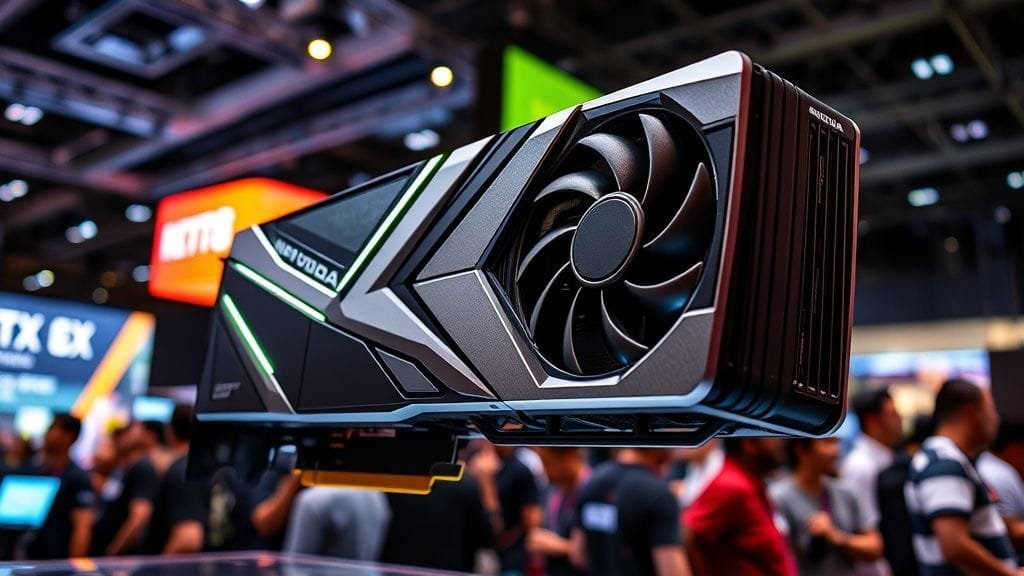
Computex 2025 truly marked a pivotal moment for graphics cards, showcasing where raw power met new ideas. Indeed, major companies like Nvidia, AMD, and Intel did more than just unveil new products; they clearly outlined the future of graphics technology. During the event, we observed that artificial intelligence will be extensively integrated into these next-gen graphics cards. Additionally, smarter upscaling technologies will be prevalent. There was also a surprising focus on more compact, efficient designs.
The trends for Computex 2025 Graphics Cards were remarkably clear. For instance, we saw mighty flagship cards for intense gaming, alongside tiny powerhouses fitting in the palm of your hand. GPUs are not just getting faster; they are also becoming smarter and much more adaptable. This article will dive deep into these exciting developments. Specifically, it will explore the top cards, the wild concepts, and the small-form-factor wonders that truly stole the show. Ultimately, we will help you understand what these innovations mean for your next PC build or professional workflow.
The New Powerhouses at Computex 2025: Next-Gen Graphics Cards from Nvidia, AMD, and Intel
At Computex 2025, Nvidia, AMD, and Intel—the three biggest names in GPUs—all showcased their best work. Specifically, they unveiled new architectures and powerful graphics cards. These cards are designed to redefine what’s possible in gaming, content creation, and AI workloads. These announcements, therefore, set the tone for the upcoming year, promising significant leaps in performance and efficiency.
Competition among these companies was fierce. However, the real winners are consumers. Indeed, users now have more choices than ever, with each offering unique advantages among the new graphics cards. Let’s break down what each company showcased, starting with Nvidia’s highly anticipated Blackwell architecture.
Nvidia’s Blackwell Reign: RTX 50 Series Graphics Cards Shine at Computex
Nvidia made a significant impression with its GeForce RTX 50 Series. These graphics cards are built on the advanced Blackwell architecture. The star of the show, without a doubt, was the RTX 5090. This flagship GPU won a Computex Best Choice Award for Gaming and Entertainment. Such an accolade clearly demonstrates its immense power and innovative features. Consequently, it promises to be a game-changer for serious gamers and professionals alike.
The RTX 5090 features ultra-fast GDDR7 memory and a wide 512-bit memory bus. Furthermore, it incorporates fifth-generation Tensor Cores. These are vital for AI-driven tasks. Therefore, this card is not just about frames per second; it’s about intelligent processing. Indeed, its capabilities make it a standout among new graphics cards.

The most revolutionary aspect of Nvidia’s new graphics cards is DLSS 4. This is more than just a minor update. In fact, it’s a completely new suite of neural rendering technologies. DLSS 4 uses artificial intelligence to significantly increase frame rates. Furthermore, it also reduces latency and enhances image quality significantly. Key features include Multi Frame Generation and enhanced Ray Reconstruction. This combination, therefore, makes ray tracing appear remarkably realistic.
Nvidia’s RTX 50 Series: AI and Portable Innovations
Beyond the desktop, Nvidia also demonstrated its strength in small systems. The RTX 5080 Laptop GPU, for example, was featured in the new ROG NUC (2025) mini PC. This highlights Nvidia’s strategy. Essentially, they aim to bring top-tier performance to smaller, portable devices. For gamers on the go, this ultimately means fewer compromises.
Additionally, the RTX 5060 was released. Its launch, however, was notable. There were no independent reviews available before it went on sale. Nevertheless, it still makes the RTX 50 series available at lower price points for those seeking new graphics cards.
Finally, Nvidia introduced “Project G-Assist.” It’s an RTX-powered AI assistant. Specifically, it is designed to assist users in PC games and various applications. Imagine a smart helper. For instance, it provides tips or information during gameplay. This truly blurs the lines between AI and gaming. In essence, it significantly enhances the user experience.
AMD’s RDNA 4 Revolution: RX 9000 Series and FSR “Redstone”
AMD arrived at Computex 2025 with its brand-new RDNA 4 graphics architecture. It debuted with the Radeon RX 9070 XT and RX 9070. These graphics cards are poised to offer strong competition. They are especially strong in the performance-per-dollar segment. Both models, for example, feature 16GB of GDDR6 memory. This significant capacity ensures smooth gameplay and handles large textures efficiently.
Moreover, AMD has significantly improved its raytracing and AI capabilities in this generation of graphics cards. This means games will feature improved visuals. Consequently, AI-driven tasks will run faster. The RX 9070 XT aims to match or surpass the RX 7900 XT from the previous generation. The RX 9070, however, is projected to outperform the RX 7800 XT. This offers a substantial upgrade for many users.

AMD announced its next-generation FSR “Redstone” AI upscaling technology. This technology promises to be a game-changer. Indeed, this exciting new technology will launch in late 2025. FSR Redstone does more than simple upscaling. Instead, it utilizes advanced neural rendering technologies, such as Neural Radiance Caching. Consequently, it can create highly detailed and realistic visuals. It achieves this without a significant cost in computational power.
AMD’s Next-Gen Graphics Cards and AI Innovations at Computex
FSR Redstone is particularly exciting due to AMD’s significant claim. It might run on Nvidia and Intel GPUs. This represents a significant shift. Effectively, it transforms AMD’s neural rendering core into components that can work with any computer. Imagine a future where top-tier upscaling technology works on any platform. Ultimately, this would benefit all PC gamers, regardless of their GPU brand. Such a development, therefore, signals an exciting move towards wider compatibility for graphics cards.
For professionals, AMD did not disappoint. They announced the Radeon AI PRO R9700 graphics card. It targets professional visuals and AI acceleration at the edge. Furthermore, this powerful card features a massive 32 GB of GDDR6 memory. It delivers an impressive 1,531 AI TOPS (INT4 sparse). Indeed, such a card offers incredible capabilities. It assists with complex data analysis, machine learning development, and other demanding professional applications.
Finally, AMD also introduced the mid-range Radeon RX 9060 XT 16 GB. It is priced attractively at $350. AMD confidently calls this card the “Fastest Under $350” for 1080p gaming with ray tracing. This strategic move also demonstrates AMD’s dedication to providing strong performance and value at various price points. Ultimately, therefore, these new graphics cards will make advanced gaming more accessible.
Intel’s Arc Pro Battlemage: Workstation Power for Professionals
Intel is a newer player in the discrete GPU market. It continued to expand its Arc Pro lineup at Computex 2025. They unveiled the Arc Pro B50 and B60 workstation graphics cards. They utilize Intel’s Battlemage architecture. However, these cards are not aimed at gamers. Instead, they target professionals who rely on specialized applications. In these fields, accuracy and efficiency are paramount.
The Arc Pro B50, for example, is a compact, dual-width card. It features a very low 70W TDP (Thermal Design Power). It comes with 12GB of memory and is priced competitively at $299. Consequently, this makes it an excellent choice for workstations. It fits where space and power consumption are key, but solid performance is still required. It is, therefore, an ideal card for entry-level professional use.

For more demanding AI tasks, Intel offers the Arc Pro B60. It features 24GB of memory. This increased capacity is vital for handling larger AI models and more complex data. Thus, it empowers professionals to accomplish more with their work. Moreover, Intel’s “Project Battlematrix” platform enables users to link up to eight Arc Pro GPUs. This multi-GPU setup significantly accelerates large AI models. In turn, it provides incredible computing power for researchers and developers.
Intel’s strategy also depends heavily on its partners. Companies like ASRock, Gunnir, Maxsun, Sparkle, Onix, Senao, and Lanner are expected to offer their own custom Arc Pro card designs. Therefore, this broad support means there will be numerous options and custom solutions for different professional needs. This, furthermore, strengthens Intel’s position in the workstation GPU market and impacts the overall graphics card landscape.
Beyond the Benchmark: Innovative Graphics Card Concepts at Computex 2025
Computex isn’t just about what can be purchased today. Indeed, it’s also a window into tomorrow for graphics cards. This year’s show featured many exciting concept cards. These prototypes often boast stunning aesthetics. Furthermore, they also explore new technologies. Ultimately, they push the limits in design, cooling, and user interaction. They showcase what’s possible for future graphics cards.
These creative efforts also reveal how companies are thinking innovatively. They are exploring new materials, integrated displays, and unique aesthetics for their upcoming graphics cards. Therefore, let’s explore some of the most interesting concepts showcased at Computex 2025.
MSI’s Visionary Prototypes: Materials and Displays at Computex
MSI, a well-known manufacturer, showcased many interesting GeForce RTX 50 Series GPU concepts. Their focus was clearly on novel materials. Additionally, they focused on advanced cooling solutions for these next-gen graphics cards. Significantly, these prototypes weren’t just about raw power. Instead, they explored how GPUs might look and feel in the future. This added a new level of style.
For instance, the SUPRIM TITANIUM EDITION concept utilized titanium. This was for enhanced structural integrity. Imagine a graphics card that is powerful and incredibly tough. This, therefore, points to a future where high-performance components last longer. Such durability, consequently, offers peace of mind to tech enthusiasts.
Then there was the CYCLONE VISUAL. This concept integrated a dynamic display directly into the fan system of the graphics card. This is an exciting development. It allows for playing videos or displaying custom animations directly on your GPU. Effectively, it transforms a functional component into a personal statement. Moreover, it adds a unique aesthetic to your PC build.

The TWIN FROZR 2025 concept refined MSI’s classic cooling aesthetic. It built upon a popular design. Additionally, it also showcased improvements in cooling efficiency. This demonstrates a steady focus on quiet and effective cooling. This, in turn, ensures future graphics cards perform optimally even under heavy load.
Finally, MSI’s EXPERT Series won a prestigious iF Design Award. It won for its exceptional engineering. This award also highlights the meticulous detail and innovative design MSI incorporates into its products. Ultimately, it demonstrates that aesthetics and functionality can truly converge in high-performance hardware, especially for next-generation graphics cards.
Colorful’s Artistic Flair: Themed Graphics Card Designs from Computex 2025
Colorful consistently manages to stand out with its unique and often artistic GPU designs. In this regard, Computex 2025 was no exception. Colorful showcased several graphics cards. These models were powerful and boasted striking aesthetics. Their style often blends high performance with a distinctive visual appeal. This appeals to users who want their PC to stand out.
One notable example was the Colorful GeForce RTX 5090 Doom The Dark Ages Special Edition. This limited-edition graphics card featured solid metal accents. These elements imbued it with a robust and premium feel. Themed designs can transform a graphics card into a collectible item. It’s more than just a component. This particularly appeals to fans of specific games or aesthetics, especially among the new graphics cards.
The Colorful GeForce RTX 5090 Neptune presented another impressive design. This graphics card featured an All-In-One (AIO) cooler. This signaled a move towards enhanced liquid cooling for top-tier performance. Its unique “spaceship” aesthetic featured silver metallic accents and ocean-blue LED lighting. It was notably eye-catching. This design, consequently, clearly points to a future where cooling solutions will not just perform well, but also be an integral part of the card’s visual identity.
Colorful also showcased customizable graphics cards. They featured 3D-printed shrouds. This is a remarkable innovation. Indeed, it allows users to customize their GPU’s appearance like never before. Imagine designing and printing your own unique shroud. You could, for instance, match your PC’s theme or express your personal style. This, therefore, highlights a trend towards greater user customization in high-end hardware like these next-gen graphics cards.
Palit’s Cooling Evolution and Themed Artistry for GPUs
Palit, another prominent GPU manufacturer, also presented interesting concepts at Computex 2025. Their products showcased novel cooling designs. In addition, they also demonstrated a keen sense for themed aesthetics. These graphics cards, indeed, demonstrated that other manufacturers are rapidly adopting and refining new technologies.
The Palit GeForce RTX 5090 Tornado Concept was particularly significant. It was the first non-Nvidia RTX 5090 to utilize Nvidia’s dual-flow-through cooling. This cooling technology was once exclusively seen in Nvidia’s own Founders Edition cards. By adopting this design, Palit aims to offer enhanced cooling. Moreover, it also aims for quieter operation. This is excellent news for high-performance enthusiasts eagerly awaiting these next-generation graphics cards.
Furthermore, Palit showcased an RTX 5080 graphics card. It pushed the boundaries of visual design. This particular card heavily utilized 3D printing, laser cutting, and acrylic work. The entire design was themed around “Doom the Dark Ages,” much like Colorful’s offering. This collaboration on a popular game title, consequently, suggests a trend. It’s about creating highly special and collectible GPU versions. It, therefore, blends gaming culture with hardware artistry, creating unique pieces for passionate enthusiasts.
ASUS’s Cable-less Future for Graphics Cards: A Cleaner Build Concept
ASUS, known for its innovation, showcased an interesting concept. It addresses a common problem in PC building: cable clutter. Specifically, they revealed a prototype for GPUs under 250W. It eliminates the need for external power cables. This, in turn, represents a significant step towards creating much cleaner PC builds. It also enhances their aesthetic appeal, especially with future graphics cards.
The innovative concept is to modify the PCIe 16x slot. It will supply supplementary power. Today, most powerful graphics cards require additional power cables from the power supply. By integrating this power into the PCIe slot, ASUS envisions a future. Installing a graphics card will be simpler and neater. This not only improves a PC’s aesthetics, but furthermore, it also frees up space, which could potentially improve airflow.
This concept is currently limited to GPUs under 250W. But it hints at a future where modularity and integration are key for graphics cards. It demonstrates how manufacturers are approaching whole-PC design. They are not just considering one component’s performance. Ultimately, this could lead to designs that are easier to use, and to systems that offer enhanced aesthetics for many users.
Tiny Titans: Small-Form-Factor Graphics Cards and External Powerhouses at Computex 2025
While many people focused on the massive flagship cards, Computex 2025 also highlighted the small-form-factor (SFF) market for GPUs. There’s a growing demand for powerful PCs that don’t occupy much space. So, manufacturers responded with considerable interest. Consequently, they showcased numerous GPUs, external enclosures, and mini PCs. These were designed to deliver top-tier performance in compact spaces.
These “SFF gems” demonstrate that a massive tower isn’t necessary for top-tier gaming or demanding AI tasks. Instead, powerful computing solutions are becoming more portable and less conspicuous. This, in turn, opens up new possibilities. These include home entertainment systems, office setups, and even for on-the-go professionals. All this is thanks to innovations in Computex 2025 Graphics Cards.
Low-Profile and ITX-Ready: Compact Graphics Cards in Petite Packages
Low-profile and ITX-ready GPUs are essential for individuals building compact PC systems. Computex 2025 saw many manufacturers showcasing graphics cards. These were specifically engineered for tight spaces. Notably, these designs prioritize compactness. They achieve this without sacrificing significant power. This, consequently, is often a challenging balance to achieve.
Zotac, for instance, showcased its GeForce RTX 5060 Low-profile. This graphics card is truly impressive. It integrates three fans into a slim, space-saving design. This is ideal for tiny cases where every millimeter counts. Crucially, this ensures users still achieve effective cooling even in confined spaces. It prevents overheating and maintains stable performance.
MaxSun also displayed its MS GeForce RTX 5060 LP 8GB. This compact graphics card is only 162mm long. This allows it to fit even the smallest ITX cases. Despite its compact footprint, it features one 8-pin power connector. It also offers four robust display outputs. This, therefore, provides excellent connectivity for multiple displays. Such a card is perfect for those building quiet, powerful home theater PCs or compact workstations.
PNY contributed to this category with an Nvidia GeForce RTX 5060 single-fan model. Single-fan designs represent the epitome of compactness. They often fit into the thinnest cases. While a single fan might imply reduced cooling capacity, these cards are usually designed for lower TDPs. This ensures they operate efficiently and quietly within their design limits. This, therefore, further expands the options for incredibly compact builds.
External GPUs (eGPUs): Boosting Graphics Card Performance on the Go
External GPUs (eGPUs) have been popular for years. They enhance the graphics power of laptops and mini PCs. However, Computex 2025 demonstrated that this technology for graphics cards is becoming more refined. New products offer desktop-level performance with minimal drawbacks. These devices are ideal for professionals and gamers. They offer portability while maintaining performance when plugged in.
GIGABYTE, a leader in this space, expanded its AI BOX eGPU lineup. They did so with the AORUS RTX 5060 Ti AI BOX. This is a compact, portable external GPU. It is designed to bring desktop-level power to ultrabooks. It connects using high-speed Thunderbolt 5 and USB4. This ensures rapid data transfer. Impressively, it exhibits only a 5% performance difference compared to an internal card. This is a significant achievement. In fact, this represents a major leap. It makes eGPUs a truly viable solution for demanding tasks.
Moreover, GIGABYTE confirmed its flagship AORUS RTX 5090 AI BOX is still available. This powerful device delivers over 3,000 TOPs of FP4 computing power. It’s an exceptional solution for advanced AI, professional rendering, and extreme gaming on the go. It, furthermore, represents the pinnacle of external GPU performance. It pushes the boundaries of what’s possible outside a desktop tower.
Aoostar also entered the eGPU arena with the EG01, a Thunderbolt 5 eGPU dock. This versatile device supports full-size desktop graphics cards. Users can add almost any high-end GPU desired. Furthermore, it even includes mounting for a mini-PC. This, therefore, creates a powerful, modular desktop experience that significantly saves space, especially when paired with modern graphics cards.
Mini PCs with Maxi Power: Compact Gaming and AI Hubs
Mini PCs are no longer just for basic office work. They are evolving into true powerhouses for gaming and AI tasks. Computex 2025 demonstrated that these compact systems can now be exceptionally powerful. They often compete with larger desktops, thanks to advanced graphics cards. This shift means powerful computers can integrate seamlessly into any room or workspace. Indeed, all this is thanks to innovations in these next-gen graphics cards.
The ROG NUC (2025) was a prime example of this trend. It featured an Intel Core Ultra 9 processor (Series 2) alongside a powerful Nvidia GeForce RTX 5080 Laptop GPU. Despite its compact size, it incorporates triple-fan cooling. Consequently, this ensures that these high-performance components remain cool under pressure. This mini PC is designed to deliver a top-tier gaming experience in a very compact form factor. It, therefore, showcases the potential of modern graphics cards in compact systems.
Zotac reinforced this trend with its MAGNUS ONE and MAGNUS EN mini PCs. These systems were noted as some of the most compact in the world. They were equipped with desktop GeForce RTX 50 series GPUs. This represents a significant achievement. Users can play AAA games and run local AI on a device that occupies very little desk space. These systems, moreover, demonstrate excellent thermal design and ingenious components. They provide desktop-level performance in a console-like size. Furthermore, these are powered by advanced graphics cards.
The Quiet Revolution: Passive Cooling Solutions for Graphics Cards
Most high-performance GPUs employ active cooling solutions with fans. But ASRock showcased an interesting option at Computex: an Arc Pro B60 Passive graphics card. Indeed, this design garnered significant attention. It demonstrated an innovative way to cool a professional workstation GPU.
A passive graphics card utilizes large heatsinks. It relies on natural airflow (convection) inside a PC case to dissipate heat. This means no fans are required. In turn, this results in completely silent operation. This, consequently, offers a significant benefit in environments like recording studios, scientific laboratories, or quiet offices. Fan noise often distracts individuals in such settings. While passive cooling usually limits the card’s peak power, it’s ideal for workstation tasks that prioritize quiet operation and reliability. These tasks often place less emphasis on peak gaming speed. This innovation, therefore, truly offers something special for certain professional users.
The Unifying Thread: AI’s Central Role in Computex 2025 Graphics Cards Evolution
One central theme ran through all of the Computex 2025 graphics card news. It was the pervasive integration of artificial intelligence. AI is significantly transforming the landscape. However, AI is no longer just a buzzword. Instead, it’s becoming the core engine for next-gen GPU capabilities. This trend impacts everything. It transforms how we game and how professionals solve complex computational problems.
Nvidia’s DLSS 4 with its fifth-generation Tensor Cores clearly leads the charge in gaming for these next-gen GPUs. It leverages AI not just to boost frame rates. It rethinks how games are rendered. Thereby, it creates more engaging and fluid experiences. Meanwhile, AMD’s FSR “Redstone” demonstrates a similar commitment. Importantly, AMD aims for FSR to run on any GPU. This, therefore, highlights a future where AI upscaling benefits everyone, not just one brand.
For professionals, the focus on AI was even more pronounced. AMD’s Radeon AI PRO R9700 is built for AI acceleration at the edge. It boasts immense AI TOPS capability and substantial memory. Likewise, Intel’s Arc Pro B-series graphics cards are for researchers and developers. They work with large AI models. Moreover, Project Battlematrix, for instance, enables AI acceleration using multiple GPUs. Nvidia’s Project G-Assist also integrates AI directly into the user experience. It offers intelligent assistance within games and applications. This illustrates the broad impact of these advanced graphics cards.
Pervasive AI Integration in Computex 2025 Graphics Cards
Even in the realm of small-form-factor computing, AI played a crucial role for graphics cards. The AORUS AI BOX eGPUs, for instance, are not just for gaming. They also bring significant computing power for AI tasks to portable setups. The Zotac MAGNUS mini PCs are lauded. Specifically, they can handle local AI inferencing. This means users can run complex AI models right on their compact desktops.
Ultimately, this widespread integration means GPUs are becoming highly intelligent co-processors. They don’t just execute commands. Instead, they also learn, adapt, and enhance all our digital interactions. AI is unlocking new levels of performance and efficiency. This is true across all graphics card applications. It ranges from generating realistic visuals to processing vast data sets. This, therefore, represents a monumental shift. It makes graphics cards not only faster but also much smarter and more useful than ever before.
What Do Computex 2025 Graphics Cards Mean for Your Next PC?
Computex 2025 gave us a fantastic look into the future of computing hardware. We witnessed incredible leaps in raw power from Nvidia’s RTX 50 series and AMD’s RX 9000 series. Intel also made significant strides in the professional field with its Arc Pro Battlemage cards. Significantly, these advancements promise smoother gameplay, faster content creation, and more efficient AI processing for everyone.
Beyond just performance, innovative concepts truly stood out. Manufacturers showcased amazing concept graphics cards. They featured novel materials, integrated displays, and unique aesthetics. This, consequently, points to a future where your graphics card could be a customizable centerpiece of your PC. Furthermore, the push for cable-less designs and silent passive cooling suggests a cleaner future. This, in turn, will mean a quieter and more user-friendly computing experience.
Perhaps the most exciting aspect is the rise of powerful compact computers. This includes low-profile graphics cards for small builds. It also covers external GPUs that bring desktop-level power to laptops. Indeed, mini PCs now boast top-tier performance. Compact computing is more capable than ever. This, therefore, means users have more options than ever. They can create a powerful PC that fits their lifestyle and space requirements.
Ultimately, the future of graphics cards unveiled at Computex 2025 is incredibly exciting. It’s a future where power, intelligent technology, and design converge. They create truly remarkable hardware. AI is at the core of many innovations. These new GPUs, therefore, promise to redefine what’s possible in gaming, creative work, and artificial intelligence.
What are you most excited to see from the next generation of graphics cards, and which innovation do you think will have the biggest impact?