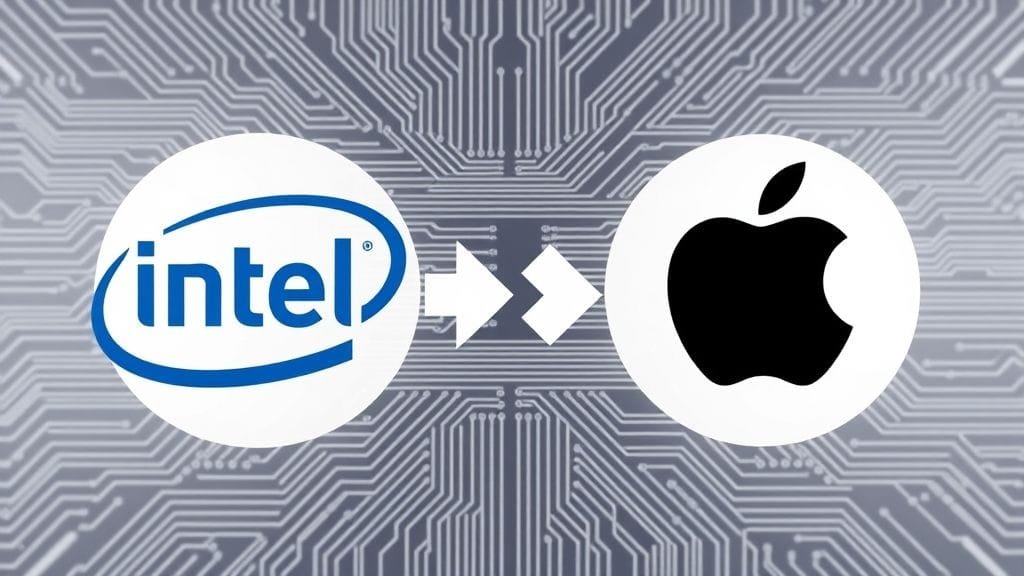
For years, Intel reigned supreme in the laptop processor market. However, in 2020, Apple unleashed its M-series chips, fundamentally shifting the landscape. Consequently, Intel suddenly faced a formidable challenge. Indeed, Apple Silicon was lauded for groundbreaking performance-per-watt efficiency and seamless integration. Therefore, many wondered if Intel’s era of mobile chip dominance was truly over. Nevertheless, whispers of a resurgence have grown louder. Specifically, they paint a picture of an ambitious, multi-faceted strategy. Ultimately, this strategy is designed to reclaim lost ground. This, then, is the story of Intel’s Laptop Chip Comeback. Essentially, it is a strategic maneuver to catch up. Moreover, the goal is to potentially surpass Apple’s benchmark.

The New Battleground: Why Apple’s M-Series Sparked a Revolution
Before delving into Intel’s fightback, it’s essential to understand the seismic shift Apple initiated. Historically, Apple relied on Intel for its Mac lineup. However, over time, performance bottlenecks, efficiency limitations, and delayed manufacturing became frustrating. Furthermore, Intel’s own advancements were perceived as slow. Consequently, Apple’s response was audacious: design its own silicon.
When the M1 chip debuted, it wasn’t just another processor; it was a statement. For instance, the M1 MacBook Air was fanless and sleek. Moreover, it delivered strong performance. Indeed, this often matched or even exceeded Intel’s high-end MacBook Pro models. Crucially, it also consumed remarkably less power. Therefore, this was not a mere incremental upgrade. Instead, it was a paradigm shift in laptop performance. Furthermore, it offered incredible battery life. Significantly, power was not sacrificed. As a result, consumers suddenly had a clear choice. Specifically, they saw efficiency and integrated performance. Consequently, PC manufacturers found this difficult to match.
Intel’s Multi-Front Offensive: A Strategy for Resurgence
While Intel’s path back to competitive leadership is far from simple, it is certainly clear. To this end, the company has orchestrated a comprehensive strategy. Specifically, it targets every aspect of chip design and manufacturing. Indeed, this is not about tweaking existing designs. Rather, it is a deep structural overhaul. Moreover, the focus is on an engineering-first culture. Therefore, let’s explore the key pillars driving Intel’s Laptop Chip Comeback.
Accelerating Manufacturing: Five Nodes in Four Years
Fundamentally, at the heart of any modern chip’s performance and efficiency lies its manufacturing process, or “node.” Previously, Apple’s M-series chips leveraged TSMC’s advanced nodes, giving them a significant edge. However, Intel recognized this challenge. Consequently, the company committed to an aggressive roadmap. Specifically, it plans five new manufacturing nodes in just four years.
Evidently, this rapid progression is absolutely critical for achieving competitive power efficiency and raw performance. Furthermore, beyond 18A, Intel has already laid plans for 14A. Ultimately, it aims to offer compelling advantages over rival foundries. Moreover, to achieve these leaps, Intel is integrating groundbreaking technologies. For example, RibbonFET is a gate-all-around transistor design. Similarly, PowerVia is a backside power delivery solution. Crucially, both will debut with Intel 20A and 18A. Together, they promise unprecedented miniaturization and energy efficiency.

Next-Generation Architectures with an AI Core
While manufacturing prowess is only half the equation, innovative chip architecture is equally vital. Therefore, Intel’s recent and upcoming processors are meticulously crafted. Indeed, they tackle Apple Silicon head-on. Specifically, there is a distinct emphasis on AI capabilities. Crucially, these are integrated directly into the silicon.
The Core Ultra Era: Meteor Lake and Beyond
- Meteor Lake (Core Ultra Series): Initially launched in late 2023, these chips marked a pivotal moment. Crucially, they represent Intel’s first foray into integrated Neural Processing Units (NPUs) dedicated to AI tasks. For their construction, the Intel 4 (7nm) process is utilized. Moreover, these chips also incorporate FOVEROS 3D packaging. Significantly, Meteor Lake was designed for ultra-thin laptops. Ultimately, it aims for improved efficiency.
- Arrow Lake and Lunar Lake: Furthermore, these processors are expected in 2024 and 2025. They are, moreover, touted for significant advancements. Specifically, this includes CPU, GPU, and NPU performance. Crucially, all operate within a constrained power budget. Indeed, Intel has publicly demonstrated Lunar Lake prototypes, showcasing tangible progress. Consequently, early benchmarks for Arrow Lake HX hint at strong multi-core performance. Notably, this sometimes surpasses Apple M4 and Snapdragon X Elite.
- Panther Lake: Lastly, confirmed for 2025, the design for this next-generation chip is “well underway.” Specifically, Panther Lake is slated for production. Significantly, it uses the cutting-edge Intel 18A process. Therefore, this promises another substantial leap in performance and efficiency. Indeed, it is a key part of Intel’s Laptop Chip Comeback.
Bridging the Performance Gap: The Data Speaks
Significantly, Intel executives have repeatedly stated their roadmap. Indeed, it spans from Meteor Lake through Panther Lake. Ultimately, this roadmap aims to make platforms “very competitive.” Moreover, they seek to be superior to Apple’s offerings. In fact, the ultimate goal is to match or exceed Apple Silicon’s heralded performance-per-watt. However, while the journey is challenging, recent benchmarks illustrate Intel’s determined progress.
First, consider the historical context. For example, the Apple M1 chip was noted as 40% faster in single-thread testing. Moreover, it was also more power efficient. Indeed, it surpassed an Intel Core i7-10750H. However, fast forward to today, and the picture is evolving.
| Metric (Example) | Apple M4 (vs. Intel i9-14900KS) | Intel Core Ultra 7 155H (vs. Apple M3) |
|---|---|---|
| Single-Core | ~22% Faster | Apple often retains lead |
| Multi-Core | Very Strong | Can compete/slightly surpass (e.g., Cinebench R23) |
| Power Efficiency | Significantly Superior | Still trails Apple and Qualcomm |
Note: Benchmarks vary widely based on specific tests, configurations, and applications. Data is indicative of general trends.
Indeed, newer Intel chips can certainly compete. For instance, the Core Ultra 7 155H is an example. In fact, it can even slightly surpass the Apple M3 in multi-core tasks. However, Apple consistently maintains a lead in single-core performance and significantly better power efficiency. Furthermore, the M4 chip has demonstrated substantial leads. For example, it is 22% faster in single-core performance than Intel’s i9-14900KS. Moreover, it also has robust multi-core capabilities. Ultimately, these compete against a range of rivals. Thus, this shows Intel’s Laptop Chip Comeback is making headway, but challenges remain.
The Bold Move: Intel’s Foundry Business
Beyond designing its own chips, Intel is pursuing an even more audacious goal: becoming a major foundry. In other words, this means manufacturing chips for other companies. Specifically, these include potential rivals like Apple and Nvidia. Consequently, this is a significant strategic shift. Therefore, Intel transforms from a pure IDM. Ultimately, it becomes a hybrid model, much like Samsung.
Furthermore, this move aims to capitalize on Intel’s advanced manufacturing capabilities. Indeed, this is especially true for its upcoming 18A and 14A processes. Moreover, establishing onshore production could attract major customers. Specifically, this means locations in the US, like Arizona and Ohio. This is because customers seek supply chain diversification. Furthermore, they also consider geopolitical uncertainties. Interestingly, analyst Jeff Pu has suggested something. Namely, Apple might consider Intel’s 14A process for future M-series chips. If so, this could be a second source to TSMC. Consequently, this would be a monumental victory for Intel’s Laptop Chip Comeback.
Software Optimization and the Ecosystem Advantage
Admittedly, Apple enjoys tight hardware-software integration. Indeed, this is an unparalleled advantage. However, Intel understands the broader PC ecosystem. Fundamentally, a chip’s success does not solely rest on raw silicon. Rather, it depends heavily on how well software runs on it. Therefore, Intel actively collaborates with partners like Microsoft. Crucially, this enhances the Windows on Intel experience. Moreover, it especially helps emerging AI applications.
Indeed, the importance of this collaboration cannot be overstated. After all, a powerful NPU is only as good as the software designed to leverage it. Consequently, Intel fosters a rich ecosystem of optimized applications. Thus, it aims to deliver a compelling user experience. Moreover, this can rival Apple’s. Significantly, it does so even without Apple’s vertical integration. Ultimately, this holistic approach is crucial for Intel’s Laptop Chip Comeback.
Navigating the Hurdles: Challenges and the Road Ahead
While Intel has an ambitious roadmap and demonstrable progress, yet, it faces significant hurdles. Specifically, this is true in its quest for Intel’s Laptop Chip Comeback.
- Power Efficiency Gap: Although Intel chips are getting faster, however, they often consume more power than Apple’s M-series. Indeed, this is especially true under sustained loads. Consequently, this directly impacts battery life, a crucial factor for laptop users.
- Established Relationships: Secondly, Intel faces an uphill battle in the foundry business. This is because deeply entrenched relationships exist. For example, these are between companies like Apple and TSMC. Therefore, building trust and proving reliability will take time and consistent execution.
- Apple’s Continued Innovation: Furthermore, Apple isn’t standing still. Instead, each new M-series generation brings further advancements. Consequently, this continually raises the bar. Thus, Intel’s target becomes a moving one.
- Niche Strengths: Finally, some specialized applications might still perform better on Intel Macs. For instance, examples include simulation or 3D analysis. This is primarily due to architectural strengths or software optimizations. Furthermore, app compatibility issues for ARM-based Macs can still occasionally exist, though this is becoming less frequent.
However, the opportunities are equally immense. For example, a successful foundry business could transform Intel’s revenue streams and strategic importance. Moreover, continuous chip design improvement is key. Similarly, a robust software ecosystem also helps. Together, these could re-establish Intel as the undisputed leader. In fact, it would be undisputed in PC processing. Indeed, the engineering-first culture seems to yield “concrete, measurable results.” This is particularly seen with successful Lunar Lake and Arrow Lake prototype launches.
The Future of Laptop Computing: A Renewed Rivalry
Ultimately, Intel’s Laptop Chip Comeback is more than a corporate strategy. Rather, it is a renewed rivalry. Consequently, this promises to accelerate innovation. Moreover, it impacts the entire computing industry. As Intel pushes its manufacturing boundaries, and as it integrates powerful AI capabilities, then consumers will ultimately benefit. Indeed, they will get faster, more efficient, and more intelligent laptops. Thus, the competition with Apple Silicon is forcing both giants to innovate at an unprecedented pace.
So, will Intel fully reclaim its crown? Or, will Apple continue to forge ahead, especially as it holds a custom silicon advantage? Ultimately, only time will tell. However, one thing is certain: laptop computing just got more exciting. Therefore, what is the most crucial factor? Specifically, it will determine Intel’s long-term success against Apple Silicon. Consequently, what do you believe it is? Finally, share your thoughts in the comments below!