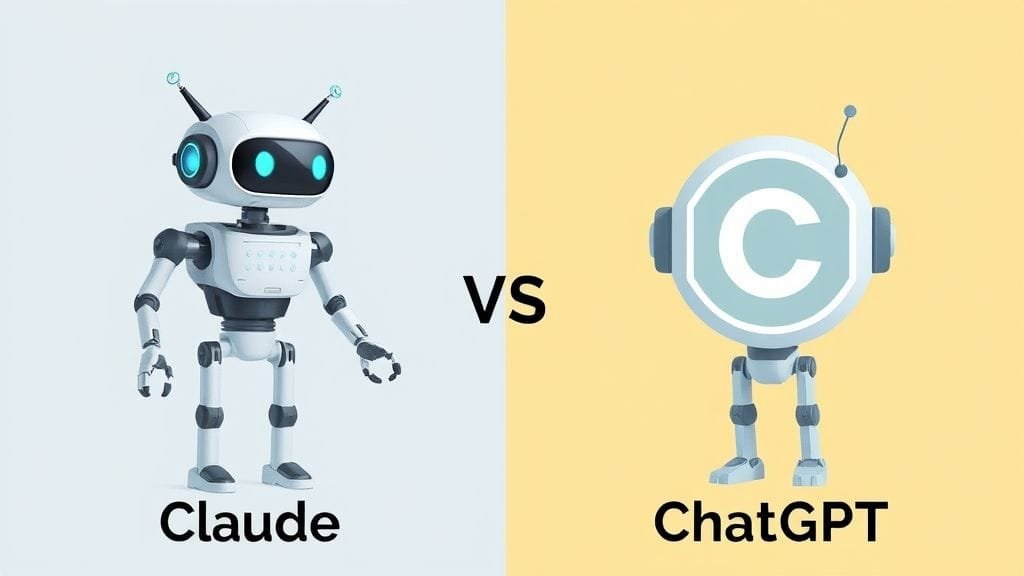
The landscape of large language models (LLMs) continues to evolve rapidly. Indeed, among the leading contenders, Claude and ChatGPT stand out, each developed with distinct philosophies and excelling in different areas. Consequently, these advanced conversational AI capabilities cater to varied user needs. Therefore, choosing between these powerful tools often depends on specific use cases, performance benchmarks, available feature sets, and ethical considerations. Thus, understanding their core differences is essential for making an informed decision. This guide will, therefore, explore these key aspects to help you determine which AI, or combination of both, best suits your requirements.
Performance Benchmarks: A Head-to-Head Comparison
Assessing the raw performance of leading LLMs, conversely, reveals a nuanced competition. While recent iterations of both Claude and ChatGPT showcase impressive advancements, their strengths often diverge in critical areas. Ultimately, users considering which AI to integrate into their workflows should examine these distinctions closely. The following sections, therefore, break down their performance across various technical and creative domains.
Coding and Complex Reasoning: Where Claude Excels
To begin with, Claude models have demonstrated strong capabilities in coding, deep reasoning, and handling complex tasks. Claude 3.5 Sonnet, for example, achieved a remarkable 92% score on the HumanEval test for coding proficiency. Notably, this performance edges out ChatGPT’s 90.2% on the same benchmark. Furthermore, Claude Opus 4 recorded 74.5% on SWE-bench Verified, outperforming ChatGPT-5 in deep engineering tasks. Indeed, this highlights Claude’s particular aptitude for intricate development challenges.
Many users also rate Claude higher for creative writing. Specifically, they cite its natural writing style and ability to provide nuanced code solutions. Moreover, Claude Opus 4 incorporates a hybrid reasoning architecture, which allows for quicker responses or more thorough, extended thinking, depending on the complexity of the query. Consequently, for tasks requiring sophisticated code generation or detailed creative text, Claude often proves to be the preferred choice.
Mathematical Prowess and Multimodal Understanding: ChatGPT’s Edge
Conversely, ChatGPT, with models like GPT-4o and ChatGPT-5, frequently leads in mathematical reasoning and multimodal understanding. For instance, GPT-4o scores an impressive 76.6% on the MATH benchmark, surpassing Claude’s 71.1%. ChatGPT-5 further solidifies this lead, achieving 94.6% on AIME 2025 mathematics problems. Therefore, these statistics underscore ChatGPT’s strong capabilities in complex numerical and logical problem-solving.

Additionally, ChatGPT excels in multimodal understanding, scoring 84.2% on the MMMU benchmark. In other words, this indicates its superior ability to interpret and process information from various formats, including text, images, and potentially other media. Generally, users rate ChatGPT higher for research depth, versatility, and practical tasks. Its responses also tend to be more verbose and exhaustive, thereby providing comprehensive answers for diverse queries. Nevertheless, in general intelligence, both LLMs achieve essential parity on MMLU (Massive Multitask Language Understanding).
Factual Accuracy and Hallucination Rates
A critical aspect of LLM performance, moreover, involves factual accuracy and the rate of “hallucinations.” Specifically, hallucinations refer to instances where an AI generates incorrect or nonsensical information, presenting it as fact. For example, GPT-4o demonstrates a lower hallucination rate of 1.5%. In contrast, Claude 3.5 Sonnet shows a rate of 8.7%. Consequently, this indicates that ChatGPT often provides better factual accuracy in certain contexts. Therefore, users seeking highly reliable factual information might find ChatGPT more dependable in this regard.
Feature Sets and Capabilities: Beyond the Basics
Beyond raw performance, therefore, the distinct feature sets of Claude and ChatGPT significantly differentiate their utility for various applications. Furthermore, both platforms offer advanced AI capabilities, but their approaches to integrating additional tools and handling different types of data vary considerably. Ultimately, understanding these unique offerings is crucial when deciding between Claude vs ChatGPT for your specific project.
ChatGPT’s All-in-One AI Toolkit
Initially, ChatGPT excels as an all-in-one AI toolkit, offering a broad range of integrated functionalities. Its integration with DALL-E 3, for instance, allows for sophisticated image generation directly within the chat interface. Furthermore, ChatGPT supports voice interactions, enabling users to communicate with the AI verbally. Web browsing capabilities are also a standard feature, allowing the model to access current information online. In addition, a notable feature is “Custom GPTs,” which empower users to create specialized versions of the chatbot tailored for specific tasks or knowledge domains. Moreover, features like “Canvas” enable in-chat document editing, streamlining workflows. ChatGPT also offers a “Projects” feature, similar to Claude’s, designed to centralize chats and files for organized work environments. Overall, this comprehensive suite makes ChatGPT highly versatile for a broad range of creative and practical applications.
Claude’s Long-Context Handling and Artifacts
Conversely, Claude possesses robust vision capabilities, effectively analyzing uploaded images and PDFs. However, it currently does not support image generation or voice interaction in the same manner as ChatGPT. Significantly, where Claude truly shines is in its exceptional ability to handle long contexts. For example, models like Claude 4 support an impressive 200,000-token context window, equating to approximately 150,000 words. Thus, this allows it to analyze extensive documents, entire books, or large codebases without losing coherence or context.

Consequently, this long-context window is invaluable for tasks requiring deep analysis of extensive materials. Claude’s “Artifacts” system further enhances complex work environments. In particular, it creates a dedicated window for important content, such as code snippets or detailed documents, separating them from the main conversational flow. Ultimately, this separation helps users maintain focus and organize critical information efficiently. Claude also provides “Projects” for shared work environments, facilitating collaboration.
Emerging AI Agent Features
Both platforms are, indeed, actively developing advanced AI agent features. For example, Claude’s “computer use” functionality and ChatGPT’s “Operator” aim to enable autonomous task completion. Essentially, these features allow the AI to interact with external tools and applications to execute complex commands independently. However, these agent capabilities are generally still in experimental phases or limited to higher-tier subscription plans. Nevertheless, their full potential for everyday use is still unfolding, promising even greater automation in the future.
Ethical Stance and Privacy Considerations
The ethical foundations and privacy safeguards built into LLMs are, thus, increasingly important factors for users and organizations. Notably, Anthropic, the developer behind Claude, places a significant emphasis on AI safety. For example, this commitment is evident in its “Constitutional AI” framework. The framework, therefore, incorporates 32 ethical principles designed to minimize harmful and biased outputs. As a result, such a proactive approach helps reduce model risk, making Claude less likely to engage with problematic prompts that could lead to undesirable outcomes.
OpenAI, the creator of ChatGPT, also utilizes reinforcement learning to adhere to ethical guidelines and ensure responsible AI development. However, controlled tests have shown Claude to exhibit lower bias in political orientation analysis. Moreover, it also demonstrates a higher refusal rate for privacy-violating requests. Consequently, this strong ethical stance and focus on privacy can be a decisive factor for users and enterprises operating in sensitive domains. Therefore, choosing Claude often aligns with a preference for stringent ethical AI practices.
User Experience and Pricing: What to Expect
Both Claude and ChatGPT, furthermore, offer free and paid versions, catering to a wide range of users from individuals to large enterprises. To elaborate, understanding their respective pricing structures and user feedback provides further insight into their suitability for different needs. Indeed, the user experience can vary significantly based on interaction style, output quality, and available features.
Pricing Models and API Costs
Initially, ChatGPT Plus typically costs $20 per month. This subscription, in turn, provides priority access to advanced models like GPT-4o and premium features. Meanwhile, Claude Pro is priced at $17 per month when billed annually, or $20 per month on a monthly basis. This plan also offers priority access to its most capable models. For larger organizations, however, both providers offer enterprise and team plans. Notably, these plans include varying features, enhanced security, and customized pricing.

Furthermore, the API pricing for Claude models can be more cost-effective for high-volume text processing compared to some of ChatGPT’s offerings. Consequently, this can be a significant consideration for developers and businesses integrating LLMs into their own applications. Therefore, for projects with substantial API usage, a detailed cost analysis is highly recommended when evaluating Claude vs ChatGPT.
User Feedback and Interaction Style
User feedback consistently suggests, for instance, that ChatGPT is often preferred for its ease of use and overall versatility. Its conversational and friendly style, moreover, makes it accessible for a broad audience. However, its responses can sometimes be quite verbose, requiring users to sift through extensive text. Conversely, Claude is widely lauded for its structured tasks and emotional nuance. Often, its responses are frequently described as more natural-sounding and human-like. As a result, this often requires less editing for tone or clarity. Indeed, for creative writing, nuanced explanations, or highly optimized solutions, Claude’s output style is often considered superior. Ultimately, users appreciate its concise and well-structured answers.
Market Presence and Growth Trajectories
The market for large language models is highly dynamic; consequently, both Claude and ChatGPT are demonstrating significant growth. As of mid-2025, for example, ChatGPT holds a larger market share. Specifically, it processes an impressive 2.5 to 3 billion prompts daily. This platform also boasts approximately 190.6 million daily users and 800 million weekly active users. Therefore, ChatGPT Plus, its paid subscription service, counts around 10 million paid users, indicating strong commercial adoption.
Meanwhile, Claude has also experienced substantial growth and increasing market penetration. For instance, it achieved a 40% gain in monthly active users, reaching 30 million users. Furthermore, Claude processes over 25 billion API calls per month, with a significant 45% originating from enterprise customers. Hence, this highlights its strong appeal to businesses and developers. Claude also boasts an impressive 92% user satisfaction rate, underscoring its quality and utility.
Conclusion: Making Your Choice in the Claude vs ChatGPT Debate
Ultimately, the decision between Claude vs ChatGPT hinges on your specific use cases and priorities. Indeed, each LLM offers distinct advantages that cater to different needs. Therefore, understanding these strengths allows users to leverage the most appropriate tool for their tasks. Consequently, many advanced AI users find value in utilizing both platforms for their complementary strengths. In short, this approach often maximizes productivity and output quality across diverse projects.
When to Choose ChatGPT
ChatGPT, for example, stands out as an excellent all-around tool. It is particularly strong, for instance, in mathematical reasoning, multimodal creativity (including image/video generation and voice interaction), and web-enabled research. Thus, it serves as a versatile AI toolkit for a broad range of applications, from brainstorming to data analysis. Therefore, if you need a robust, general-purpose AI with extensive integrations and multimodal capabilities, ChatGPT is an outstanding choice.
When to Opt for Claude

Conversely, Claude, with its profound emphasis on AI safety, superior long-context handling, nuanced creative writing, and robust coding capabilities, offers a powerful alternative. Specifically, it is often preferred for in-depth analysis of lengthy documents, complex code generation, and tasks requiring highly optimized solutions. Therefore, users seeking a more natural, concise output and a model with a strong ethical framework will find Claude particularly appealing. In summary, it excels in focused text and code-centric work.
Strategic Selection for Your Needs
For users prioritizing ethical AI, deep document analysis, or complex code work, Claude, in particular, presents a strong argument. Conversely, if versatility, mathematical prowess, and multimodal interactions are paramount, ChatGPT remains a leading option. By carefully considering your project requirements, therefore, you can effectively navigate the Claude vs ChatGPT landscape and select the AI that best empowers your work. Ultimately, this strategic approach ensures you harness the full potential of these advanced technologies.