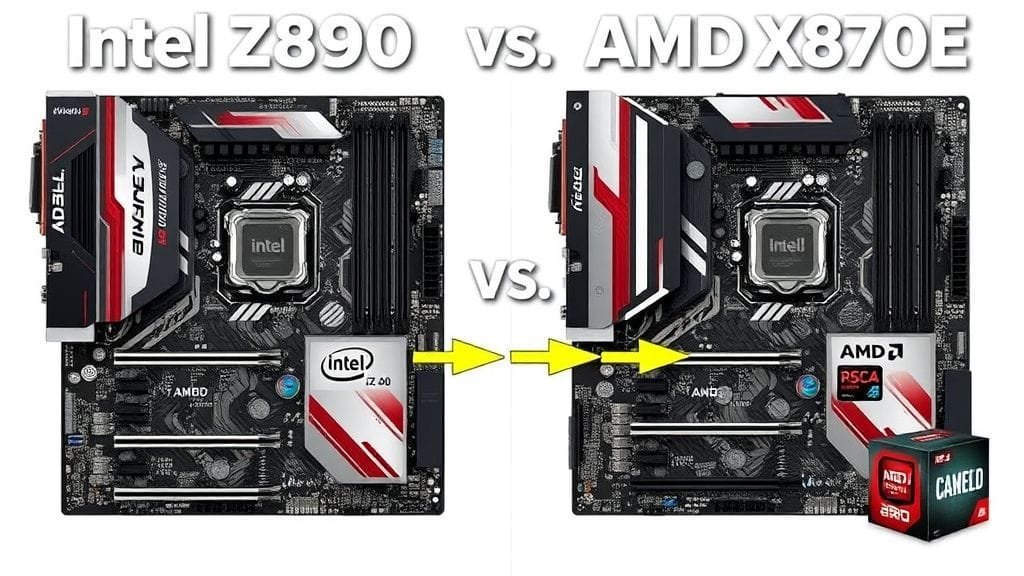
Indeed, the world of high-performance computing constantly evolves. Consequently, few battles are as contested as the Intel versus AMD showdown. However, a new era of processing power is here. Consequently, enthusiasts and professionals eye Intel’s Z890 and AMD’s X870E chipsets. Thus, each platform promises groundbreaking advancements. Specifically, they harness Intel’s 15th Gen Core “Arrow Lake-S” and AMD’s Ryzen 9000 series “Zen 5” CPUs. But which one truly deserves the crown? Therefore, consider this in the ultimate Z890 vs. X870E comparison for your next high-end build.

Indeed, this article deeply explores these two formidable contenders. Specifically, we delve into their architecture, features, and real-world implications. Furthermore, we will explore PCIe lanes, memory speeds, and AI capabilities. Platform longevity is also covered. Ultimately, this helps you discern the best powerhouse platform for your specific needs and ambitions. Consequently, get ready to uncover the nuances that define the next generation of PC performance.
Decoding Intel’s Z890 Platform: Powering Arrow Lake-S
First, Intel’s Z890 chipset marks a significant leap forward. Specifically, it introduces the new LGA 1851 socket. Notably, this socket is exclusively for Core Ultra 2-series “Arrow Lake-S” processors. Indeed, this is not just an incremental update. Rather, it represents Intel’s vision for future computing. Moreover, it combines raw power with integrated AI capabilities. In fact, Z890 motherboards and CPUs were revealed in October 2024. Consequently, they are setting a new standard for performance and connectivity.
The Core of Z890: Processor and Memory Prowess
Ultimately, Intel Core Ultra 2-series “Arrow Lake-S” CPUs are at the Z890 platform’s heart. Specifically, these processors introduce a revolutionary disaggregated architecture. Moreover, it features a sophisticated blend of P-cores and E-cores. Indeed, this design optimizes workload distribution. Thus, demanding tasks and background processes run smoothly. Arrow Lake-S CPUs also integrate a dedicated Neural Processing Unit (NPU). Consequently, this NPU accelerates AI tasks directly on your system. Furthermore, it opens new possibilities for smart applications and workflows.
Memory support on the Z890 is equally impressive. Specifically, the platform embraces dual-channel DDR5 memory. In fact, speeds push well beyond DDR5-8000. Some specialized kits even reach 9600 MT/s. Furthermore, the Z890 supports up to 256GB of RAM. Therefore, this ensures memory-intensive applications thrive. For example, these include professional video editing and complex simulations. Indeed, this high-speed memory is crucial. Thus, it maximizes the potential of both the CPU and integrated NPU.
Unlocking Connectivity: PCIe, Thunderbolt, and Networking
Indeed, connectivity is a cornerstone of the Z890 experience. Notably, the platform boasts an impressive total of 48 PCIe lanes. Specifically, of these, 20 Gen 5 lanes come directly from the CPU. Crucially, they provide lightning-fast bandwidth for primary graphics cards. They also support cutting-edge M.2 NVMe storage devices. Consequently, this direct CPU connection minimizes latency. Furthermore, this is paramount for competitive gaming and professional creative work. Moreover, the Z890 chipset contributes an extra 24 Gen 4 lanes. Thus, these offer ample expansion for secondary SSDs, add-in cards, and other peripherals.
Furthermore, high-end Z890 motherboards often feature flexible PCIe lane configurations. For example, options include a dual PCIe 5.0 x16 layout. Specifically, this can operate as x8/x8 with two powerful graphics cards. Therefore, this flexibility caters to users demanding maximum graphical horsepower. For external devices, Z890 offers native Thunderbolt 4 support. Indeed, this delivers rapid data transfer speeds. However, some premium Z890 boards elevate this further. In fact, they include Thunderbolt 5. Notably, this boasts an incredible 80 Gbps throughput. Moreover, a specialized boost mode reaches 120 Gbps for high-resolution displays. Ultimately, this external bandwidth level significantly benefits creators and professionals.

Additionally, enhanced USB 3.2 options are available. Specifically, up to five USB 3.2 Gen 2×2 ports deliver 20Gb/s. Therefore, this ensures many high-speed peripheral connections. For networking, Wi-Fi 7 is standard on premium Z890 motherboards. Indeed, it promises ultra-low latency and higher throughput for wireless connectivity. Many boards also integrate dual Ethernet ports. Typically, these are often a 10GbE and a 2.5GbE. Thus, they provide robust wired network options for any scenario. For example, this ranges from high-speed local network transfers to competitive online gaming.
Overclocking and AI: Pushing Performance Boundaries
Moreover, the Z890 platform is engineered for overclocking enthusiasts. For instance, it offers granular control over processor performance. Specifically, users can finely tune P-cores and E-cores independently. Thus, this allows for optimized clock speeds. Thereby, they balance performance and efficiency. Furthermore, features like DLVR bypass and V/f curve control provide advanced tools. Indeed, experienced overclockers use them to extract maximum performance. Notably, this applies to Arrow Lake-S CPUs.
Indeed, a standout Z890 innovation is “NPU Boost.” In essence, this feature lets users overclock the integrated NPU. Specifically, this is found within Arrow Lake CPUs. Consequently, it significantly enhances AI performance for supported applications. For example, imagine accelerating AI-driven content creation. Or, picture real-time language translation or advanced image processing directly on your desktop. Ultimately, this dedicated AI acceleration, coupled with overclocking, positions the Z890. Thus, it is a forward-looking platform for the era of artificial intelligence.
Exploring AMD’s X870E Platform: The Zen 5 Foundation
Meanwhile, AMD unleashes its own formidable competitor: the X870E chipset. Specifically, it integrates seamlessly with new Ryzen 9000 series “Zen 5” processors. Furthermore, the X870E builds upon AMD’s enduring AM5 socket. Therefore, this ensures impressive backward compatibility. Indeed, this commitment to platform longevity is an AMD hallmark. Thus, it offers a compelling upgrade path for existing AM5 users. In fact, X870 and X870E motherboards hit the market slightly earlier. Notably, they became available in late September 2024.
AM5 Longevity: Processor and Memory Support
Specifically, the AMD X870E platform proudly supports the latest Ryzen 9000 series (Zen 5) CPUs. Indeed, these are expected to deliver significant generational performance improvements. However, AMD truly stands apart due to its unwavering commitment to the AM5 socket. Moreover, the X870E maintains backward compatibility. Thus, it works with Ryzen 7000 and 8000 series processors. Notably, AMD has pledged AM5 socket support until at least 2027. Consequently, users investing in an X870E motherboard today can anticipate multiple future CPU upgrades. Crucially, a new motherboard will not be needed. Therefore, this offers a notable advantage in value and upgradeability for many consumers.

Like its Intel rival, the X870E supports dual-channel DDR5 memory. In fact, speeds extend beyond DDR5-8000. Also, maximum capacities reach 256GB. Moreover, AMD’s renowned EXPO (Extended Profiles for Overclocking) technology is fully integrated. Indeed, it simplifies achieving optimal memory performance. Specifically, EXPO lets users easily load pre-defined, high-performance memory profiles. Thus, this makes memory overclocking accessible even for newcomers. Ultimately, this ensures your Zen 5 CPU has the fast memory bandwidth it needs to shine.
PCIe 5.0 Everywhere: Storage and Graphics Capabilities
Indeed, AMD’s approach to PCIe connectivity with the X870E is clear: full embrace of PCIe 5.0. Notably, Ryzen CPUs, paired with X870E motherboards, offer up to 44 PCIe lanes. However, a key X870E differentiator is a hard requirement. Specifically, it mandates PCIe Gen 5 connectivity for both graphics cards and NVMe storage. Instead, this is not just an option. Rather, it is a standard feature. Consequently, it ensures any X870E board delivers maximum bandwidth. For example, this applies to your primary GPU and ultra-fast SSDs.
Moreover, many X870E boards further emphasize this commitment. Specifically, they feature two PCIe 5.0 M.2 slots. Typically, one is often CPU-controlled, the other by the chipset. Therefore, this configuration benefits users needing multiple high-speed storage devices. For example, this includes content creators with large video files. Developers managing massive datasets also benefit. Ultimately, this consistent, widespread adoption of PCIe 5.0 ensures future-proof storage and graphics performance. Indeed, it applies across the entire X870E ecosystem. For more on high-speed lanes, check this [detailed explanation of PCIe Gen 5 technology](https://en.wikipedia.org/wiki/PCI_Express).
I/O, Networking, and Next-Gen Overclocking
In terms of external connectivity, the X870E platform standardizes native USB4 (40Gbps) support across all boards. Indeed, USB4 offers broad compatibility. Moreover, it delivers bandwidth comparable to Thunderbolt 3/4. Thus, this makes it highly versatile for many peripherals. For example, these include external storage and display solutions. However, it might not match Thunderbolt 5’s peak speeds. Nonetheless, its widespread adoption and open standard nature are appealing.

Similar to the Z890, X870E motherboards widely support Wi-Fi 7. Indeed, this provides cutting-edge wireless networking. Furthermore, they often include dual Ethernet (10GbE and 2.5GbE). Ultimately, this offers robust wired connections. Therefore, these modern networking capabilities ensure both platforms are ready. Specifically, they meet demands of next-generation internet and local network environments.
For overclocking, the X870E platform provides robust CPU and memory tuning capabilities. Specifically, AMD introduces new features like “Curve Shaper.” Thus, this allows for more nuanced voltage and frequency optimization. On-the-fly memory tuning also lets users adjust memory parameters without reboots. Indeed, this level of control appeals to experienced overclockers. Ultimately, they can fine-tune their systems. Furthermore, some ASUS X870E boards integrate “AI Cache Boost.” Notably, this proprietary feature claims up to 29% faster local LLM performance. This offers a different, yet equally compelling, approach to AI acceleration. In essence, it contrasts with Intel’s NPU-centric strategy. Also, you might be interested in seeing Ryzen 9000 performance in real-world scenarios. Check our dedicated [Ryzen 9000 performance review](/blog/ryzen-9000-performance-review/).
Z890 vs. X870E: A Head-to-Head Showdown
When examining the Z890 vs. X870E battle, it quickly becomes clear that neither chipset is an undisputed “king.” Instead, each excels in different areas. Ultimately, they cater to distinct user priorities. Therefore, let’s break down the key battlegrounds.
Platform Longevity: AMD’s Enduring AM5 vs. Intel’s New LGA 1851
First, one of the most significant differentiators lies in platform longevity. Notably, AMD’s AM5 socket is the foundation for the X870E. Indeed, it is a testament to long-term support. Specifically, a commitment extends until at least 2027. Thus, users can invest in an X870E motherboard today. Moreover, they can confidently upgrade their CPU to future Ryzen generations. Therefore, a complete platform overhaul is not needed. Consequently, this represents substantial cost savings and convenience over time. Ultimately, it benefits users who prefer generational upgrades.
In contrast, Intel’s LGA 1851, introduced with the Z890, is a brand-new socket. Indeed, it promises to support future Intel CPU generations. Moreover, this extends beyond Arrow Lake-S. However, users upgrading from older Intel platforms will need a new motherboard. For example, this includes LGA 1700 users. Therefore, this might be seen as a disadvantage for some. Specifically, these users prioritize multi-generational compatibility from one motherboard purchase. Yet, it signifies a fresh start for Intel’s architecture. Ultimately, it potentially unlocks greater future performance potential.
PCIe Connectivity: Quantity vs. Guaranteed Speed
Indeed, both platforms offer ample PCIe 5.0 connectivity. Specifically, this is crucial for the fastest GPUs and NVMe SSDs. Intel’s Z890 platform overall offers more PCIe lanes. For example, it has 48 (combining CPU and chipset lanes) compared to AMD’s X870E (up to 44). Thus, this might appeal to users with many expansion cards or storage devices.

However, the X870E has a hard requirement for PCIe 5.0. Specifically, this applies to both graphics and NVMe storage across all boards. Consequently, this guarantees top-tier performance for your primary GPU. It also ensures at least one high-speed M.2 SSD performs well. Many X870E boards also offer two CPU-connected PCIe 5.0 M.2 slots. Indeed, this is a compelling advantage for professionals. For example, they need multiple ultra-fast storage devices without compromising speed. In contrast, Z890 offers more total lanes. However, X870E guarantees a higher proportion of CPU-connected PCIe 5.0 lanes for critical components.
High-Bandwidth I/O: Thunderbolt 5 vs. Universal USB4
When it comes to high-bandwidth external connectivity, Intel’s Z890 takes a lead. Specifically, it has native Thunderbolt 4 support. Moreover, Thunderbolt 5 is included on premium motherboards. Notably, this offers 80 Gbps, with a 120 Gbps display boost. Therefore, Thunderbolt 5 provides unparalleled speed. For example, it’s for external SSDs, high-resolution displays, and docking stations. Thus, this makes it ideal for creative professionals. Users with robust external ecosystems also benefit.
In contrast, AMD’s X870E standardizes USB4 (40 Gbps) across all its boards. Indeed, USB4 is a highly versatile and broadly compatible open standard. Moreover, it offers similar bandwidth to Thunderbolt 3/4. Therefore, this makes it an excellent choice for most users. Specifically, they need fast, universal external connectivity. However, it does not match Thunderbolt 5’s peak speeds. Nonetheless, its wider adoption and plug-and-play simplicity are appealing. Ultimately, it comes down to prioritizing absolute highest theoretical speed or broader, more standardized compatibility.
Memory Performance: Pushing DDR5 Limits
Indeed, both the Z890 and X870E platforms demonstrate exceptional DDR5 memory support. In fact, they reach speeds beyond DDR5-8000. Therefore, this ensures memory bottlenecks are largely a thing of the past for most users. However, Intel’s Z890 is sometimes cited. Specifically, it has potential for even higher frequency memory support. For example, this is particularly true with specialized QDM kits.
In contrast, AMD’s EXPO technology on X870E simplifies high-speed memory configuration. Indeed, it makes it easier for users to achieve advertised memory speeds. Thus, extensive manual tuning is not required. Ultimately, both platforms offer ample memory bandwidth and capacity for most users. Moreover, they support up to 256GB. So, this difference might be marginal in everyday use.
Raw CPU Performance: Arrow Lake-S vs. Zen 5
Ultimately, the ultimate performance of each platform hinges on the CPUs they support. For instance, early benchmarks for Intel’s Core Ultra 7 265KF (Arrow Lake-S) show modest single-core gains. Specifically, these are up to 4% faster than the Core i9-14900KF in Geekbench 6. However, multi-core performance against its direct predecessor appears less impressive in some early tests.
In contrast, AMD’s Zen 5 architecture powers the Ryzen 9000 series. Moreover, it promises significant generational performance increases. Notably, this is due to its expanded execution window. It also has improved cache architecture. Consequently, some industry observers suggest Ryzen 9000 CPUs might offer a more substantial performance uplift. Indeed, this compares to the Ultra 200S series across many applications. Therefore, final judgment awaits comprehensive real-world benchmarks. Also, reviews of both processor lineups are needed. Furthermore, our in-depth [Arrow Lake-S performance analysis](/blog/arrow-lake-s-analysis/) dives deeper into Intel’s new CPU.
The AI Advantage: NPU Boost vs. AI Cache Boost
Indeed, artificial intelligence is no longer a niche feature. Rather, it’s becoming integral to modern computing. Thus, both the Z890 and X870E platforms offer distinct approaches to AI acceleration. For example, Intel’s Arrow Lake CPUs integrate a dedicated NPU. Subsequently, the Z890 chipset enables “NPU Boost.” Specifically, this allows users to overclock the NPU for enhanced AI performance. Ultimately, this is a direct, hardware-level acceleration for AI workloads.
In contrast, AMD’s X870E offers features like “AI Cache Boost,” especially on some ASUS boards. While details are still emerging, this appears to be a software-enhanced optimization. Notably, it focuses primarily on speeding up local LLM performance. Therefore, this represents a more targeted AI acceleration strategy. Indeed, it leverages existing CPU and memory resources. Ultimately, your choice depends on your preference. Specifically, do you want a dedicated, overclockable NPU? Or a software-driven optimization for specific AI tasks?
Price Point: Investing in the Next Generation
Certainly, investing in a new flagship platform is always a premium endeavor. For example, X870E motherboards generally start around $325. Moreover, high-end models reach up to $700. In contrast, specific Z890 pricing details aren’t universally cited. However, high-end Z890 boards are expected in a similar premium range. Indeed, this reflects their cutting-edge features and technology. Ultimately, the total cost of ownership depends on your chosen CPU, memory, and other components.
Who is the True King for Your Specific Needs?
Ultimately, we have dissected the strengths and nuances of Z890 vs. X870E chipsets. Clearly, declaring a single “New King” oversimplifies things. Instead, the best platform for you hinges entirely on your priorities and workflow. Therefore, let’s break down the key battlegrounds.
For the Longevity Seeker and Upgrade Enthusiast
If you prioritize long-term upgradeability, the AMD X870E platform stands out. Indeed, value being able to upgrade your CPU multiple times without changing your motherboard. Specifically, its commitment to the AM5 socket extends until at least 2027. Therefore, this offers unparalleled platform longevity. Moreover, it is an excellent investment for users. For example, they plan to gradually upgrade system components over several years. Consequently, this makes X870E a compelling choice. Ultimately, it suits enthusiasts who enjoy extending their core PC build’s life.
For the Connectivity-Demanding Professional
However, professionals rely heavily on high-speed external peripherals. For example, this includes creative fields like video production or graphic design. Therefore, they might find the Intel Z890 platform more appealing. Specifically, its cutting-edge Thunderbolt 5 integration offers astounding 80-120 Gbps bandwidth. Thus, this provides a significant advantage for external storage arrays. It also helps with high-resolution multi-monitor setups. Advanced docking solutions are also supported. Moreover, the slightly higher total PCIe lane count offers more flexibility for multiple add-in cards.

For the Hardcore Gamer and Content Creator
For hardcore gamers and content creators, the choice is clear. Ultimately, the Z890 vs. X870E will likely come down to real-world CPU performance. Specifically, this applies to “Zen 5” and “Arrow Lake-S” processors. Indeed, performance in their preferred applications matters most. Typically, gamers benefit from higher single-core performance. Strong graphics card support is also key. Conversely, creators will look for multi-core prowess. Moreover, efficient handling of demanding software suites is vital.
Consider these factors:
Regarding gaming, both platforms offer PCIe 5.0 for graphics. Rather, the CPU’s raw gaming performance will be the primary driver. For content creation, look at how each CPU handles specific tasks. For example, these include video rendering, 3D modeling, or compiling code. Indeed, Intel’s integrated NPU or AMD’s AI Cache Boost could be decisive. Specifically, this applies to AI-accelerated workflows. Concerning storage needs, do you need multiple, top-tier PCIe 5.0 NVMe SSDs? If so, the X870E offers guaranteed dual CPU-connected PCIe 5.0 M.2 slots. Therefore, this might be a better fit.
Conclusion: A Tailored Triumph for the New Generation
Indeed, the launch of the Intel Z890 and AMD X870E chipsets truly marks a new generation in high-performance computing. Ultimately, both platforms are technological marvels. Moreover, they push boundaries of connectivity, memory, and AI integration. Furthermore, the Z890 vs. X870E debate isn’t about universal superiority. Instead, it’s about aligning with individual needs and aspirations.
For instance, the AMD X870E shines with exceptional platform longevity. Furthermore, it has a strong, standardized commitment to PCIe 5.0. Specifically, this applies across graphics and multiple M.2 slots. Therefore, it is ideal for those seeking a future-proof investment. Indeed, it offers extensive upgrade paths. Conversely, the Intel Z890 impresses with cutting-edge Thunderbolt 5 integration. It also has a dedicated, overclockable NPU within Arrow Lake CPUs. Ultimately, this caters to professionals. Thus, it suits users needing maximum external bandwidth and direct AI acceleration.
Ultimately, your choice will reflect your personal computing philosophy. Consider whether you prioritize long-term motherboard investment or absolute bleeding-edge external connectivity. Finally, are you betting on AMD’s Zen 5 or Intel’s Arrow Lake-S to deliver the performance you crave?
What are your thoughts on the Z890 vs. X870E battle? Which features are most important to you in a new platform, and why? Share your insights in the comments below!