
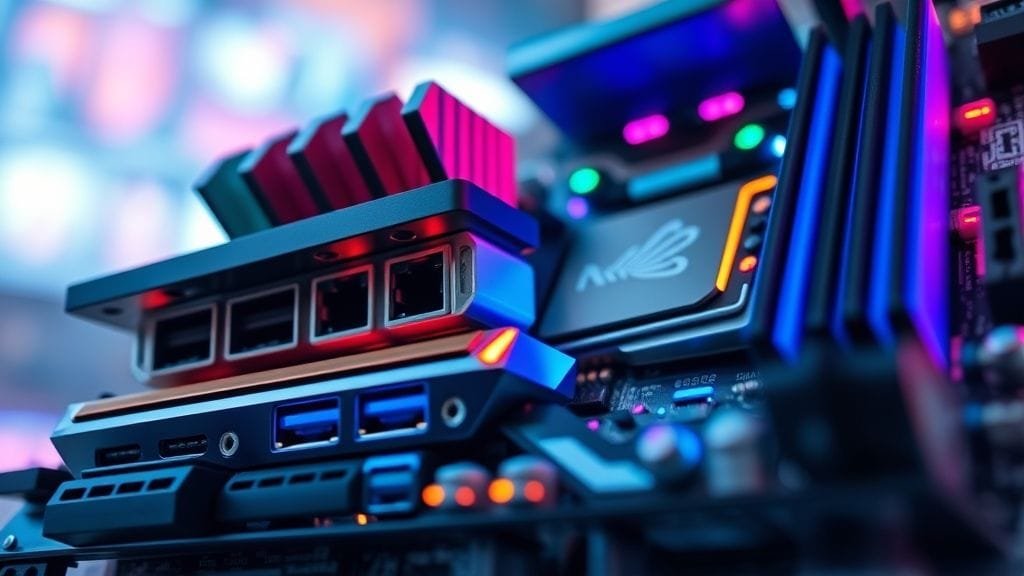
Building a high-performance [gaming PC](https://jompatech.com/best-motherboards-for-2025-unlock-ultimate-pc-power/) is an exciting endeavor, though the myriad parts and technical details can sometimes feel overwhelming. Many gamers often focus heavily on their [CPU and GPU](https://www.intel.com/content/www/us/en/gaming/resources/how-cpu-gpu-work-together.html), which are undeniably crucial. Nevertheless, one key component often receives less attention than it deserves: the best motherboard for gaming. Think of it as the central nervous system of your entire system, connecting every crucial component. This allows your powerful CPU, blazing-fast GPU, and high-speed memory to communicate effectively. In 2025, choosing the best motherboard for gaming means more than simply ensuring compatibility; it’s about unlocking your system’s full potential.
A great motherboard offers stable power delivery, extensive connectivity options, and features that support both current and future components. Conversely, neglecting to choose the best motherboard for gaming can lead to performance bottlenecks and limited upgrade options, ultimately resulting in a less satisfying gaming experience. Therefore, a smart choice now will save you headaches and money later. This guide will help you navigate the options for the best motherboard for gaming available in 2025. We will cover essential features and highlight top picks for both AMD and Intel platforms.
Why Your Motherboard Matters in a Gaming PC
Your best motherboard for gaming is far more than a simple circuit board; it is the backbone of your gaming PC. It dictates everything from the type of CPU you can use, to the speed of your memory, and how many storage devices you can install. It acts as the central hub, ensuring all components work together smoothly. Therefore, without the best motherboard for gaming, even the most powerful CPU and GPU cannot perform at their peak.
Consider this: your gaming experience depends on fast data transfer between components, and your motherboard crucially provides these pathways. Moreover, it also delivers clean, stable power to your hungry CPU and other components, determining your upgrade path for years to come. A well-chosen board extends the life and performance of your build. Thus, making a smart decision about the best motherboard for gaming is an investment in your gaming future.
Decoding Key Motherboard Features for 2025
When shopping for the best motherboard for gaming in 2025, several key features stand out as crucial for modern gaming performance and future-proofing your system. Ultimately, understanding them will help you make an excellent choice for the best motherboard for gaming. We will break down each key feature, explaining its importance for your gaming setup.

CPU Socket and Chipset: The Foundation of Your Build
The CPU socket is perhaps the most fundamental consideration when choosing the best motherboard for gaming, as it must precisely match the type of processor you plan to use. You cannot mix and match them; thus, they are platform-specific. For example, an AMD CPU will not fit into an Intel socket, and vice versa.
Beyond the socket, the chipset plays a critical role. The chipset is a set of integrated circuits. They manage data flow between your CPU, memory, and other devices, dictating the capabilities of your best motherboard for gaming. These include connectivity, overclocking support, and the number of high-speed lanes it can provide.
AMD Platform Sockets and Chipsets for Gaming
- For AMD Systems: If you are choosing AMD, you will be looking at the AM5 socket. This socket supports the latest Ryzen 7000, 8000, and upcoming 9000 series processors. AMD is known for its commitment to long-term socket support, and the AM5 socket therefore offers excellent ease of future upgrades. It will likely support several generations of CPUs. Common chipsets include X870E, X870, B850, B850E, X670E, X670, B650E, and B650. The “E” versions often mean better PCIe 5.0 support, especially for graphics cards.
Intel Platform Sockets and Chipsets for Gaming
- For Intel Systems: Intel platforms currently use two main sockets. The LGA 1851 socket supports the newest Core Ultra CPUs, part of Intel’s latest generation, while the LGA 1700 socket remains common, supporting 12th, 13th, and 14th Gen Intel Core processors. Chipsets like Z890, Z790, B760, and B860 are common. “Z-series” chipsets, such as Z890 and Z790, are generally designed for enthusiasts. They offer advanced features and provide key CPU overclocking capabilities. In contrast, “B-series” chipsets are for more mainstream builds, offering a balance of features and cost.
Understanding Sockets and Chipsets
Choosing the right socket and chipset not only ensures your CPU works correctly on your best motherboard for gaming but also unlocks potential features.
Embracing PCIe 5.0 for Future Performance
PCIe, or Peripheral Component Interconnect Express, is a high-speed interface used to connect hardware devices. Specifically, this includes graphics cards, NVMe SSDs, and other expansion cards to your motherboard. The latest version, PCIe 5.0, doubles the speed of its predecessor, PCIe 4.0. Naturally, this offers immense potential for data transfer speeds.
While current graphics cards might not fully utilize PCIe 5.0’s full bandwidth today, it is a key feature for future-proofing your system. Next-gen GPUs and ultra-fast NVMe SSDs will surely take advantage of this increased speed. For this reason, best motherboards for gaming with chipsets like Z790, B760, X670E, B650E, X870E, and B850E often include PCIe 5.0 support. Prioritizing PCIe 5.0 for at least the primary GPU slot and one M.2 slot is a wise move, helping any gamer keep their system up-to-date for years and ensuring long-term compatibility.
The Power of DDR5 Memory
Memory plays a significant role in gaming performance, and DDR5 memory is the latest standard. It offers significantly higher bandwidth and better power efficiency than older DDR4. In fact, most mid-range and high-end best motherboards for gaming released in 2025 now exclusively support DDR5.
This means that if you are building a new system, you will very likely be using DDR5 RAM. While DDR4 was excellent in its time, DDR5 provides a clear boost. This boost is evident in situations that benefit from high memory bandwidth, such as demanding game environments and multitasking while gaming. Moreover, it often offers lower latencies. Therefore, ensure your chosen best motherboard for gaming supports DDR5 to take full advantage of modern memory speeds.
Robust Power Delivery (VRMs): Fueling Your CPU
The Voltage Regulator Modules, or VRMs, are small yet powerful components on your best motherboard for gaming, tasked with delivering clean, stable power from your power supply to your CPU. Think of VRMs as the specialized fuel injectors for your CPU; just as a powerful engine needs consistent fuel flow, a high-performance CPU requires precise and stable power.
Robust VRMs are crucial, especially if you plan to use a high-core-count CPU or overclock your processor. Overclocking pushes your CPU beyond its factory settings, consequently increasing its power demands. Weak VRMs can lead to instability, thermal throttling, or even component damage when pushed hard. For this reason, a best motherboard for gaming with a robust VRM setup will feature more power phases and higher-quality components. These, in turn, ensure consistent power delivery, better heat control, and improved system stability.
Intel’s Z-series chipsets are necessary for CPU overclocking, while AMD’s X and B series chipsets generally support both CPU and memory overclocking. Always check the VRM phase count and quality reviews for any best motherboard for gaming you consider, as this small detail can have a significant impact on long-term performance and reliability.
Essential Connectivity for Modern Gamers
The best motherboard for gaming requires extensive connectivity to keep pace with today’s devices and online demands. You will therefore want plenty of options for storage, external devices, and network access.
Look for a motherboard with multiple M.2 NVMe SSD slots (generally two to five are common on new gaming boards), which allow you to install ultra-fast storage drives, greatly reducing game loading times. Furthermore, multiple USB ports are a must, including different types: USB-A for older devices and USB-C for newer peripherals. High-speed options like USB 4.0 or Thunderbolt 4 offer extremely fast data transfer speeds, making them perfect for external SSDs or high-resolution displays.
Networking is also key for online gaming; thus, ensure your motherboard supports high-speed Ethernet, such as 2.5GbE, 5GbE, or even 10GbE. This provides a stable, low-latency wired connection. Additionally, new wireless standards like Wi-Fi 6E or Wi-Fi 7 are important. They offer faster speeds and better performance in congested areas. Consequently, these features ensure you have the necessary bandwidth and low latency for competitive online gaming.
Form Factor: Size Up Your Gaming Rig
The form factor of your best motherboard for gaming determines its physical size and shape, which in turn affects the size of your PC case and the number of expansion slots available. It is a key decision, especially if you have specific build size goals.
Common Motherboard Form Factors Explained
- ATX (Standard ATX): This is the most common form factor for gaming PCs. ATX boards offer the most expansion slots, including multiple PCIe slots for graphics cards and other expansion cards. They also typically have more M.2 slots and RAM slots. Standard ATX boards require larger cases but provide ample space for cooling and cable management.
- Micro-ATX (mATX): These boards are smaller than ATX, making them suitable for more compact builds; however, they offer fewer expansion slots. Yet, many mATX gaming motherboards still provide sufficient features for a powerful gaming PC, striking a good balance between size and functionality.
- Mini-ITX (mITX): Mini-ITX boards are the smallest form factor, perfect for very small builds, often called “small form factor” (SFF) PCs. Nonetheless, their compact size means fewer PCIe slots (usually just one for the GPU), fewer M.2 slots, and generally only two RAM slots. Consequently, building with mITX often requires careful component selection and can be more challenging. But it results in a very stylish and portable machine.
Your chosen form factor should match your case preference and your component needs. An ATX best motherboard for gaming gives you maximum flexibility, whereas mATX or mITX offers portability and a smaller footprint.

Top Motherboard Picks for AMD Gamers (AM5 Socket)
AMD’s AM5 platform has become a leading choice in the gaming world, offering excellent performance and a promise of long-term future upgrades. As such, the AM5 socket supports Ryzen 7000, 8000, and upcoming 9000 series processors. This therefore makes it an ideal choice for anyone building a new AMD-based gaming PC in 2025. We will explore some of the best motherboards for gaming on the AM5 platform, covering different price points to help you find the perfect match for your budget and performance needs.
Enthusiast-Grade AM5 Motherboards
For gamers who demand the absolute best, enthusiast-grade AM5 best motherboards for gaming offer top-tier features, robust power delivery, and extensive connectivity. These boards are built for extreme performance, overclocking, and support for the most power-hungry components.
Top Enthusiast AM5 Motherboards for 2025
ASRock X870E Taichi: Elite AM5 Gaming Motherboard
This best motherboard for gaming is a powerhouse, known for its exceptionally robust power delivery—a key factor for high-end Ryzen CPUs. Moreover, it boasts extensive storage options, including dual PCIe 5.0 x16 slots for future GPUs and an impressive five M.2 slots, two of which specifically support PCIe 5.0 speeds. Connectivity is also excellent, with USB 4.0 and the latest Wi-Fi 7. Many consider the ASRock X870E Taichi to be a fantastic value, as it provides an impressive feature set for its price.
Gigabyte X870E Aorus Master: Premium AM5 Motherboard for Gaming
A favorite among high-end AMD AM5 best motherboards for gaming options, the Aorus Master offers an intuitive layout that simplifies building and upgrading. It also includes a convenient easy-release GPU button. Its DDR5 support is excellent, handling speeds up to 8600MHz, which is superb for memory overclocking. Furthermore, it provides ample USB ports for all your devices.
MSI MAG X870 Tomahawk WiFi: Robust AM5 Gaming Option
This best motherboard for gaming is highly recommended for its excellent feature set and robust build quality. It manages heat and power exceptionally well, ensuring stable performance even under heavy loads. Notably, it offers up to 21 USB ports, allowing you to connect numerous devices. Moreover, it clearly supports the upcoming Zen 5 processors, making it future-ready.
ASUS ROG Strix X870-A Gaming WiFi: High-End AM5 Motherboard
A truly high-end, future-ready option from ASUS for the best motherboard for gaming, it is specifically designed for Ryzen 7000, 8000, and 9000 series CPUs. It supports DDR5 memory and full PCIe 5.0. Furthermore, it also comes with Wi-Fi 7 for ultra-fast wireless networking. A standout feature is its AI overclocking, which helps users achieve optimal performance with less manual intervention.
Leading AM5 Flagship Motherboards
Leading AM5 Gaming Motherboards
Final Thoughts on Enthusiast Picks for the Best Gaming Motherboard
These best motherboards for gaming represent the best of AM5 technology. They are perfect for those who want no compromises in their gaming rig.
Mid-Range AM5 Motherboards: Sweet Spot Performance
Mid-range AM5 best motherboards for gaming strike a fantastic balance between cost and performance, providing essential advanced features like DDR5 and PCIe 5.0 without the high cost of enthusiast boards. These are therefore ideal for most serious gamers looking for the best motherboard for gaming. They offer excellent value and strong performance.
Recommended Mid-Range AM5 Selections
Consider these solid mid-range options:
- Asus TUF Gaming X870-Plus WiFi: This is a solid choice in the mid-range AM5 market for the best motherboard for gaming. The TUF series is known for its durability and reliable performance, providing a strong feature set for its price point, including Wi-Fi connectivity.
- ASRock B850 Steel Legend WiFi: The Steel Legend series from ASRock is known for offering great value in the best motherboard for gaming category, and this B850 board continues that tradition. It features Wi-Fi 7, full AMD AM5 socket support, and both PCIe 5.0 M.2 and GPU support. It is an excellent choice for a future-ready mid-range build.
- MSI MAG B850 Tomahawk MAX WiFi: This best motherboard for gaming truly balances performance and price, offering full AM5 support and a robust 14+2+1 dual-rail power system that ensures stable power delivery for power-hungry CPUs. Moreover, it also includes a PCIe 5.0 x16 slot for your GPU and two PCIe 5.0 slots for storage. It boasts Wi-Fi 7 and 5GbE networking, all for around $230, making it an exceptional value.
Value and Performance
These mid-range boards offer serious gaming potential without breaking the bank. They include key features needed for modern gaming.
Budget-Friendly AM5 Motherboards: Smart Value
Building a gaming PC on a tighter budget does not mean sacrificing quality or future compatibility. Several budget-friendly AM5 best motherboards for gaming offer excellent value. They provide the core features needed for a great gaming experience, making them perfect for gamers on a budget who still want to utilize the AM5 system.
Top AM5 Value Picks
Here are some excellent budget-friendly picks for you:
- Asus TUF Gaming B650-Plus WiFi: Often seen as one of the best overall budget AM5 best motherboard for gaming, this board delivers, including three M.2 slots for ample storage space and numerous USB ports. Finally, it offers strong support for high-power Ryzen CPUs, thanks to its reliable power delivery.
- GIGABYTE B650 AORUS Elite AX: This best motherboard for gaming stands out for its durability and robust power delivery. Its solid build quality ensures longevity, and its excellent networking features, including Wi-Fi, add to its appeal. Therefore, it is a reliable and well-built option for an affordable AM5 system.
- ASRock B650 Pro RS: For those looking to save every dollar, the ASRock B650 Pro RS is one of the most affordable B650 best motherboards for gaming available. Despite its low price (under $130), it provides impressive features. These include Gen5 M.2 support, three M.2 sockets, and 2.5GbE LAN. Its 17-phase VRM design is surprisingly robust for this price point, thus offering great value.
- MSI MAG B650 Tomahawk WiFi: This best motherboard for gaming delivers great value, ideal for mid-range to high-end Ryzen 7000 series builds. It is well-known for its excellent thermal management and stable power delivery, ensuring steady performance during heavy gaming sessions.
Smart Budget Choices for Your Best AM5 Gaming Motherboard
These budget options prove you can enter the AM5 platform with great features without overspending. They are smart choices for value-conscious gamers.

Top Motherboard Picks for Intel Gamers (LGA 1851 & LGA 1700 Sockets)
Intel continues to offer compelling choices for gamers with its LGA 1851 and LGA 1700 platforms. The LGA 1851 socket is designed for the very latest Core Ultra CPUs, representing Intel’s next generation. Meanwhile, the LGA 1700 socket still supports the powerful 12th, 13th, and 14th Gen Intel Core processors. Intel motherboards are known for their strong single-core performance, which is often key for gaming. Consequently, this section covers some of the best motherboards for gaming from Intel available in 2025, suiting different performance and budget levels.
High-End Intel Motherboards: Peak Performance
For the gamer who wants top performance and the newest features from an Intel system, high-end best motherboards for gaming are the way to go. These boards are packed with the latest technology, feature excellent power delivery, and offer extensive connectivity. This supports the most powerful Intel CPUs and other components.
Top Intel Flagship Models
Here are some top-tier Intel choices for enthusiasts:
- Asus ROG Maximus Z890 Hero (LGA 1851): This is a top choice for current-gen Intel CPUs among the best motherboard for gaming, notably known for its extensive features and extremely robust 20+ phase VRMs. These VRMs ensure excellent power stability for overclocking and powerful CPUs. Furthermore, it also includes enhanced cooling solutions. It features Thunderbolt 4 for very fast connections and high-end audio. Moreover, it boasts six M.2 sockets, three of which support PCIe 5.0 speeds, offering numerous fast storage options.
- Gigabyte Z790 Aorus Xtreme (LGA 1700): For the LGA 1700 platform, this best motherboard for gaming offers excellent value among flagship Z790 options. It comes with 10Gb Ethernet for lightning-fast wired networking and Thunderbolt 4. It also supports both PCIe 5.0 for GPUs and M.2 SSDs. Its robust power system is designed to handle even the most power-hungry 13th and 14th Gen Intel CPUs, thus providing reliable performance.
- MSI MPG Z890 Carbon WiFi (LGA 1851): This best motherboard for gaming stands as a strong mid-to-high-range option for the new Intel LGA 1851 socket, combining excellent features with a stylish design. It ensures stable performance and ample connectivity for advanced gaming setups.
Key Advantages of High-End Intel Motherboards for Gaming
These high-end Intel best motherboards for gaming are perfect for enthusiasts who want to push their systems to the limit, providing a solid foundation for top-tier gaming.
Mid-Range Intel Motherboards: Balancing Cost and Power
Mid-range Intel best motherboards for gaming provide a fantastic compromise between price and performance, including essential features for a strong gaming PC. They do this without the high price of flagship models. These boards often feature solid power delivery, good connectivity, and support for key technologies like PCIe 5.0 and DDR5.
Recommended Mid-Range Intel Boards
Consider these reliable mid-range options for Intel builds:
- MSI MAG Z790 Tomahawk WiFi (LGA 1700): This best motherboard for gaming is highly rated for 12th, 13th, and 14th Gen Intel CPUs, offering numerous slots and ports, including multiple M.2 slots for storage. Its robust 16+1 phase VRMs ensure stable power delivery, making it suitable for even higher-end non-K or lightly overclocked K-series processors.
- ASRock Z790 Taichi Lite (LGA 1700): This version of the Taichi series provides near-flagship features at a more accessible price, making it one of the best motherboards for gaming in its class. It boasts robust power delivery, dual Thunderbolt 4 ports, PCIe 5.0 M.2 support, and premium audio. Consequently, it is an excellent choice for those who desire high-end features without the full Taichi price tag.
- ASRock B860 Steel Legend WiFi (LGA 1851): This model is recommended as a budget-friendly pick for the new Core Ultra 200S processors for the best motherboard for gaming. It delivers a strong feature set for its price, including integrated Wi-Fi, thus offering a solid foundation for a new-generation Intel build.
Performance and Value for Your Best Intel Gaming Motherboard
These mid-range Intel motherboards are perfect for gamers who want a powerful and stable system without spending enthusiast-level money. In other words, they offer great value and performance.
Budget-Friendly Intel Motherboards: Gaming on a Dime
Building an Intel gaming PC on a budget is very possible with the right motherboard choice. Several budget-friendly best motherboards for gaming options provide excellent performance for the price. They ensure you can still fully enjoy modern gaming, focusing on core functionality and value.
Recommended Affordable Intel Boards
Here are some great budget-friendly Intel picks:
- ASRock Z790 Steel Legend (LGA 1700): This is a feature-rich Z790 option available for under $300, making it one of the best motherboards for gaming in its segment. It includes both PCIe 5.0 GPU and M.2 slots. Beyond that, it also offers a handy front-panel 20 Gbps USB-C port and Wi-Fi 6E. This board provides fantastic value for a Z790 chipset, supporting overclocking without a high cost.
- GIGABYTE B760M Gaming Plus WiFi DDR4 (LGA 1700): An attractive budget option for Intel 12th-14th Gen non-K CPUs for the best motherboard for gaming, this mATX form factor board offers impressive performance. It is perfect for gamers who do not plan on CPU overclocking, consequently providing a compact and powerful foundation.
- Gigabyte Z790 Aorus Elite AX (LGA 1700): This best motherboard for gaming offers good value for the LGA 1700 platform. It has four M.2 sockets for ample storage. Furthermore, it boasts a premium appearance, giving your budget build a high-end look. In summary, it is a solid choice for performance and aesthetics.
Making Your Final Motherboard Decision
Choosing the best motherboard for gaming for your PC in 2025 can feel like a significant decision; however, by considering your specific needs, the process becomes much clearer. First and foremost, identify your preferred CPU platform: AMD or Intel. This choice immediately narrows down your options and is therefore a key first step.
Beyond that, consider your budget. Are you looking for a no-compromise enthusiast build, a balanced mid-range system, or a budget-friendly powerhouse? Your budget will guide your selection of chipsets and specific models. Furthermore, consider your personal preferences for features like connectivity, RGB lighting, and form factor. Do you need Wi-Fi 7? How many M.2 slots do you plan on using? Do you prefer a compact build or a large tower?
| Feature / Category | High-End / Enthusiast | Mid-Range | Budget / Value |
|---|---|---|---|
| CPU Sockets | AM5 (X870E, X670E), LGA 1851 (Z890), LGA 1700 (Z790) | AM5 (X870, B850), LGA 1700 (Z790, B760) | AM5 (B650, B850), LGA 1700 (B760), LGA 1851 (B860) |
| PCIe Support | PCIe 5.0 x16 (GPU) + multiple PCIe 5.0 M.2 | PCIe 5.0 x16 (GPU), at least one PCIe 5.0 M.2 | PCIe 5.0 for M.2, typically PCIe 4.0 for GPU (some 5.0) |
| DDR Memory | DDR5 (Highest speeds, best overclocking) | DDR5 (Good speeds, some overclocking) | DDR5 (Standard speeds) |
| Power Delivery | Very robust VRMs (20+ phases), excellent for extreme OC | Robust VRMs (14-18 phases), good for moderate OC | Decent VRMs (10-14 phases), stable for stock/light OC |
| Connectivity | USB 4.0/Thunderbolt 4, Wi-Fi 7, 5/10GbE, 5+ M.2 | USB 3.2 Gen2, Wi-Fi 6E/7, 2.5GbE, 3-4 M.2 | USB 3.2 Gen1/2, Wi-Fi 6E, 2.5GbE, 2-3 M.2 |
| Form Factor | ATX (sometimes E-ATX) | ATX, Micro-ATX | Micro-ATX, ATX |
| Target User | Max performance, competitive gamer, content creator | Serious gamer, balanced performance and cost | Casual gamer, first-time builder, upgrade path |
Selecting Your Ideal Gaming Motherboard
Ultimately, there is no single “best motherboard for gaming” for everyone. The ideal best motherboard for gaming choice is the one that best suits your specific gaming goals, budget, and long-term upgrade plans. Therefore, spend a little time planning, and you will lay a solid foundation for many hours of fun gaming with your best motherboard for gaming.
The Future of Gaming Motherboards
The world of PC hardware is always evolving. Looking beyond 2025, we can expect further progress in best motherboard for gaming technology, with even faster PCIe standards. PCIe 6.0 is a potential future standard, offering incredibly high bandwidth for future GPUs and storage. DDR5 memory will likely continue to improve, with higher speeds becoming standard, and DDR6 could potentially be on the horizon.
Motherboards will also continue to integrate more advanced features, such as enhanced AI capabilities for automatic overclocking and system optimization. Connectivity will improve further. We will see more widespread adoption of high-speed USB standards and potentially new wireless technologies. In addition, power delivery systems will become even more efficient and robust, supporting increasingly powerful CPUs. The push for more compact and aesthetically pleasing designs will also continue. Remember, your best motherboard for gaming is not just a component; it’s the heart of your system. Ultimately, it evolves with gaming itself.

Frequently Asked Questions About Gaming Motherboards
Building a gaming PC involves many questions, and understanding your best motherboard for gaming‘s role is key. To that end, here are some common questions about choosing and using the best motherboards for gaming.
What is the difference between Z, B, and H chipsets for Intel?
Intel chipsets like Z, B, and H serve different purposes. Z-series chipsets (e.g., Z790, Z890) are premium, allowing CPU overclocking and offering the most PCIe lanes and features. B-series chipsets (e.g., B760, B860) are mid-range, offering good connectivity and features but typically no CPU overclocking. Conversely, H-series chipsets are entry-level, with fewer features and no overclocking.
Can I use an AMD CPU on an Intel motherboard?
No, you cannot. This is because AMD and Intel CPUs use different physical sockets and architectures. A motherboard designed for an AMD CPU (like AM5) will not work with an Intel CPU (like LGA 1700 or LGA 1851), and vice versa. You must make sure your CPU and motherboard socket match.
Is PCIe 5.0 necessary for gaming in 2025?
Most current GPUs do not fully saturate PCIe 4.0 bandwidth. However, PCIe 5.0 is strongly suggested for future-proofing your build, as upcoming graphics cards and NVMe SSDs will increasingly utilize the higher bandwidth of PCIe 5.0. Therefore, investing in it now means you won’t need a new motherboard to use future components.
How many M.2 slots do I need?
For a typical gaming PC, two M.2 slots are usually sufficient: one for your primary operating system and games, and another for additional game storage. However, if you store a very large game library, create content, or perform professional work, three to five M.2 slots can be very helpful. More slots offer greater flexibility; hence, the number depends on your specific needs.
What is the importance of Wi-Fi 6E or Wi-Fi 7?
Wi-Fi 6E and Wi-Fi 7 offer significant improvements over older wireless standards, providing faster speeds, lower latency, and better performance in congested network areas. For online gaming, this translates to a more stable and responsive wireless connection. It helps reduce lag and improves your overall experience. If you primarily use a wired connection, it’s less critical for your best motherboard for gaming; even so, it is a great feature to have.
Your Motherboard, Your Gaming Future
Choosing the best motherboard for gaming for your PC in 2025 is a critical step, as it builds the foundation for performance, stability, and future upgrades. By understanding key features like CPU socket and chipset, PCIe 5.0, DDR5 memory, robust VRMs, extensive connectivity, and form factor, you can make a smart choice. Both AMD and Intel platforms offer fantastic options for the best motherboard for gaming at every price point. Remember, a smart motherboard choice is an investment. It ensures your gaming rig remains powerful and up-to-date for years to come.
Ultimately, your best motherboard for gaming is the silent workhorse, connecting all your components and helping them reach their full potential. Therefore, take the time to choose the best motherboard for gaming wisely; it will greatly improve your gaming journey.
What motherboard feature do you prioritize most when building a new gaming PC, and why? Share your thoughts in the comments below!