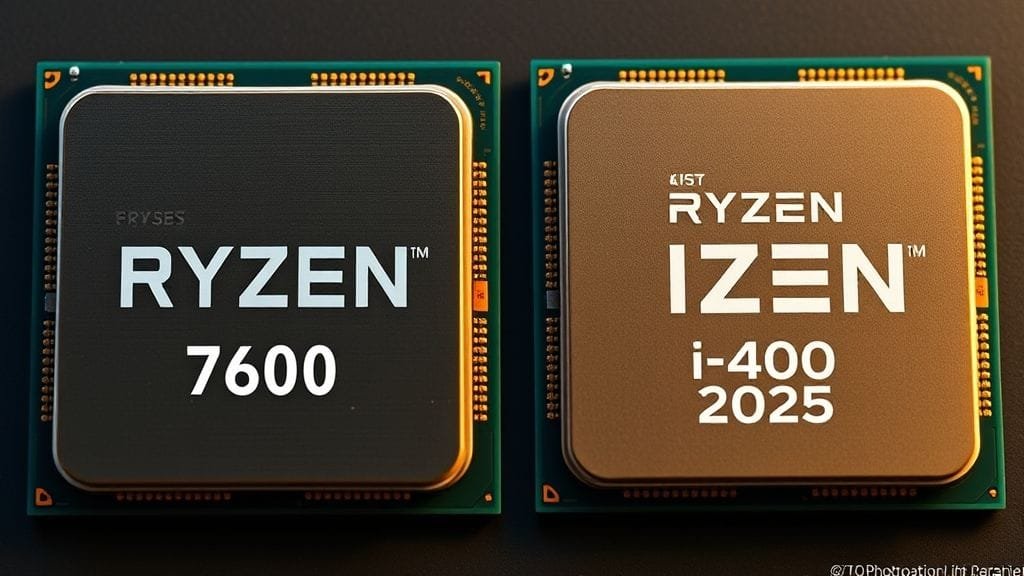
Mid-range computing in 2025 remains highly competitive. AMD and Intel remain the dominant forces. Consequently, PC builders and enthusiasts often seek an optimal balance of performance and value. Their choice frequently narrows to two excellent processors: the AMD Ryzen 5 7600 and the Intel Core i5-13400F. This article provides a detailed Ryzen 5 7600 vs i5-13400F 2025 comparison. Ultimately, both CPUs offer compelling solutions for gaming, productivity, and everyday use. Both also represent peak efficiency within their respective ecosystems. Indeed, many PC builders and enthusiasts find themselves weighing these two.
This guide explores these formidable processors in detail. First, we will dissect their architectures. Next, we will benchmark their real-world performance in 2025. We will also analyze platform costs and weigh their future-proofing capabilities. By the end, you will understand which CPU aligns best with your needs, budget, and upgrade aspirations. This distinction is crucial for your next PC build. This is particularly relevant to the Ryzen 5 7600 vs i5-13400F 2025 debate.
Ryzen 5 7600 vs i5-13400F 2025: Specifications and Architecture
To truly appreciate the strengths of the Ryzen 5 7600 vs i5-13400F 2025 comparison, we must first understand their foundational technologies. Each CPU boasts a unique approach to design, influencing everything from raw speed to power efficiency and multi-core prowess. These architectural differences are not just technical jargon; they translate directly into how your system performs. This foundational understanding is vital when evaluating the Ryzen 5 7600 vs i5-13400F 2025 performance metrics.
AMD Ryzen 5 7600: Zen 4 Powerhouse
The AMD Ryzen 5 7600 showcases AMD’s ongoing innovation. It is built upon the cutting-edge Zen 4 architecture. Moreover, TSMC’s advanced 5nm process fabricates this processor. Therefore, it delivers significant generational improvements in efficiency and IPC performance. This CPU offers a robust computing experience. It capably handles gaming and demanding applications. Consequently, it stands as a strong contender in the Ryzen 5 7600 vs i5-13400F 2025 lineup.
The Ryzen 5 7600 CPU features a 6-core, 12-thread design. Each core functions as a powerful unit. Its base clock speed is 3.8GHz. However, it can boost up to 5.1GHz, leveraging AMD’s Precision Boost Overdrive (PBO) technology. High clock speeds facilitate quick responses in single-threaded applications, such as gaming. Furthermore, the Ryzen 5 7600 includes integrated AMD Radeon Graphics. These provide basic display functions and light media support. The CPU has a 65W TDP. However, its power draw often reaches 88W under load. This shows good power management. This efficiency is a key factor for our Ryzen 5 7600 vs i5-13400F 2025 power comparison.
Intel Core i5-13400F: Hybrid Efficiency from Alder Lake S Refresh
The Intel Core i5-13400F offers Intel’s answer to the mid-range market. This processor utilizes the Alder Lake S Refresh architecture. Intel’s 7 process (equivalent to 10nm) produces it. Its key feature is an innovative hybrid core design. Intel has, therefore, refined this strategy across recent generations. This design combines high-performance cores with efficiency cores to optimize workload distribution. Consequently, it sets the stage for the Ryzen 5 7600 vs i5-13400F 2025 comparison.
The Core i5-13400F has 10 cores and 16 threads. It features 6 Performance-cores (P-cores) and 4 Efficiency-cores (E-cores). P-cores manage demanding tasks, clocking from 2.5GHz to 4.6GHz. E-cores, however, handle lighter background processes, running from 1.8GHz to 3.3GHz. This hybrid design enables robust multitasking and efficient power use. Furthermore, the “F” suffix means no integrated graphics. Thus, you need a separate graphics card for video output. Its base power is 65W, though it can boost up to 148W. During heavy use, it typically draws around 110W. These details are vital for our Ryzen 5 7600 vs i5-13400F 2025 comparison.
Gaming Performance in 2025: Ryzen 5 7600 vs i5-13400F
Gaming prowess is a primary CPU criterion for many users. In 2025, both the AMD Ryzen 5 7600 and Intel Core i5-13400F handle modern titles well. However, architectural differences lead to distinct performance profiles. This is particularly true when pushing frame rates in competitive scenarios. Gaming experience involves more than raw FPS. It also includes consistency, smoothness, and handling future game releases. All these factors play into the Ryzen 5 7600 vs i5-13400F 2025 gaming battle.
Ryzen 5 7600’s Gaming Edge in the 7600 vs 13400F Comparison
The AMD Ryzen 5 7600 generally holds a slight, yet noticeable, edge in raw gaming performance. Its Zen 4 architecture boosts IPC and single-core clocks. This directly translates into more frames per second (FPS) in demanding titles. This advantage often appears at 1080p resolution. Here, the CPU’s processing power is more of a bottleneck than the GPU. Games relying heavily on robust single-threaded performance favor the Ryzen 5 7600. These include many esports titles or CPU-intensive AAA games. Therefore, the Ryzen 5 7600 gains an advantage in Ryzen 5 7600 vs i5-13400F 2025 gaming benchmarks.
Furthermore, the Ryzen 5 7600 mandates DDR5-5200 memory support. This also contributes to its gaming lead. DDR5 offers higher bandwidth and lower latencies. This can provide a tangible boost, especially in memory-sensitive titles. However, the difference might be marginal at 1440p and 4K resolutions. Here, the graphics card typically becomes the primary bottleneck. Nevertheless, the Ryzen 5 7600 ensures you extract every possible frame. Its consistent performance across many games makes it a strong contender for serious gamers. This impacts the overall Ryzen 5 7600 vs i5-13400F 2025 gaming perception.
Core i5-13400F: Solid Gaming CPU for PC Builds in 2025
The Intel Core i5-13400F offers a remarkably solid gaming experience. It will satisfy most players. Although it might trail the Ryzen 5 7600 in some benchmarks, the real-world difference is often imperceptible. Indeed, when paired with a capable discrete graphics card, the i5-13400F competently handles mainstream games. It delivers smooth, enjoyable frame rates. Furthermore, its strong P-core performance is ample for complex game worlds and managing logic. This positions it well in the Ryzen 5 7600 vs i5-13400F 2025 gaming value discussion.
At higher resolutions like 1440p and 4K, the performance gap between these two CPUs shrinks. In these scenarios, the GPU typically limits performance. Both processors, therefore, can feed a high-end graphics card with enough data. This ensures excellent performance. The Core i5-13400F provides fantastic value for its price. It proves you don’t always need a top-tier CPU for a premium gaming experience. Indeed, this makes it a pragmatic choice for gamers. They get robust performance without overspending on the CPU component. This is particularly true when considering the Ryzen 5 7600 vs i5-13400F 2025 gaming benchmarks.

Productivity and Multi-threading: Ryzen 5 7600 vs i5-13400F 2025
Beyond gaming, modern CPUs handle diverse productivity tasks. This includes video editing, 3D rendering, complex coding, and content creation. Everyday multitasking also falls into this category. The Ryzen 5 7600 and Core i5-13400F have differing core configurations and architectures. Consequently, these lead to distinct strengths in various areas. Moreover, understanding these capabilities is crucial for professionals and power users. This helps them assess the Ryzen 5 7600 vs i5-13400F 2025 productivity battle.
Ryzen 5 7600: Multi-threaded Performance in the 7600 vs 13400F Comparison
The AMD Ryzen 5 7600 delivers strong multi-threaded performance. It achieves this even with fewer cores than its Intel rival. Its 6 Zen 4 cores are both efficient and powerful. Thus, they easily handle demanding productivity applications. Additionally, enabling Precision Boost Overdrive (PBO) significantly boosts its clocks and power limits. This helps close any multi-threaded performance gap with the Core i5-13400F. As a result, it excels in tasks such as video encoding, photo editing, and software compilation. These strengths make it a strong option for our Ryzen 5 7600 vs i5-13400F 2025 productivity comparison.
The Ryzen 5 7600 features uniform cores. This means every thread benefits from the same high-performance architecture. Consequently, this consistency aids workloads that scale well across fewer, yet powerful, cores. It also ensures predictable and reliable performance. For instance, content creators using apps like Adobe Premiere Pro or Blender will find the Ryzen 5 7600 a capable partner. It offers snappy performance, keeping workflows smooth. Furthermore, its efficiency under load limits heat generation and reduces power consumption during intense operations. These factors are key in the Ryzen 5 7600 vs i5-13400F 2025 matchup.
Core i5-13400F: Hybrid Advantage for Multi-tasking in the Ryzen 5 7600 vs i5-13400F 2025 Debate
The Intel Core i5-13400F excels in multi-tasking and productivity. It uses an innovative hybrid architecture. Specifically, its setup includes 6 Performance-cores (P-cores) and 4 Efficiency-cores (E-cores). This gives it 10 cores and 16 threads. Such a configuration offers a flexible, powerful processing engine. P-cores handle demanding applications and heavy lifting. Meanwhile, E-cores manage background processes, system services, and less intensive tasks. This smart distribution keeps background activities from impeding foreground performance. Consequently, it is crucial for the Ryzen 5 7600 vs i5-13400F 2025 productivity debate.
Many users run several applications daily. They edit videos, browse the web, or stream content. Some even keep many browser tabs open. For these people, the Core i5-13400F offers a smoother, faster experience. Its high thread count, for example, helps with demanding tasks. These include 3D rendering or complex scientific calculations. Additionally, Adobe Creative Suite apps often perform notably well. The CPU’s core types efficiently manage tasks. Consequently, the i5-13400F excels at productivity and content creation. It often outperforms the Ryzen 5 7600 in heavily multi-threaded workloads. Therefore, it competes strongly in the Ryzen 5 7600 vs i5-13400F 2025 market.

Platform Comparison: Ryzen 5 7600 vs i5-13400F 2025 Motherboards and Future-Proofing
Choosing a CPU involves more than the chip itself. Instead, it encompasses the entire platform. Motherboard compatibility, memory requirements, and socket longevity are critical factors. These influence initial build cost and future upgrade potential. In 2025, platform differences between AMD’s AM5 and Intel’s LGA 1700 are perhaps the most significant. They deeply influence the Ryzen 5 7600 vs i5-13400F 2025 decision.
AMD AM5: Long-Term Value in the Ryzen 5 7600 vs i5-13400F 2025 Decision
The AMD Ryzen 5 7600 uses the AM5 socket. This is a relatively new platform. AMD has committed to supporting it until at least 2025, and likely beyond. Therefore, this commitment offers a monumental advantage for future-proofing. Builders of an AM5 system today will have a clear upgrade path. For instance, they can move to future AMD Zen 5, Zen 6, or even newer CPUs without replacing their motherboard. This greatly reduces the total cost of ownership over time for gradual upgraders. Indeed, this is a major point in the Ryzen 5 7600 vs i5-13400F 2025 long-term value assessment.
The AM5 platform uses only DDR5 memory. While DDR5 costs more than DDR4 in 2025, it is the future standard. It offers better bandwidth and lower latency. As a result, system performance improves, especially for gaming and demanding apps. AM5 motherboards also support PCIe 5.0. This new standard doubles PCIe 4.0’s speed. It also prepares systems for future SSDs and graphics cards. This design ensures top performance from new parts. For instance, B650 series motherboards provide great features for most users. Therefore, this is key when comparing the Ryzen 5 7600 vs i5-13400F 2025 platforms.
Intel LGA 1700: Value for the i5-13400F in 2025, Limited Future
The Intel Core i5-13400F operates on the LGA 1700 socket. This platform served Intel well through 12th and 13th generations. However, it is largely considered nearing its end-of-lifecycle for new CPU generations. This means that if you build an LGA 1700 system in 2025, your CPU upgrade options will be limited. You can only choose other 12th or 13th-gen Intel chips. There is no clear path to future Intel architectures on the same motherboard. Consequently, the LGA 1700 platform is less “future-proof” than AM5. This is a vital aspect of the Ryzen 5 7600 vs i5-13400F 2025 platform discussion.
The LGA 1700 platform offers flexibility and cost savings. For example, many B660 or B760 motherboards support both DDR4-3200 and faster DDR5-4800 memory. Therefore, builders can select cheaper DDR4, cutting system costs. Moreover, the platform usually supports PCIe 4.0. This standard works well for all current GPUs and SSDs. Some high-end boards even provide PCIe 5.0 for one GPU slot. As a result, LGA 1700 attracts budget builders. It also suits users not planning quick CPU upgrades. Its established setup and lower platform cost offer clear benefits. These points highlight its value in the Ryzen 5 7600 vs i5-13400F 2025 budget comparison.
Power, Thermals, and Cooling: Ryzen 5 7600 vs i5-13400F 2025
CPU efficiency directly impacts system thermals. It also influences the type of cooler needed and your electricity bill. Both the Ryzen 5 7600 and Core i5-13400F are mid-range processors. However, their power consumption and thermal demands differ. Moreover, understanding these aspects is crucial for selecting appropriate cooling. It also helps maintain a stable, quiet PC. This is vital when assessing the Ryzen 5 7600 vs i5-13400F 2025 power profile.
Ryzen 5 7600: Power Efficiency in the 7600 vs 13400F Comparison
The AMD Ryzen 5 7600 stands out for impressive power efficiency. This is largely thanks to its advanced 5nm Zen 4 architecture. Furthermore, it has a stated Thermal Design Power (TDP) of 65W. Under sustained load, its actual power draw typically reaches around 88W. This relatively low power consumption directly translates into less heat output. Consequently, the Ryzen 5 7600 is easier to cool than many higher-end CPUs. This offers a clear benefit in the Ryzen 5 7600 vs i5-13400F 2025 thermal comparison.
The processor comes bundled with a stock cooler. This is generally adequate for basic operation and light workloads. However, users planning extended gaming sessions or demanding productivity tasks should invest in a decent aftermarket cooler. An air cooler or a liquid AIO cooler is recommended. This ensures lower temperatures and quieter operation. It also allows the CPU to maintain boost clocks more consistently. Furthermore, the efficient design means potentially lower long-term electricity costs. This applies especially to systems running many hours daily. It is a strong point for Ryzen 5 7600 vs i5-13400F 2025 efficiency.
Core i5-13400F: Cooling Demands for the Ryzen 5 7600 vs i5-13400F 2025 Build
The Intel Core i5-13400F has a Processor Base Power of 65W. Despite this, its maximum turbo power (MTP) is significantly higher at 148W. Under typical sustained load, its actual power draw often hovers around 110W. This higher consumption means the i5-13400F can generate more heat. This happens particularly during burst operations or all-core loads, exceeding the Ryzen 5 7600. Consequently, these thermal characteristics are important when comparing the Ryzen 5 7600 vs i5-13400F 2025 models.
The Core i5-13400F ships with Intel’s Laminar RM1 stock cooler. However, most experts consider this a basic solution. For optimal performance, especially during tasks like gaming or rendering, builders need an aftermarket cooler. This also ensures quiet operation and prevents thermal throttling. A good mid-range air cooler or a 240mm AIO liquid cooler works well. It keeps the i5-13400F cool and stable. Thus, its P-cores and E-cores can reach their full potential. Furthermore, proper case airflow is vital for i5-13400F systems. It manages heat effectively, impacting cooler choices in a Ryzen 5 7600 vs i5-13400F 2025 build.
Cost Analysis: Ryzen 5 7600 vs i5-13400F 2025 Initial Build vs. Long-Term Value
Deciding between the AMD Ryzen 5 7600 and Intel Core i5-13400F involves a careful look at your system’s final price. It’s not just the CPU cost. Furthermore, the motherboard, RAM, and even a cooler significantly impact the total budget. This “platform cost” is where the two contenders diverge considerably in 2025. This makes it a critical aspect of the Ryzen 5 7600 vs i5-13400F 2025 evaluation.
AMD Ryzen 5 7600: Platform Cost in the Ryzen 5 7600 vs i5-13400F 2025 Debate
The AMD Ryzen 5 7600 typically has a slightly higher initial CPU price compared to the Core i5-13400F. However, the more substantial difference arises from its platform requirements. As an AM5 CPU, it mandates the use of DDR5 RAM. While DDR5 prices have decreased significantly since its launch, they still generally remain higher than equivalent DDR4 kits. Furthermore, AM5 motherboards, even entry-level B650 models, tend to be more expensive than their LGA 1700 counterparts. This directly impacts the Ryzen 5 7600 vs i5-13400F 2025 cost comparison.
The Ryzen 5 7600 system usually has a higher total initial platform cost. This is due to a slightly more expensive CPU, mandatory DDR5, and pricier motherboards. However, the AM5 platform offers unparalleled future-proofing. Indeed, this higher entry barrier is offset by its future-proofing. The ability to upgrade to future Zen 5 or Zen 6 CPUs without buying a new motherboard can lead to a lower Total Cost of Ownership (TCO). This applies over a longer period. It also makes it a compelling long-term investment for those planning CPU upgrades. This is a key consideration in the Ryzen 5 7600 vs i5-13400F 2025 discussion.
Intel Core i5-13400F: Budget CPU for PC Build 2025
The Intel Core i5-13400F shines brightly in the budget-friendly category. The CPU itself is often more affordable than the Ryzen 5 7600, providing an immediate saving. The most significant cost advantage, however, comes from its platform flexibility. LGA 1700 motherboards, especially B660 or B760 chipsets, are generally more economical. Crucially, these boards offer the option to use more affordable DDR4 RAM, which can substantially reduce the total system cost. This makes the Ryzen 5 7600 vs i5-13400F 2025 cost-benefit analysis lean towards Intel for immediate savings.
Builders can construct a highly capable PC for significantly less money. They simply opt for a Core i5-13400F with a budget-friendly LGA 1700 motherboard and DDR4 memory. This makes it an incredibly attractive option for budget-constrained builds in 2025. Indeed, every dollar counts in these scenarios. While the LGA 1700 platform lacks AM5’s long-term upgrade path, its immediate value is undeniable. For those prioritizing immediate savings or not planning CPU upgrades, the i5-13400F offers exceptional performance per dollar. Therefore, this defines its role in the Ryzen 5 7600 vs i5-13400F 2025 market.
Who Should Buy Which Best Mid-Range CPU in 2025? (Ryzen 5 7600 vs i5-13400F)
Making the final decision requires understanding your priorities, budget, and long-term plans. Both the AMD Ryzen 5 7600 and the Intel Core i5-13400F are excellent mid-range CPUs. However, they cater to slightly different user profiles. Consider these recommendations carefully before committing to your next PC build. This is especially true when weighing the Ryzen 5 7600 vs i5-13400F 2025 factors.
Choose the AMD Ryzen 5 7600 (Best Mid-Range CPU 2025) if…
- You prioritize maximum gaming FPS: The Ryzen 5 7600 generally offers a slight edge in raw gaming performance, especially at 1080p, thanks to its strong single-core speed and efficient Zen 4 architecture, a key differentiator in the Ryzen 5 7600 vs i5-13400F 2025 gaming matchup.
- You want a strong upgrade path for several years: The AM5 platform’s longevity, with AMD’s commitment to supporting future Zen architectures, means you can upgrade your CPU without replacing your motherboard. This provides significant long-term value, an undeniable advantage in the Ryzen 5 7600 vs i5-13400F 2025 future-proofing discussion.
- You are comfortable with a higher initial budget for the platform: The mandatory DDR5 RAM and typically higher-priced AM5 motherboards will result in a greater upfront cost.
- You value power efficiency: The 5nm Zen 4 architecture of the Ryzen 5 7600 is more power-efficient, leading to lower power draw and easier cooling requirements.
- You might occasionally use integrated graphics: The inclusion of AMD Radeon Graphics provides a fallback or basic display output capability, useful for troubleshooting or very light productivity without a discrete GPU.
Choose the Intel Core i5-13400F if…
- You have a strict budget for the entire PC build: The i5-13400F CPU itself is often cheaper, and the ability to use more affordable DDR4 RAM and LGA 1700 motherboards significantly reduces the total platform cost. This makes the Ryzen 5 7600 vs i5-13400F 2025 cost argument lean towards Intel.
- You need solid all-around performance for gaming and productivity: Its hybrid architecture and 10 cores deliver excellent performance in both gaming and multi-threaded productivity tasks, making it a versatile workhorse, and a strong contender in the Ryzen 5 7600 vs i5-13400F 2025 all-rounder category.
- You don’t plan to upgrade your CPU for a very long time on the same motherboard: The LGA 1700 socket is at the end of its lifecycle for new generations, meaning future CPU upgrades would require a new motherboard. If you’re building and forgetting, this isn’t a drawback for the Ryzen 5 7600 vs i5-13400F 2025 choice.
- You already have a discrete GPU (or plan to buy one): The “F” designation means it lacks integrated graphics, so a dedicated graphics card is essential for any display output.
- You prefer a mature, potentially cheaper DDR4 ecosystem: The option to use DDR4 memory offers flexibility and significant cost savings, especially in 2025.
Conclusion: Making Your Ryzen 5 7600 vs i5-13400F 2025 Decision
The mid-range CPU market in 2025 remains fiercely competitive, with both the AMD Ryzen 5 7600 and Intel Core i5-13400F standing out as exceptional choices. Your ultimate decision hinges on what you value most in a new PC build. The intricacies of the Ryzen 5 7600 vs i5-13400F 2025 comparison are nuanced, but ultimately boil down to key factors.
The AMD Ryzen 5 7600 emerges as the technically superior option for pure gaming performance. It also offers an undeniable advantage in future-proofing. This is due to its AM5 platform and PCIe 5.0 support. It represents a solid long-term investment. However, this comes with a higher initial platform cost. This defines its position in the Ryzen 5 7600 vs i5-13400F 2025 landscape.
Conversely, the Intel Core i5-13400F offers immediate, outstanding value. Its lower overall platform cost makes it incredibly attractive for budget-conscious builders. This is thanks to DDR4 compatibility and more affordable motherboards. It delivers robust performance for both gaming and productivity. This proves that high performance doesn’t always come with a premium price tag. Consequently, it makes it a compelling option in the Ryzen 5 7600 vs i5-13400F 2025 contest.
Ultimately, both processors will provide a fantastic computing experience for years. Therefore, reflect on your budget, your expected usage, and your long-term upgrade philosophy. This will determine which mid-range titan fits your 2025 PC build. It helps navigate the Ryzen 5 7600 vs i5-13400F 2025 choice.
Frequently Asked Questions
Q1: Does the Ryzen 5 7600 come with a cooler?
Yes, the AMD Ryzen 5 7600 typically comes bundled with an AMD Wraith Stealth cooler. While this stock cooler is generally adequate for basic operation, an aftermarket cooler is recommended for optimal performance, lower temperatures, and quieter operation, especially during sustained heavy loads like gaming. Considering cooling for the Ryzen 5 7600 vs i5-13400F 2025 models is important.
Q2: Can I use DDR4 memory with the Ryzen 5 7600?
No, the AMD Ryzen 5 7600, being part of the AM5 platform, exclusively supports DDR5 memory. It is not compatible with DDR4 RAM. This means you will need to factor in the cost of DDR5 memory when building an AM5 system. This is a key difference in the Ryzen 5 7600 vs i5-13400F 2025 memory considerations.
Q3: Is the Intel Core i5-13400F good for 1440p gaming in 2025?
Yes, the Intel Core i5-13400F is perfectly capable of handling 1440p gaming in 2025. At this resolution, the performance bottleneck often shifts from the CPU to the GPU. When paired with a strong discrete graphics card, the i5-13400F will deliver smooth and enjoyable frame rates in most modern titles. This makes it a strong option when evaluating the Ryzen 5 7600 vs i5-13400F 2025 for 1440p gaming.
Q4: What motherboard should I pair with the Ryzen 5 7600 for gaming?
For most gaming builds with the Ryzen 5 7600, a B650 chipset motherboard offers an excellent balance of features, performance, and price. These motherboards support all the essential AM5 features like DDR5 RAM and PCIe 5.0, providing great value without the premium cost of higher-end X670 boards. This choice highlights a specific aspect of the Ryzen 5 7600 vs i5-13400F 2025 platform planning.
Q5: How long will the AM5 platform be supported?
AMD has committed to supporting the AM5 platform until at least 2025, and likely beyond. This commitment provides excellent future-proofing, allowing users to upgrade to newer generations of AMD CPUs (like Zen 5 and Zen 6) without needing to replace their motherboard for several years. This longevity is a key advantage of the Ryzen 5 7600 when considering the Ryzen 5 7600 vs i5-13400F 2025 long-term value.