The digital world evolves at an astonishing pace, and at the heart of much of this progress lies the Peripheral Component Interconnect Express (PCIe) interface. PCIe 5.0, in fact the latest iteration of this critical technology, is rapidly moving from a distant promise to a widespread reality. Therefore, for anyone building a new system or upgrading an existing one, understanding the implications of PCIe 5.0 is no longer optional; it’s essential for maximizing performance and future-proofing your investment.
This article, moreover, delves deep into the real-world benefits that PCIe 5.0 brings, specifically for two key demographics: passionate gamers chasing the ultimate immersive experience and dedicated content creators demanding unparalleled efficiency. We’ll explore its technical advancements, its current adoption status, and what this generational leap consequently means for your daily tasks and future ambitions.

The Dawn of PCIe 5.0: Understanding the Bandwidth Leap
First, imagine a digital highway. PCIe acts as the fundamental infrastructure for that highway, thereby determining how quickly data can flow between your CPU and crucial components like graphics cards and storage drives. PCIe 5.0, consequently, represents a significant upgrade to this infrastructure, doubling the lanes and capacity of its predecessor. Indeed, this translates into a raw speed advantage that redefines what’s possible for modern computing. Furthermore, the underlying technical enhancements are sophisticated, enabling a massive leap in data transfer rates across your system.
From PCIe 4.0 to 5.0: A Generational Leap in Speed
Essentially, PCIe 5.0 offers fundamentally double the bandwidth of PCIe 4.0. Specifically, an impressive data transfer rate of 32 gigatransfers per second (GT/s) per lane is achieved. For context, an x16 bidirectional link, which is common for graphics cards, now boasts a theoretical maximum bandwidth of 128 GB/s. This, then, is a monumental jump from PCIe 4.0’s 64 GB/s. However, such an increase in speed isn’t just about bigger numbers; it’s about enabling entirely new levels of performance. Moreover, these improvements stem from physical layer enhancements, including advanced equalization techniques and stricter signal integrity measures. Consequently, this ensures reliable high-speed communication even over longer distances within your motherboard.
Where PCIe 5.0 Stands Today: Adoption Across Hardware
Presently, widespread adoption of PCIe 5.0 is gaining significant momentum. By mid-2025, it is becoming a standard feature on many new motherboards, in fact. Specifically, platforms supporting Intel’s 14th Gen processors and AMD’s AM5 chipsets (Ryzen 7000 series and newer) are leading this charge, integrating PCIe Gen 5 slots for both graphics and storage. PCIe 5.0 NVMe Solid State Drives (SSDs) have also seen rapid growth. These ultra-fast drives started appearing in mid-2023, and numerous models are now readily available. Projections, furthermore, suggest a 5% penetration rate for PCIe Gen 5 in high-end PCs by the second quarter of 2025, accelerating to an impressive 20-30% in 2026. However, the integration of PCIe 5.0 into graphics cards has progressed at a slightly slower pace. The NVIDIA RTX 50 series, among others, is finally bringing this crucial standard to high-end GPUs, indicating further widespread adoption.

PCIe 5.0 for Gamers: Future-Proofing Your Rig
To begin with, for many gamers, the question often boils down to “Will this make my games run faster now?” Nevertheless, with PCIe 5.0, the answer is nuanced. While immediate, jaw-dropping performance increases might not be universally evident with current titles, the true value, nonetheless, lies in preparing your system for the demands of tomorrow. For example, think of it as building a highway with more lanes than currently needed. Those extra lanes, in turn, become invaluable when traffic increases exponentially. This foresight, therefore, is precisely what PCIe 5.0 offers to the gaming community.
Modest Immediate Gains, Massive Future Potential
Currently, the immediate real-world benefits of PCIe 5.0 for gaming, especially concerning graphics cards, are relatively modest. Indeed, most existing high-end GPUs, such as the NVIDIA RTX 40-series and AMD Radeon RX 7000-series, do not fully saturate the bandwidth provided by PCIe 4.0 x16 in typical gaming scenarios. Early tests, even with cutting-edge cards like the upcoming RTX 5090, have shown only a minimal 1-4% performance difference between PCIe 5.0 and PCIe 3.0 x16, and an almost negligible 1% difference between PCIe 5.0 and PCIe 4.0 x16 in most games. However, investing in PCIe 5.0 hardware serves a crucial purpose: future-proofing your gaming system. Such an investment, specifically, ensures your rig has the necessary bandwidth headroom for the next generation of graphics cards. These future GPUs, for example, are expected to handle significantly larger datasets for advanced AI tasks, require faster VRAM access for ultra-high resolutions and texture details, and engage in more complex compute workloads than ever before. Ultimately, this robust interface prepares your system for those demanding applications.
The DirectStorage Revolution and PCIe 5.0 SSDs
In particular, one of the most exciting developments for gamers, directly benefiting from PCIe 5.0 SSDs, is Microsoft’s DirectStorage API. This revolutionary technology, in essence, bypasses traditional storage bottlenecks, creating a more direct and efficient path for game assets. Crucially, it allows data to flow from the SSD straight to the GPU’s memory. This, in turn, minimizes CPU overhead and dramatically reduces loading times. For example, imagine entering a massive open-world game where sprawling environments and high-resolution textures stream seamlessly without noticeable hitches. Therefore, DirectStorage, combined with the extreme speeds of PCIe 5.0 NVMe drives, can make this a reality. Consequently, this leads to quicker game launches, faster level loading, and significantly smoother asset streaming. For an in-depth look at GPU technologies, consider reading our guide on [/blog/choosing-your-your-next-gaming-gpu/].

Why Gamers Should Consider PCIe 5.0 for Tomorrow’s Titles
While the current performance uplift for many games is minor, the long-term benefits of PCIe 5.0 are substantial. Tomorrow’s games, for example, will leverage advanced rendering techniques, incorporate more sophisticated AI, and feature increasingly detailed open worlds that demand rapid asset streaming. Thus, a PCIe 5.0-enabled system will be better equipped to handle these innovations without becoming a bottleneck. Furthermore, as game developers optimize their engines to utilize DirectStorage and take advantage of faster storage, the performance gap between PCIe 4.0 and PCIe 5.0 SSDs will widen considerably. Investing in PCIe 5.0 now, therefore, means you’ll be ready to fully experience future titles as intended, maximizing your hardware’s potential for years to come. This strategic upgrade, then, helps ensure your gaming PC remains at the cutting edge.
PCIe 5.0 for Content Creators: Immediate Workflow Acceleration
Unlike gamers, many content creators will experience immediate and profoundly tangible benefits from PCIe 5.0. Their professional workflows often involve massive files, intense real-time processing, and continuous data transfers, making bandwidth and speed critical. PCIe 5.0, as a result, directly addresses these demands, particularly through its high-speed NVMe SSDs. Indeed, for anyone working in fields like video production, 3D animation, or advanced scientific computing, the upgrade to PCIe 5.0 isn’t just about future-proofing; it’s, in fact, about boosting productivity and efficiency right now.
Supercharging Your Storage: PCIe 5.0 SSDs in Action
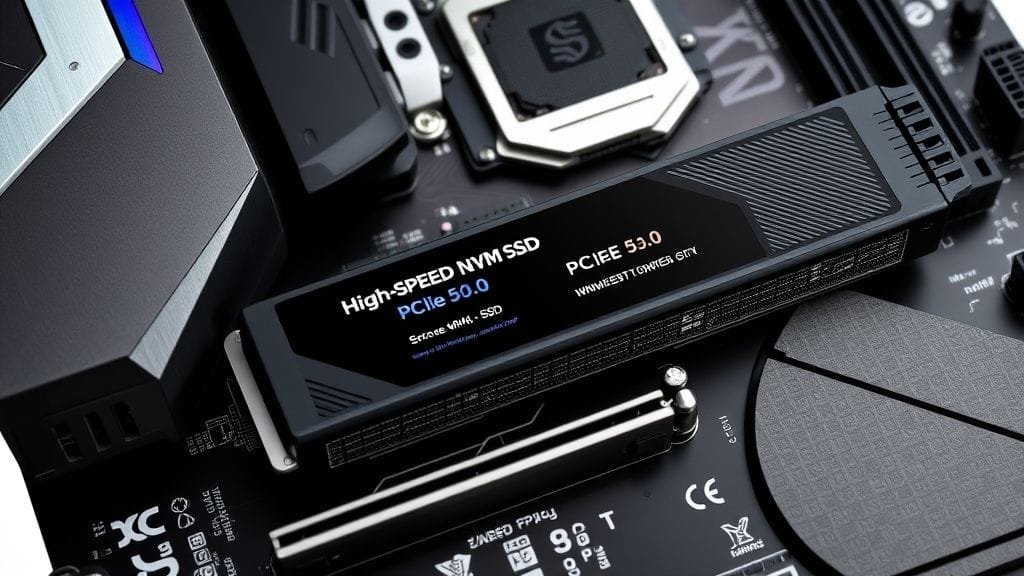
Clearly, PCIe 5.0 NVMe SSDs are a game-changer for content creation. Specifically, these drives deliver significantly faster sequential read and write speeds, effectively doubling the performance of their PCIe 4.0 counterparts. Some of the latest drives, indeed, can achieve incredible speeds, reaching up to 14,900 MB/s for reads and 14,000 MB/s for writes. These figures are not merely theoretical; instead, they translate directly into noticeable improvements in professional applications. Consequently, the sheer speed of these SSDs dramatically reduces waiting times for common tasks. For example, imagine loading several terabytes of 4K or 8K video footage in a fraction of the time, or opening massive project files in seconds rather than minutes. This exponential increase in storage performance, therefore, is paramount for maintaining a fluid and efficient creative workflow. For more on choosing the right storage, explore our [/blog/ssd-buying-guide/].
Real-World Impact: 4K/8K Editing, Rendering & AI Workloads
Significantly, the accelerated speeds offered by PCIe 5.0 SSDs are incredibly advantageous for demanding professional workloads. For instance, 4K and 8K video editors will notice quicker scrubbing through timelines, faster rendering of effects, and seamless export processes. Similarly, 3D artists and animators can experience rapid loading of complex scenes, quicker texture streaming, and reduced render times. Furthermore, professionals working with advanced AI models for tasks like upscaling footage, generating content, or performing complex data analysis will see a substantial boost. The increased bandwidth of PCIe 5.0, moreover, allows for efficient real-time data handling, which is crucial for large-scale AI training, machine learning, and immersive 3D rendering. This efficiency consequently translates directly into more projects completed in less time.

The Productivity Advantage of PCIe 5.0
Indeed, for content creators, time is money. Every minute spent waiting for files to load, projects to render, or data to transfer is a minute lost in productivity. However, PCIe 5.0 directly addresses this bottleneck, transforming frustrating wait times into opportunities for more creative output. By minimizing the time spent on technical delays, therefore, creators can focus more on their craft. The ability to work with larger files, more complex projects, and advanced software without slowdowns empowers creators to take on more ambitious projects. This not only enhances the quality of their work but also significantly boosts their overall output. Ultimately, PCIe 5.0 offers a distinct competitive advantage in demanding professional environments. Consider how a robust system can impact your work by reading about [/blog/building-a-content-creation-pc/].
Navigating the PCIe 5.0 Landscape: Challenges & Considerations
While PCIe 5.0 offers groundbreaking performance, its adoption isn’t without its challenges. Like any new technology, it comes with specific considerations regarding cost, power consumption, and thermal management. Understanding these aspects, therefore, is crucial for making an informed decision about integrating PCIe 5.0 into your next build or upgrade. Weighing these factors against the benefits will, accordingly, help you determine if PCIe 5.0 is the right investment for your particular needs and budget.
Power, Heat, and Cost: Early Adoption Hurdles
Early generations of PCIe 5.0 SSDs, in particular, faced challenges with higher power consumption. Consequently, this often necessitated robust active or passive cooling solutions, such as sizable heatsinks, to prevent thermal throttling and maintain peak performance. Overheating, in turn, can severely degrade drive speed and longevity, making proper cooling a non-negotiable requirement for these high-performance components. While newer PCIe 5.0 SSDs are continuously improving in power efficiency and thermal management, they generally remain more expensive than their PCIe 4.0 counterparts. This price premium, naturally, is a significant factor for budget-conscious buyers. Furthermore, motherboards supporting PCIe 5.0 also tend to sit in the higher price brackets, reflecting their advanced features and capabilities.

Is PCIe 5.0 Right for You? Weighing the Investment
Initially, for the average consumer or mainstream gamer, the perceptible difference in daily usage, such as boot times or game loading, between a high-end PCIe 4.0 and a PCIe 5.0 SSD might only be a few seconds. For many, this difference, initially, might not feel immediately significant enough to justify the higher cost. Consequently, the primary appeal of PCIe 5.0 for this group currently lies in future-proofing their systems. It, therefore, prepares their machines for upcoming hardware generations and more demanding software applications. However, for content creators, professionals, and power users who routinely handle massive files and perform intensive tasks, the direct impact on workflow efficiency and productivity makes PCIe 5.0 a more immediately justifiable investment. The time saved and the increased operational capacity, indeed, can quickly offset the initial cost, offering a clear return on investment. Evaluate your own usage patterns and future needs, then, before making the leap.
The Future is Fast: Embracing PCIe 5.0
Ultimately, PCIe 5.0 represents a pivotal advancement in computing technology, pushing the boundaries of data transfer speeds and system performance. While its immediate impact on casual gaming might seem subtle, its role in future-proofing gaming rigs and revolutionizing content creation workflows is undeniable. This next-generation interface, thus, empowers professionals with unparalleled efficiency and prepares enthusiasts for the demanding software and hardware of tomorrow. Whether you’re rendering 8K video, training AI models, or simply aspiring to play future AAA titles at their absolute best, PCIe 5.0 offers the foundational speed you need. The journey towards widespread adoption continues, yet the benefits for those who embrace it are already clear.
What aspects of PCIe 5.0 are you most excited to see evolve in the coming years? Share your thoughts below!