
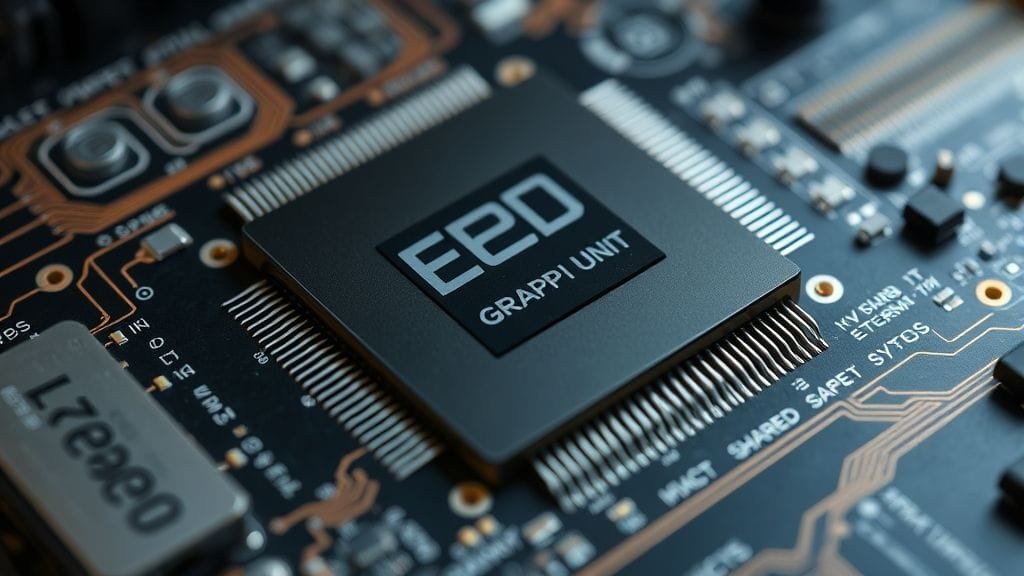
The world of Windows laptops is rapidly evolving. As September 2025 approaches, buyers face a key question: Should they choose an integrated graphics processor (iGPU) or a discrete graphics processor (dGPU)? The decision between Integrated vs Discrete GPUs is more critical than ever, directly affecting your laptop’s speed, battery life, portability, and cost.
For many years, the choice appeared straightforward. Discrete GPUs were primarily reserved for high-performance users, in contrast, integrated graphics were relegated to basic computing tasks. However, technological advancements have significantly narrowed the gap. Indeed, modern integrated graphics have become remarkably powerful. Consequently, the line between Integrated vs Discrete GPUs is increasingly blurred. Let’s delve deeper into each option to help you make the best choice for your computing needs in 2025.
Understanding the Core Components: Integrated Graphics Processors
Integrated Graphics Processors (iGPUs) are integrated directly into your laptop’s main processor, the Central Processing Unit (CPU), effectively forming a single chip that handles multiple functions. This design means the iGPU shares system resources for graphics. For example, it primarily utilizes your laptop’s main memory, called RAM. This shared resource model is fundamental to iGPU operation, and represents a key distinction in the Integrated vs Discrete GPUs comparison.
Unlike discrete GPUs, iGPUs do not have their own dedicated memory. Instead, the iGPU accesses the same system memory (RAM) as the CPU. This might suggest a performance bottleneck. However, modern architectural advancements ensure efficient performance, particularly for everyday computing. Ultimately, this is a crucial aspect in the Integrated vs Discrete GPUs comparison.
Defining the Integrated GPU (iGPU)
An integrated GPU is part of the System on a Chip (SoC). Specifically, it resides alongside the CPU cores within a single, compact silicon die. This compact design contributes to thinner, lighter laptops with efficient performance. Moreover, this design is a defining characteristic in the Integrated vs Discrete GPUs landscape. Crucially, iGPUs eliminate the need for a separate, bulky graphics card. Similarly, they also do not require dedicated video memory (VRAM), a stark contrast to discrete GPU systems.
This built-in design makes them simpler to manufacture and generates less heat. Moreover, the integrated GPU leverages the CPU’s existing cooling infrastructure. Thus, the overall system design is streamlined. Consequently, you won’t encounter the extensive, often noisy, cooling systems typical of discrete GPU laptops. This streamlined configuration offers distinct advantages, often simplifying the choice between Integrated vs Discrete GPUs for users prioritizing efficiency and adequate performance.

The Upsides: Cost, Portability, and Battery Life with Integrated Graphics
Laptops with solely iGPUs offer distinct advantages. First, they are consistently more affordable. This is because a separate graphics card is rendered unnecessary. This significantly reduces the overall cost, offering better value if an iGPU adequately addresses your computing requirements. These are crucial considerations when comparing Integrated vs Discrete GPUs.
Second, they are significantly more portable. The absence of a bulky discrete GPU and its requisite cooling system enables manufacturers to design thinner, lighter laptops. For instance, they easily slip into bags and feel substantially lighter during commutes or extended travels.
Finally, they are highly power-efficient. Integrated GPUs consume significantly less power than discrete graphics cards. As a result, this reduced power consumption translates directly to extended battery life. For students, frequent travelers, or anyone needing to work unplugged for hours, an iGPU laptop is often the ideal choice. Therefore, this makes the choice between Integrated vs Discrete GPUs a straightforward decision for many users.
Everyday Excellence: Browsing, Office, and Streaming with an iGPU
For most daily computer tasks, modern integrated graphics excel. Users are often impressed by their smooth performance. Web browsing is fluid, even with numerous tabs open. Similarly, office programs like Word, Excel, and PowerPoint also operate flawlessly. Consequently, this enables seamless creation of presentations and efficient spreadsheet management. In fact, this level of performance challenges previous notions regarding Integrated vs Discrete GPUs for everyday computing.
Watching high-definition video from services like Netflix, YouTube, or Disney+ is effortless. The iGPU handles video playback with ease, delivering crisp visuals and fluid viewing. Overall, iGPU laptops are excellent for video consumption. They provide a superior viewing experience whether at home or on the move.
Light photo editing is also capably handled. Tasks such as cropping, color correction, and basic adjustments perform admirably. Programs like Adobe Photoshop Express or free online editors work well. Users will experience no noticeable slowdowns during these routine activities. Therefore, this makes iGPU laptops highly versatile for general productivity.
Surprisingly Capable: Integrated GPUs for Entry-Level Gaming and Creative Tasks in 2025
The most significant transformation in Integrated vs Discrete GPUs by September 2025 is the remarkable advancement in iGPU capabilities. Indeed, they are now highly proficient for entry-level gaming and moderately demanding creative applications. The days when integrated graphics struggled with even simple games are a thing of the past. For example, AMD’s latest Radeon 890M leverages the advanced RDNA 3.5 architecture. Similarly, the Radeon 8060S powers Ryzen AI Max+ 395 chips. Both fundamentally redefine expectations for integrated graphics performance.
These potent iGPUs can rival, or even surpass, the performance of entry-level discrete GPUs. In fact, benchmarks and real-world usage confirm this. The NVIDIA GeForce GTX 1650 serves as a notable benchmark. This level of performance complicates the Integrated vs Discrete GPUs decision. Furthermore, advanced technologies enable them to approach the capabilities of a mobile RTX 4070 in specific scenarios. How is such remarkable progress achieved? Technologies like AMD’s FSR (FidelityFX Super Resolution) intelligently enhance image quality and generate additional frames. Essentially, these methods allow iGPUs to render games at a lower internal resolution, which is then upscaled to appear excellent on a 1080p display.
You can experience numerous popular games at 1080p resolution, achieving smooth gameplay at low to medium settings. For creative users, moreover, these iGPUs capably manage moderately intensive graphics tasks. Intel’s Arc-based iGPUs further enhance this with dedicated XMX engines. These engines are optimized for accelerated AI workloads. They significantly boost performance in creative apps and AI-based development. This dual-purpose capability, therefore, renders modern iGPUs highly versatile. Indeed, it unequivocally demonstrates the profound evolution in the Integrated vs Discrete GPUs landscape.
Unleashing Raw Power: Discrete Graphics Processors
Discrete Graphics Processors (dGPUs) are the counterpart in the Integrated vs Discrete GPUs discussion. In contrast, they are fundamentally distinct from integrated graphics. These powerful components, for instance, have their own dedicated video RAM (VRAM). Additionally, they also have separate, often more robust, cooling systems. Ultimately, they are engineered from the ground up to deliver peak graphics performance. You usually find them in high-performance, often high-end, Windows laptops.
When you need the most graphics power, a discrete GPU is the undisputed champion. This is true for demanding gaming, professional content creation, or intricate computational tasks. Crucially, unlike integrated GPUs, a dGPU does not share system resources with the CPU in the same direct manner. Its autonomous design, consequently, allows it to dedicate all its processing power and memory exclusively to graphics rendering. This means significantly superior performance. Here, the difference between Integrated vs Discrete GPUs becomes paramount.
What Sets Discrete GPUs Apart from Integrated Graphics?
The main difference in the Integrated vs Discrete GPUs discussion is their inherent independence. A discrete GPU is a standalone processor. It has its own dedicated memory, called VRAM. This VRAM is designed to facilitate rapid data transfer. In fact, it’s essential for handling high-resolution textures and complex graphical computations. Furthermore, it also aids in rendering real-time visuals. Significantly, it does not compete with the CPU for system RAM, ensuring consistently swift access to graphics data.
Discrete GPUs also mandate their own sophisticated cooling systems. These often include larger heat sinks, multiple fans, and specialized thermal compounds. As a result, this effectively dissipates substantial heat from heavy graphics use. This robust cooling ensures sustained optimal performance for the discrete GPU, preventing thermal throttling. This is crucial for demanding applications. Consequently, discrete GPU performance stands as a distinct advantage in the Integrated vs Discrete GPUs comparison.

Peak Performance: Gaming and Content Creation with a Discrete GPU
For serious gamers and professional content creators, a discrete GPU is indispensable. These powerful discrete graphics provide substantially higher raw performance. This means exceptionally fluid gameplay in modern high-end games. Specifically, you can experience the latest titles at elevated resolutions, such as 1440p or even 4K. Furthermore, you can also maximize graphics settings to high or ultra. Features like ray tracing, for example, render lighting, reflections, and shadows with stunning realism. A powerful discrete GPU brings these features to life with striking clarity. This is where discrete GPUs unequivocally outperform integrated options in the Integrated vs Discrete GPUs debate.
Beyond gaming, discrete GPUs significantly accelerate demanding content creation workflows. Video editors using software such as Adobe Premiere Pro or DaVinci Resolve will see dramatically faster rendering times, minimizing downtime and maximizing creative output. Similarly, 3D artists, animators, and CAD designers leverage discrete GPUs for rapid viewport updates. Moreover, they also use them for complex simulations and exporting high-fidelity models. The dedicated VRAM and immense parallel processing capabilities are instrumental in performing these tasks. Importantly, they also greatly enhance productivity.
The Professional Edge: Discrete GPUs for AI, Deep Learning, and VR
In specialized professional domains, the power of a discrete GPU is transformative. A high-end discrete GPU is essential for tasks such as deep learning. Furthermore, they are vital for training large-scale AI/ML (Machine Learning) models. Likewise, they are crucial for scientific simulations or professional VR development. These are the most computationally intensive tasks. Consequently, they need immense parallel processing capabilities and substantial amounts of dedicated VRAM. For high-performance computing, therefore, the Integrated vs Discrete GPUs debate is unequivocally settled.
Laptops with top-level NVIDIA RTX 5080/5090 or AMD Radeon AI PRO R9700 discrete GPUs are tailored for these intensive workloads. Their specialized cores and ample VRAM dramatically accelerate task execution. Moreover, they also enable them to process vast datasets. For professionals in these fields, investing in a powerful discrete GPU is a justified expense. It yields significant gains in workflow efficiency and empowers them to undertake complex projects. This shows the undeniable advantage of discrete options in the Integrated vs Discrete GPUs comparison for experts.
Beyond Performance: Multitasking and Multiple Displays with Discrete Graphics
A discrete GPU also facilitates robust multitasking. In addition, it enhances support for multiple external displays. For example, you might use multiple demanding applications concurrently. These could be a video editor, a 3D modeling program, and a web browser with many tabs. A discrete GPU ensures sustained responsiveness. It offloads graphics-intensive tasks from the CPU, allowing the system to manage background processes with greater fluidity. This flexibility is another crucial factor in the Integrated vs Discrete GPUs decision.
Discrete GPUs are designed to effortlessly power multiple high-refresh-rate or 4K displays. Professionals need a large workspace for intensive data analysis, coding, or detailed creative work. Consequently, effortless connectivity and utilization of multiple high-resolution displays is a significant advantage. This makes for a more productive and immersive computing experience. It presents a compelling argument for discrete options in the Integrated vs Discrete GPUs debate.
The Trade-Offs: Price, Portability, and Power with Discrete GPUs
Discrete GPUs offer unparalleled performance. However, this power comes with distinct trade-offs that buyers must consider. The most obvious drawback is the price: Laptops with discrete GPUs are considerably more expensive. This added cost stems from the GPU component itself, its dedicated VRAM, and the sophisticated cooling systems required. This can easily add hundreds, if not thousands, to the laptop’s overall cost. These are critical aspects in the Integrated vs Discrete GPUs comparison.
Second, higher performance generates more heat. This, in turn, necessitates more robust cooling solutions. These frequently result in discrete GPU laptops being larger and heavier. Thin-and-light gaming laptops do exist. Nevertheless, they typically weigh more and are thicker than laptops with solely integrated GPUs. Thus, for Integrated vs Discrete GPUs, portability often takes a backseat to raw performance.
Finally, power consumption is substantially higher. A discrete GPU consumes more energy. Consequently, this means significantly shorter battery life compared to integrated GPU laptops. These laptops excel when connected to power. However, you will find yourself seeking a power outlet considerably sooner when working on the go. This is a critical distinction in Integrated vs Discrete GPUs when it comes to battery life.
The Best of Both Worlds: Hybrid Graphics for Integrated vs Discrete GPUs
Modern Windows laptops often use an intelligent solution called hybrid graphics. This technology, firstly, aims to bridge the gap in the Integrated vs Discrete GPUs comparison. Secondly, it offers a judicious balance between performance and power efficiency. The system dynamically switches based on your workload, thereby ensuring optimal graphics power without unnecessary battery drain.
It’s important to understand the operational principles of hybrid graphics to appreciate their value. This system eliminates the need for manual graphics switching by users. Consequently, this simplifies the user experience. Moreover, it optimizes resource utilization, largely transparent to the user. This intelligent management is crucial in today’s demanding computing environment, especially in the context of Integrated vs Discrete GPUs.
How Hybrid Graphics Bridge the Gap Between Integrated and Discrete GPUs
In a hybrid graphics setup, your laptop incorporates both an integrated GPU (iGPU, as part of the CPU) and a discrete GPU (dGPU). For routine tasks like browsing the web, sending emails, or writing documents, the system defaults to the power-efficient integrated GPU. This transition occurs automatically, conserving battery life and maintaining a cooler, quieter operating environment. This intelligent approach effectively addresses a common dilemma in the Integrated vs Discrete GPUs choice.
When you start a demanding application, the system seamlessly transitions to the discrete GPU. A graphics-intensive game, video editing software, or 3D modeling application, for instance, will activate this powerful discrete graphics chip, handling the intensive workload and delivering the requisite performance. Once the demanding task is completed, the system reverts to the integrated GPU. This automatic switching, consequently, provides an optimal balance between performance and power efficiency. This is a significant advantage in the Integrated vs Discrete GPUs discussion.
The Blurring Lines: Tomorrow’s Graphics Landscape for Integrated vs Discrete GPUs
Looking ahead, the differences between integrated and discrete graphics are becoming increasingly ambiguous. We are moving towards a time when traditional definitions for Integrated vs Discrete GPUs may no longer be adequate. Exciting new partnerships and designs promise enhanced performance within more compact and power-efficient devices.
Imagine future Intel-NVIDIA collaborations. For instance, these could feature advanced RTX graphics components integrated directly into the System on a Chip (SoC). This vision suggests a new paradigm of “hybrid graphics.” Consequently, such designs could yield substantial improvements in both performance and efficiency. Such designs seek to blend the raw power of dedicated graphics with the efficiency and compact design benefits of integrated graphics. This approach could lead to thinner, lighter laptops, delivering high-end performance coupled with exceptional battery life. This would be much like what the popular Apple M-series chips have achieved. This future could fundamentally reshape laptop graphics. Ultimately, it promises unparalleled versatility.
Making Your Choice: Integrated vs Discrete GPUs in September 2025
Deciding between an integrated and discrete GPU in September 2025 depends on your primary usage patterns. Furthermore, it hinges on your budget and key priorities. There is no single “best” option among Integrated vs Discrete GPUs. Instead, the optimal choice is subjective and specific to your needs. Let’s explore recommendations tailored to various user profiles to aid you in making an informed decision.
Carefully consider your daily activities and prospective future uses. Buying a laptop is a significant investment. Ensuring its graphical capabilities align with your requirements will lead to greater satisfaction and provide reliable performance over its lifespan. Therefore, let’s examine various scenarios to assist your decision on Integrated vs Discrete GPUs.
For the Everyday User and the Road Warrior: Opting for an Integrated GPU
If you primarily engage in web browsing, email correspondence, or office productivity applications (Word, Excel, PowerPoint), a laptop with a modern, capable integrated GPU will suffice. Moreover, it is well-suited for media consumption and light photo editing. For such tasks, an integrated GPU presents itself as the obvious choice.
Laptops with AMD’s Radeon 890M or Intel’s latest Iris Xe/Arc iGPUs offer an excellent blend of performance and efficiency. Specifically, they deliver a fluid, responsive experience across all common tasks. These integrated GPU systems excel in battery life and portability. They are ideal for students, frequent travelers, or anyone prioritizing a lightweight device. Moreover, they can last an entire day on a single charge, providing significant value without overspending on unneeded power. Consequently, this makes choosing between Integrated vs Discrete GPUs a straightforward decision for a wide range of users.
For the Avid Gamer and the Digital Artist: The Power of a Discrete GPU
For those who demand more from their laptop, a discrete GPU is essential. This includes tackling the latest high-end games, performing intensive video editing, or rendering complex 3D models. Indeed, a discrete GPU is not merely beneficial, but critical. An integrated GPU, even with its advances, simply cannot provide the raw graphical horsepower needed for these demanding tasks. This makes the Integrated vs Discrete GPUs choice obvious for powerful users, consequently.
The NVIDIA RTX 50-series and AMD’s new Radeon RX 9000 series are leading choices for discrete GPU performance. For example, an RTX 5060 offers robust discrete GPU performance at a more accessible price point. An RTX 5080 or 5090 delivers peak discrete GPU performance. These discrete GPU laptops typically feature superior cooling systems. Furthermore, they are equipped with more robust power delivery, ensuring sustained optimal operation. Consequently, this translates to enhanced visuals, faster rendering, and a far smoother overall experience. This applies to creative and gaming work. The difference in Integrated vs Discrete GPUs is unmistakable in this context.
For the Cutting-Edge Professional and AI Developer: The Need for Discrete GPUs
If your work involves highly specialized tasks, a high-end discrete GPU is indispensable. These tasks include deep learning and training large-scale AI/ML (Machine Learning) models. Furthermore, they also include scientific simulations, or professional VR development. These are the most computationally intensive tasks. Consequently, they need immense parallel processing capabilities and substantial dedicated VRAM. For high-performance computing, the Integrated vs Discrete GPUs debate is definitively resolved.
Laptops with top-level NVIDIA RTX 5080/5090 or AMD Radeon AI PRO R9700 discrete GPUs are tailored for these intensive workloads. Their specialized cores and ample VRAM dramatically accelerate task completion. Moreover, they also enable them to manage vast datasets. For professionals in these fields, investing in a powerful discrete GPU is a prudent decision. It yields significant enhancements in workflow velocity and empowers them to execute highly complex projects. This shows the undeniable advantage of discrete options in the Integrated vs Discrete GPUs comparison for experts.
Navigating Budget vs. Performance in Integrated vs Discrete GPUs
Your budget is always a paramount consideration in any purchasing decision. For example, integrated graphics offer an excellent option for budget-conscious users who still require solid general performance and capable light gaming power. In such cases, you can get a highly capable integrated GPU laptop for considerably less than a discrete GPU equivalent. This is a crucial aspect when evaluating Integrated vs Discrete GPUs from a budgetary perspective.
If your budget allows, buying a discrete GPU unlocks a realm of superior performance. Moreover, it provides access to specialized, more demanding applications. This decision is about aligning your investment with your specific requirements. Think about your projected usage of the laptop throughout its lifespan. Indeed, an initial higher investment often mitigates future complications and the necessity for early upgrades. The choice between Integrated vs Discrete GPUs thus becomes a balancing act.

The Role of AI Acceleration: Integrated vs Discrete GPUs
AI acceleration is becoming increasingly pivotal across all computing platforms. A GPU’s performance in this domain represents a key differentiator in the Integrated vs Discrete GPUs comparison. Dedicated discrete GPUs still offer the highest raw performance for the most demanding AI tasks. Nevertheless, modern integrated GPUs are making significant strides. Many now incorporate dedicated AI accelerators. Specifically, these are often called NPUs (Neural Processors) or specialized engines like Intel’s XMX.
These integrated accelerators capably manage numerous AI tasks, such as real-time language translation, enhanced video calls, and even foundational machine learning tasks. A significant advantage, furthermore, is their contribution to improved battery life during AI computations. This contrasts with a discrete GPU, which consumes considerably more power. Consequently, for everyday AI-enhanced features, an integrated GPU with NPU support is highly advantageous. However, when comparing Integrated vs Discrete GPUs for intensive AI training and development, a discrete GPU remains indispensable.
Quick Comparison: Integrated vs. Discrete GPUs (September 2025)
| Feature | Integrated GPU (iGPU) | Discrete GPU (dGPU) |
|---|---|---|
| Performance | Good for everyday, light gaming, medium creative | Superior for AAA gaming, heavy creative, AI/ML |
| Power Consumption | Low | High |
| Battery Life | Excellent (longer) | Shorter |
| Cost | More affordable | More expensive |
| Portability | Thin, light, compact designs | Often bulkier, heavier |
| Cooling | Shared with CPU, simpler | Dedicated, robust, complex |
| VRAM | Shared system RAM | Dedicated VRAM (GDDR6, GDDR6X) |
| Key Technologies (2025) | AMD Radeon 890M/8060S (RDNA 3.5), Intel Iris Xe/Arc (XMX for AI), FSR | NVIDIA RTX 50-series, AMD Radeon RX 9000 series, Ray Tracing, DLSS/FSR |
| Ideal User | Everyday user, student, road warrior, casual gamer | Avid gamer, content creator, AI/ML developer, engineer |
Your Ideal Windows Laptop Awaits: Integrated vs Discrete GPUs
As we assess Windows laptops in September 2025, the choice between Integrated vs Discrete GPUs is more nuanced than ever before. Nevertheless, it is also considerably more exciting. Integrated graphics, in particular, have become remarkably powerful. Indeed, they offer exceptional value, efficiency, and performance for a broad user base. They excel in daily computing scenarios, providing effortless portability and even competent light gaming experiences.
However, for users demanding the absolute pinnacle of graphics performance — be it for high-tier gaming, professional video editing, or 3D rendering, or alternatively, for cutting-edge AI/ML development — a discrete GPU is still a fundamental tool. It provides the raw power, dedicated memory, and advanced features necessary to handle the most challenging computational tasks. This is the core of the Integrated vs Discrete GPUs decision, ultimately.
The “best” Windows laptop for you is the one that most closely aligns with your specific needs. Crucially, it must also complement your workflow and budgetary constraints. Therefore, take time to honestly assess your anticipated laptop usage. Do you value portability and long battery life? Or are demanding applications your primary concern? Knowing these priorities will ultimately guide you to the perfect choice regarding Integrated vs Discrete GPUs.
What kind of tasks are most important for your next laptop? How does the Integrated vs Discrete GPUs debate affect your decision? Share your thoughts below!