Google is transforming its operating system and smart home platforms. At its core is Google TV Gemini AI integration. This strategic move embeds artificial intelligence into daily digital interactions. It will redefine how users experience their televisions and mobile devices. Interactions will become more intuitive, personalized, and conversational. Gemini, Google’s advanced AI assistant, is rolling out to Google TV, marking a clear departure from the traditional Google Assistant. Its ultimate goal is a “free-flowing conversational” experience that goes beyond simple commands, profoundly impacting the user experience of Google TV Gemini AI integration.
Android 15, named “Vanilla Ice Cream,” introduces significant enhancements to the operating system. This new version targets several key areas. For instance, it boosts both privacy and security. It also improves the user experience across various devices. Moreover, Google has deeply integrated AI throughout the platform. Google’s advancements are evident, spanning from smart TV content to smartphone data security. This notably includes the pivotal Google TV Gemini AI integration. Ultimately, these changes create a smarter, more connected, and user-focused digital world. Therefore, this article will explore these crucial updates. We will examine their features, rollout plans, and market impact. Particular focus will be given to the seamless Google TV Gemini AI integration.
The Dawn of a Smarter Living Room: Gemini’s Arrival on Google TV
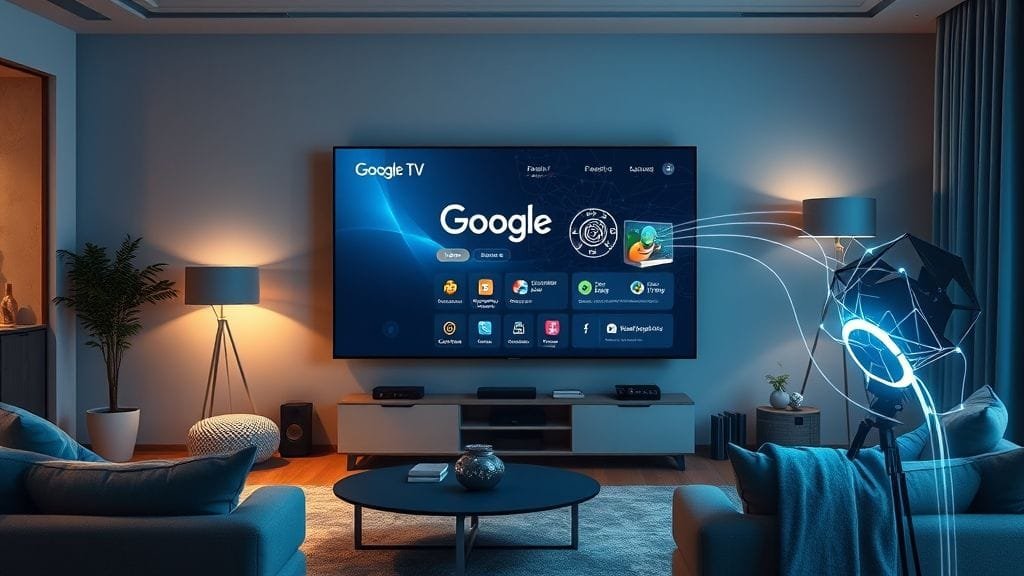
The living room, once just for entertainment, is now becoming an intelligent interaction hub. Google’s phased Gemini rollout to Google TV will transform it. Televisions will become smarter, more responsive, and incredibly personalized. This crucial Google TV Gemini AI integration marks a key evolution for Google TV. It places the platform at the forefront of the AI-powered smart home experience. Users can expect a major shift in how they engage with entertainment, information, and smart home devices. All of this will be orchestrated by Gemini’s advanced capabilities. This deeper intelligence is a direct result of the thoughtful Google TV Gemini AI integration.
From Assistant to AI Powerhouse: Gemini’s Impact as a Google TV AI Assistant
Gemini is not merely a simple update. Instead, it completely reimagines the Google TV voice assistant. It moves beyond Google Assistant’s rigid command-and-response model. Therefore, Gemini offers more natural and sophisticated interactions. This advanced AI assistant uses deep learning and natural language processing, enabling it to understand complex queries and user intent and provide highly relevant answers. Its main goal is a “free-flowing conversational” experience. This effectively mimics human dialogue. Consequently, interactions will feel less like talking to a machine. Users will engage with an intelligent companion, thanks to the robust Google TV Gemini AI integration.
This shift allows users to have more nuanced discussions with their TV. They can ask open-ended questions, for instance. Users can also follow up on previous queries. Furthermore, they can provide vague descriptions, expecting Gemini to understand and act. Gemini’s power comes from its ability to learn and adapt. It progressively adapts to individual user preferences and patterns over time. This personalized intelligence truly differentiates Gemini. It also sets the stage for a new era of home entertainment. This era is largely driven by the advanced Google TV Gemini AI integration.

Unpacking Google TV Gemini AI Integration’s Revolutionary Features
Gemini’s integration unlocks a multitude of powerful new capabilities. These are designed to enhance virtually every part of the Google TV experience. Significantly, these features extend beyond simple content playback. They transform your television into a versatile hub. This hub is ideal for discovery, learning, and daily assistance. All these functions are therefore enabled by Google TV Gemini AI integration.
Enhanced Content Discovery
One of Gemini’s most compelling offerings is its ability to revolutionize content discovery. Gone are the days of endless menu scrolling or forgotten show titles. Users can now engage Gemini intuitively. They can easily find what they want to watch, or indeed discover new content entirely. This demonstrates the power of Google TV Gemini AI integration. For instance, a user might say, “Hey Google, find me a feel-good comedy from the 90s.” Similarly, another request could be, “Show me a sci-fi movie with a strong female lead that’s not too intense.”
Furthermore, Gemini offers deeper content knowledge. It can summarize past seasons of a series a user wants to watch. It also provides reviews from critics and audiences. It even suggests related titles based on obscure preferences. This intelligent engine transcends basic genre suggestions. It understands mood, themes, and narrative styles, delivering truly personalized viewing options. Moreover, it can also assist when a show’s name is forgotten. It works with descriptive clues, leveraging the advanced capabilities of Google TV Gemini AI integration.
Google TV Gemini AI Integration: Unlocking Google TV’s Full Potential
Learning and Information Hub
Google TV, powered by Gemini, is more than just entertainment. It transforms into a powerful learning and information hub. Imagine wanting to learn a new skill – Gemini can assist. It pulls up relevant YouTube videos for cooking tutorials or instrument lessons. Moreover, users can ask complex questions about history, science, or current events. Gemini will then provide concise explanations, often accompanied by supporting visual content from YouTube or other reputable sources. This is a direct benefit of the comprehensive Google TV Gemini AI integration.
This capability transforms the TV into an invaluable tool for households. It supports educational tasks for students. It also satisfies general curiosity for adults. For example, Gemini can explain complex scientific concepts with illustrative videos. It can also provide step-by-step instructions for DIY projects. Gemini uses Google’s vast knowledge base to bring this information directly to the home’s largest screen. This blend of entertainment and education thus makes Google TV more versatile and enriching. It solidifies the importance of Google TV Gemini AI integration.
Seamless Everyday Assistance through Google TV Gemini AI Integration
Seamless Everyday Assistance
Beyond entertainment and learning, Gemini on Google TV acts as a capable everyday assistant. It seamlessly integrates into daily routines. In fact, it offers practical help and convenience. For instance, users can ask for a quick weather forecast or news updates. They can also plan parts of a trip directly from their couch. All this is facilitated by Google TV Gemini AI integration. A typical query might be, “Hey Google, what’s the weather like in Paris next week?” Another could be, “Find me some highly-rated restaurants near Times Square.”
Crucially, Gemini also controls compatible smart home devices. Users can adjust thermostat settings with a simple voice command. Furthermore, they can dim lights, lock doors, or check security camera feeds. All these actions happen seamlessly without needing a separate device. This centralized control transforms the television into a smart home command center. It simplifies management and enhances convenience for the entire household. This highlights the versatility of Google TV Gemini AI integration.
Intuitive Interaction
Interacting with Gemini on Google TV is effortlessly intuitive. Existing Google Assistant users will find the primary methods familiar. For instance, a simple voice command, “Hey Google,” activates Gemini. This allows for hands-free interaction. Alternatively, users can press the dedicated microphone button on their TV remote. This offers a discreet and precise way to engage the assistant. This dual approach thus ensures accessibility and convenience. It caters to different user preferences and situations within the living room, thanks to Google TV Gemini AI integration.
Google TV Gemini AI Integration: Smart Assistance and Intuitive Interaction
The true innovation in interaction lies in Gemini’s ability to maintain context. It understands the conversational flow. Users can thus ask follow-up questions without repeating previous information. This enables a more natural and fluid exchange. Indeed, this intelligent context retention is a cornerstone of Gemini’s “free-flowing conversational” design. Rather than isolated commands, it creates a truly interactive experience that understands the user’s ongoing needs. This is greatly enhanced by the thoughtful Google TV Gemini AI integration.

Navigating the Rollout: When and Where to Expect Google TV Gemini AI Integration
The rollout of Gemini on Google TV is a phased process. It begins with select devices and then gradually expands. This strategic deployment allows Google to refine the integration and gather user feedback before a wider release. Initial availability began in September 2025. It specifically targeted the new TCL QM9K series of televisions. These premium models therefore served as Gemini’s launchpad. They showcased its capabilities in a high-performance environment, demonstrating the initial success of Google TV Gemini AI integration.
Google states Gemini will reach more Google TV devices “later this year.” This rollout includes several popular models. For example, Google’s set-top box, the Google TV Streamer, will soon get Gemini. This gives many users direct AI access. Additionally, the budget-friendly Walmart Onn 4K Pro will update with Google TV Gemini AI integration. Google also confirms that 2025 models like Hisense U7, U8, and UX series. TCL’s QM7K, QM8K, and X11K series will likewise receive Gemini. This initial plan for Google TV Gemini AI integration is clear. However, wider availability beyond these devices is still unknown. Users should check official Google announcements for their hardware updates.
Google TV’s Refreshed Interface with Gemini on Google TV: A Visual Evolution
Alongside the Gemini rollout, Google TV is also revamping its interface. This gradual change has been rolling out since September 2025. Consequently, this visual overhaul aims to streamline navigation. It enhances the user experience and aligns with Google’s broader design language. Key changes include, for example, a more organized layout. Navigation buttons are now grouped conveniently in the screen’s top-left corner. This positioning thus makes primary functions more accessible and intuitive. It notably improves the overall Google TV Gemini AI integration experience.
The redesign reduces the number of tabs. This simplifies the user journey and minimizes clutter. For instance, the “For You” section is now “Home.” This new label is simpler for users to grasp. It also serves as a central hub for personalized content, thus enhancing Google TV Gemini AI integration. Google TV’s Android platform follows a unique update cycle. It might skip Android 15, moving directly to Android 16 for major upgrades. Although the Google TV Streamer received a 2025 security update, it gained no new features or Android version. This indicates a staggered update approach, even with Google TV Gemini AI integration.
The Competitive Edge: How Google TV Gemini AI Integration Stands Out
Gemini’s integration places Google TV in a highly competitive sector. This is within the fiercely competitive smart home and entertainment market. Indeed, major technology players are all vying to embed advanced AI in the living room. They understand its potential to reshape user engagement. Google’s move with Gemini directly challenges established and emerging AI-powered voice assistants. Each of these, however, boasts its own unique strengths and ecosystem integrations. Consequently, Google TV Gemini AI integration serves as a crucial differentiator.
Amazon’s Alexa+, an upgraded assistant, continues to expand its reach. This is especially true within the vast Amazon ecosystem. Samsung’s Bixby, now refined, aims to integrate deeply with its smart TVs and home appliances. Apple’s upcoming Siri enhancements will also bring more intelligent and seamless interactions. These will apply to its own device ecosystem.
Beyond the TV: Android OS Evolves with Gemini Android OS Updates at Its Core
In this competitive arena, Gemini offers a distinct advantage. Its “free-flowing conversational” nature is key. Furthermore, it integrates deeply with Google’s excellent search and information capabilities. Gemini summarizes content and provides educational support. It also handles complex, multi-turn queries. This sets a high bar for intuitive and comprehensive assistance. Consequently, Google TV becomes a more compelling choice for users. They seek truly intelligent entertainment and smart home control. This is all thanks to the innovative Google TV Gemini AI integration.
Android 15 AI Features (“Vanilla Ice Cream”): A Deep Dive into Key Features
While Google TV shows a dramatic shift with Gemini, the core Android operating system is also evolving. Android 15, code-named “Vanilla Ice Cream,” represents its latest iteration. This iteration introduces numerous advancements. It reinforces Google’s commitment to user privacy and device security. It also optimizes the user experience across mobile devices, foldables, and tablets. Central to this evolution is pervasive AI integration, spearheaded by Gemini. This AI reimagines the mobile experience, thereby complementing advances seen with Google TV Gemini AI integration.
Fortified Privacy and Security
Android 15 arrives packed with significant features and API changes. These affect almost every aspect of the user experience. They range from how we protect data to how applications interact with hardware. Each update therefore empowers users with more control. It also enhances performance and streamlines interactions. These goals closely mirror those set for Google TV Gemini AI integration.
Privacy and security remain paramount for Google. Android 15 thus introduces several robust enhancements in this area. Health Connect, the platform for managing fitness data, now receives updates. Users gain more granular control over what information they share with third-party apps. This ensures sensitive health data remains private and manageable. Furthermore, Android 15 tightens security. It restricts older, less secure TLS versions. This pushes developers towards more modern and resilient encryption standards. Thus, it protects data in transit. This holistic security approach extends to and benefits Google TV Gemini AI integration.
Android 15 AI Features: Comprehensive Enhancements
Revolutionizing Camera and Media Capabilities
Among the key security enhancements are new theft-deterrent features. These innovations make stolen devices useless. For instance, Android 15 now requires a PIN or biometric scan for key settings. This prevents thieves from altering crucial settings. Additionally, a smart lock-down system secures a device after too many failed login attempts. It makes the device unusable. Furthermore, the “Private space” feature offers a clever solution. It organizes and hides sensitive apps behind extra security. This keeps personal data private, even if the device is unlocked. Such strong security is crucial for AI systems, including Google TV Gemini AI integration.
Key Android 15 AI Features
Android 15 also offers exciting new camera and media tools. These improvements enhance how users capture and experience media. For example, “Low Light Boost” greatly enhances photos in dim conditions. This provides clearer, brighter shots, even in darkness. This feature significantly improves content quality in challenging lighting conditions. Moreover, developers now gain access to enhanced in-app camera controls. This lets third-party apps provide advanced photo features. Such options were once only in native camera apps. As a result, users can engage in more creative photo and video editing. They can also create richer content, complementing features like Google TV Gemini AI integration.

Advanced Connectivity: The Satellite Frontier
Beyond photography, media consumption also improves. Android 15 extends platform support for AV1 software decoding, benefiting devices without dedicated hardware support for this efficient video codec. Consequently, a wider range of devices can play high-quality, bandwidth-efficient AV1 content smoothly. This enhances streaming and media playback experiences across the ecosystem. Such advancements perfectly complement the rich media discovery and playback capabilities from Google TV Gemini AI integration.
Key Android 15 AI Features and Improvements
Enhanced User Experience and Multitasking
Android 15 introduces numerous improvements. These refine the user experience and bolster multitasking, particularly for large-screen devices, foldables, and tablets. Partial screen sharing is, for instance, a standout feature. It allows users to share or record only a specific app window. This means they do not share their entire screen. This is invaluable for privacy during video calls. Furthermore, it helps with focused content creation. For devices with larger displays, a persistent and pinnable taskbar enhances productivity. It provides quick access to frequently used apps. Ultimately, these enhancements work in tandem with the intelligence of Google TV Gemini AI integration.
Android 15 AI Features: User and Developer Innovations
Developer-Centric Innovations
“App Pairs” simplifies split-screen multitasking. Users can thus launch two apps at once with a single tap. This feature greatly boosts efficiency. Moreover, it allows smooth transitions between tasks, such as browsing and note-taking. Better cover screen support on foldables also ensures more functional external displays. This offers a smoother shift between folded and unfolded states. A new collapsible volume panel and default edge-to-edge apps modernize the UI. These changes optimize screen space utilization. They also provide a more immersive visual experience, much like the refined interface of Google TV Gemini AI integration.
While Android 15 focuses heavily on end-users, it also brings valuable features for developers. This fosters a more robust and innovative app ecosystem. Notably, OS-level support for app archiving and unarchiving improves quality of life. Users can temporarily remove apps to free up space. They do so without losing data or settings. They can then easily restore them later. This optimizes storage management. It also reduces friction for users, complementing the seamless management promised by Google TV Gemini AI integration.

Gemini’s Broader Embrace: Google TV Gemini AI Integration Across the Android Ecosystem
Extended Universal MIDI Packet (UMP) support enhances virtual MIDI apps. This significantly boosts capabilities for musicians and audio developers. It allows for more advanced and expressive musical applications on Android. Furthermore, Google continues to modernize the Canvas graphics system. This provides developers with powerful, efficient tools. They can thus create rich, dynamic user interfaces and animations. These developer-centric updates are crucial. They maintain Android’s position as a leading platform for innovation. Ultimately, they create fertile ground for features like Google TV Gemini AI integration.
Gemini Live: Conversational AI on Your Phone
Gemini’s reach extends beyond Google TV. Google is also deeply integrating it into the broader Android operating system. This fundamentally reimagines the phone experience with AI at its core. Indeed, this ubiquitous integration makes AI an intrinsic part of user interaction. It thus facilitates understanding natural language, completing complex tasks, and generating creative content. All this works in concert with the powerful Google TV Gemini AI integration.
Google TV Gemini AI Integration: Revolutionizing the Android Experience
Gemini Nano: On-Device Intelligence for Privacy
“Gemini Live” vividly demonstrates this goal. It provides a highly conversational AI on Android devices. This tool understands context, nuances, and follow-up questions. It therefore allows for natural user interaction. Users can truly converse with their phone, much like a human. Thus, it can handle complex tasks, summarize long articles, or draft emails. Moreover, it creates images right from an overlay. This offers instant, smart help across apps and system functions. Clearly, this constant availability and fluent conversation will transform smartphones into even stronger personal assistants. This capability mirrors the Google TV Gemini AI integration.
Gemini’s Comprehensive Android Integration, Extending to Google TV Gemini AI Integration
Global Reach and Accessibility
Google created Gemini Nano, a powerful on-device AI model. It prioritizes privacy, especially for sensitive data. The model therefore processes information directly on your phone. It avoids cloud servers for this work. This local processing ensures data privacy and security for many uses. For example, “Call Notes” on Pixel 9 transcribes and summarizes phone calls. Importantly, the audio never leaves your device. Additionally, “Pixel Screenshots” analyzes and acts on screenshot information. All this processing occurs securely on-device. Thus, Gemini Nano boosts AI features while keeping user data private. This core principle also extends to Google TV Gemini AI integration.

The Enduring Legacy: Android’s Journey and Strengths
Google harbors a truly global ambition for Gemini. The AI assistant is widely accessible. It supports an impressive 45 languages. It is also available on hundreds of phone models across over 200 countries and territories. This expansive reach ensures that most Android users worldwide benefit from Gemini’s advanced capabilities. It fosters a more inclusive and intelligent digital experience, regardless of location or language. This global deployment therefore underscores Google’s commitment. It aims to make cutting-edge AI available to everyone, including through the accessible Google TV Gemini AI integration.
A History of Innovation
Android’s evolution showcases continuous innovation. It also highlights its commitment to an open ecosystem. Since its inception and Google’s acquisition, Android has grown dramatically. It evolved from a nascent mobile OS into the dominant global platform. Indeed, it underpins a vast array of devices and experiences. This includes the sophisticated Google TV Gemini AI integration.
Pillars of Power: Customization, Ecosystem, Security
Android Inc. started its journey in 2003. Andy Rubin, Rich Miner, Nick Sears, and Chris White founded it. Initially, they envisioned a camera operating system. However, Google acquired Android Inc. in 2005, shifting its focus to smartphones. As a result, the HTC Dream (T-Mobile G1), the first Android phone, launched in 2008. Since then, Android has seen continuous development. It has also stayed true to its open-source nature. Android regularly introduces pioneering features. Furthermore, each dessert-named version has brought significant advancements. This has made Android synonymous with cutting-edge mobile technology. Today, initiatives like Google TV Gemini AI integration continue this legacy.

The Symbiotic Future: Google TV, Gemini, and Android’s Unified Vision
Android’s enduring strength derives from several core pillars. Its unparalleled customization options let users and manufacturers tailor the experience. This meets their precise needs. It also fosters a diverse range of device aesthetics and functionalities. This flexibility therefore differentiates Android from more closed ecosystems. Furthermore, deep integration with Google services offers a seamless and powerful user experience. These services include Gmail, Maps, YouTube, and Chrome. They make Android devices highly functional for everyday tasks. Such synergy deeply benefits Google TV Gemini AI integration.
Anticipating the User Impact of Google TV Gemini AI Integration
The Google Play Store ecosystem offers a vast array of software. It contains millions of apps, ranging from work tools to entertaining games. Thus, this marketplace meets most digital needs. Moreover, Android delivers strong multitasking features. Users can quickly switch apps or use split-screens, boosting productivity. Furthermore, the platform regularly improves its security features. These include biometric access, encrypted storage, and frequent updates. They reliably protect user data and devices. Ultimately, this approach showcases Android’s flexibility and wide reach. For example, it supports many devices, including phones and smartwatches. These will increasingly integrate with Google TV Gemini AI integration.

The Road Ahead: What’s Next for Google’s AI Ecosystem
Google’s overarching strategy is clear. It combines the distinct yet interconnected advancements in Google TV (with Gemini) and the Android OS (with Android 15). The vision is simple: artificial intelligence is not merely an add-on. Rather, AI serves as the central nervous system that connects and enriches every digital interaction. Thus, this symbiotic relationship between Google TV, Gemini, and the Android platform creates a cohesive and deeply intelligent ecosystem. This ecosystem anticipates user needs and simplifies daily life. Importantly, Google TV Gemini AI integration lies at its heart.
A unified vision promises users a more intuitive experience. It powers seamless interactions across all Google devices. Indeed, the boundaries between separate device features are disappearing. Imagine searching for a movie on your Google TV with Gemini. You can then smoothly continue this search on your Android phone. For instance, look up actor bios or order food. All this occurs in a smart, AI-aware environment. Gemini learns from your TV, thus informing phone recommendations and vice-versa. This creates a personalized digital companion, extending beyond one device. Consequently, users face less friction and enjoy greater personalization. Technology truly adapts to you, all thanks to Google TV Gemini AI integration.

Frequently Asked Questions
Q1: What is the main difference with Gemini on Google TV and Google Assistant?
A1: The main difference is Gemini’s advanced “free-flowing conversational” AI. While Google Assistant primarily responds to direct commands, Gemini understands complex queries, maintains context across conversations, offers more intuitive content discovery, and provides detailed information or summaries, making interactions feel more natural and human-like, thanks to Google TV Gemini AI integration.
Q2: When can I expect Gemini to arrive on my Google TV device?
A2: The rollout of Gemini on Google TV began in September 2025, initially on select TCL QM9K series TVs. Google has confirmed it will expand to more devices “later this year,” including the Google TV Streamer, Walmart Onn 4K Pro, and 2025 models from Hisense (U7, U8, UX) and TCL (QM7K, QM8K, X11K). Check Google’s official announcements for specific timelines for other devices regarding the Google TV Gemini AI integration.
Q3: What are the most significant privacy enhancements in Android 15?
A3: Android 15 introduces several key privacy enhancements, including updates to Health Connect for better fitness data management, stricter enforcement of modern TLS versions for secure data transfer, and new theft-deterrent features that require PIN/biometric authentication for sensitive settings—measures that underpin the security of Google TV Gemini AI integration.
Q4: How does Gemini Nano enhance privacy on Android devices?
A4: Gemini Nano is a large, on-device multimodal AI model. It enhances privacy by processing sensitive information, such as transcribing call notes or analyzing pixel screenshots, directly on the Android phone. This on-device processing prevents the data from being sent to cloud servers, ensuring personal data remains private and secure on the user’s device, reflecting the privacy-first approach also evident in the Google TV Gemini AI integration.
Q5: Will Google TV devices skip Android 15 and go directly to Android 16?
A5: Indications suggest that Google TV’s underlying Android platform may follow a two-year update cycle for major versions, potentially skipping Android 15 and jumping directly to Android 16. However, this is an ongoing observation, and official confirmation of this specific skipping pattern for all Google TV devices is still emerging, though the continuous evolution will still support the latest advancements in Google TV Gemini AI integration.