The GPU market is changing rapidly, with demand for AI applications, data centers, and immersive gaming driving explosive growth. This dynamism is central to any upcoming GPU market analysis. Furthermore, a fierce three-way competition further defines this expansion. NVIDIA, AMD, and Intel—these technology titans—are deploying distinct strategies. Consequently, each company is leveraging new architectures and innovations to gain market share.
This upcoming GPU market analysis explores key developments and examines the future roadmaps of NVIDIA, AMD, and Intel. Specifically, we will cover NVIDIA’s Blackwell architecture and its ongoing dominance. We will also detail AMD’s strategic move to RDNA 4 and its ambitious UDNA plans. Additionally, Intel’s Arc series, including Battlemage and Celestial, will be discussed. Understanding these trajectories is vital for gamers, content creators, data scientists, and enterprise decision-makers.
The Exploding GPU Landscape: An Upcoming GPU Market Analysis Overview
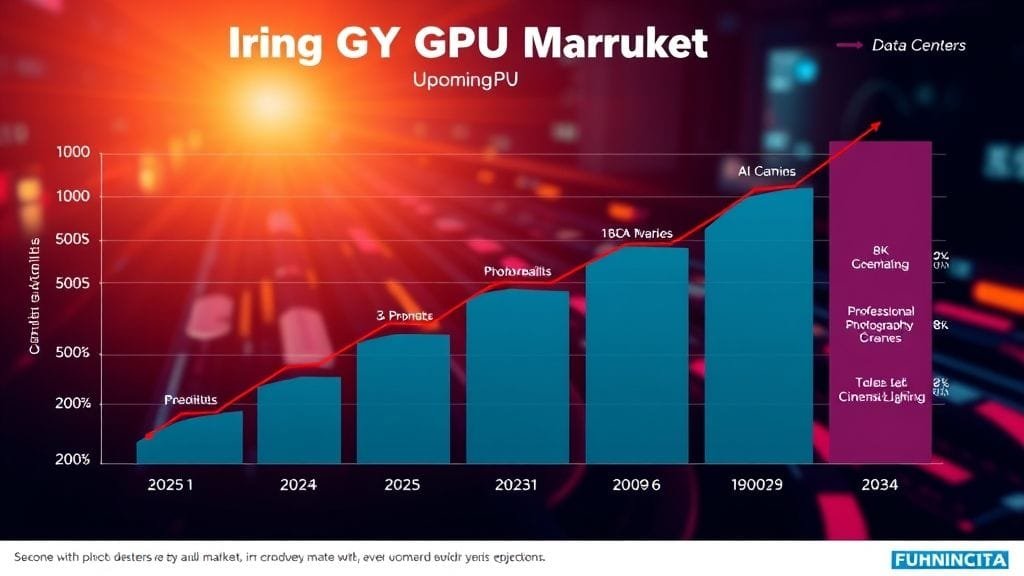
The GPU market is a powerhouse of innovation and economic growth. Projections indicate a staggering expansion, with estimates ranging from $82.68 billion in 2025 to over $352.55 billion by 2030, reflecting a compound annual growth rate (CAGR) of 33.65%. Other analyses are even more optimistic, forecasting a leap to $1.41 trillion by 2034. Any robust upcoming GPU market analysis must consider these figures. These figures highlight the critical role GPUs play across various sectors.
Several key factors are boosting this market. Artificial Intelligence (AI) is a key driver, demanding significant computing power. Thus, robust GPUs are essential for AI training and data center tasks. Cloud services also contribute significantly, as businesses increasingly leverage cloud AI. Furthermore, the gaming industry continues its rapid innovation. This, in turn, necessitates more powerful GPUs for lifelike graphics and virtual worlds. Our upcoming GPU market analysis will detail these trends. However, the market also faces challenges. These include high production costs and potential supply chain issues. Additionally, powerful hardware consumes more energy.

NVIDIA’s Dominance: A Key Factor in Any Upcoming GPU Market Analysis
NVIDIA remains the undisputed leader in the discrete GPU market, particularly when it comes to high-end performance and AI acceleration. The company’s strategic focus on a robust ecosystem, exemplified by its CUDA platform, has created a formidable competitive moat. This provides a key insight for any upcoming GPU market analysis. With over 90% of AI developers locked into CUDA, the switching costs for competitors are incredibly high.
NVIDIA launched its next-generation Blackwell-powered GeForce RTX 50 series GPUs at CES 2025. This event marked a significant milestone. Furthermore, this new lineup pushes the boundaries of gaming performance and AI integration. Consequently, it significantly shapes any upcoming GPU market analysis.
Blackwell Architecture and RTX 50 Series Rollout: Shaping Future GPU Trends
Blackwell GPUs first launched in early 2025, bringing substantial upgrades and new features. For instance, the flagship RTX 5090, priced at $1,999, led the charge. It saw immense demand and rapid sell-outs on January 30th. Next, the high-performance RTX 5080 arrived at $999. Additionally, mid-range options like the RTX 5070 Ti ($749) and RTX 5070 ($549) followed in February and March. These models offered compelling performance across a wider price spectrum. Consequently, our upcoming GPU market analysis closely observes this trend.
Early performance leaks and user benchmarks quickly validated the excitement surrounding the RTX 5090. Indeed, reports indicated impressive gains. The top-tier card potentially offered 33% to 54% higher scores in synthetic benchmarks. These results, moreover, significantly surpassed its predecessors. Such advancements are critical points in our upcoming GPU market analysis. This performance leap stems from Blackwell’s architectural enhancements and sophisticated AI technologies.
Advanced AI Technologies: DLSS 4 and Reflex 2
A cornerstone of NVIDIA’s strategy is the integration of advanced AI capabilities directly into its gaming GPUs. The RTX 50 series introduces significant advancements with DLSS 4 (Deep Learning Super Sampling) and Reflex 2. This strategy is a major factor in any comprehensive upcoming GPU market analysis.
- DLSS 4 with Multi Frame Generation: This next iteration of NVIDIA’s AI-powered upscaling technology promises even greater performance boosts and visual fidelity. Multi Frame Generation likely builds upon the success of Frame Generation in DLSS 3, creating additional frames using AI to deliver smoother gameplay, particularly in demanding titles.
- Reflex 2 with Frame Warp: NVIDIA Reflex has become essential for competitive gamers, significantly reducing system latency. Reflex 2, combined with the rumored Frame Warp technology, aims to further minimize input lag, providing an even more responsive gaming experience. These innovations not only enhance performance but also solidify NVIDIA’s reputation as a leader in AI-driven graphics.

NVIDIA’s Market Share and Future Outlook in the Upcoming GPU Market Analysis
NVIDIA maintains a very firm grip on the discrete GPU market. The company remained dominant in Q4 2024, despite modest gains from AMD. This leadership also extends to the highly profitable AI GPU segment, where NVIDIA commanded an estimated 86% market share by Q1 2025. Furthermore, NVIDIA holds an overwhelming 92% share for discrete desktop and laptop GPUs, with the RTX 5090’s rapid sell-out further illustrating the immense demand for its top-tier offerings.
NVIDIA is not resting on its laurels. Rumors suggest “Super” refreshes for the RTX 5000 series might arrive in Q1 or Q2 2026. These mid-cycle upgrades typically enhance performance and/or memory. Therefore, they keep NVIDIA’s lineup fresh and competitive. This also reinforces its position in the upcoming GPU market analysis. Overall, NVIDIA’s strategy emphasizes consistent innovation, ecosystem lock-in, and a powerful brand. These factors contribute to its sustained market leadership.
AMD’s RDNA 4 and UDNA Ambitions: A Critical Part of the Next-Gen GPU Forecast
The projected growth rates for the GPU market are truly impressive. They underscore the indispensable role of graphics processors in modern computing. Indeed, this is a key finding in any upcoming GPU market analysis.
- Artificial Intelligence (AI): The burgeoning field of AI is the single most significant driver. This includes generative AI for content creators and large language models. Training complex neural networks requires massive parallel processing power. GPUs are uniquely suited to provide this. Furthermore, hyperscale inference in data centers, where AI models make predictions, also contributes heavily.
RDNA 4: Targeting the Mainstream Market
AMD’s RDNA 4 GPUs will launch in early 2025. Crucially, these new graphics cards will focus on the entry-level to mid-range market. This marks a deliberate strategic shift. AMD will deliberately avoid direct competition in the ultra-enthusiast segment with RDNA 4. Several factors likely influenced this decision. For instance, AMD faced challenges with RDNA 3’s chiplet architecture. Consequently, this made direct competition against NVIDIA’s monolithic designs at the top end challenging.
AMD is focusing on the high-volume, mid-tier market. This approach aims to capture a larger user base. Moreover, it aims to offer competitive performance and efficiency to a wide range of gamers and general users. This segment often yields the most significant sales volumes. Consequently, this is a shrewd strategic move that influences our upcoming GPU market analysis.
UDNA/RDNA 5: AMD’s Return to High-End Ambitions and its Impact on Future GPU Trends
RDNA 4 targets the mainstream. However, AMD’s long-term vision includes a powerful return to the high-end market. Rumors indicate AMD is preparing an entirely new architecture, possibly named UDNA, to succeed RDNA 4. The naming is fluid; indeed, some reports suggest UDNA is RDNA 5. This indicates a significant architectural overhaul, not just an upgrade. This ambition forms a significant part of the upcoming GPU market analysis. AMD anticipates mass production for this architecture beginning in Q2 2026. Therefore, a launch could happen as late as 2027.
This future architecture will directly challenge NVIDIA’s top-tier offerings. Leaks suggest the top-end Navi 5X SKU, under UDNA/RDNA 5, could feature 96 Compute Units (CUs). This represents a considerable leap in raw processing power. Furthermore, these future GPUs may include a 384-bit memory bus. They could also utilize cutting-edge GDDR7 memory. This would provide significantly higher bandwidth than current GDDR6.

Speculation about UDNA/RDNA 5 also reaches the console space. Indeed, rumors suggest the upcoming PlayStation 6 (PS6) console might adopt this advanced GPU technology. This would provide a powerful, high-performance foundation for next-generation console gaming. Moreover, it would further demonstrate AMD’s capability in delivering cutting-edge silicon. Any comprehensive upcoming GPU market analysis meticulously tracks such developments.
Intel’s Position in the Upcoming GPU Market Analysis: Battlemage’s Arrival and Celestial’s Uncertain Future
Intel is a relative newcomer to the discrete GPU market. Nevertheless, it continues its ambitious journey with the Arc series. Following the “Alchemist” generation, Intel is steadily advancing its graphics capabilities. Through new architectures, Intel seeks to establish itself as a viable third option. Indeed, this is a key aspect of any upcoming GPU market analysis.
Battlemage (Xe2): A Step Forward in Arc
Intel’s second-generation Arc GPUs, code-named “Battlemage” (Xe2), have debuted, with the Arc B580 launching in late 2024 and early 2025. This marked a crucial step forward for Intel’s discrete graphics efforts and represents a significant development for any upcoming GPU market analysis. Intel is building these Battlemage GPUs on TSMC’s 4nm node. This is a significant upgrade from Alchemist’s manufacturing process. This advanced node promises increased transistor density and improved power efficiency. It also addresses key areas where the first generation received criticism.
The Battlemage architecture also appears in Intel’s integrated GPUs. Notably, it debuted as the graphics component within Intel’s Lunar Lake “Core Ultra” CPUs. This provided a substantial boost in graphical performance for laptops and ultra-portable devices. This dual deployment strategy helps Intel leverage its architectural investments, applying them across both integrated and discrete product lines. Consequently, this showcases its commitment to a comprehensive graphics portfolio. Analysts consistently consider this factor in an upcoming GPU market analysis.

Celestial (Xe3): Ambition Meets Uncertainty
After Battlemage, Intel plans the third-generation “Celestial” (Xe3) architecture. Initially, reports outlined an ambitious roadmap for Celestial. These suggested Intel would design it for TSMC’s 3nm node. Consequently, its launch was initially slated for the second half of 2026. Ultimately, this would represent another significant leap in manufacturing technology and performance potential.
The future of discrete Celestial GPUs has become uncertain. More recent rumors from May 2024 and September 2025 cast doubt on its immediate future. Indeed, some reports even hint at potential delays or outright cancellation of the discrete product line. Therefore, this uncertainty adds complexity to any upcoming GPU market analysis. Additionally, one intriguing rumor suggests an alleged partnership with NVIDIA. This could fundamentally alter Intel’s long-term discrete GPU strategy.
Despite rumors, Intel remains confident in its Celestial project. Officials confirm the hardware design is now “finished.” Furthermore, software development continues steadily. The core technology is thus ready for launch. However, its release may hinge on market conditions or key partnerships. Moreover, whispers suggest Celestial GPUs might move production away from TSMC. Intel could produce them internally instead. This change would give Intel more manufacturing control. It might also reduce costs. Our upcoming GPU market analysis will closely track these shifts. The next few years will reveal Celestial’s ultimate path.
The Evolving Competitive Landscape and Market Share Dynamics in the Upcoming GPU Market Analysis
The GPU market is not static. It is a dynamic arena where market share shifts and competitive strategies constantly evolve. This is a key focus for an upcoming GPU market analysis. NVIDIA maintains a commanding lead. However, AMD shows signs of growth, and Intel continues earnest efforts to establish a foothold.
NVIDIA’s Unwavering Dominance: A Constant in Future GPU Trends
NVIDIA holds an exceptionally strong market position. Its high-performance products and unparalleled ecosystem bolster this position. The company’s focus on AI and data center solutions has paid immense dividends. Indeed, it secured a dominant 86% share in the AI GPU segment. Furthermore, NVIDIA’s 92% share in the discrete desktop/laptop GPU market testifies to its brand loyalty, technological superiority, and comprehensive product stack. The RTX 5090’s rapid sell-out further illustrates the immense demand for its top-tier offerings. Any upcoming GPU market analysis notes this.
AMD’s Strategic Gains
AMD still lags behind NVIDIA. Nevertheless, the company shows clear potential for growth. Its market share increased from 10% in Q3 2024 to 17% in Q4 2024. This rise, while modest compared to NVIDIA’s larger presence, confirms AMD’s strategy resonates with buyers. AMD provides compelling performance for its cost, especially in the mid-range sector. Consequently, this makes it crucial for any upcoming GPU market analysis. Its RDNA 4 architecture specifically aims at the entry-to-mid-range market. Therefore, AMD intends to build upon this achievement. It offers a solid choice for users who do not require NVIDIA’s priciest products, with many consumers finding its overall value attractive.
Intel’s Uphill Battle
Intel faces a challenging market. For instance, despite launching its Battlemage GPUs, Intel holds under 1% of the discrete GPU market. This small share highlights the formidable difficulty of breaking a duopoly. Two experienced giants already dominate, both bolstered by strong ecosystems. Nevertheless, Intel’s Arc commitment indicates a long-term strategy. Battlemage’s upgrades and Celestial’s development confirm this direction. To succeed, Intel requires consistent performance, robust driver support, and competitive pricing. Furthermore, it must offer a unique advantage against NVIDIA and AMD. These points are vital for its position in the upcoming GPU market analysis.
Driving Forces, Future Projections, and Lingering Challenges for the Upcoming GPU Market Analysis
The future of the GPU market is bright, largely driven by fundamental technological shifts and increasing demand across multiple sectors. This forms a core part of an upcoming GPU market analysis. However, this growth also presents its own set of hurdles.
Accelerating Growth and Key Drivers for Next-Gen GPU Forecasts
This upcoming GPU market analysis reveals intense innovation, strategic positioning, and significant growth potential. These three tech titans are pushing the boundaries of silicon, memory, and software. Consequently, the benefits will cascade through every facet of technology. This includes scientific research, data centers, immersive entertainment, and everyday computing. The next few years promise to be revolutionary for graphics processing.
Enduring Challenges
The GPU market faces several challenges. These could impact its future path:
High Costs: Developing and manufacturing advanced GPUs is very expensive. This, in turn, drives up retail prices for consumers, especially for top models. Consequently, high costs may limit market access for some buyers. Any upcoming GPU market analysis must consider these hurdles.
Supply Chain Constraints: The global semiconductor industry recently experienced numerous supply chain issues. Although some issues have eased, the creation of advanced nodes (like 4nm and 3nm used by Battlemage and potentially Celestial) remains complex. Furthermore, it can be vulnerable to global tensions or production bottlenecks.
The Road Ahead: What to Expect from the Upcoming GPU Market Analysis
Further challenges also exist for the GPU market:
- Energy Consumption: Powerful GPUs consume considerable energy. This is a significant concern for data centers, which face high electricity bills and environmental demands. Moreover, individual users worry about power costs and heat. Therefore, innovations in power efficiency are vital for sustained growth. An upcoming GPU market analysis consistently stresses this point.
- Competition: The strong competition among NVIDIA, AMD, and Intel benefits consumers. However, it demands constant innovation and fair pricing. This can, however, strain company profit margins. Furthermore, new players might add to this pressure.
The GPU market is shifting rapidly. NVIDIA, for example, will likely continue to dominate high-end GPUs and AI products. Its strong ecosystem provides a clear advantage. Moreover, “Super” refreshes should ensure Blackwell remains competitive. In contrast, AMD follows a two-part strategy. It targets mid-range success with RDNA 4. Additionally, AMD seeks a strong return in enthusiast cards using UDNA/RDNA 5. This method could significantly improve its market position. Intel, however, still struggles. Despite this, it aims to establish itself as a serious third rival. Battlemage forms its current base. Yet, Celestial promises future expansion, despite some uncertainties. Our upcoming GPU market analysis will detail these key changes.
Consumers can expect more powerful, efficient, and AI-integrated GPUs. Increasing competition should lead to more aggressive pricing. It should also foster a wider variety of options across all performance tiers. However, the premium for top-tier hardware will likely remain high. This is especially true for AI-accelerated solutions. Continuous advancements in manufacturing processes (like TSMC’s 4nm and 3nm nodes) will underpin these improvements. Consequently, they allow for greater transistor density and enhanced performance per watt. These advancements are crucial considerations for any upcoming GPU market analysis.
Conclusion
The interplay between these three giants will define the next chapter of graphics processing. Indeed, this is a critical insight from this upcoming GPU market analysis. Each company’s success will hinge on several factors. These include seamless AI integration, compelling value, and sustainable ecosystems. Furthermore, they must meet the diverse and escalating demands of the modern computing world.
The GPU market is dynamic and expanding rapidly. AI, cloud computing, and gaming drive this rapid growth. Therefore, an upcoming GPU market analysis is essential for understanding tech trends. NVIDIA, using its Blackwell architecture, leads in AI and high-end GPUs, and notably dictates much of the market’s direction. Meanwhile, AMD is recalibrating. It is focusing RDNA 4 on the vital mid-range. AMD also aims for a high-end return with its UDNA/RDNA 5 project. Intel, though an underdog, is building its Arc foundation with Battlemage. It is also poised for future impact with Celestial, yet its path is less clear.
Frequently Asked Questions
Q1: What is the current state of the GPU market?
A1: The GPU market is experiencing robust growth, driven primarily by demand for AI, data centers, and gaming. It is projected to grow significantly, from around $82 billion in 2025 to over $350 billion by 2030, with NVIDIA holding a dominant market share. A comprehensive upcoming GPU market analysis confirms these trends.
Q2: What are NVIDIA’s latest GPU offerings?
A2: NVIDIA launched its Blackwell-powered GeForce RTX 50 series GPUs in early 2025, including the RTX 5090, RTX 5080, RTX 5070 Ti, and RTX 5070. These cards feature advanced AI technologies like DLSS 4 and Reflex 2.
Q3: What are AMD’s plans for its next-gen GPUs?
A3: AMD’s RDNA 4 GPUs are expected in early 2025, focusing on the entry-level to mid-range market. For the high-end, AMD is developing a successor architecture, potentially named UDNA (or RDNA 5), aiming for a 2027 launch with up to 96 Compute Units and GDDR7 memory.
Q4: How is Intel progressing with its Arc GPUs?
A4: Intel has launched its second-generation Arc “Battlemage” (Xe2) GPUs, built on TSMC’s 4nm node, in late 2024/early 2025. The third-generation “Celestial” (Xe3) is planned to follow, but its discrete GPU future faces some uncertainty and rumors of delays or potential strategic shifts.
Q5: What are the main challenges facing the GPU market?