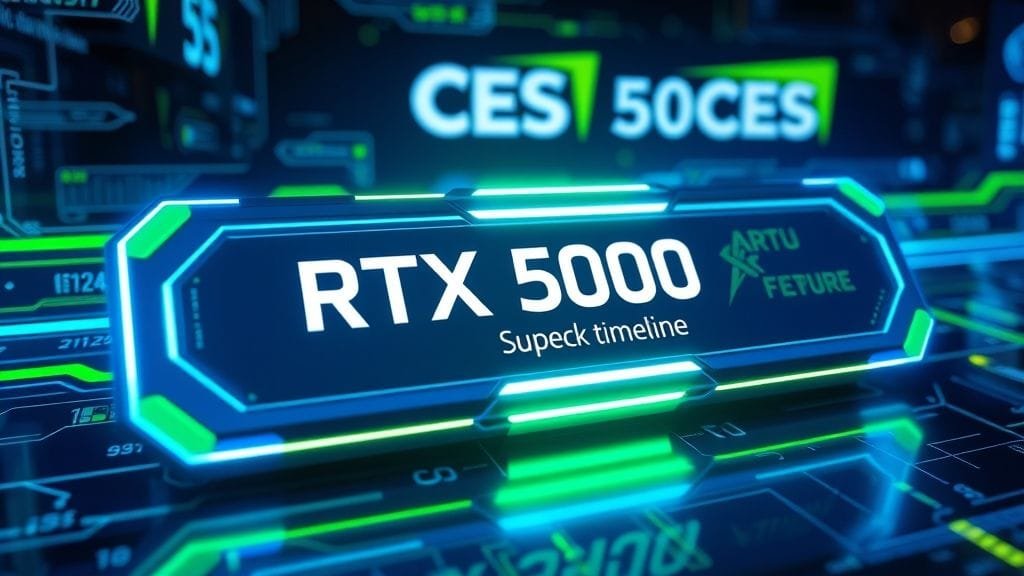
The highly anticipated RTX 5000 Super launch timeline currently fuels widespread speculation among gamers and professionals. Enthusiasts eagerly monitor every leak and rumor. NVIDIA remains silent; however, a strong consensus suggests a CES 2026 unveiling. Market availability will likely follow by spring. Consequently, this article separates fact from rumor. We provide a comprehensive overview of the RTX 5000 Super series, furthermore exploring its potential impact on the GPU market.

The Stage is Set: Why CES 2026 is Key to the RTX 5000 Super Launch Timeline
CES in Las Vegas provides a premier global platform for groundbreaking product launches. CES 2026 (January 6-9) offers NVIDIA a prime chance to unveil the RTX 5000 Super launch timeline. The event garners widespread attention, generating immense buzz for new GPUs. NVIDIA consistently uses high-visibility events for major announcements, making CES 2026 perfect for the new RTX Super availability.

Industry sources largely agree the RTX 5000 Super series will debut at CES 2026. This aligns with NVIDIA’s usual reveal pattern. CES provides an ideal stage to showcase enhanced GPUs to a global audience of media, partners, and consumers. The event’s scale ensures widespread announcement, maximizing impact and building anticipation for the 50-series Super reveal.
Consumers must distinguish between announcement and market availability for the RTX 5000 Super launch timeline. A CES 2026 unveiling is highly likely, but cards won’t reach stores immediately. This phased approach is common for complex tech, allowing strategic rollout. It balances early excitement with logistical needs for new RTX Super availability.
Understanding the RTX 5000 Super Launch Timeline: Announcement vs. New RTX Super Availability
CES in Las Vegas provides a premier global platform for groundbreaking products. CES 2026 (January 6-9) offers NVIDIA a prime chance to unveil the RTX 5000 Super launch timeline. The event gains widespread attention and generates immense buzz for its latest GPUs. NVIDIA consistently uses high-visibility events for major announcements, fitting CES 2026 perfectly for the NVIDIA Super release date.
Industry sources agree the RTX 5000 Super series will debut at CES 2026. This follows NVIDIA’s usual product reveal pattern. CES provides an ideal stage, allowing NVIDIA to showcase enhanced GPUs to a global audience including media, partners, and consumers. The event’s scale ensures widespread announcement, maximizing impact and building anticipation for the Blackwell refresh schedule.
Consumers must understand a crucial distinction for the new RTX Super availability: “announcement” differs greatly from “market availability.” A grand unveiling at CES 2026 is very likely, but cards won’t reach stores immediately. This common phased approach allows strategic rollout, balancing early excitement with logistical needs for the 50-series Super reveal.
NVIDIA’s Release Cadence: Predicting the RTX 5000 Super Launch Timeline
Consumers wanting system upgrades should note a key distinction regarding the RTX 5000 Super launch timeline. An announcement differs greatly from market release. The RTX 5000 Super series will likely debut at CES 2026, but we project market availability between March and May 2026. This normal two-to-four-month gap reflects complex GPU manufacturing and distribution processes.

This delay offers NVIDIA several strategic advantages for the Blackwell refresh schedule. It allows fine-tuning manufacturing, ensuring sufficient stock. Rushing causes shortages, frustrating consumers. It also provides flexibility for global logistics and distribution, plus enables early feedback for marketing adjustments before widespread availability.
Earlier rumors suggested a Q4 2025 launch for the RTX 5000 Super series. Recent credible leaks have dismissed these, with current information strongly favoring the Q1/Q2 2026 window. This refined timeline gives future GPU buyers a clearer picture, allowing consumers to adjust strategies and rivals like AMD to plan for the NVIDIA Super release date.
What to Expect: Enhancements Alongside the RTX 5000 Super Launch Timeline
To understand the RTX 5000 Super launch timeline, consider NVIDIA’s past GPU release patterns. Historically, new core architectures arrive every two years. Between these, “Super” or “Ti” refreshes often appear at one-year intervals. These mid-cycle updates invigorate the product line, offering better performance at specific price points and responding to market demands.

The current RTX 5000 series uses the advanced Blackwell GPU architecture, a significant generational leap. The RTX 5000 Super series refreshes this architecture but does not replace it. This aligns perfectly with NVIDIA’s pattern of incremental refinements. NVIDIA has an aggressive annual release schedule for AI hardware, but gaming GPUs typically follow a slower cadence for their Blackwell refresh schedule.
Despite a faster AI pace, NVIDIA supports existing gaming GPU lineups for months post-launch, ensuring early RTX 5000 series adopters feel supported. This maximizes product lifecycle. The CES 2026 reveal and Q1/Q2 2026 launch for new RTX Super availability fit this framework perfectly. This signals NVIDIA’s aim to maintain a predictable yet competitive gaming GPU market presence, impacting the overall RTX 5000 Super launch timeline.
The “Super” Strategy: Impacting the Blackwell Refresh Schedule
Beyond the launch date buzz, the RTX 5000 Super series promises exciting improvements. Leaks suggest three models: RTX 5070 Super, RTX 5070 Ti Super, and RTX 5080 Super. These new cards will offer significant performance boosts, driven by focused specification upgrades over standard versions. This strategy directly impacts the Blackwell refresh schedule.

A key upgrade for the 50-series Super reveal is increased VRAM capacity, crucial for modern gaming at high resolutions and with ray tracing. Rumors indicate the RTX 5080 Super and RTX 5070 Ti Super might offer 24GB of VRAM, providing generous memory headroom and future-proofing. The RTX 5070 Super could also upgrade to 18GB VRAM.
These VRAM increases likely stem from new 24 Gbit GDDR7 memory chips, offering faster bandwidth. This improved bandwidth and expanded capacity will boost overall performance in memory-intensive tasks. Beyond VRAM, modest increases in shader counts and GPU clock speeds are expected across the RTX 5000 Super series. These enhancements will improve raw processing power and gaming fluidity, not a dramatic generational leap.
The Silence from Partners: Clues for the RTX 5000 Super Launch Timeline
An interesting detail stands out: a reported lack of official communication with add-in board (AIC) partners regarding RTX 5000 Super GPUs. Graphics card makers like ASUS, MSI, and Gigabyte are vital to NVIDIA’s ecosystem. This absence of official details strongly demonstrates NVIDIA’s tight control, managing both the RTX 5000 Super launch timeline and specific product details very closely.
This tight control is a double-edged sword. It effectively prevents early leaks and ensures precise execution of NVIDIA’s launch strategy. However, AIC partners receive less time to develop custom coolers, PCB layouts, and software. Since the Super series refreshes existing Blackwell architecture, many design principles and components are already known. This may streamline partner development once details are shared for the new RTX Super availability.
Anticipated Impact of the RTX 5000 Super Launch Timeline on the GPU Market
NVIDIA’s RTX 5000 Super series strategy is a calculated, successful move within the competitive GPU market. This mid-cycle refresh revitalizes existing GPU generations, maintains momentum, and keeps the lineup attractive. It offers a flexible tool against rivals, shaping the RTX 5000 Super launch timeline.

‘Super’ cards address market feedback and evolving demands. VRAM increases alleviate bottlenecks, extending product longevity and competitiveness. This iterative approach refines NVIDIA’s offerings based on real-world usage and criticism, informing the Blackwell refresh schedule.
This strategy optimizes manufacturing and maintains brand presence. Building on existing architectures uses mature production processes, leading to better yields and lower costs. These efficiencies can translate into favorable consumer pricing or improved margins as they approach the NVIDIA Super release date.
Preparing for the New RTX Super Availability: Advice for Prospective Buyers
For those considering an upgrade to the RTX 5000 Super series, here is some useful advice:
- Stay Informed: Stay informed. Keep a close eye on official NVIDIA channels and reputable tech news outlets. Look for CES 2026 announcements and subsequent reviews. Initial benchmarks and hands-on impressions will be vital for an informed decision about the RTX 5000 Super launch timeline.
- Assess Your Current Needs: Assess your current needs. Evaluate your system’s capabilities and typical usage scenarios. Consider if you truly need the extra VRAM or a marginal performance boost. A non-Super RTX 5000 series card, perhaps discounted, might suffice before the new RTX Super availability.
- Budget Accordingly: Budget accordingly. Start setting aside funds now. Specific pricing details are not yet available. However, “Super” cards typically match their original counterparts’ price points, with added performance usually justifying the cost for the 50-series Super reveal.
- Consider the Ecosystem: Consider the entire ecosystem. A GPU is part of a larger system. Ensure your power supply can handle the new card and your CPU won’t bottleneck its performance.
- Be Patient: Be patient. Excitement is palpable. However, waiting for independent reviews and real-world benchmarks is wise, especially after the Q1/Q2 2026 market launch for the NVIDIA Super release date. This allows for a more objective assessment of value.

Conclusion: Anticipation Builds for NVIDIA’s Next Chapter
The RTX 5000 Super launch timeline is now much clearer, promising an exciting start to 2026 for PC hardware enthusiasts. All signs strongly indicate a major unveiling at CES 2026. NVIDIA will showcase the refined power and enhanced memory of its Blackwell refresh there. Market availability is expected between March and May 2026. Consumers now have a distinct window to anticipate these new cards.
The rumored specifications are significant. VRAM increases, powered by GDDR7, clearly highlight NVIDIA’s focus. They address demands from modern gaming and professional workloads. The industry eagerly awaits official confirmation and concrete details for the RTX 5000 Super series. Nevertheless, the RTX 5000 Super series will certainly reinvigorate the high-end GPU market, setting new performance benchmarks and pushing visual fidelity boundaries. The countdown to CES 2026 and its market launch has truly begun, promising a vibrant and competitive year for graphics technology.
Frequently Asked Questions
NVIDIA is widely expected to announce the RTX 5000 Super series at CES 2026, an event scheduled for January 6-9 in Las Vegas, Nevada. While the announcement will happen then, the actual market launch of these new GPUs will follow a bit later. We anticipate the new RTX Super availability sometime in Q1 or Q2 2026, likely falling between March and May of that year.
The upcoming RTX 5000 Super lineup reportedly boasts substantial VRAM upgrades. For instance, both the RTX 5080 Super and RTX 5070 Ti Super may feature an impressive 24GB of VRAM, while the RTX 5070 Super could offer 18GB. These memory boosts will likely be possible due to new 24 Gbit GDDR7 memory chips. Furthermore, minor increases in shader counts and GPU clock speeds are also expected, delivering improved performance for the 50-series Super reveal.
Market Impact and NVIDIA’s Strategy
Before the RTX 5000 Super series launches, it’s quite possible that current RTX 5000 series prices will drop. Analysts suggest NVIDIA might clear existing inventory, leading to discounts or promotions. These offers would likely appear as the new ‘Super’ models become available, stimulating demand and managing stock for the NVIDIA Super release date.
NVIDIA frequently introduces ‘Super’ or ‘Ti’ refreshes. These serve as mid-cycle updates to their existing GPU architectures, typically released between major generational leaps. The RTX 5000 Super series, therefore, is expected to refresh the Blackwell GPU architecture. This approach consistently provides incremental performance and feature updates, fitting well within NVIDIA’s established history and shaping the Blackwell refresh schedule.