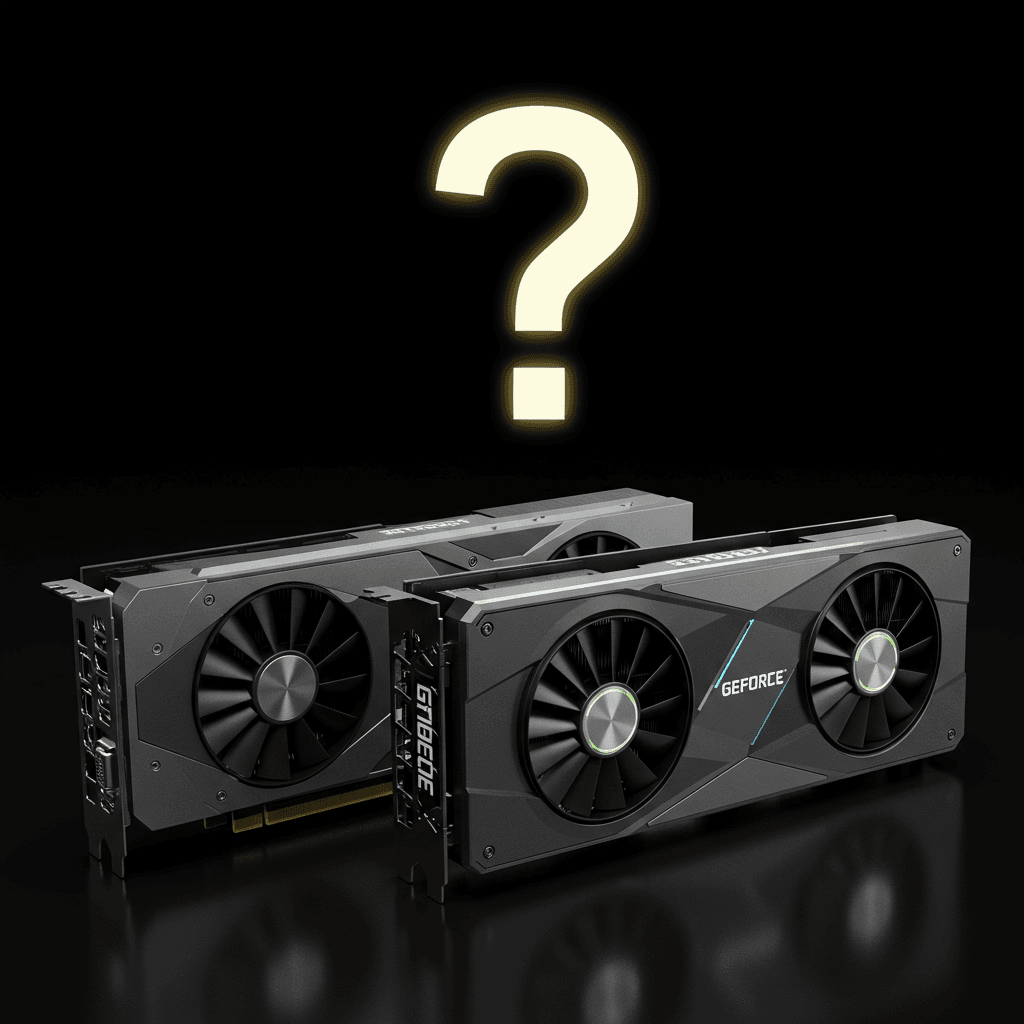
For PC gamers and enthusiasts, indeed, a new generation of graphics cards always brings anticipation. Thus, the RTX 4060 vs 5060 comparison is currently a hot topic, especially as NVIDIA’s next-generation GPUs loom on the horizon. While the NVIDIA GeForce RTX 4060 has been a staple in the mainstream market since its release, its successor, the RTX 5060, remains an unconfirmed mystery. In fact, NVIDIA has not officially announced or released the RTX 5060. Therefore, any direct comparison, including specific features, performance metrics, and detailed pros and cons, is purely speculative.
First, this article delves into what we know about the existing RTX 4060. Specifically, we will examine its strengths, weaknesses, and target audience. Moreover, we also synthesize general expectations and industry rumors surrounding NVIDIA’s forthcoming Blackwell architecture. Furthermore, this approach will help us project the potential capabilities and features of a future RTX 5060. Ultimately, we aim to provide an informed perspective on what to expect when these two mainstream GPUs eventually stand side-by-side.

NVIDIA GeForce RTX 4060: Current-Gen Overview
NVIDIA launched the GeForce RTX 4060 on May 18, 2023. Indeed, this graphics card sits firmly in the performance-segment, targeting gamers who seek solid 1080p performance. Furthermore, it forms part of the Ada Lovelace generation, benefiting from NVIDIA’s advanced architecture and manufacturing process. In essence, the RTX 4060 primarily caters to users demanding smooth frame rates at high settings in popular titles. Moreover, it can even handle some 1440p gaming with the assistance of NVIDIA’s groundbreaking DLSS 3.0 technology.
Ada Lovelace Architecture and Manufacturing
To begin, the RTX 4060 is built upon the Ada Lovelace architecture. Specifically, this architecture debuted with the RTX 40 Series lineup. Moreover, TSMC’s custom 5 nm process (specifically, 4N) is used for its manufacturing. As a result, this advanced process node allows for higher transistor density and improved power efficiency. Consequently, Ada Lovelace GPUs deliver more performance per watt than previous generations. Furthermore, the architectural enhancements include advancements in CUDA Cores, Tensor Cores, and Ray Tracing Cores, all designed to boost gaming and creative application performance.
Key Specifications of the RTX 4060
First, understanding the raw specifications of the RTX 4060 provides a clearer picture of its capabilities. Indeed, these numbers reflect its design for mainstream gaming. Overall, the card boasts a respectable set of features for its price point.
- Architecture: Ada Lovelace
- Process Node: 5 nm (TSMC 4N process)
- CUDA Cores: 3072
- Tensor Cores: 96 (4th generation)
- Ray Tracing Cores: 24 (3rd generation)
- Memory: 8 GB GDDR6
- Memory Interface: 128-bit
- Memory Bandwidth: 272 GB/s
- Boost Clock: Up to 2460 MHz
- TGP (Total Graphics Power): 115 W
- PCIe Interface: PCIe 4.0 x8
- Launch Price: $299 USD
Pros of the RTX 4060
Notably, the RTX 4060 brings several significant advantages to the table, especially for its target demographic. Thus, these strengths make it a compelling choice for many gamers.
Performance and Key Features
#### Performance and Feature Highlights
First and foremost, the RTX 4060 excels in 1080p gaming. Specifically, it consistently delivers strong performance at maximum settings. Many modern titles achieve over 60 FPS, while older games can easily surpass 100 FPS. Therefore, this makes it ideal for a vast majority of PC monitors.
Moreover, one of its standout features is support for NVIDIA’s Deep Learning Super Sampling (DLSS) 3. Indeed, this includes Frame Generation technology. Consequently, DLSS 3 can dramatically boost framerates in compatible games, providing a smoother, more immersive experience. Furthermore, it represents a notable advantage over previous generations and many competing cards. You can learn more about this technology on NVIDIA’s official DLSS page [here](https://www.nvidia.com/en-us/geforce/technologies/dlss/).
Additionally, for its price segment, the RTX 4060 offers good ray tracing performance. When combined with DLSS enabled at 1080p, it can render stunning visuals with realistic lighting and reflections. Thus, this brings high-fidelity graphics to a more accessible price point.
Efficiency and Market Position
#### Efficiency and Value Proposition
Regarding efficiency, the Ada Lovelace architecture significantly improved power efficiency. Specifically, the RTX 4060 features a low Total Graphics Power (TGP) of just 115W. Indeed, this is considerably lower than its predecessor, the RTX 3060 (170W). Consequently, lower power consumption translates to reduced electricity bills and often quieter, cooler system operation.
NVIDIA launched the RTX 4060 at $299 USD. Moreover, this price was lower than the RTX 3060’s launch price, especially when adjusted for inflation. Therefore, it positioned the card as an attractive option for budget-conscious gamers.

Cons of the RTX 4060
Despite its advantages, the RTX 4060 also faces some criticisms. In particular, these drawbacks are important considerations for potential buyers. Indeed, they highlight areas where the card might not fully meet expectations.
Performance and Memory Weaknesses
#### Performance and Memory Limitations
First, the 8 GB of GDDR6 memory on a 128-bit memory bus is a significant concern for many. Consequently, this configuration can limit future-proofing, especially for demanding games. For instance, high-resolution textures, 1440p gaming (without heavy DLSS reliance), and future titles may struggle. Therefore, many reviewers regard 8GB VRAM as a clear limitation for current and future high-fidelity gaming.
Without DLSS 3, the raw performance improvement over the RTX 3060 was considered modest by some. While it generally outperforms its direct predecessor, certain benchmarks show it performing behind the RTX 3060 Ti in native rasterization. Indeed, this might disappoint those expecting a larger leap.
Architectural and Connectivity Drawbacks
#### Architectural and Interface Considerations
The RTX 4060 actually has fewer CUDA cores (3072) than the RTX 3060 (3584). Its performance gains rely heavily on architectural efficiencies and higher clock speeds rather than brute force. Consequently, this can impact performance in non-DLSS scenarios or applications that heavily leverage core counts.
Furthermore, the card utilizes a PCIe 4.0 x8 interface. While generally sufficient for its performance tier, it does not use the full x16 bandwidth of PCIe 4.0. For instance, in certain scenarios, especially on systems with older PCIe generations or with demanding workloads, this could introduce a minor bottleneck. However, for most mainstream gaming, its impact is often negligible.
NVIDIA GeForce RTX 5060: The Next-Gen Vision (Speculative)
Currently, the NVIDIA GeForce RTX 5060 exists purely in the realm of speculation. Indeed, NVIDIA has not yet confirmed its existence, let alone provided any official specifications or release dates. However, based on NVIDIA’s typical product cycles and announcements regarding their next-generation Blackwell architecture, we can form educated guesses. For example, the Blackwell architecture was officially unveiled at NVIDIA’s GTC 2024 keynote in March 2024. Initially, this announcement focused on data center accelerators. However, consumer-focused RTX 50 series GPUs, including a potential RTX 5060, are anticipated to arrive later. Furthermore, market analysts suggest a possible launch window of Q4 2025 or early 2026, possibly starting with higher-end models first, with “Super” variants following.
Expected Improvements with Blackwell Architecture
First, the Blackwell architecture is the successor to Ada Lovelace. Notably, it is designed for significant advancements in generative AI and accelerated computing. Consequently, these improvements are expected to trickle down into consumer GPUs. Therefore, a future RTX 5060 would likely feature substantial upgrades over the RTX 4060.
Key Blackwell Architectural Enhancements
First, the Blackwell architecture is the successor to Ada Lovelace. Notably, it is designed for significant advancements in generative AI and accelerated computing. Consequently, these improvements are expected to trickle down into consumer GPUs. Therefore, a future RTX 5060 would likely feature substantial upgrades over the RTX 4060.
Core Architecture and Manufacturing
#### Core Architectural and Manufacturing Advancements
First, the RTX 5060 would be built on the Blackwell microarchitecture. Specifically, this new design includes fifth-generation Tensor Cores and new precision formats. These are crucial for AI workloads but also benefit gaming through features like DLSS. Overall, Blackwell aims for significant performance, energy efficiency, and scalability improvements.
In addition, Blackwell GPUs, including consumer variants, are anticipated to use an improved TSMC process. More precisely, this could be a refined 4NP process (an evolution of 5nm). As a result, this advanced manufacturing should lead to higher transistor density. Furthermore, it should offer better power efficiency and enable higher clock speeds.
Performance and Graphics Advancements
#### Performance and Graphics Enhancements
Historically, NVIDIA GPUs deliver a noticeable performance increase with each new generation. Therefore, we can expect the RTX 5060 to offer a significant performance uplift over the RTX 4060. Specifically, this improvement would manifest in both raw rasterization and ray tracing capabilities. Indeed, newer RT Cores and Tensor Cores will power these gains.
With next-generation RT and Tensor Cores, the RTX 5060 would likely offer superior ray tracing. Consequently, this translates to more realistic graphics with less performance penalty. Additionally, improved DLSS performance, potentially supporting a new iteration of the technology, would further boost frame rates and image quality.
Memory, Efficiency, and Connectivity Upgrades
#### Memory, Efficiency, and Connectivity
Regarding memory, there are strong rumors suggesting that NVIDIA’s RTX 50 series will feature increased VRAM capacities. GDDR7 memory is also a possibility for some cards. While specific VRAM for a non-Super RTX 5060 isn’t confirmed, an increase from 8GB (RTX 4060) to 12GB or more would be a highly anticipated upgrade. A wider memory bus would also address the 4060’s main VRAM drawback.
Furthermore, Blackwell is heavily touted for its energy efficiency, especially in data center applications. Consequently, this focus on efficiency should extend to gaming GPUs. Therefore, we can expect the RTX 5060 to deliver even more performance per watt than the already efficient RTX 4060.
Finally, the Blackwell architecture is expected to support PCIe 5.0 for consumer GPUs. In effect, this would double the available bandwidth compared to PCIe 4.0 used by the RTX 4060. While mainstream cards might not fully saturate PCIe 5.0 x16, it offers greater headroom for future applications and ensures compatibility with modern motherboards.
Potential Pros of the RTX 5060
Ultimately, based on these expected improvements, a speculative RTX 5060 would likely offer several compelling advantages.
- Significantly Improved Raw Performance: Gamers could expect a substantial leap in frame rates for both 1080p and 1440p gaming. This would make the card more capable for higher resolutions.
- Superior Ray Tracing and DLSS Performance: Next-gen RT and Tensor Cores would enhance visual fidelity. They would also improve frame generation and upscaling technologies, making ray tracing more accessible and less performance-intensive.
- Increased VRAM and/or Memory Bandwidth: Addressing the 4060’s primary weakness, the RTX 5060 would likely feature more VRAM (e.g., 12GB) and potentially a wider memory bus, improving future-proofing and high-resolution texture handling.
- Even Higher Power Efficiency: Building on Ada Lovelace’s strengths, Blackwell is expected to deliver more performance per watt. This means lower operating temperatures and reduced power consumption for similar or higher performance.
- Newer Features and Technologies: The Blackwell architecture might introduce new features beyond raw performance, potentially enhancing game fidelity, AI-driven experiences, or content creation tools. For general knowledge about GPU architectures, see the Wikipedia article on Graphics Processing Units [here](https://en.com/wiki/Graphicsprocessingunit).

Potential Cons of the RTX 5060
While exciting, a future RTX 5060 might also come with its own set of challenges and drawbacks. Indeed, these drawbacks are important considerations for potential buyers. They highlight areas where the card might not fully meet expectations.
- Likely Higher Launch Price: Generational improvements often lead to increased pricing. The RTX 5060 could launch at a higher price point than the RTX 4060’s $299, potentially making it less accessible for strict budget gamers.
- Limited Availability at Launch: New GPU launches, especially for popular mainstream cards, can suffer from limited stock and scalping. Early adoption might be difficult.
- Scrutiny Over Memory Configuration: Even with potential VRAM increases, the card could still face scrutiny regarding its memory bus width. If it remains relatively narrow, it might still be seen as a bottleneck for demanding future titles, especially compared to competitors.
- Power Consumption (Potentially Higher for Max Performance): While power efficiency improves, if the card aims for a much higher performance tier, its absolute TGP might increase from the RTX 4060’s ultra-low 115W.
The Future of Mainstream Gaming: Making Your Decision
The Core Dilemma: RTX 4060 vs. RTX 5060
To begin, the comparison of the RTX 4060 vs 5060 highlights a classic dilemma for PC enthusiasts: buy now or wait for the next generation. On one hand, the RTX 4060 is a known quantity. Indeed, it offers excellent 1080p gaming with impressive power efficiency and the transformative power of DLSS 3 Frame Generation. Consequently, it represents a solid choice for many, especially those looking for an upgrade for current-generation gaming at an affordable price point. However, its main limitations, primarily its 8GB VRAM and modest native performance uplift, are important to consider for long-term future-proofing or specific demanding workloads.
On the other hand, the RTX 5060 is a promise. Specifically, it represents the pinnacle of NVIDIA’s next-generation Blackwell architecture for the mainstream segment. Indeed, we can expect significant performance gains, superior ray tracing, and potentially much-needed VRAM upgrades. Therefore, this could make it a highly desirable card for 1440p gaming and a more robust solution for future titles. However, it comes with the uncertainty of release dates, pricing, and exact specifications. Ultimately, gamers who can afford to wait and prioritize cutting-edge performance and technology will likely find the RTX 5060 more appealing.
When to Buy: Current Needs vs. Future-Proofing
If you are currently building a PC or need an immediate upgrade for 1080p gaming, the RTX 4060 remains a perfectly viable option. Moreover, you can often find it at competitive prices now. If, however, you have a capable system and can hold off for another year or more, waiting for the RTX 5060 might prove to be a worthwhile investment. Ultimately, this decision depends on your budget, your current gaming needs, and your willingness to embrace the speculative nature of future hardware. Therefore, consider if you prioritize immediate value or future-proofed performance. For advice on choosing the right GPU, check out our guide on `(/blog/choosing-the-best-gpu-for-1080p-gaming/)`.

Conclusion
In summary, the ongoing comparison of the RTX 4060 vs 5060 is a tale of the present versus the future. On one hand, the NVIDIA RTX 4060 stands as a strong contender in the 1080p gaming segment. Indeed, it delivers excellent power efficiency and the significant advantage of DLSS 3 Frame Generation. However, its core drawbacks, including limited 8GB VRAM and a somewhat modest native performance uplift over its predecessor, are important considerations for discerning buyers.
Conversely, the NVIDIA GeForce RTX 5060, built on the much-anticipated Blackwell architecture, promises a substantial leap forward. Specifically, we expect it to bring significant performance enhancements, improved ray tracing and AI capabilities, and superior power efficiency. Crucially, it may also address the VRAM concerns with increased capacity and potentially GDDR7 memory. Until NVIDIA officially announces and releases the RTX 5060, however, all these assessments remain speculative. Therefore, gamers must weigh the known benefits of the current generation against the exciting, yet unconfirmed, potential of the next. The choice ultimately hinges on individual needs and patience.