
The PC gaming landscape is evolving rapidly. Indeed, 2026 is poised to be a pivotal year for next-gen titles. Specifically, these games promise unprecedented realism and immersive experiences. Moreover, they also feature sophisticated AI integration. Consequently, this will push current hardware to its limits. Therefore, understanding the PC gaming demands 2026 brings is crucial for any enthusiast, as this helps them stay ahead. Furthermore, this article explores essential hardware upgrades, and it covers technological shifts to consider. Ultimately, these ensure your gaming rig is truly ready for the future.

The Evolving Landscape of Next-Gen PC Gaming
Next-gen games offer more than prettier graphics. Instead, they fundamentally shift how titles are developed. Likewise, player experiences also change. To achieve this, developers use advanced technologies. Thus, they create more dynamic worlds. Furthermore, characters are more lifelike, and narratives are deeply engaging. Unsurprisingly, this evolution naturally translates into significantly higher hardware requirements.
A Push for Realism and Immersion
Game studios relentlessly pursue photorealism and deeper immersion. Indeed, this involves intricate environmental details. Furthermore, complex lighting models are used. Similarly, physics engines accurately simulate real-world interactions. Consequently, such ambitious visual fidelity requires immense processing power, taxing both the GPU and CPU. Players expect seamless experiences. For example, this includes exploring vast open worlds. Moreover, it also means engaging in fast-paced action. Therefore, a PC must render these scenes without stuttering.
AI and Advanced Graphics Technologies
Artificial intelligence (AI) is transforming gaming. Specifically, it impacts multiple fronts. For example, AI powers more intelligent NPCs. In addition, it creates more responsive game environments. Furthermore, AI also drives intelligent cooling systems within hardware. Concurrently, advanced graphics technologies like ray tracing are becoming standard. While these innovations enhance the player experience, they also place significant new burdens on your system’s capabilities. Ultimately, meeting the PC gaming demands 2026 requires embracing these technological leaps.
Core Hardware Components: What You’ll Need
To prepare your PC for demanding 2026 titles, focus on your system’s fundamental components. Clearly, each part plays a critical role. Indeed, it delivers a smooth, high-fidelity gaming experience. Therefore, investing wisely now can save you from immediate obsolescence.
Graphics Processing Units (GPUs): The Visual Powerhouse
The GPU is critical for gaming performance. Specifically, this is especially true for 1440p or 4K resolutions. Consequently, next-gen games will heavily tax your graphics card. Thus, for a 2026-ready rig, look for GPUs with at least 16GB of VRAM. Current options like an NVIDIA RTX 5070 Ti, or its equivalent, are effective, as they handle current ray tracing workloads. However, new architectures are anticipated. For instance, Nvidia’s Rubin and AMD’s UDNA/RDNA 5 are examples. Rubin is based on Blackwell with HBM4 memory, while AMD’s is the Radeon RX 9000 series. Ultimately, these future GPUs promise substantial improvements. Specifically, expect better AI capabilities and ray tracing performance. Furthermore, overall frame rates will also improve. In contrast, insufficient VRAM (8GB) bottlenecks many new titles. Therefore, 12GB will likely become the bare minimum for future cards.

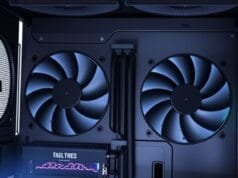
A close-up of a high-end next-gen GPU, possibly an NVIDIA RTX 5070 Ti or a conceptual Radeon RX 9000 series card, emphasizing its cooling system and multiple fans, a key component for PC Gaming Demands 2026.
Central Processing Units (CPUs): The Brain of Your System
A 6-core CPU might still suffice for some gaming. However, 8-core CPUs are increasingly recommended. They not only offer optimal performance in demanding titles but also allow efficient multitasking. Processors such as the Ryzen 7 7700 or Ryzen 7 9700X offer excellent current-generation performance. Looking ahead to late 2026, AMD’s Zen 6 and Intel’s Nova Lake processors are slated for release. Regarding Zen 6, it will prioritize power efficiency. It will also focus on multi-threaded performance. Additionally, advanced 3nm and 2nm process nodes will be utilized. Meanwhile, Nova Lake will likely emphasize AI performance and low latency. Crucially, both next-gen CPUs will support DDR6 RAM. Furthermore, they will also support PCIe 5.0. Ultimately, this forms a robust foundation for future gaming rigs.
Random Access Memory (RAM): Speed and Capacity
RAM is more crucial than ever for next-gen gaming. Currently, the sweet spot for modern gaming is 32GB DDR5 RAM. Specifically, ideal speeds are around 6,000MT/s, and a CL30 latency is also preferred. Upcoming AAA games will greatly benefit from 32GB RAM; in fact, some even benefit from 64GB. Therefore, 32GB is becoming the new standard for serious gamers. Furthermore, DDR6 RAM is also anticipated. It will, for example, debut in high-end systems by mid-2026. Notably, DDR6 offers double the bandwidth of DDR5. Ultimately, upgrading RAM boosts system responsiveness and handles larger asset loads of future titles.
Storage: Blazing-Fast Loading Times
For optimal gaming, a 2TB Gen4 NVMe SSD is generally recommended. Indeed, this storage provides exceptionally fast loading times. It not only minimizes delays but also enhances the overall gaming experience. Gen5 SSDs offer even higher transfer speeds. However, their benefits for current gaming are negligible. Nonetheless, this may change with future game designs. By 2026, therefore, PCIe 5.0 motherboards will be standard. Crucially, this is important for maximizing communication speed. It directly links the CPU, GPU, and high-end NVMe drives. Furthermore, many titles like Borderlands 4 and Dragon Quest VII Reimagined are anticipated. They often list 100GB+ of required storage. Consequently, ample, fast storage is essential, as it meets the PC gaming demands 2026.

Motherboards: The Foundation
Your motherboard acts as your system’s backbone. In essence, it connects all vital components. For a 2026-ready PC, therefore, B650 or B850 motherboards are recommended. These boards offer essential features. Specifically, these include Gen5 M.2 slots for fast SSDs. They also feature Wi-Fi 6E/7, which ensures superior wireless connectivity. Moreover, 2.5Gb LAN provides stable wired connections, and versatile USB-C ports are also included. For the bleeding edge, however, X670 or X870 chipsets are best. These chipsets provide mandatory PCIe 5.0 support for GPUs and USB4. Ultimately, this ensures maximum bandwidth, meaning all peripherals and future upgrades benefit. Therefore, choosing the right motherboard ensures your system leverages high-end CPU, GPU, and storage performance.
Driving Technologies: Ray Tracing and AI
Two advancements significantly shape PC gaming demands 2026. Namely, these are ray tracing and artificial intelligence. Crucially, these aren’t just buzzwords; instead, they represent fundamental shifts. Consequently, games will look and perform differently. Therefore, ignoring them means missing key next-gen title features.
The Rise of Ray Tracing
Ray tracing simulates light’s physical behavior. Indeed, this graphics technology is quickly becoming standard. By 2025, in fact, most major game releases will use ray tracing. It subsequently offers realistic reflections, shadows, and global illumination. However, ray tracing is computationally intensive. Thus, it often requires upscaling technologies. DLSS and FSR help maintain playable frame rates. DLSS is NVIDIA’s Deep Learning Super Sampling. Similarly, FSR is AMD’s FidelityFX Super Resolution. These upscaling solutions use AI. Essentially, they render games at lower internal resolutions. Then, they intelligently upscale them to higher resolutions. Ultimately, this results in sharp images and performance gains.
AI’s Transformative Role in Gaming Hardware
Artificial intelligence will revolutionize gaming hardware. Moreover, it extends far beyond visual enhancements. For instance, AI will drive resolution scaling advancements, as shown by DLSS and FSR. Furthermore, AI also powers intelligent cooling systems. These, consequently, dynamically adjust fan speeds based on real-time loads. Additionally, AI will enable more responsive game environments. This means player actions will have nuanced consequences. It also means lifelike NPCs will exhibit sophisticated behaviors and interactions. Ultimately, deeper integration is coming. Therefore, future hardware needs dedicated AI processing. This, in turn, handles complex tasks efficiently. As a result, the overall gaming experience will be significantly richer.
Beyond the Core: Other Key Trends
Core components are vital. However, other aspects of your gaming setup are changing. Indeed, the broader industry is also seeing significant shifts. Consequently, these trends further inform the PC gaming demands 2026. Ultimately, they offer new perspectives on how we approach gaming.
Monitors: Visual Clarity and Speed
A capable monitor is essential. After all, it fully appreciates next-gen graphical fidelity. High refresh rate monitors are common. Moreover, they are also more affordable. Therefore, expect 360Hz or above with 1ms response times. High-quality Mini-LED and OLED panels are rising. These panels offer superior contrast. Specifically, expect deeper blacks and vibrant colors. Collectively, these display technologies provide an unparalleled visual experience. Consequently, every detail of a next-gen game will pop. Thus, a high-performance monitor ensures you perceive fluid motion. It also shows stunning visuals your powerful PC produces. For more on monitor choices, incidentally, check out our guide on [/blog/choosing-a-gaming-monitor/].
The Impact of Cloud Gaming
Cloud gaming services will reshape hardware needs. For instance, NVIDIA GeForce NOW and Xbox Cloud Gaming are examples. This, in turn, impacts many players. Essentially, these services offer an alternative: they allow access to demanding titles on lower-end hardware. Consequently, the primary hardware shifts. It moves, therefore, from a powerful local PC. Instead, a fast, stable internet connection is now key. However, dedicated enthusiasts prefer local high-performance rigs. Cloud gaming offers an accessible entry point for others. Ultimately, this trend diversifies content consumption. Nevertheless, core PC gaming demands 2026 remain strong, as top-tier local experiences are still desired.
Modular Hardware and Sustainability
The gaming industry responds to sustainability calls. Specifically, manufacturers prioritize energy-efficient designs. This, consequently, reduces power consumption. It also lowers gaming’s carbon footprint. Furthermore, demand for modular hardware is rising. Likewise, customizable hardware is also sought. This, in turn, allows easier upgrades. It also extends product lifecycles. Ultimately, this approach combats electronic waste, as gamers replace individual components rather than entire systems. Therefore, investing in modular systems is a smart, long-term strategy. It not only meets future hardware requirements but also ensures your investment remains relevant longer.
Anticipated Games Pushing the Limits
Many highly anticipated titles for 2026 are coming. Indeed, they will push PC hardware boundaries. For example, games like Grand Theft Auto VI and Marvel’s Wolverine are on the horizon. Similarly, Resident Evil Requiem and Fable are also coming. Other prominent titles include Code Vein II, Nioh 3, and 007 First Light. Moreover, Pragmata and Mortal Shell 2 are also set for release. Significantly, many games will use Unreal Engine 5. Consequently, they will deliver cinematic visuals and vast open worlds. Their complex gameplay mechanics will truly test your system. Ultimately, these games represent peak development efforts. They, therefore, embody the full scope of PC gaming demands 2026. In conclusion, prepare for stunning graphics and deeply engaging experiences.
Building Your Future-Proof Rig for 2026
To effectively tackle PC gaming demands 2026, a strategic hardware approach is essential. First, focus on a powerful GPU with ample VRAM. Second, an 8-core CPU offers robust processing. Third, get 32GB of fast DDR5 RAM. Finally, a capacious, high-speed NVMe SSD is also needed. Together, these components form a next-gen gaming machine’s foundation. While a premium rig is a significant investment, going “overboard” may not be necessary. Indeed, excellent 1440p gaming experiences are achievable without it. Instead, prioritize components offering the best performance-per-dollar within your budget. This, therefore, ensures a balanced system. For further tips on optimizing your current system, moreover, read our guide on [/blog/optimizing-pc-performance/].

Conclusion
2026 marks a significant milestone for PC gaming. Indeed, it brings a new era of immersive experiences. Therefore, expect visually stunning games. Meeting PC gaming demands 2026 requires careful hardware consideration. To achieve this, focus on a powerful GPU with at least 16GB VRAM. Furthermore, a capable 8-core CPU is needed. Also, get 32GB of DDR5 RAM. Finally, a fast 2TB Gen4 NVMe SSD is also essential. Consequently, continuous evolution of chip designs, AI, and faster memory will unlock engagement. Performance, therefore, will reach unprecedented levels. Thus, upgrade strategically. This, ultimately, ensures your rig is ready and will be truly optimized. In conclusion, prepare for the exciting future of next-generation gaming.