
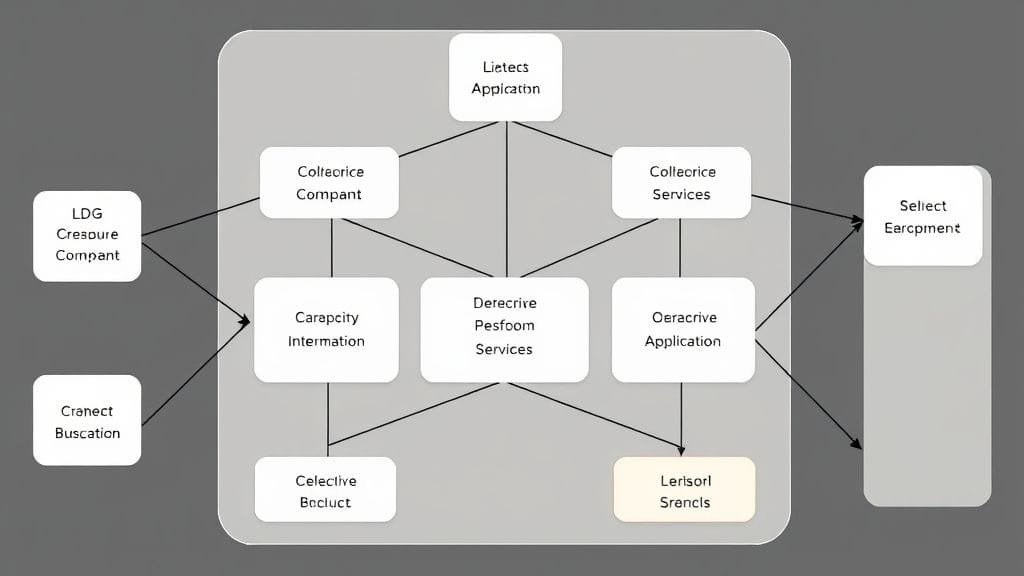
Imagine you’re building a grand city. Would you construct it as one enormous, indivisible building where a problem in the plumbing affects the entire structure? Or, would you design it as a collection of independent districts, each with its own specialized functions, where a power outage in one area doesn’t bring the whole city to a halt? This challenge is central to modern software design, particularly when considering Microservices Architecture.
This analogy perfectly captures the essence of this architecture. At its core, it’s a powerful way to build software. It breaks down a large, complex application into many small, independent services. These services are loosely connected. Each of these “districts,” or microservices, is responsible for a specific business capability. Crucially, they can be developed, deployed, and maintained completely on their own. Microservices communicate with each other using clear APIs, much like city departments use clear rules to share information.
Conversely, this method stands in stark contrast to traditional monolithic architecture. In a monolith, all application components are tightly integrated into a single, unified unit. Monoliths have their uses. However, today’s digital world often needs more agility, resilience, and scalability. Monoliths cannot always provide this easily. So, Microservices Architecture offers a compelling alternative. As a result, companies can innovate faster and operate more reliably.
What is Microservices Architecture?
The adoption of Microservices Architecture is evident. Recent reports, for instance, highlight its widespread usage. Gartner reports that 74% of organizations already use microservices, with an additional 23% planning adoption soon. An O’Reilly survey from 2020 revealed that 77% of businesses utilized microservices. A remarkable 92% of them deemed their adoption successful. These figures thus demonstrate a clear trend. Microservices, therefore, are no longer merely emerging technology; they represent a core component of modern enterprise Microservices Architecture.

Core Strengths of Service-Oriented Design
Microservices Architecture offers numerous significant benefits. Chief among these, it addresses problems frequently encountered in monolithic applications. These benefits thus foster a development environment that is more resilient, scalable, and agile. Ultimately, they enable businesses to react swiftly to market needs. This, in turn, helps them remain competitive.
Unmatched Scalability and Flexibility with Microservices Architecture
A primary advantage of adopting a Microservices Architecture is its inherent scalability. Consider, for instance, a popular feature in your application, such as a recommendation engine. What if demand for it surges? With microservices, you don’t have to scale the entire application; instead, you can allocate more resources specifically to that recommendation service. This granular scaling approach is highly efficient. Consequently, you can optimize resource utilization and significantly reduce operational costs. In essence, you only pay for the capacity you actually use, exactly where you need it. This renders the architecture highly cost-effective.
Robust Fault Isolation and Enhanced Resilience in Microservices Architecture
In a monolithic application, a single failure can bring down the entire system. Think of it like a chain reaction. That is, if one component fails, the entire application ceases to function. Microservices, however, allow services to operate independently. Consequently, if one service encounters an issue or crashes, it is far less likely to impact the rest of the application. This isolation significantly enhances system robustness. It also prevents issues from propagating. Thus, critical business functions remain operational, even if a non-essential service experiences downtime. Therefore, a well-designed microservices architecture renders your application far more reliable overall.
Agile Deployments and Rapid Innovation
This architectural design significantly accelerates development and deployment cycles. Each service can be independently built, tested, and deployed. This independence enables teams to release updates and new features far more rapidly. Specifically, they eliminate the need to coordinate large, complex deployments for the entire application. This, in turn, substantially lowers the risk associated with changes. Furthermore, it facilitates smaller, more frequent releases, which are key signs of continuous integration and continuous delivery (CI/CD). Such agility fosters faster innovation and leads to a quicker time to market for new features.
Empowering Teams with Autonomy and Productivity
This architectural approach fosters a more efficient and productive team environment. Small, focused teams can take complete ownership of a particular service. In effect, this allows them to focus solely on building, maintaining, and operating their service. They avoid getting bogged down by the complexities of the entire system. This focused ownership leads to deeper expertise within teams. Additionally, it empowers them to make decisions more swiftly. It minimizes unnecessary communication. Thus, teams achieve greater independence. Consequently, this frequently translates into improved morale and higher productivity within a microservices setup.
Embracing Technology Diversity in Microservices Architecture
A significant advantage of this architecture is the freedom to embrace technology diversity. In a monolithic application, teams are typically constrained to a single technology stack for the entire system. With microservices, however, each team can select the optimal language, framework, and database for their specific service. For example, one service might use Python for machine learning tasks, while another uses Java for high-performance transactions. This flexibility thus fosters innovation. Moreover, it allows teams to leverage specialized tools. It also helps avoid vendor lock-in.
Driving Cost-Efficiency and Experimentation
The independent nature of microservices, therefore, contributes to cost savings in multiple ways. For instance, by enabling services to scale independently, organizations can optimize their infrastructure investments. Furthermore, deploying services in isolation greatly simplifies experimentation. New features can be rolled out to a subset of users or introduced into a single service for testing. If, for example, an experiment fails, it can be quickly rolled back or discarded. This occurs without impacting the broader system. Ultimately, this reduces the cost and risk associated with implementing new ideas. It thus helps foster constant improvement and innovation within this architectural style.

Navigating the Challenges of Distributed Systems
Microservices Architecture offers substantial benefits, but it is not a panacea. Instead, adopting this architecture introduces inherent complexities and challenges. Consequently, it necessitates careful planning, robust tooling, and a skilled team. A clear understanding of these challenges is paramount for successful implementation. Many organizations initially perceive small services as straightforward. However, they soon confront the complexities inherent in managing a distributed system.
The Inherent System Complexity of Microservices Architecture
Decomposing a large application into numerous smaller services inherently increases the overall system complexity. For instance, instead of a single monolithic codebase, you now manage multiple smaller ones, each requiring its own repository, build process, and deployment pipeline. Moreover, the distributed nature introduces novel management overhead. Specifically, this involves managing numerous distinct services. You must track their versions and comprehend their interdependencies. This can become overwhelming without robust automation and governance. Therefore, this renders the architectural style inherently demanding.
Data Management and Consistency Hurdles
Ensuring data consistency across numerous services presents a significant challenge. This is especially true with polyglot persistence. Polyglot persistence implies that different services may utilize diverse database technologies. For instance, one service might use a relational database, another a NoSQL database, and yet another a graph database. Maintaining data consistency across these disparate systems is complex. Indeed, this challenge is amplified when dealing with distributed transactions. It requires sophisticated design patterns and robust error handling mechanisms. Therefore, it is considerably more challenging than managing a single database within a monolith. This complexity is a key consideration for Microservices Architecture design.
Debugging in a Distributed Microservices Architecture
Debugging becomes significantly more intricate in a distributed system. For instance, an issue might span multiple services. Each service possesses its own logs and may operate on disparate servers or containers. Tracing a single request across numerous services can be an arduous and time-consuming task. Consequently, developers require specialized tools. These include distributed tracing, centralized logging, and monitoring. Ultimately, they aid in comprehending a transaction’s complete journey and rapidly pinpointing the root cause of issues. Thus, robust tooling is vital for effective debugging within this architecture.
Increased Infrastructure and Operational Overhead
Each new microservice can introduce additional costs. These encompass testing, deployment, hosting, and monitoring tools. While development might be faster, nevertheless, the operational effort can significantly escalate. Therefore, organizations require robust monitoring solutions. These track the health and performance of potentially hundreds or thousands of services. Essentially, this mandates dedicated staff, advanced automation, and stringent operational protocols. Without these elements, managing this architecture can quickly spiral out of control.
Inter-Service Communication: A Crucial Design Point
Managing inter-service communication presents another critical challenge within this architectural style. Services need to communicate reliably, securely, and efficiently. This, in turn, necessitates careful selection of communication protocols. Examples include REST, gRPC, or message queues. It also involves managing network latency and ensuring robust failure handling in communication. Poorly designed inter-service communication can result in degraded performance. Indeed, it can also lead to increased network traffic and an unstable system. Consequently, this aspect demands significant architectural planning. Furthermore, it requires continuous refinement within this architecture.
The Essential Role of Expert Teams and DevOps
Successful implementation of this architecture demands specialized skills. Furthermore, it necessitates a mature organizational culture. Teams need experience with distributed systems, cloud-native technologies, and containerization. Crucially, a robust DevOps culture is indispensable. This culture emphasizes collaboration, automation, and continuous improvement, applying across both development and operations. Developers are empowered to understand and manage their services’ runtime behavior. Operations teams are engaged earlier in the development lifecycle. This collaborative, team-focused environment is thus pivotal. Ultimately, it facilitates managing the increased operational complexity of this architecture, ensuring services are well-built and run reliably and efficiently in production.
Securing a Distributed Microservices Architecture
Securing a distributed system introduces a more intricate security landscape for this architecture. For instance, each microservice can potentially serve as an entry point. Moreover, every inter-service communication channel must be secured. This necessitates managing access control across numerous services. You must encrypt inter-service communication and implement robust API gateways. Crucially, security cannot be an afterthought; it must be intrinsically embedded into the architecture from its inception. This mitigates the risk associated with an expanded attack surface.
Microservices Architecture: Adoption & Market Trends
Microservices Architecture has rapidly evolved from a theoretical concept to a prevalent paradigm in software development. Its impact has been profound. Its appeal stems from its promise to address the scale and complexity of modern applications. Presently, businesses across diverse industries are demonstrably adopting this architecture. Indeed, robust statistics and significant market growth underscore this adoption. They point towards a promising future for this architectural style.
The Rise of Microservices Architecture: Key Statistics
The widespread acceptance of this architecture is substantiated by clear evidence. Moreover, organizations are not merely experimenting with it; rather, they are deeply embedding it into their software development methodologies. This extensive adoption signifies a broader industry transformation. The shift is towards more flexible and scalable software, significantly driven by microservices.
Here’s a look at some key figures illustrating this trend:
| Metric | Statistic | Source |
|---|---|---|
| Current Usage of Microservices Architecture | 74% of organizations are currently using Microservices Architecture. | Gartner |
| Planned Adoption of Microservices Architecture | An additional 23% of organizations plan to adopt Microservices Architecture within six months. | Gartner |
| Overall Adoption (2020) of Microservices Architecture | 77% of businesses had adopted Microservices Architecture. | O’Reilly Survey (2020) |
| Successful Adoption (2020) of Microservices Architecture | 92% of businesses that adopted microservices considered their adoption successful. | O’Reilly Survey (2020) |
| Market Growth (2024-2025) of Microservices Architecture | The global Microservices Architecture market is projected to grow from $6.27 billion in 2024 to $7.45 billion in 2025. This reflects an 18.8% Compound Annual Growth Rate (CAGR). | Market Research Reports |
| Key Challenge Identified in Microservices Architecture | 62% of organizations find managing inter-service dependencies a significant challenge in microservice environments. | Camunda Survey |
These numbers are more than just facts; they tell a story. Specifically, they indicate that organizations perceive tangible value in this architecture. Furthermore, companies are prepared to invest in it, despite its inherent challenges. The projected rapid market growth further affirms its pivotal role. The highlighted challenge regarding inter-service dependencies is evident, therefore underscoring the necessity for robust design and powerful tooling when implementing this architecture.

Monoliths vs. Modern Service Architectures
The decision between a monolithic and a Microservices Architecture is a pivotal one in software development. There is no universally “best” option. The optimal choice largely hinges on your project’s specific requirements, team structure, and business context. Consequently, it’s not a matter of which architecture is inherently superior, but rather which one optimally aligns with your specific needs. Thus, a nuanced understanding of each approach’s distinctions is crucial. This is essential before committing to a particular architectural strategy.
Understanding Project Needs for Microservices Architecture: Size and Complexity
Microservices Architecture is generally more suited for large, complex projects. These projects typically demand high scalability, flexibility, and autonomous teams. For instance, consider applications such as online retail platforms, streaming services, or extensive enterprise systems. These often feature diverse functionalities and evolving requirements. Conversely, simpler projects, such as startups or proof-of-concept applications, may not warrant this complexity. Indeed, they might not justify the additional overhead and complexity inherent in microservices. Instead, for such projects, a monolithic approach can offer a significantly faster and simpler starting point. Thus, it enables rapid product launch without premature architectural burdens.
The Evolutionary Path: From Monolith to Microservices Architecture
Many successful projects do not commence with this architecture; in fact, it’s often advisable to begin as a monolith. This allows development teams to prioritize core business logic and user value, circumventing distributed system challenges from the outset. However, as the application and team scale, the monolith can become increasingly unwieldy. It might become difficult to maintain, deploy, or scale efficiently. This is particularly true when numerous developers operate on the same codebase. At this juncture, transitioning to microservices can be a strategic move. Specifically, components of the monolith are gradually refactored into independent services. This can prove to be a highly effective evolutionary strategy. Indeed, this “strangler fig” pattern is a popular and less risky way to transition to this architectural style.
A Mindset Shift: Beyond Just Code for Microservices Architecture
Adopting Microservices Architecture demands more than mere technical adjustments. Rather, it necessitates a fundamental shift in organizational mindset. It transcends simply decomposing an application into smaller code segments. Instead, it’s about fundamentally re-envisioning how systems are designed, deployed, and operated. This involves embracing concepts like domain-driven design. It favors independent deployments. And it fosters robust communication among autonomous teams. It also entails acknowledging the inherent complexities of distributed systems. Consequently, this transformation impacts every facet. For instance, it influences team structure, as well as monitoring and logging methodologies. Thus, organizational culture and preparedness are as crucial as technical acumen for its success.

Strategic Migration Approaches for Microservices Architecture: Top-Down, Bottom-Up, or Blended
When migrating from a monolith to this architecture, organizations can employ several strategic approaches:
- Top-Down Approach: This approach decomposes functions based on business capabilities or specific domain needs. In this approach, you identify core business functions, such as “Order Management” or “User Profiles,” and design services accordingly. This often establishes clear service boundaries that directly align with business operations within this architecture.
- Bottom-Up Approach: In this method, the focus is on grouping functionalities by their technical characteristics. You might extract common technical components first, such as an “Authentication Service.” This can yield early successes. However, conversely, it might not always align perfectly with business domains for a comprehensive microservice setup.
- Blended Approach: Many organizations, however, find optimal results by blending both methodologies. They might first identify clear business domains (top-down), while also prioritizing the extraction of services that are technically distinct or pose challenges within the monolith (bottom-up). Ultimately, this flexible strategy yields the most favorable outcomes. It effectively balances business imperatives with technical feasibility within this architectural pattern.
When a Monolith Might Still Be Best Instead of Microservices Architecture
Despite the prevalent discourse surrounding microservices, a monolithic architecture remains a superior choice in numerous scenarios. For instance, for smaller projects with limited budgets and a concise team, a monolith can facilitate faster initial development and reduced operational expenses. Furthermore, if your application’s domain is stable and well-defined, and it does not foresee massive scaling requirements, a monolith can prove simpler to manage. Indeed, its simpler deployment and more straightforward debugging can be immensely advantageous. Therefore, it is crucial to remember that the goal is to build the appropriate system for your specific needs, not merely to conform to the latest trend. When judiciously chosen, a monolith can be highly effective and efficient. This is particularly true when compared to an unnecessarily complex architecture.
Best Practices for Microservices Implementation
To effectively implement Microservices Architecture, more than just technical prowess is required. Instead, it demands a judicious strategy for design, development, and operations. Many organizations have learned that neglecting best practices can swiftly transform microservices’ advantages into significant liabilities. Thus, a meticulous and well-considered plan is vital for success. Essentially, adhering to these guidelines will enable you to harness the power of microservices while mitigating their inherent complexities.
Domain-Driven Design for Microservices Architecture Decomposition
A crucial aspect of Microservices Architecture is establishing appropriate boundaries for each service. Domain-Driven Design (DDD) provides an invaluable framework for this. It advocates constructing services around specific business capabilities and well-defined boundaries. In essence, each service should be autonomous, managing a clearly defined business domain, such as “Customer Management” or “Product Catalog.” Clear boundaries thus prevent services from becoming overly coupled. Consequently, this fosters genuine service independence, making them easier to comprehend, build, and maintain within this architecture.
Robust API Design and Management for Microservices Architecture
Microservices communicate via APIs; thus, designing robust, clear, and well-documented APIs is paramount for this architecture. These APIs serve as the contract between services. They ensure services can interoperate reliably, without needing internal knowledge of each other’s implementation. Best practices include utilizing standard protocols (such as REST or gRPC). Additionally, APIs should be versioned to manage changes smoothly, and comprehensive documentation must be provided. Furthermore, robust API management tools become essential, assisting in securing, monitoring, and scaling API access. This ensures seamless inter-service communication within this architecture.
Centralized Logging and Monitoring for Microservices Architecture
In a distributed system, relying on a single log file or a basic dashboard is insufficient. Instead, centralized logging is imperative to aggregate logs from all services into a unified repository. This facilitates easier searching, analysis, and troubleshooting within this architecture. Likewise, comprehensive monitoring is vital. For instance, tools offering distributed tracing can track requests across multiple services. Performance monitoring aids in identifying bottlenecks, while health checks confirm service operationality. Collectively, these tools provide the necessary insight to understand system behavior and rapidly pinpoint issues in complex microservice environments.

Implementing Effective CI/CD Pipelines for Microservices Architecture
Effective CI/CD pipelines are paramount for the success of this architecture. Each microservice should possess its own automated pipeline for building, testing, and deployment. This automation significantly accelerates releases, minimizes human errors, and ensures rapid, reliable delivery of changes. Automated testing is also critically important. Specifically, this encompasses unit, integration, and end-to-end tests. It instills confidence in teams that their changes will not adversely impact other services or the overall microservice system.
Prioritizing Security from Day One in Microservices Architecture
Security must not be an afterthought in this architecture; it must be intrinsically woven into the fabric of the design process from its inception. Specifically, this entails:
- Authentication and Authorization: Implement robust mechanisms for service authentication and authorization. For example, leverage API gateways for centralized authentication.
- Secure Communication: Encrypt all inter-service communication (e.g., using TLS).
- Vulnerability Management: Regularly scan services for vulnerabilities and maintain all related software with up-to-date patches.
- Least Privilege: Ensure each service only has the permissions it absolutely needs to perform its function.
Ultimately, a proactive stance on security is vital. It safeguards your distributed system from potential threats within this architecture.
Fostering a Strong DevOps Culture for Microservices Architecture
The success of this architecture is inextricably linked to a robust DevOps culture. Importantly, this culture dismantles traditional barriers between development and operations teams. It emphasizes shared responsibility, automation, communication, and continuous feedback. Developers are empowered to understand and manage their services’ operational lifecycle. Operations teams are engaged earlier in the development lifecycle. This collaborative, team-focused environment is thus pivotal. Ultimately, it facilitates managing the increased operational complexity of this architecture, ensuring services are well-built and run reliably and efficiently in production.

The Future of Distributed Systems
This architecture is not static; it continually evolves. For instance, as cloud computing matures and new technologies emerge, the paradigms for designing, building, and operating microservices also transform. The future undoubtedly promises even more advanced tools and patterns. Indeed, these will further amplify the benefits of distributed systems. They may also alleviate some of their current complexities. Staying abreast of these trends is crucial for any organization focused on modern software and this architecture.
Serverless Integration and Event-Driven Architectures with Microservices Architecture
A prominent trend involves the increased integration of microservices with serverless computing platforms. Examples include AWS Lambda, Azure Functions, or Google Cloud Functions. Serverless further extends the concept of independent deployment. It allows developers to deploy single functions. These scale autonomously and consume resources only when active. Moreover, event-driven architectures are gaining widespread adoption. In this paradigm, services communicate by emitting and reacting to events, rather than making direct calls. This loose coupling thus renders systems even more resilient and scalable. Furthermore, this presents a significant advantage for this architecture. It also facilitates an exceptionally flexible system. Services can evolve independently without rigid dependencies. The synergy of microservices with serverless and event-driven patterns promises highly agile and cost-effective solutions for modern distributed systems.
AI-Powered Monitoring and Automation for Microservices Architecture
As an application scales with more microservices, manual monitoring and problem resolution become untenable. Therefore, the future anticipates the emergence of more advanced, AI-powered tools specifically designed for monitoring and automation within this architecture. These tools will leverage machine learning to:
- Predict Issues: Identify anomalies and predict potential problems before they impact users.
- Automate Fixes: Automate the remediation of common issues, or trigger alerts enriched with comprehensive diagnostic information.
- Improve Performance: Continuously analyze performance data and suggest optimal resource utilization strategies.
Ultimately, these intelligent systems will substantially reduce the effort required to manage complex distributed systems. Consequently, this will render this architecture more practical, enabling teams to focus on innovation rather than merely reacting to urgent problems.
Continued Focus on Developer Experience in Microservices Architecture
Developer experience (DX) will remain a paramount focus for this architecture. Tools and platforms will continue to evolve. Indeed, they will streamline the process of building, testing, and deploying microservices, making it more intuitive and enjoyable. Specifically, this encompasses:
- Opinionated Frameworks: Frameworks offering intelligent default configurations and minimizing boilerplate code for microservice development.
- Better Local Dev Environments: Enhanced local development environments that enable developers to effortlessly run and test components of a microservices application on their local machines.
- Service Mesh Technologies: Solutions like Istio or Linkerd. These abstract away the complex intricacies of inter-service communication, security, and monitoring from individual services.
By simplifying development, these advancements will lower the barrier to entry for adopting this architecture. Ultimately, they will empower teams to be even more productive and efficient.
Conclusion: Power and Prudence in Modern Application Design
Microservices Architecture has profoundly reshaped modern software development. It offers unparalleled benefits. These encompass scalability, resilience, agility, and technological flexibility. Moreover, this architecture empowers teams, accelerates innovation, and can significantly optimize resource utilization. Its widespread adoption across numerous industries underscores its profound impact and value for complex, evolving applications.
However, it is vital to approach this architecture with a clear understanding of its inherent challenges. Specifically, these include increased system complexity, intricate data management, challenging debugging processes, and higher operational overhead. These are not trivial concerns; instead, they necessitate meticulous planning, significant investment in specialized tooling, and, most importantly, a highly skilled team operating within a mature DevOps culture. Without these fundamental elements, the promised benefits can swiftly devolve into an unmanageable quagmire of complexity.
Ultimately, the choice between microservices and other architectural styles, such as a monolith, is a strategic decision. It depends critically on your project’s specific context, your team’s capabilities and size, and your long-term business objectives. Therefore, commencing with a simpler approach and evolving towards this architecture when necessitated is often a judicious strategy.
Moreover, by adhering to best practices, organizations can fully harness the power of this architecture. These practices include intelligent domain-driven design, robust API management, comprehensive monitoring, and stringent security measures. This journey mandates a fundamental shift in mindset. It extends beyond merely decomposing an application. Ultimately, it’s about re-envisioning how systems are designed, deployed, and operated.
What do you believe is the single most critical factor for success when an organization decides to adopt this architecture? Share your thoughts below!