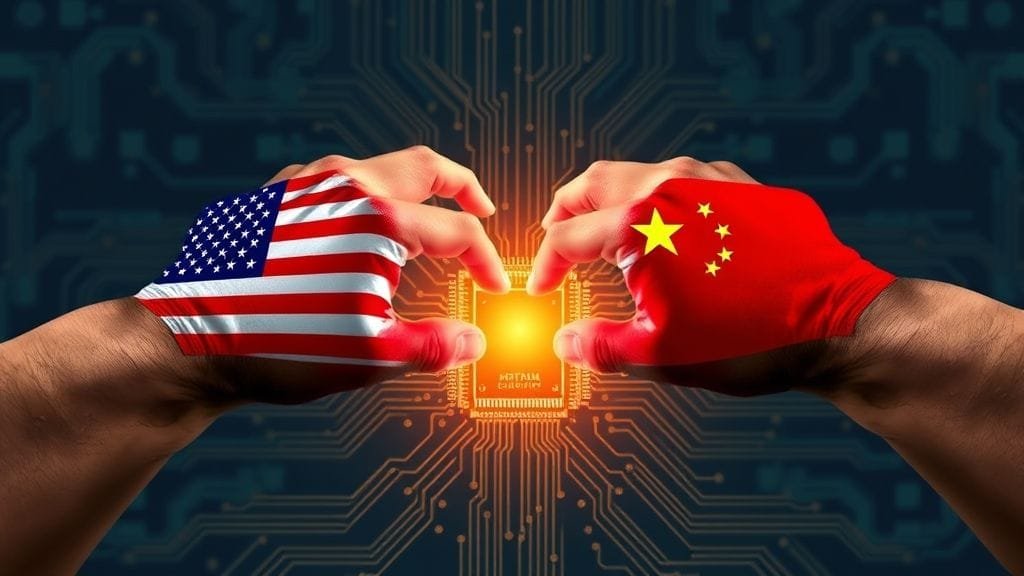
The world is currently grappling with an accelerating Global Technology War. Indeed, this multifaceted struggle sees technological supremacy emerging as a core aspect of geopolitical competition. More specifically, the United States and China are primarily locked in this intense contest. Consequently, it extends across economic, military, and ethical domains, profoundly reshaping global markets, supply chains, and even the fundamental nature of warfare. Therefore, understanding this global technology war is crucial for comprehending modern international relations.

Understanding the Global Technology War
At its heart, the global technology war is a race for dominance in critical and emerging technologies. These include Artificial Intelligence (AI), semiconductors, 5G networks, quantum computing, and advanced cyber capabilities. Consequently, this competition defines the current geopolitical landscape. Furthermore, it also influences future economic prosperity and national security.
This struggle is not merely about innovation; it’s about control. Specifically, nations want to secure their economic future. Moreover, they also aim to enhance their military capabilities and safeguard their national interests. Ultimately, the stakes in this global technology war are incredibly high for all involved.
The Race for Critical Technologies
The competition for technological leadership drives much of this global technology war. Indeed, countries are vying to lead in several crucial areas. Consequently, dominance in these fields promises significant economic and strategic advantages. Thus, this technological arms race shapes international policy and trade.
Furthermore, governments and corporations pour vast resources into research and development. This is because they believe that innovation is the key to national power. Therefore, investing in cutting-edge technologies becomes a top priority. Ultimately, this commitment fuels the escalating global technology war.
Geopolitical Bifurcation and Geotech Statecraft
One of the defining characteristics of this era is geopolitical bifurcation. Specifically, two distinct technology ecosystems are emerging. These are largely led by the US and China. Consequently, this trend is leading to a clear division of global markets and supply chains. Many industry leaders anticipate two separate supply chains for these two major powers within the next decade.
Moreover, companies are already splitting their operations. This allows them to serve both the US and Chinese markets effectively. Thus, this separation highlights the deep impact of the global technology war on global commerce. Indeed, it reshapes how businesses operate worldwide.

A world map showing distinct technological supply chain zones, colored differently for US-aligned and China-aligned systems, illustrating global technology war bifurcation.
Furthermore, governments are actively engaging in “geotech statecraft.” This involves intentionally manipulating technology dissemination across borders. Ultimately, the goal is to secure or enhance national security interests. Such strategies include various measures to control the flow of technology.
These measures encompass export controls, import restrictions, and investment limitations. Moreover, data localization requirements are also becoming more common. For example, the US has implemented stringent export controls to impede China’s high-end semiconductor industry. In response, China has enacted its own measures, such as banning specific foreign products in its telecommunications infrastructure. Clearly, these actions demonstrate the strategic nature of the global technology war.
Technology’s Role in Military Transformation
Advanced technologies are profoundly transforming modern warfare. Indeed, experts describe this shift as a “third revolution of warfare.” This follows the advent of gunpowder and nuclear weapons. Consequently, AI, space, and cyber realms are now fusing with traditional military assets.
Sensors, Unmanned Aerial Vehicles (UAVs), and beyond-visual-range weapons are becoming integrated. As a result, this significantly reduces “Sensor To Shooter” kill chains. The ongoing Russia-Ukraine conflict offers a stark illustration. Drones, for instance, have seen extensive use. Specifically, they account for an estimated 70% of casualties on both sides. Thus, this demonstrates the critical role of technology in contemporary global technology war scenarios.
The Economic Imperative of Tech Supremacy
Technology serves as a crucial engine for economic growth. It accounts for 60% to 85% of economic growth in the developed world. Therefore, nations understand this vital link. They are therefore heavily investing in research and development (R&D). Ultimately, their aim is to gain a competitive edge in the global market.
This economic imperative fuels much of the global technology war. Indeed, technological leadership translates directly into economic power and influence. Consequently, countries prioritize innovation to secure their future prosperity. Thus, this drive ensures sustained investment in advanced sectors.
Global Investment in Research & Development
Global R&D spending reached approximately $2.8 trillion in 2023. Significantly, this figure has nearly tripled since the year 2000. Consequently, this massive investment underscores the importance nations place on technological advancement. Indeed, it is a clear indicator of the intensity of the global technology war.
Breakdowns of this spending reveal key trends. Specifically, Asian economies led with 46% of global R&D spending in 2023. North America followed with 29%, and Europe with 21%. Thus, these figures illustrate the shifting global landscape of innovation.
- Leading R&D Spenders (2023):
* The United States is the largest spender in pure dollar terms. In fact, it invested $823.4 billion, representing 3.4% of its GDP.
* Meanwhile, China ranks second, with R&D investment surging to $723 billion. This constitutes 26% of global R&D spending.
* As a percentage of GDP, Israel leads globally at 6.3%, followed by South Korea at 5%. Clearly, these countries demonstrate a strong commitment to innovation.
High-tech goods trade also saw robust growth. Specifically, it increased by 9% in 2024. Moreover, China solidified its position as the world’s largest high-tech exporter, with exports reaching $825.2 billion. Conversely, the United States experienced a 12.6% surge in high-tech exports, totaling $385.3 billion. Therefore, the competition in high-tech trade is a direct reflection of the global technology war. For more insights on global trade dynamics, you can visit the World Trade Organization’s official website.
Investment in Artificial Intelligence (AI) is a top priority. Notably, an overwhelming 85% of companies globally plan to increase investment in AI within the next 12 months. Consequently, this highlights AI’s strategic importance. Indeed, it is a key battleground in the ongoing global technology war.
Regional Perspectives on the Tech War
Different regions approach the global technology war with unique strategies and concerns. Therefore, each actor navigates this complex landscape based on its national interests, economic capabilities, and geopolitical alliances. Ultimately, their varied perspectives shape the future trajectory of technological competition.
The United States’ Stance
The United States aims to maintain its long-held technological supremacy. To this end, it actively restricts China’s access to critical technologies. Moreover, US officials often portray China’s technological advancements as having been dishonestly obtained. Furthermore, the US possesses a strong competitive position, attracting significant capital and talent to its technology ecosystem. Consequently, this allows for robust innovation and leadership in key tech sectors. For context on US policy, consider reviewing publications from the Council on Foreign Relations.
China’s Drive for Self-Reliance
Beijing focuses intensely on achieving technology self-reliance. To this end, China has aggressively developed and expanded markets for new tech opportunities. For instance, examples include 5G and cloud computing. Furthermore, China scores highly in intellectual property metrics, including patents, trademarks, and industrial designs. Ultimately, this drive towards independence is a direct response to external pressures in the global technology war.
Europe’s Regulatory Approach
European nations participate actively in the global tech landscape. However, they show mixed confidence in their tech leadership. Instead, the European Union (EU) emphasizes developing technological standards and regulations. Specifically, these standards align with democratic principles and fundamental rights, especially for AI. Germany and France are among the top R&D spenders within the EU. Thus, their focus often balances innovation with ethical governance, a different facet of the global technology war.

India’s Strategic Balancing Act
India finds itself both exposed and empowered by the US-China tech war. However, while not yet producing cutting-edge chips, India sees opportunities in areas like chip design and rare earth processing. Moreover, India is increasingly aware of the need to strengthen its deterrence capabilities. Furthermore, it also seeks to shape new international regulations. Specifically, this is particularly true concerning space technology and hybrid warfare, important aspects of the global technology war. India’s emerging role in the tech sector is a growing topic of discussion. For instance, articles on `(/blog/india-tech-advances/)` provide more detail.
Southeast Asia’s Pragmatic Engagement
Countries in Southeast Asia often adopt a pragmatic approach. Specifically, they balance delicate diplomacy between the US and China. These nations remain open to technologies from various sources. For example, they benefit from Chinese companies’ aggressive market expansion in areas like 5G infrastructure and e-payment. At the same time, they are cognizant of data safety and surveillance risks. Thus, this region illustrates the complex choices smaller nations face in the global technology war.
Ethical Challenges of Military AI
The rapid advancements in military AI and autonomous weapons systems present complex ethical, legal, and political questions. Consequently, these technologies compel international discussions. Moreover, they force societies to confront the moral implications of automated warfare.
Human Control and Accountability
A central concern revolves around human control over lethal decision-making. Specifically, delegating such power to machines raises profound questions about accountability. It also challenges traditional notions of moral responsibility in conflict. Therefore, ensuring human oversight is a critical debate in the global technology war context.

Compliance with International Law
Critics argue that autonomous systems may struggle to make nuanced decisions. Indeed, these decisions are often required by International Humanitarian Law (IHL). For example, distinguishing accurately between civilians and combatants poses a significant challenge. Consequently, this could potentially lead to unlawful harm and violations of IHL. Therefore, the global technology war demands clear ethical frameworks.
Dehumanization and “Flash Wars”
The increasing automation and use of AI in military decision-making risk removing human commanders further from the moral responsibility of warfare. Consequently, this can dehumanize those affected by conflict. Moreover, the speed at which autonomous weapons could interact raises the prospect of “flash wars.” In fact, these conflicts might erupt too quickly for human intervention. Thus, this would lead to greater unpredictability and global instability in an already tense global technology war. The challenges of regulating AI are discussed in more detail on `(/blog/regulating-ai/)`.
Conclusion: Navigating the Future of Tech Conflict
The Global Technology War is undoubtedly a defining feature of the current international landscape. Indeed, intense competition for technological leadership drives it forward. Significant R&D investments and strategic geopolitical maneuvering further fuel this struggle. Ultimately, this global technology war has profound implications for international relations, economic development, and the very future of warfare.
Therefore, addressing its ethical dimensions is paramount. Furthermore, establishing robust international norms and frameworks becomes increasingly vital. Consequently, as technology continues to evolve at an unprecedented pace, so too must our approach to managing its power and impact on global stability. The future success of nations will heavily depend on how they navigate this complex and dynamic technological battlefield.