
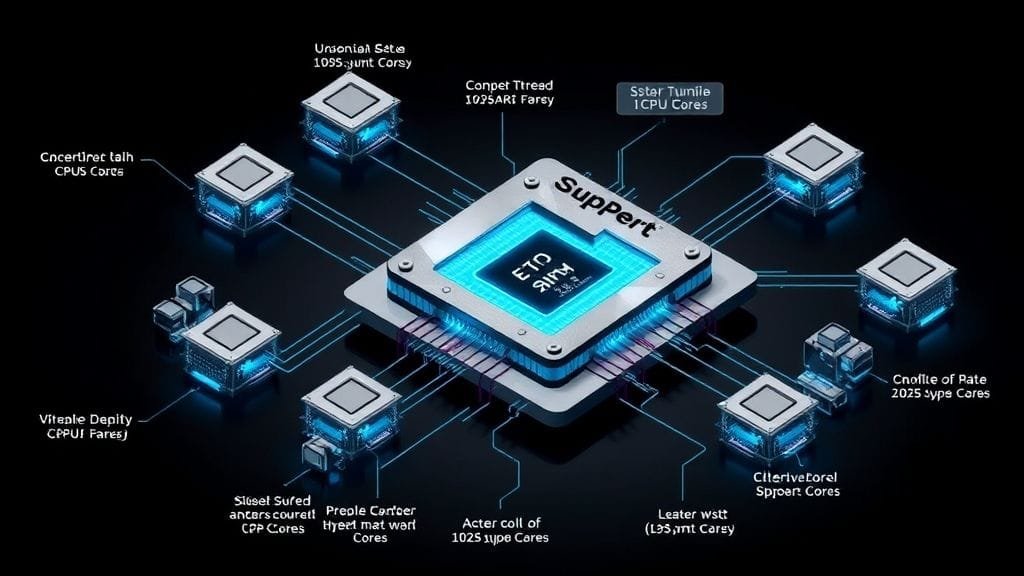
Imagine a world where your computer’s processor, or CPU, operates not just harder, but smarter. We often seek faster speeds and bigger numbers in technology. But what if the secret to better performance isn’t raw power, but smart teamwork? Recently, Intel, a major processor maker, introduced a new idea. This concept, known as Intel Software Defined Super Cores, could redefine our understanding of CPU power.
This new idea, Intel Software Defined Super Cores (SDC), might sound complex. Yet, it offers a novel way to make your computer handle single tasks faster. Some have even dubbed it “reverse hyper-threading.” This article will explain what Intel Software Defined Super Cores mean and how they work. We’ll also cover their possible impact on your future computer use. Get ready to learn about a significant step forward in processor technology.
The Quest for Single-Threaded Power: How Intel Software Defined Super Cores Help
Making processors faster has been a significant challenge for many years. At first, engineers focused on speeding up clock frequencies. They also built bigger, stronger single cores. Imagine constructing a single engine to be larger and more powerful. However, this approach, while effective initially, has its inherent limits. Faster clock speeds, for example, often lead to increased heat generation and greater power consumption. Similarly, creating massive single cores eventually becomes excessively power-hungry.
This is where the idea of Intel Software Defined Super Cores (SDC) comes in. This new concept is vital for addressing the problem of single-threaded speed. Indeed, these cores are designed to tackle this very challenge. Many important applications still demand a fast single thread. For example, these include video games, some scientific programs, and certain AI tasks. Thus, accelerating performance in this area is a major goal for Intel, especially with Intel Software Defined Super Cores.
Understanding Intel Software Defined Super Cores: Beyond Traditional Design
What exactly are Intel Software Defined Super Cores? Simply put, Intel Software Defined Super Cores (SDC) enable many smaller physical cores to work together. They act as one stronger core. Instead of building a larger physical core, Intel aims to join two or more existing cores. These joined cores then work in concert. Together, they run a single set of instructions. To your computer’s operating system, they appear as one very strong logical core.
Consider this example. Instead of one person trying to lift a very heavy box alone, Intel Software Defined Super Cores allow two or more people to lift that same box together. This makes the task much easier and faster, leveraging teamwork fully. The system splits a single task into smaller parts. It then distributes these parts among the collaborating cores. Each core handles a part, but they all contribute to the same overall job. This, ultimately, is the core idea behind Intel Software Defined Super Cores.
The “Shadow Store Buffer“: Ensuring Order in Software Defined Super Cores
When multiple cores work on one task, a significant challenge emerges: ensuring everything happens in the correct order. If instructions get mixed up, your program will not function correctly. Thus, the “Shadow Store Buffer,” a specialized tool, is key for Intel Software Defined Super Cores.
This buffer acts like a very organized traffic controller. It carefully follows the original order of instructions, making sure they happen in the right sequence. As the joined cores work on their instruction blocks, the Shadow Store Buffer reconstructs the results perfectly. Maintaining this precise order is paramount. This careful upkeep of program order is vital for Intel Software Defined Super Cores to work. Without it, the whole system would fail, causing errors and problems. So, this buffer is a key part of the SDC system. It ensures everything is right even when tasks are spread out.

Comparing Intel Software Defined Super Cores with Hyper-Threading
Intel is well-known for its Hyper-Threading Technology (HTT). This feature has been a staple for many years. It is a version of Simultaneous Multi-threading (SMT). So, it’s important to understand how Intel Software Defined Super Cores (SDC) differ from HTT. These technologies aim for very different kinds of performance.
HTT enables a single physical core to appear as two logical cores to the operating system. This feature allows the core to execute two distinct threads concurrently. The main goal of HTT is to maximize the utilization of all the core’s internal components. This efficiency is crucial. If one part of the core is busy, for example, another part can handle a different thread. This approach significantly enhances the processor’s overall throughput. In essence, it optimizes your CPU for concurrent multi-tasking.
Practical Benefits of Software Defined Super Cores
The main difference between the two technologies is clear. HTT, for example, runs multiple threads simultaneously on one physical core. This improves the system’s overall workload capacity. However, Intel Software Defined Super Cores utilize multiple physical cores. They then make them work together to speed up a single thread.
Imagine a highway. Hyper-Threading is like adding an extra lane to an existing road. This lets more cars (threads) travel at the same time, and it’s great for handling traffic. But, Software Defined Super Cores are like combining two separate roads into a single, very fast express route. This route is designed specifically for one key task. It allows a ‘single thread’ to run through it unimpeded. For you, this could mean a big jump in speed for tough single-threaded tasks. These include, for example, heavy gaming or complex mathematical problems.
| Feature | Software Defined Super Cores (SDC) | Hyper-Threading Technology (HTT) |
|---|---|---|
| Primary Goal | Boost single-thread performance | Improve overall multi-thread throughput |
| Core Interaction | Multiple physical cores fuse for one thread | One physical core runs multiple threads |
| OS View | Presents as one powerful logical core | Presents as multiple logical cores |
| Mechanism | Instruction stream splitting, parallel execution | Concurrent instruction execution within one core |
| Performance Target | IPC (Instructions Per Clock) for single tasks | Resource utilization, task parallelism |

Intel’s Strategic Pursuit: The Competitive Edge of Software Defined Super Cores
Intel is working on Intel Software Defined Super Cores (SDC) for new technological innovations. It’s also a strategic move in the highly competitive CPU market. The company faces tough rivals from many sides. For example, AMD has made significant strides with its Ryzen processors. These also boast strong multi-threaded performance. Apple’s specialized Arm chips, like the M-series, have also set new standards. They excel at single-threaded speed and consume little power.
These challenges compel Intel to innovate and differentiate its products. So, Intel Software Defined Super Cores aim to give Intel a special advantage. They seek to provide a substantial boost in Instructions Per Clock (IPC). IPC, simply put, is a key metric for how much work a processor completes in each clock cycle. Intel claims Intel Software Defined Super Cores could achieve this without needing more voltage or faster clock speeds. These improvements thus promise enhanced speed without significantly increasing power consumption or heat generation. This level of efficiency is very important in today’s computer world.
Real-World Impact: Applications Enhanced by Intel Software Defined Super Cores
The benefits of Intel Software Defined Super Cores could be profound, especially for some types of programs. Many modern applications, for instance, still contain sections that are inherently single-threaded, even with advancements in multi-threading. In these cases, Intel Software Defined Super Cores are very helpful. Here are a few examples where Intel Software Defined Super Cores (SDC) could make a big difference:
- Gaming: Many games, even modern ones, rely on a “main thread” for rendering, AI, and physics calculations. Consequently, a faster single thread translates to smoother frame rates and a superior gaming experience.
- Scientific Modeling and Simulation: Many complex simulations are used in areas like engineering, climate science, and drug discovery. These often involve repeated calculations. However, parallelizing these calculations across many processor cores is often challenging. Therefore, accelerating these single-threaded tasks, particularly with Intel Software Defined Super Cores, can significantly reduce overall computation time.
- Certain AI Tasks: While many AI tasks can be done in parallel, some steps, like data preparation or certain model inference processes, benefit more from faster single-core speed.
- Legacy Applications: Older software, not designed for many cores, could see a new lease on life with SDC. They could run much faster than before.
Early research suggests that Intel Software Defined Super Cores (SDC) could deliver up to a 50% boost in single-thread performance in optimal scenarios. This is a substantial number. It suggests a possible game-changer for programs that really need fast single-core speed. Imagine your favorite game running 50% faster, or complex calculations finishing in half the time. The promise, therefore, is truly exciting.
The Road Ahead: Challenges and Hurdles for SDC
Despite its exciting promise, Intel Software Defined Super Cores (SDC) are not without challenges. For example, transforming such a complex idea (currently a patent) into a viable product is inherently difficult. It will undoubtedly require extensive development. Intel must overcome significant technical problems. The biggest problems involve how cores in Intel Software Defined Super Cores communicate and stay in sync.
For multiple physical cores to act as one, they need to communicate very quickly. Any latency in transmitting information between them, for instance, could negate potential speed gains. So, cores need to communicate very, very fast. Think of it like a symphony orchestra. Each musician (core) must play their part right on time with others. If one is even a fraction of a second off, the whole performance suffers. This precise timing is crucial for maintaining instruction order across these collaborative cores.
The Software Challenge: Compilers and Operating Systems
The hardware challenges are only one side of the coin. Also, making Intel Software Defined Super Cores (SDC) work also needs robust software support. This means compilers must be highly sophisticated. Compilers are programs that translate human-readable code into machine-executable instructions. For Intel Software Defined Super Cores to work well, compilers must be intelligent. They need to identify parts of a single thread that can be split and assigned to fused cores.
The operating system (OS) needs to be SDC-aware and provide robust support. Therefore, it must be capable of recognizing these “super cores” and scheduling workloads onto them effectively. This presents a complex software problem. For example, critics often point to Intel’s past experience with the Itanium processor. Itanium needed a lot of smart compiler tricks to reach its speed goals. However, it was not very successful. This historical example, therefore, underscores the risks associated with technology overly reliant on perfect software execution.

Reliability and Compatibility: Learning from Past Experiences
Apart from technical issues, there are concerns about reliability and software compatibility for Intel Software Defined Super Cores. New technologies can bring new problems, especially those that change how the CPU interacts with software.
We have seen similar challenges in the past. For example, Intel’s 12th Gen processors introduced a mix of Performance-cores (P-cores) and Efficiency-cores (E-cores). This new design at first encountered problems with the Windows Task Scheduler. The OS sometimes had trouble assigning tasks to the right core type for optimal performance. These past experiences remind us that even promising hardware needs excellent and stable software support to succeed. The success of Intel Software Defined Super Cores will depend on this support. Furthermore, as Intel Software Defined Super Cores (SDC) is currently only a patent, its market availability will depend on successful prototype development and seamless software integration.
Deconstructing “Anti-Hyperthreading”: A Historical Perspective
The term “anti-hyperthreading” frequently arises in discussions surrounding Intel Software Defined Super Cores (SDC). So, it’s important to understand what it truly means. It is not a technology that simply reverses Hyper-Threading. Instead, it refers to the practice of choosing to disable Hyper-Threading (SMT) for certain benefits. However, this historical practice is fundamentally different from the objective of Intel Software Defined Super Cores. This is a key distinction.
Why Hyper-Threading Was Sometimes Disabled
In the past, disabling Hyper-Threading (SMT) has been a strategic choice for several important reasons:
- Performance Degradation: Certain software applications may experience performance degradation with HTT enabled. This is particularly true for applications that are not heavily multi-threaded, for instance. Tasks that heavily utilize CPU resources, such as specific database systems, might actually run slower. This occurs because the two logical cores contend for the same underlying physical resources. This contention, in turn, can lead to performance bottlenecks. Yet, this scenario differs from Intel Software Defined Super Cores. SDC, instead, aims to make resources work together harmoniously.
- Security Concerns: Over time, Hyper-Threading has been linked to security vulnerabilities that can be exploited through side-channel attacks. These flaws can allow attackers to infer private data by observing processor behavior. To mitigate these potential security risks, some users and businesses disable HTT. This also adds an extra layer of safety, especially when data is sensitive.
- Software Licensing and Overhead: For older or specialized software, licensing models may be based on the number of CPU cores. With HTT enabled, the operating system reports more logical cores. This can sometimes lead to higher software costs. Also, some High-Performance Computing (HPC) programs turn off HTT. Their goal is to avoid extra overhead for the OS and issues with task balancing. This ensures the most efficient use of resources for their critical, often very specific tasks. They prefer direct, explicit control over resources, a philosophy very different from the approach of Intel Software Defined Super Cores.

SDC: Not Disabling, But Redefining
It’s important to understand this difference. Intel’s SDC patent, however, outlines a novel approach for Intel Software Defined Super Cores. It does not involve disabling existing multi-threading features. Instead, it actively synthesizes resources from multiple physical cores. This, in turn, facilitates accelerated single-thread execution. This represents, simply put, a fundamental shift in design. The new method also seeks to redefine how single-thread speed is achieved in modern processors. It doesn’t just revert to older operational paradigms.
Looking to the Future: The Potential Evolution of CPU Architecture
The idea of Intel Software Defined Super Cores signals an exciting shift in CPU design. For many years, for example, the trend has been to include more and more cores. Processors with dozens, even hundreds, of cores are now common in data centers. However, this strong emphasis on core count often overlooked single-threaded performance. This holds true despite the importance of numerous cores for parallelized tasks.
Intel Software Defined Super Cores (SDC) show that Intel is thinking differently. They hint at a future where processors are more than just an aggregation of discrete cores. These flexible systems would adapt dynamically, based on the workload. Such adaptability would provide greater flexibility. Furthermore, this approach highlights the growing synergy between hardware and software. This is a main idea of Intel Software Defined Super Cores. The hardware provides flexible building blocks (physical cores), while the software then smartly decides how to best utilize these blocks. This could, therefore, lead to CPUs that are significantly more versatile and efficient, unlocking new avenues for performance.

Is SDC the Next Big Leap? What This Means for You
Intel’s Software Defined Super Cores present a new and exciting path for processor technology. They enable multiple physical cores to synergistically combine their power to accelerate single-threaded tasks. This promises a substantial performance increase for demanding applications. Such a development could transform experiences for gamers, scientists, and anyone requiring exceptionally fast single-core performance. It would make computers more powerful.
Bringing this idea to market will be challenging, as is often true for new technologies. The success of Intel Software Defined Super Cores, therefore, depends on solving complex technical problems. These include how cores communicate and maintain perfect synchronization. Such precise timing is critical for the technology’s proper function. The system also needs sophisticated compiler optimizations and robust operating system support. Without these, Intel Software Defined Super Cores cannot achieve their full potential. Lessons from past projects, like Itanium, remind us that even brilliant hardware ideas require a well-orchestrated software ecosystem to succeed.
SDC’s Promise for Consumers
As consumers, this technology promises exciting advancements. It could mean faster, more responsive computers that handle your hardest tasks with ease. Also, they would potentially use less power. This is a big advantage. It signals Intel’s commitment to innovation and its ambition to maintain leadership in processor manufacturing. The concept moves beyond simply adding more cores or speeding up clock frequencies. Instead, it’s a smarter way to utilize existing resources.
What do you think about Intel’s idea for creating these “super cores”? Do you believe the technical problems for Intel Software Defined Super Cores can be overcome? Or will making the software work with it be the hardest test? Share your thoughts in the comments below!