The world of computing never stands still. Indeed, every year, new silicon promises to push the boundaries of performance, efficiency, and capability. Consequently, in October 2023, Intel launched its 14th generation processors, officially dubbed “Raptor Lake Refresh.” Specifically, these new chips arrived with a specific mission. Namely, they optimized the robust 13th Gen architecture. Therefore, this offered an incremental, yet meaningful, boost to desktop and mobile computing. So, are you planning a new PC build or upgrade? If so, understanding these Intel 14th Gen processors is crucial, as it helps you make an informed decision.
To be clear, the “Raptor Lake Refresh” is not a revolutionary leap. Instead, think of it as a finely tuned performance vehicle. Specifically, it received a polished engine and extra horsepower. Moreover, this generation marks a significant moment for Intel. Indeed, it signals the final use of “Core i” branding. Henceforth, future lineups will use “Core” and “Core Ultra” branding. Ultimately, this simplifies the nomenclature. The 14th Gen is thus a landmark. Therefore, we will now delve deeper. With this in mind, consider performance, power, and your wallet.

Understanding the “Raptor Lake Refresh” Philosophy
Initially, Intel’s 14th Gen approach was strategic. Indeed, it focused on optimization. Consequently, a complete architectural overhaul was avoided. Therefore, this “Refresh” philosophy keeps the design consistent. In fact, it is largely inherited from 13th Gen Raptor Lake. However, Intel engineered these new chips differently. Specifically, they have higher clock speeds. Furthermore, core counts were boosted in some instances. Ultimately, this strategy delivers performance gains. Nevertheless, these gains are palpable in specific scenarios. Crucially, it is not a seismic shift in technology.
Moreover, the core hybrid architecture continues to be central. Indeed, it is a hallmark of recent Intel designs. Specifically, this innovative design combines core types. For instance, powerful Performance-cores (P-cores) handle demanding tasks. Meanwhile, efficient Efficient-cores (E-cores) manage background processes. Consequently, they improve overall system responsiveness. Ultimately, it shows Intel’s engineering prowess. Thus, continuous refinement extracts more from existing foundations. As a result, many users benefit directly. This is because higher frequencies and intelligent core management help. Therefore, this means a snappier, more capable computing experience.
The End of an Era: Core i Branding
The launch of 14th generation processors also signaled a significant Intel branding transition. Indeed, for years, the “Core i” moniker – from i3 to i9 – has been synonymous with Intel’s consumer CPU offerings. However, this era is drawing to a close. Specifically, with future generations, Intel is streamlining its branding to simply “Core” and “Core Ultra.”
Consequently, this shift simplifies the product stack. Moreover, it may introduce clearer performance tier distinctions. Thus, the 14th Gen is the swansong for “Core i” naming. Therefore, these chips are unique in Intel’s CPU lineage. So, are you building a system with one of these CPUs? If so, you’ll be among the last to feature the classic “Core i” badge. Ultimately, this historical context adds another layer of interest to the Intel 14th Gen processors.
Key Models and Specifications of Intel 14th Gen Processors
Initially, Intel focused 14th Gen desktop rollout on K-series processors. Indeed, these are for enthusiasts demanding maximum performance. Specifically, users often engage in overclocking. Consequently, these models represent the pinnacle of “Raptor Lake Refresh”. Therefore, they bring noteworthy, incremental improvements. Ultimately, understanding their specific features will help you identify the best fit for your needs.
First, let’s break down the flagship offerings. Specifically, we will highlight their core configurations and critical specifications. Consequently, this detailed look provides a clear picture. Moreover, it shows each processor’s position. Thus, you’ll know what power to expect. Furthermore, we will explore Core i9, i7, and i5 models. Significantly, all use the LGA 1700 socket. Therefore, this ensures broad compatibility with existing motherboards.
Flagship: Intel Core i9-14900K
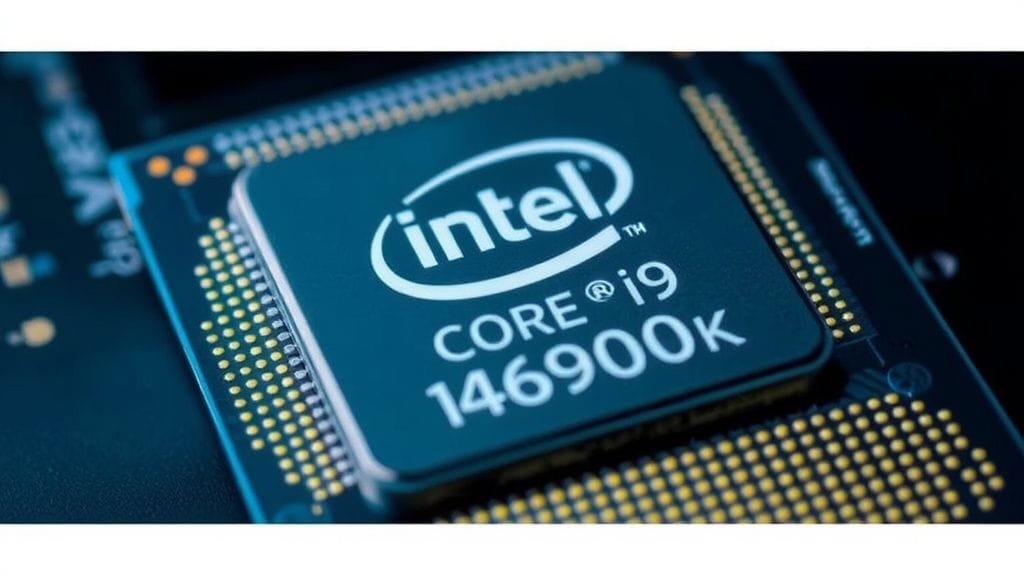
Undoubtedly, the Core i9-14900K stands as the undisputed flagship of the 14th Gen lineup. Indeed, it boasts 24 cores (8 P-cores, 16 E-cores). It also has 32 threads. Consequently, this makes it formidable for gaming and multi-threaded apps. Although its base frequency is 3.2 GHz, its true power shines via Turbo Boost. Specifically, it can reach an astonishing 6 GHz. Therefore, this extreme clock speed offers leading single-core performance.
Furthermore, with 36 MB of L3 cache, the 14900K ensures rapid data access for complex tasks. However, this raw power has a trade-off. Specifically, its base TDP is 125W. Moreover, Max Turbo Power (MTP) escalates to 253W. Consequently, this high power draw necessitates a robust cooling solution. Ultimately, priced around $589, the i9-14900K targets users who prioritize absolute peak performance. For them, power efficiency is not a concern.
The Sweet Spot: Intel Core i7-14700K
Notably, it offers the most significant generational upgrade. Indeed, this chip features 20 cores (8 P-cores, 12 E-cores). Additionally, it has 28 threads. Specifically, this is a gain of four E-cores over its 13th Gen predecessor. Consequently, this increased core count directly translates into superior multi-threaded performance.
Furthermore, the i7-14700K’s base frequency is 3.4 GHz, and it boosts up to 5.6 GHz. Moreover, it includes a generous 33 MB of L3 cache. Thus, it delivers exceptional performance and value. Consequently, this makes it compelling for many PC enthusiasts. Priced at $406, the i7-14700K is attractive. Not only does it offer serious processing power, but it also won’t break the bank. Significantly, its improved core count is a bonus. Therefore, you get more for your money with this particular chip.
Mainstream Power: Intel Core i5-14600K
First, are you seeking a powerful, budget-friendly option? Then, the Core i5-14600K delivers strong performance. Specifically, this processor features 14 cores (6 P-cores, 8 E-cores) and 20 threads. Moreover, it boosts up to 5.3 GHz. This is, in fact, a slight increase over the 13600K’s 5.1 GHz.
Furthermore, the i5-14600K has 24 MB of L3 cache. Consequently, this provides ample capacity for most workloads. Moreover, priced around $319, it remains a highly competitive option in the mid-range segment. Although its generational gains are modest, still, it’s a solid choice for a new build. Indeed, it offers excellent performance for its cost. Therefore, pair it with a good GPU for best results. Ultimately, the Intel 14th Gen processors clearly offer options across different price points.
Platform Compatibility and Features
Firstly, a distinct advantage of 14th Gen desktop processors is their exceptional platform flexibility. Specifically, all models use the existing LGA 1700 socket. Moreover, they are fully compatible with 600- and 700-series motherboards. Consequently, this compatibility is a huge win for consumers. Indeed, it allows an easy upgrade path for LGA 1700 users. Typically, therefore, only a BIOS update is needed.
Furthermore, these chips offer versatile memory support. Specifically, they accommodate DDR4 and faster DDR5 RAM (DDR5 up to 5600). Consequently, this flexibility lets you reuse existing components. You can also invest in future-proof memory. Ideally, do this as your budget allows. Moreover, high-speed PCIe 4.0 and 5.0 connectivity is included. Therefore, this guarantees compatibility with new GPUs and NVMe SSDs.
Let’s look at the key specifications in a structured way:
| Feature | Core i9-14900K | Core i7-14700K | Core i5-14600K |
|---|---|---|---|
| Architecture | Raptor Lake Refresh | Raptor Lake Refresh | Raptor Lake Refresh |
| P-cores (Threads) | 8 (16) | 8 (16) | 6 (12) |
| E-cores (Threads) | 16 (16) | 12 (12) | 8 (8) |
| Total Cores | 24 (8P + 16E) | 20 (8P + 12E) | 14 (6P + 8E) |
| Total Threads | 32 | 28 | 20 |
| Base Frequency | 3.2 GHz | 3.4 GHz | 3.5 GHz |
| Max Turbo Freq. | 6.0 GHz | 5.6 GHz | 5.3 GHz |
| L3 Cache | 36 MB | 33 MB | 24 MB |
| Base TDP | 125W | 125W | 125W |
| Max Turbo Power | 253W (up to 385W observed) | 253W | 181W |
| Socket | LGA 1700 | LGA 1700 | LGA 1700 |
| RAM Support | DDR4/DDR5 (up to 5600) | DDR4/DDR5 (up to 5600) | DDR4/DDR5 (up to 5600) |
| PCIe Support | 4.0/5.0 | 4.0/5.0 | 4.0/5.0 |
| Launch Price (Est.) | ~$589 | ~$406 | ~$319 |
Performance Deep Dive: Where Do 14th Gen Processors Excel?
First, when examining 14th Gen performance, approach it with realistic expectations. Indeed, as a refresh, improvements are modest. Specifically, they are often 1-5% over the 13th Gen. Furthermore, this applies across various applications and games. However, these small gains can add up. This is especially true in specific workloads. For instance, clock speed or core count increases make a difference there. Ultimately, it’s not about new architecture. Rather, it’s about maximizing an already strong foundation.
However, the overall average might seem small. Nevertheless, certain applications or games show more uplift. Consequently, this nuanced performance picture is critical. Indeed, discerning users need precise return on investment knowledge. Ultimately, understanding these strengths and weaknesses helps paint a complete picture of the Intel 14th Gen processors.
Gaming Performance: A Nuanced Perspective
Initially, gaming performance with Intel 14th Gen processors presents an interesting paradox. While Intel markets the i9-14900K as a gaming powerhouse, independent reviews paint a more nuanced picture. Indeed, in many titles, 13th Gen and 14th Gen performance is negligible. Specifically, it’s typically within a 2-3% margin at 1080p. Furthermore, as resolution increases and the GPU becomes the primary bottleneck, this difference often shrinks further.
Conversely, AMD’s Ryzen 7000X3D series often leads in gaming. Specifically, the Ryzen 7 7800X3D is especially strong. This is because of its innovative 3D V-Cache. While the i9-14900K can outperform AMD Ryzen 9 7950X3D and Intel claims superiority in 15 of 26 tested titles, however, the 7800X3D often holds the top spot for overall gaming. Therefore, if gaming is your sole priority, review specific game benchmarks first. Indeed, this is highly recommended before settling on an Intel 14th Gen chip.
Multi-threaded Workloads: A Clear Winner Emerges
Notably, this is where the Core i7-14700K truly shines as the star of the 14th Gen refresh. Specifically, it has four additional E-cores. Consequently, this brings its total to 20 cores, 28 threads. As a result, this processor shows significant multi-threaded improvement. Indeed, you’ll find substantial gains. Moreover, it excels in apps that fully utilize all cores and threads.
For instance, the i7-14700K can be up to 14% faster. Specifically, this is compared to the i5-14600K. Moreover, it’s even 10% faster than AMD’s Ryzen 9 7900X in some benchmarks. Therefore, in apps like Cinebench and V-Ray, multi-core performance is key. Consequently, the i7-14700K showed 7-14% improvements. Notably, this was over its predecessor. Furthermore, in certain scenarios, it outperforms the AMD Ryzen 7950X. Thus, this makes it compelling for content creators and engineers. In short, it’s great for anyone doing CPU-intensive tasks. However, the i9-14900K and i5-14600K show more modest multi-threaded gains, typically in the 2-8% range.

A bar chart comparing the multi-threaded performance (e.g., in Cinebench R23) of the Intel Core i7-14700K against its 13th Gen predecessor and selected AMD Ryzen CPUs.
Single-threaded Gains: Incremental Yet Significant
Although focus often shifts to core counts, single-threaded speed still remains critical. Indeed, this includes gaming and OS responsiveness. It also helps lightly threaded software. Nevertheless, 14th Gen single-threaded increases are marginal. Specifically, they typically hover around 2-4% across the lineup.
Significantly, these gains stem from higher clock speeds. Indeed, Intel squeezed them from the optimized Raptor Lake architecture. Although 2-4% might not sound like much, nevertheless, these boosts contribute to a snappier feel. Moreover, they provide an edge in apps not scaling with multiple cores. Ultimately, it reinforces the idea that the 14th Gen is about refinement, enhancing an already strong foundation.
Application Optimization (APO): Intel’s Software Boost
Furthermore, beyond raw hardware improvements, Intel also introduced Application Optimization (APO) with the 14th Gen. Specifically, this innovative software adjusts thread affinities. Thus, it guides the OS for specific games. Consequently, game threads allocate to appropriate CPU cores. Ultimately, this ensures optimal performance.
Indeed, APO represents Intel’s commitment to extracting maximum performance through software-hardware synergy. However, its impact is currently limited to select games. Nevertheless, early results show promising boosts in titles like Metro Exodus. Moreover, this feature could become more important as more games optimize for the hybrid architecture. Therefore, this offers extra value to Intel 14th Gen processors.
Power Consumption and Thermal Management: The Elephant in the Room
Firstly, 14th Gen processors have significant power consumption. Consequently, their thermal implications must be addressed. This is particularly pronounced with the Core i9-14900K. For instance, under heavy load, it can reach 385W. Even more concerning, average power usage during benchmarks frequently hovers around 339W.
Indeed, such power requirements are substantial. Moreover, they exceed 13th Gen counterparts. They also exceed AMD’s Ryzen series, which often prides itself on efficiency. Consequently, this immense power draw directly translates into considerable heat generation. Therefore, adequately cooling a 14900K is essential; furthermore, this applies to a fully-loaded 14700K too. Specifically, you’ll need top-tier cooling. For instance, consider high-end AIO liquid coolers or custom water loops. This is crucial because this maintains optimal performance and prevents thermal throttling. Ultimately, throttling reduces clock speeds and performance. Thus, skimping on cooling for these powerful chips is simply not an option.

Value Proposition: Is an Upgrade to Intel 14th Gen Worth It For You?
To begin, assess the value of Intel 14th Gen processors. Considerably, consider your current hardware, budget, and expectations. Although Intel has largely maintained similar pricing for its K-series models compared to their 13th Gen predecessors, ultimately, the i9 and i5 show modest performance gains. Therefore, upgrading from a 13th Gen CPU is often not worthwhile, as the performance uplift simply doesn’t justify the cost.
However, the picture changes dramatically for users coming from older generations. For example, if you’re running an 11th, 12th, or older Intel CPU, the 14th Gen offers a substantial performance boost. Indeed, this jump means a snappier system. You can also enjoy smoother gaming and faster content creation. Therefore, it’s crucial to consider your starting point when evaluating the refresh.
Upgrading from Previous Generations
First, have a system predating 13th Gen? If so, Intel 14th Gen processors offer a compelling upgrade. For instance, imagine moving from a 10th Gen Core i7 to a 14th Gen Core i7-14700K. Consequently, you’d gain monumental improvements. Specifically, expect better core count, clock speed, and system responsiveness. Indeed, tasks that once felt sluggish would suddenly complete in a fraction of the time.
Furthermore, consider the practical implications. For example, expect faster video rendering. Similarly, code compilation will be quicker. Thus, enjoy a smoother experience across demanding applications. Consequently, the performance leap justifies investment. This may involve getting a new CPU and perhaps new RAM. Moreover, this applies if moving from DDR4 to DDR5. Ultimately, the 14th Gen is a strategic upgrade. Indeed, it suits systems several years old, especially if they are showing their age.
Competing with AMD: A Platform Battle
Indeed, Intel’s 14th Gen and AMD’s Ryzen 7000 compete fiercely. Specifically, AMD’s X3D models lead in gaming performance. Conversely, Intel claims superiority in certain professional applications. This is particularly true with the i7-14700K. However, AMD often offers a better performance and power efficiency balance. Ultimately, this balance is key for many users, especially those who care about operating costs and thermal management.
Therefore, the choice often comes down to your primary use case. For example, for a dedicated gaming rig where every frame matters, AMD’s X3D chips frequently take the crown. However, for a workstation that also games, consider the i7-14700K. Indeed, it offers formidable multi-threaded power and provides solid gaming performance. Ultimately, you need to weigh the specific strengths of each platform against your most demanding tasks.
The Cost-Effectiveness of the LGA 1700 Platform
Conversely, a distinct advantage of Intel 14th Gen processors is compatibility. Specifically, they use the existing LGA 1700 socket. Thus, you can drop a 14th Gen CPU into an older motherboard, provided it is a 600- or 700-series board. You simply need to update the BIOS. Consequently, backward compatibility lowers costs. Indeed, this applies to upgrading or building a new system.
In contrast, AMD’s AM5 platform mandates new motherboards and DDR5. However, Intel’s flexibility allows reusing DDR4 RAM. Compatible motherboards can also be reused. Consequently, this reduces the barrier to entry. Therefore, this cost-effectiveness makes the 14th Gen attractive. The i7-14700K, in particular, is especially appealing. It suits budget-conscious builders. Namely, they maximize performance within spending limits. Ultimately, it’s a compelling proposition for those seeking a powerful system without a complete overhaul. To learn more, find out about upgrading your BIOS on Intel’s official support page for optimal performance.
[External Link: [Intel Support: BIOS Update Information](https://www.intel.com/content/www/us/en/support/articles/000005724/processors.html)]
[Internal Link: [/blog/choosing-the-right-motherboard/)]
Beyond Desktop: Intel 14th Gen Mobile Processors
While desktop K-series processors often steal the limelight, Intel 14th Gen processors also reach mobile computing. Indeed, a new lineup of 14th Gen Core mobile processors was launched, spearheaded by the powerful i9-14900HX. This chip was, moreover, declared “world’s fastest mobile processor” at its December 2023 launch. Ultimately, it underscores its significant laptop performance.
Furthermore, these mobile CPUs leverage hybrid architecture with P-cores and E-cores. Consequently, this enhances laptop performance for demanding tasks. For instance, examples include gaming, content creation, and multitasking. Therefore, professionals and serious gamers who need desktop-level power but also seek a portable form factor will find the 14th Gen mobile processors offer a compelling solution. Indeed, they ensure that even on the move, you have access to cutting-edge processing power.

Deciding Your Next Upgrade
In summary, Intel’s 14th Gen processors are a “Raptor Lake Refresh.” They are, in essence, a careful optimization of the prior generation. Specifically, they offer iterative improvements. Indeed, this is mainly due to higher clock speeds. The i7-14700K also has more E-cores. Overall, Intel’s 14th Gen chips remain competitive. While the i7 excels in multi-threaded tasks and productivity apps, its power consumption is high. Furthermore, i9 and i5 gains are marginal, so upgrading from 13th Gen is not generally recommended.
However, the i7-14700K is compelling for some users. Specifically, this includes those with older hardware (11th Gen or earlier). It also suits new system builders who value platform compatibility and workstation tasks. Indeed, its increased core count and competitive pricing make it a true standout. Moreover, if you want to avoid new motherboard and RAM costs, the LGA 1700 platform’s longevity is a strong argument, especially with the 14th Gen. Ultimately, the 14th Gen offers a solid, refined choice within Intel’s robust ecosystem.
Finally, what aspects of Intel 14th Gen processors are most important? Therefore, consider this for a new build or upgrade. Then, share your thoughts in the comments below!
[Internal Link: [/blog/how-to-build-a-gaming-pc/)]
[External Link: [Wikipedia: Intel Raptor Lake](https://en.wikipedia.org/wiki/Raptor_Lake)]