The pursuit of extreme overclocking performance represents the pinnacle of hardware enthusiasm. Indeed, it’s not just about making a system faster. Rather, this endeavor is an art form and a science. Moreover, it represents a relentless quest. Here, components are pushed beyond their advertised limits. Specifically, dedicated enthusiasts pursue this. It involves deep dives into Voltage Regulator Modules (VRMs). Furthermore, they study sophisticated power delivery systems. They also explore granular BIOS features. Indeed, these elements are the bedrock. They allow record frequencies. They also enable unprecedented stability. Consequently, understanding them is crucial. Specifically, this applies to anyone aiming to master the overclocking arena.

This article details critical components. It also covers techniques. Ultimately, these define extreme overclocking performance. Specifically, we will explore component choices. Meticulous tuning is also covered. Ultimately, these empower enthusiasts. They unlock previously impossible capabilities. Thus, we aim to equip you with “hard-won wisdom.” This will elevate your overclocking journey. Instead, move beyond mere adjustments. Achieve masterful system optimization.
The Heart of Stability: Decoding VRM Quality for Extreme Overclocking
Think of your system’s VRM (Voltage Regulator Module). Indeed, it is your motherboard’s tireless heart. Specifically, it pumps stable, clean power. This goes to your CPU, GPU, and RAM. Therefore, for extreme overclocking performance, the quality of this “heart” is paramount. Ultimately, it ensures critical components get precise energy. Moreover, this energy must be unwavering. It’s vital when pushed to absolute limits.
Specifically, a VRM’s job is complex. It takes the 12V supply from your power supply unit (PSU). Then, it meticulously transforms it into lower voltages. These are highly stable. Indeed, modern processors require them. In fact, this conversion process relies on a symphony of components. They work in concert. Specifically, components include MOSFETs (transistors) and chokes (inductors). Capacitors are also present. Furthermore, a PWM (Pulse Width Modulation) controller orchestrates the operation. Furthermore, efficiency and quality dictate system health. They also impact stability. Specifically, this applies to your overclocked system.
Beyond the Phase Count: The True Measure of VRM Excellence
Many enthusiasts focus on VRM phases. However, true excellence in extreme overclocking performance lies elsewhere. Rather, it’s about the quality of each individual component within those phases. It’s a common misconception that more phases automatically equate to better power delivery. However, a few high-quality phases can often outperform many inferior ones.
High-end motherboards are designed for record-breaking attempts. Indeed, they feature superior-grade components. For example, they commonly use Japanese capacitors. These are known for their reliability and longevity. Super Ferrite Chokes (SFCs) are also incorporated. Moreover, they offer improved efficiency and reduced power loss. Moreover, DrMOS (Driver-MOSFET) power stage integration is a significant leap forward. Specifically, these compact modules combine MOSFETs and their drivers. They form a single, highly efficient package.
Why DrMOS and Premium Components Matter
DrMOS solutions offer several compelling advantages. Indeed, these are vital for extreme overclocking performance. First, they boast higher power efficiency. Consequently, less energy is wasted as heat. Furthermore, they allow better design control. This is important in limited motherboard space. Thus, this integration lowers operating temperatures. It also extends power stage lifespan. Therefore, cooler VRMs resist throttling. This is critical for stability. Specifically, it applies under sustained heavy loads.

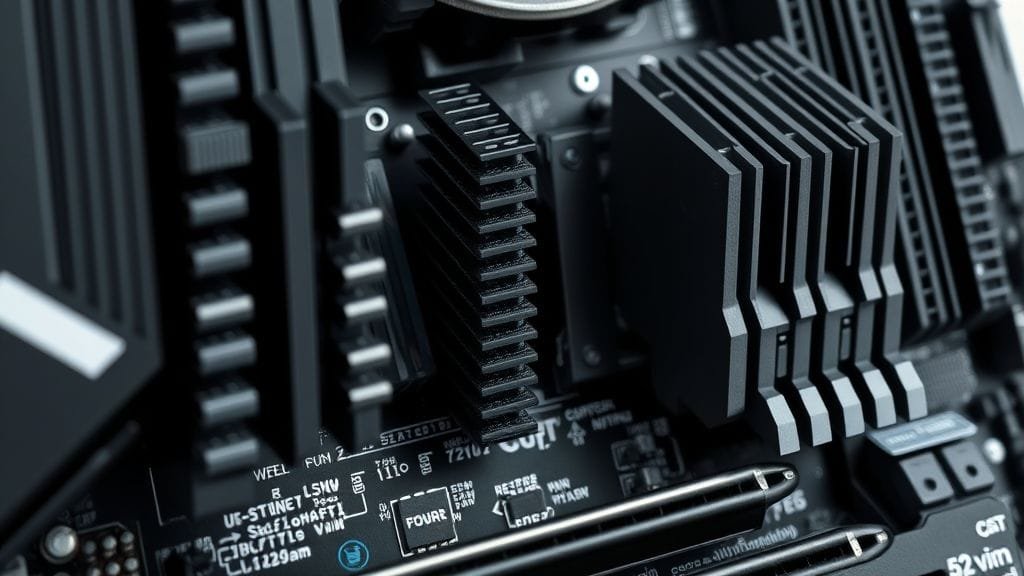
Additionally, another crucial specification is phase amperage. This is the current each individual phase can handle. Therefore, savvy overclockers often prioritize fewer phases. These have a higher current-handling capacity. Consequently, this design reduces voltage fluctuation. Furthermore, motherboards can support higher Thermal Design Power (TDP). They avoid performance bottlenecks. However, remember, effective cooling is non-negotiable. Indeed, robust VRMs need it. Therefore, massive, well-engineered heatsinks are often used. This prevents overheating. Ultimately, it ensures maximum stability.
Powering the Beast: Advanced Delivery Systems for Uncompromised Stability
The VRM is central. However, it’s part of a much larger network. This intricate Power Delivery Network (PDN) spans your system. Therefore, for stellar extreme overclocking performance, consider the entire chain. It runs from your power supply unit (PSU). Specifically, it goes down to tiny chip pads on your processor. Every link in this chain impacts power cleanliness. It also affects power stability. Ultimately, this power reaches your components.
A high-quality PSU forms the absolute foundation. Indeed, it creates a reliable overclocking setup. It’s the primary stable power source for VRMs. Thus, an excellent PSU minimizes ripple and noise. This starts from the outset. In contrast, a substandard PSU creates problems. Consequently, VRMs work harder to clean power. This generates more heat. Ultimately, it can compromise system stability. Investing in a top-tier PSU is therefore non-negotiable for serious enthusiasts.
Beyond the Motherboard’s Edge: PCB Design and Specialized Features
Motherboards engineered specifically for extreme overclocking performance go far beyond robust VRM designs. Instead, their entire power delivery system is meticulously crafted. It sustains heavy, continuous loads. Specifically, this includes high-amperage VRM phases. Optimized Printed Circuit Board (PCB) layouts are also present. For instance, such boards often feature 2oz copper layers in the PCB. This significantly improves electrical conductivity. It also aids heat dissipation. Furthermore, server-grade materials are frequently employed. They enhance durability and signal integrity. Specifically, this applies under extreme conditions.
Moreover, specialized slot designs are vital. Indeed, they ensure ripple-free voltage. They also provide low-noise, stable delivery. This applies even at component breaking points. For example, some manufacturers, like MSI, incorporate “nitro path” technology. Specifically, this is for DRAM slots. Ultimately, this design aims to improve communication. It’s between memory and CPU. Additionally, it simultaneously reduces errors. Thus, these minor details contribute significantly. They boost overall stability. Ultimately, they enhance ultimate extreme overclocking performance.
The Overclocker’s Cockpit: Mastering BIOS Features for Granular Control
Your hardware is the engine. Meanwhile, the BIOS (Basic Input Output System) is its cockpit. It provides granular, direct access. Specifically, critical hardware settings are available. They let you push components. Indeed, go far beyond stock limits. Therefore, this is vital for extreme overclocking performance. Learning to navigate and understand these features is crucial. Specifically, this applies to any aspiring overclocker.
The BIOS is where the real magic happens. Indeed, it offers a suite of powerful tools. Here, for instance, manipulate core frequencies. Fine-tune voltages. Manage power delivery. Ultimately, extract every ounce of performance. However, understand each setting’s impact. It is essential. Otherwise, incorrect adjustments cause instability. They can also damage hardware permanently. Therefore, always proceed with caution. Use incremental changes.
Essential BIOS Settings for Unlocking Performance
Let’s delve into some of the most critical BIOS features. You’ll encounter them when pursuing extreme overclocking performance:
Key CPU and Power Control Settings
- CPU Core Ratio (Multiplier) and Base Clock (BCLK):
These settings directly dictate your CPU’s operating frequency. Therefore, overclockers manually adjust them incrementally. Indeed, they often focus on the core ratio. This achieves higher clock speeds. Ultimately, a slight increase here can mean a significant jump in processing power.
- CPU Core Voltage (Vcore):
Providing sufficient voltage is often necessary. Specifically, it maintains stability at higher clock speeds. Furthermore, it offers your CPU power headroom. However, this adjustment requires extreme caution. Excessive Vcore can rapidly degrade component lifespan. It can also drastically increase heat output.
- Load Line Calibration (LLC):
This intelligent feature actively compensates for “Vdroop.” Specifically, Vdroop is a natural voltage fluctuation. It occurs under heavy CPU load. Consequently, LLC adds extra voltage. It counteracts Vdroop. Ultimately, this maintains stable voltage to your CPU. It significantly improves extreme overclocking performance stability.
- Power Phase Control:
Settings such as “Extreme” ensure utilization. Specifically, all active VRM power phases remain constantly utilized. Indeed, this prevents phases from powering down. It avoids this when the CPU idles. Ultimately, maximum stability is ensured. It also prevents potential throttling.
Optimizing Memory and Thermal Management
- Memory Settings (XMP/EXPO, Timings, Frequency):
Overclocking RAM is just as crucial as CPU tuning. Indeed, it impacts overall system performance. The BIOS allows activating Extreme Memory Profile (XMP for Intel) or EXPO (for AMD). Specifically, this runs memory at advertised speeds. These are high-speed specifications. Furthermore, advanced users can fine-tune memory. Adjust individual timings and frequencies. Ultimately, this brings further extreme overclocking performance gains.
- Advanced Thermal and Power Management:
The BIOS often provides detailed fan curve controls. It also offers other thermal safeguards. Indeed, these are vital. Operate hardware at elevated frequencies and voltages. Ultimately, controls manage increased heat output effectively.

BIOS Profile Management and Updates
Modern BIOS versions offer convenient features. For instance, these include saving multiple overclocking profiles. Consequently, this allows enthusiasts to quickly switch settings. Use optimized settings for different use cases. Alternatively, or for rigorous testing scenarios. Motherboard manufacturers consistently update their BIOS. Compatibility is also enhanced by these updates. Furthermore, crucial bug fixes are provided. Therefore, keeping your BIOS updated is paramount. Ultimately, this ensures optimal extreme overclocking performance. Specifically, it applies when pushing hardware limits. Moreover, some boards even offer “AI-driven” tuning solutions. These simplify overclocking for a broader user base.
The Relentless Pursuit: Record Breaking and Community Engagement
The “Overclocking Arena” is more than stable, everyday overclocks. Instead, it’s defined by a relentless pursuit of performance records. Enthusiasts push boundaries here. Specifically, they challenge CPU, GPU, and memory frequencies. Every last megahertz is sought. Similarly, every microsecond is pursued. Therefore, this endeavor needs extreme cooling. For instance, liquid nitrogen (LN2) is one method. Liquid helium is another. Ultimately, these achieve sub-ambient temperatures. They unlock maximum clock speeds.
This high-stakes environment fosters intense community engagement. For example, overclockers share techniques. They share benchmark results. They share hardware insights. Consequently, this fuels innovation. It pushes the entire field forward. Thus, the shared passion for maximizing extreme overclocking performance creates a vibrant ecosystem. It is also supportive. Indeed, many forums and online communities thrive. They thrive on this collaborative spirit. Ultimately, this makes the pursuit a communal effort.

Manufacturer Collaboration and Future Trends
Manufacturers actively engage with this community. Specifically, they develop specialized “Extreme OC” motherboards. For example, brands like ASUS ROG Apex and MSI Lightning engineer these boards. They feature robust power delivery. Advanced cooling is also included. Furthermore, voltage controls are extensively unlocked. These specialized designs directly facilitate record-breaking attempts. Ultimately, they showcase a commitment to extreme overclocking performance.
Meanwhile, looking ahead, we see exciting innovations. For instance, future MSI RTX 50 graphics cards are anticipated. They will feature “Unlocked Extended Voltage Control.” Indeed, this significant leap allows triple-channel voltage adjustments. It covers core, memory, and auxiliary rails. Moreover, this granular control exceeds standard voltage sliders. It enables unprecedented tuning. Specifically, this is for graphics card extreme overclocking performance. Ultimately, this level of control opens up new frontiers. It pushes GPU limits.
The Enduring Appeal of Extreme Overclocking
Some argue practical performance gains diminished. Indeed, modern chips run near factory potential. Nevertheless, the hardcore enthusiast community remains vibrant. Ultimately, the thrill of extracting every last drop of extreme overclocking performance from a system is a reward in itself.
New hardware architectures continuously offer fresh avenues. Specifically, these are for exploration and record-setting. DDR5 memory, for example, boasts significantly higher overclocking headroom. This is compared to its predecessors. Similarly, CPUs featuring heterogeneous core types present challenges. However, they are complex but rewarding. Technical discourse continues. Specifically, it covers VRM designs and power integrity. BIOS optimizations are also discussed. Indeed, these topics remain central and “viral.” Ultimately, dedicated users extract every ounce of extreme overclocking performance. This comes from cutting-edge systems.
What aspect of extreme overclocking performance do you find most challenging or rewarding? Share your thoughts and experiences in the comments below!