
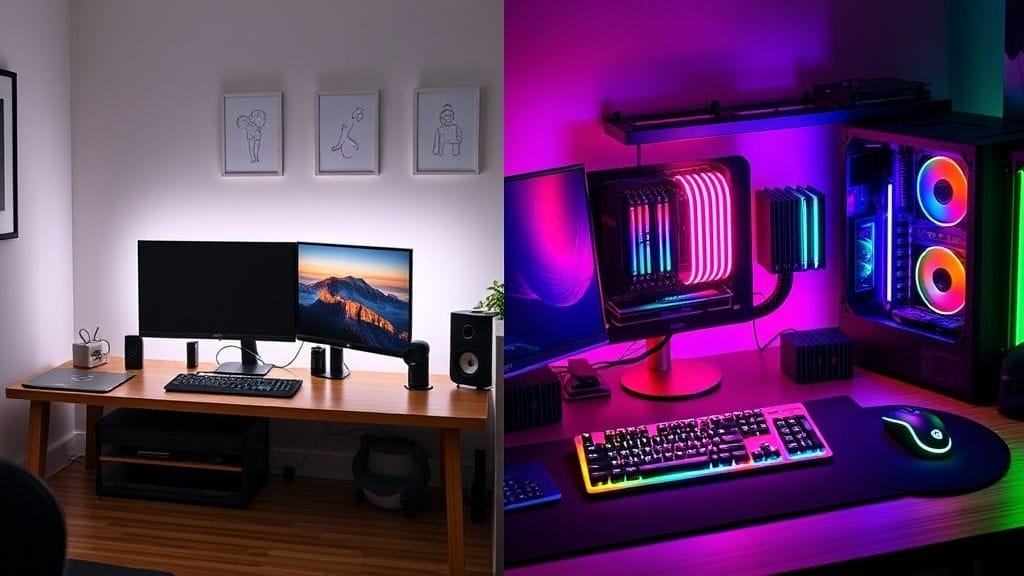

Choosing the perfect aesthetic for your PC setup can, indeed, feel overwhelming. Specifically, it applies whether for your gaming rig or workspace. On one end, we have the serene simplicity of clean vs RGB minimalist designs. However, on the other, we have the dynamic, customizable glow of RGB lighting. So, which one reigns supreme? Ultimately, this isn’t just about pretty lights or stark simplicity; rather, it’s about crafting an environment that reflects your personality. Furthermore, this choice enhances your focus and, consequently, it elevates your entire experience.
For many enthusiasts, indeed, the clean vs RGB debate is more than hardware choices. Rather, it’s a philosophical stance on how technology integrates into their lives. Consequently, are you seeking tranquil productivity or an immersive, electrifying escape? This comprehensive guide will, therefore, delve deep into this stylistic showdown. Ultimately, it will empower you to make an informed decision. In fact, this choice will truly resonate with your needs and preferences. Therefore, let’s unpack the arguments for each side. We will also explore the nuanced middle ground.
Embracing the Allure of Clean/Minimalist Aesthetics
The minimalist approach to tech aesthetics, first and foremost, champions simplicity. Indeed, it prioritizes functionality and uncluttered spaces. Consequently, it’s about stripping away the superfluous to reveal the essential. Ultimately, this fosters an environment where clarity of thought can flourish. Therefore, those who champion a clean aesthetic do so for compelling reasons. Moreover, these reasons extend far beyond mere looks.
Enhanced Focus and Productivity
First, imagine a workspace free from visual noise. Thus, your eyes aren’t constantly drawn to flashing lights or intricate patterns. Indeed, this is the promise of a minimalist setup. By eliminating distractions, a clean environment can, consequently, significantly enhance your focus. In essence, think of it as a blank canvas for your mind. Therefore, it allows you to dive deeper into tasks. Moreover, you can solve complex problems. You can also maintain concentration for longer periods.
Significantly, research suggests that decluttered spaces reduce stress. They also improve cognitive function. Consequently, for professionals, students, and intensive mental workers, a serene, clean setup is a powerful tool. Specifically, it boosts productivity. Furthermore, it fosters a sense of calm. Ultimately, this enables clear thinking and efficient workflow.
Timeless Elegance and Versatility
Notably, one undeniable strength of clean designs is their enduring appeal. In fact, these aesthetics feature sleek lines and neutral color palettes. Likewise, understated forms also characterize them. Therefore, they possess a timeless quality. Consequently, they avoid fleeting trends. Ultimately, this ensures your setup remains sophisticated and relevant for years. Furthermore, a minimalist design seamlessly integrates into almost any interior design scheme.
For instance, your home décor might be modern, traditional, or industrial. However, a clean aesthetic will complement it, rather than clash. Consequently, this versatility makes it an excellent long-term investment. Indeed, it adapts to changing tastes or future room renovations. Thus, no complete overhaul is needed. Ultimately, it’s about quiet sophistication that speaks volumes without shouting.
Improved Functionality and Easier Maintenance
Beyond looks, a clean setup, therefore, offers substantial practical benefits. Specifically, fewer components, organized layouts, and thoughtful cable management improve functionality. In PC builds, superior cable management is, moreover, a hallmark of clean designs. Consequently, it is crucial for optimal airflow. Thus, better airflow means cooler components. Subsequently, this can extend their lifespan. It also ensures stable performance, especially under heavy loads.
Moreover, a minimalist environment is, inherently, easier to clean and maintain. For instance, there are fewer nooks and crannies for dust. Consequently, fewer items need moving. Thus, you’ll spend less time on upkeep. Instead, you will spend more time enjoying your space. This efficiency isn’t just about saving time. Rather, it’s about reducing friction in your daily routine.
Potential Cost-Effectiveness
High-end minimalist components can still be pricey. However, opting for non-RGB parts often offers a cost-effective pathway. Indeed, RGB lighting typically adds a premium to components. Specifically, this includes motherboards, RAM, fans, and peripherals. Therefore, by foregoing these illuminated extras, you can potentially reallocate your budget.
This strategic saving, furthermore, allows investment in core performance components. For example, consider a more powerful CPU or a higher-tier graphics card. Alternatively, additional storage is another option. Therefore, for users prioritizing raw performance over visual flair, a clean PC build offers superior bang for your buck. Ultimately, it ensures your system delivers where it truly counts.
Reduced Eye Strain and Fatigue
Notably, excessive lighting can be a significant drawback for many. This includes, for example, professional gamers and content creators. It also affects anyone spending long hours in front of a screen. This is especially true in low-light conditions. Consequently, bright, flashing lights from RGB components can cause eye strain. Moreover, they may lead to headaches and visual fatigue. Therefore, a clean aesthetic with minimal or no internal lighting helps mitigate these issues.
Instead, it creates a consistent and comfortable viewing environment. Consequently, this reduces the need for your eyes to constantly adjust. Indeed, varying light intensities are less impactful. Therefore, this thoughtful consideration for visual comfort is beneficial. Specifically, it can lead to more productive work sessions. It also allows more enjoyable gaming marathons. This happens without the discomfort that vibrant, dynamic lighting can sometimes induce.
The Vibrant Appeal of RGB Aesthetics
In stark contrast to minimalism, RGB lighting, therefore, ushers in a world of vibrant color. Specifically, it offers dynamic effects and unparalleled personalization. Moreover, it’s a celebration of visual expression. Indeed, it transforms functional tech into dazzling showcases. Consequently, the arguments for embracing RGB aesthetics are deeply rooted in customization. They also focus on immersive experiences.
Unparalleled Customization and Personal Expression

First and foremost, one compelling reason to choose RGB is its sheer customization breadth. Indeed, RGB offers millions of color combinations. It also provides a plethora of lighting effects. Consequently, this allows you to personalize your environment like never before. For example, you can tune your setup to match your mood. Moreover, celebrate your favorite team’s colors. You can also align with a specific theme. Ultimately, this level of creative control empowers users. Thus, they can truly make their space their own.
- Mood Matching: For instance, instantly switch to calming blues for relaxation or energizing reds for intensity.
- Themed Setups: Alternatively, create a “cyberpunk” glow or a “forest” ambiance with specific color palettes.
- Brand Loyalty: Moreover, showcase your favorite gaming team or hardware brand’s colors.
Ultimately, this personal touch goes beyond mere aesthetics. Rather, it’s an extension of your identity. In fact, it allows your tech to genuinely reflect who you are. Consequently, the flexibility of RGB lighting means your setup can evolve with you.
Increased Immersion and “Wow” Factor
For gamers, RGB lighting, consequently, profoundly increases immersion. Moreover, synchronized lighting often integrates with game events. Thus, it can extend the digital world into your physical space. For example, imagine your desk setup pulsating red. This happens when you take damage in-game. Conversely, it shifts to a cool blue as you explore an icy landscape. Ultimately, this dynamic feedback blurs virtual and real lines. Consequently, it makes every gaming session feel more visceral and engaging.
Beyond immersion, a well-executed RGB setup is, furthermore, an undeniable showstopper. Indeed, it possesses a “wow” factor. Therefore, such a setup can transform a mundane room, turning it into a futuristic command center or an art installation. Consequently, do you enjoy showcasing your passion for technology and design? If so, RGB offers a platform for impressive visual displays. Moreover, these capture attention and spark conversation. Ultimately, it’s not just about looking good. Rather, it’s about creating an experience.
Modern and Futuristic Appeal
RGB lighting has, consequently, become synonymous with modern aesthetics. Indeed, it signifies high-tech and futuristic designs. Specifically, it’s frequently featured in advanced gaming PCs. Cutting-edge peripherals and smart home devices also use it. Therefore, opting for RGB infuses your setup with a contemporary vibe. Thus, it signals a forward-thinking approach to technology and design.
Ultimately, the clean lines of a modern RGB build combine with its vibrant illumination. Therefore, they create a sophisticated yet playful environment. In fact, it is both functional and visually stimulating. Thus, it positions your space at the forefront of technological style.
Navigating the Nuances: Drawbacks and Different Perspectives
Indeed, the debate isn’t simply black and white. Rather, it’s a spectrum of personal preferences. Furthermore, practical considerations and evolving trends play a part. Consequently, both clean and RGB aesthetics offer distinct advantages. They also come with potential drawbacks. Therefore, nuances are worth exploring. Ultimately, understanding these helps you make a truly informed choice.
Potential for Distraction and Eye Strain
RGB can, indeed, be immersive. However, excessive or poorly managed lighting can quickly become a hindrance. Specifically, bright, flashing, or rapidly changing colors distract heavily. This is especially true during focused work sessions. It also impacts intense competitive gaming. Consequently, this visual noise can pull your attention from the screen. Thus, it makes concentration harder.
Moreover, prolonged exposure to bright, dynamic lighting can cause issues. This is particularly true in low-light environments. Consequently, it contributes to eye strain and fatigue. Therefore, this is a crucial consideration. Specifically, it applies to anyone spending many hours in front of their setup. Ultimately, the key here is moderation. Mindful implementation is also vital.
Increased Cost and Complexity

First and foremost, RGB components typically carry a higher price tag. Indeed, this is an undeniable fact. Consequently, the added LEDs and specialized controllers inflate costs. Moreover, more intricate designs also contribute. Thus, this can be anywhere from 10% to 30% more. This is compared to non-illuminated counterparts. Therefore, achieving a full RGB setup requires a larger initial investment.
- Hardware Cost: For instance, motherboards with RGB headers, RGB fans, RAM, and peripherals are often more expensive.
- Software Hassle: Furthermore, managing RGB across different brands often necessitates multiple software applications (e.g., Corsair iCUE, Razer Synapse, ASUS Aura Sync).
- Resource Consumption: These background applications can, however, consume system resources (CPU, RAM), albeit minimally.
- Compatibility Issues: Moreover, synchronizing lighting across various manufacturers can sometimes be frustrating, ultimately leading to compatibility headaches and inconsistent effects.
Ultimately, this complexity can be a significant barrier. Specifically, it affects users seeking a straightforward, plug-and-play experience.
Minimal Performance Impact
Crucially, the lighting itself does not boost your system’s performance. However, the software required can have a slight impact. Specifically, this software controls and synchronizes RGB components. Consequently, these background applications consume a small amount of CPU and RAM. For most casual users, therefore, this impact is negligible; indeed, it is likely unnoticeable.
However, a minimal resource drain could, theoretically, affect performance. This is especially true in highly demanding applications. It also applies to competitive gaming where every frame counts. Furthermore, systems with limited resources also see this. This is generally a minor concern. But it’s worth noting for performance-critical scenarios. Ultimately, it further highlights the trade-offs. Indeed, these are inherent in the RGB vs minimalist debate.
“Rainbow Puke” vs. Tasteful RGB: A Critical Distinction
Indeed, the term “rainbow puke” describes a haphazard RGB setup. Specifically, colors are displayed without coordination. Consequently, this leads to a garish and uncoordinated visual mess. Ultimately, this unrefined approach gives RGB aesthetics a bad rap. However, many individuals appreciate subtle, well-coordinated RGB lighting. It enhances rather than overwhelms.
- Strategic Placement: For example, limiting RGB to key components like RAM, the GPU, or a single fan.
- Static Colors: Alternatively, choosing a single, static color that complements your theme.
- White Cases: These are often preferred for RGB builds as they reflect and diffuse colors beautifully.
- Black Cases: Conversely, black cases can make individual light sources pop and create stark contrasts.
Ultimately, thoughtful design is key to successful RGB. Instead, it’s about creating an atmosphere. Crucially, it is not just about flashing lights. Moreover, savvy users understand that less can often be more, and this is true even when embracing vibrant illumination. Consequently, they achieve a harmonious RGB setup rather than a chaotic one.
Evolving Trends and Hybrid Approaches

First and foremost, tech and gaming communities are dynamic. Consequently, aesthetic trends constantly evolve. Notably, there’s a noticeable shift, especially among mature enthusiasts. Specifically, they move away from excessive “RGB puke.” Instead, they prefer more refined, minimalist, and multi-functional designs. However, this doesn’t mean RGB is dead. Rather, it’s evolving. Indeed, many new products blend both aesthetics seamlessly.
This hybrid approach, therefore, often features subtle RGB elements. Specifically, they integrate into an otherwise clean design. For instance, consider a sleek PC case. Alternatively, it might have a single, tasteful RGB strip. Moreover, a minimalist keyboard with individually lit keys is another example. Importantly, these can be set to a static, muted color. Ultimately, this leverages the benefits of both worlds. Thus, you get the customizable flair of RGB. You also keep the sophisticated simplicity of a clean setup. This trend, consequently, suggests the future isn’t about choosing one. Rather, it’s about finding the perfect synthesis.
Lighting and Productivity: Beyond Aesthetics
Beyond immediate visual appeal, lighting, furthermore, impacts mood. It also affects alertness and productivity. This, consequently, applies to any environment, including your tech setup. Indeed, it goes beyond the clean vs RGB debate. Rather, it delves into the science of ambient illumination.
- Cooler Lights: For instance, brighter lights with a blueish tint (higher color temperature) can boost concentration and alertness, thus making them ideal for intense work.
- Warmer Lights: Conversely, softer, yellower lights (lower color temperature) promote relaxation and comfort, ultimately perfect for winding down or creative activities.
- Dynamic Lighting: Moreover, some modern lighting systems allow you to adjust color temperature throughout the day to match natural circadian rhythms, thereby optimizing energy levels and sleep patterns.
Ultimately, understanding light’s psychological impact allows you to curate your environment. Consequently, it supports your activities. For instance, this can be intense focus or relaxed entertainment. Therefore, you can integrate subtle, color-temperature-adjustable lighting into a clean setup. Alternatively, use RGB to dynamically shift your entire room’s mood. Moreover, this adds another layer of depth to your aesthetic considerations. You can even find inspiration from articles discussing the [psychology of light on Wikipedia](https://en.wikipedia.org/wiki/Lightandmood). Or explore deeper dives into [workspace lighting best practices](/blog/optimizing-workspace-lighting-for-productivity/).
Finding Your Balance: A Personal Journey
Ultimately, the choice between clean vs RGB aesthetics is, indeed, deeply personal. Consequently, there’s no universal “better” option. Rather, an ideal setup depends entirely on your priorities. It also depends on your lifestyle. Moreover, how you interact with your technology also matters. Therefore, both approaches offer unique advantages. They specifically cater to different needs and desires.
When a Clean Setup Shines
- Prioritize Focus: For instance, if your primary goal is an environment conducive to deep work, studying, or competitive gaming where distractions are minimized.
- Value Timelessness: Alternatively, if you prefer an aesthetic that will remain sophisticated and relevant regardless of fleeting trends.
- Seek Simplicity: Moreover, if you appreciate ease of maintenance, improved airflow, and a less visually stimulating space.
- Budget-Conscious Performance: Furthermore, if you want to allocate more of your budget towards core performance components rather than cosmetic lighting.
Ultimately, a minimalist PC setup offers a sanctuary of calm. Indeed, it is a deliberate choice. Consequently, it simplifies and optimizes for clarity and efficiency. Thus, it’s about letting the technology’s performance speak for itself, unadorned.
When RGB Comes Alive
- Embrace Personalization: For instance, if you crave the ability to endlessly customize your environment to match your mood, theme, or personal brand.
- Desire Immersion: Alternatively, for gamers who want to extend their virtual worlds into their physical space, thereby enhancing the experience with dynamic lighting.
- Love the “Wow” Factor: Moreover, if you enjoy showcasing your rig, creating a visually impressive focal point, and delighting in modern, futuristic aesthetics.
- Creative Expression: Furthermore, if your setup is an extension of your artistic or expressive self, thus allowing you to paint with light.
Ultimately, an RGB gaming setup or workspace is a canvas for creativity. Indeed, this dynamic partner responds to your input, thereby transforming your environment and becoming an active part of your experience.
The Power of the Hybrid Approach
Therefore, many users find their ideal sweet spot. Specifically, they adopt a hybrid approach. This consequently incorporates subtle, well-managed RGB elements. Moreover, they blend these into an otherwise clean and functional setup. Ultimately, this allows them to achieve the best of both worlds. Thus, they get the tranquility and focus of minimalism. Additionally, this combines with carefully placed touches of customizable flair.
For example, consider a setup with excellent cable management. Moreover, it has neutral colors. Then, add a single, static RGB light strip. Place it behind the monitor for ambient backlighting. Alternatively, choose a keyboard with a gentle, unified glow. Ultimately, this nuanced integration proves you don’t always have to choose extremes. Instead, you can curate a space. It can be both visually appealing and highly functional. Consequently, this approach is gaining significant traction. Indeed, tools for controlling RGB lighting are becoming more sophisticated. They are also more user-friendly. Thus, this allows for more tasteful implementations. For tips on managing your hybrid setup, therefore, consider exploring guides on [advanced cable management techniques](/blog/mastering-cable-management-for-a-clean-setup/).
Conclusion: Your Vision, Your Setup
Ultimately, the perennial debate between clean vs RGB isn’t about declaring a winner. Instead, it’s about understanding what truly serves you. Indeed, both styles offer valid, compelling reasons for adoption. Moreover, each brings a unique set of benefits and drawbacks. Consequently, your ultimate decision will hinge on your priorities. For example, do you crave a serene environment? Is it distraction-free for peak productivity? Or do you prefer a dynamic, visually engaging space? Ultimately, one that immerses you in entertainment and expresses your unique style?
Perhaps, you’ll find your balance in a refined hybrid setup. Specifically, thoughtful minimalism meets subtle, coordinated illumination there. Indeed, the beauty of modern PC building and interior design lies in this freedom of choice. Therefore, there are no right or wrong answers. Ultimately, only what feels right for you.
Ultimately, what does your ideal setup look like? So, do you lean towards minimalist calm, vibrant RGB, or a clever blend of both? Therefore, share your thoughts and help others find their perfect aesthetic!