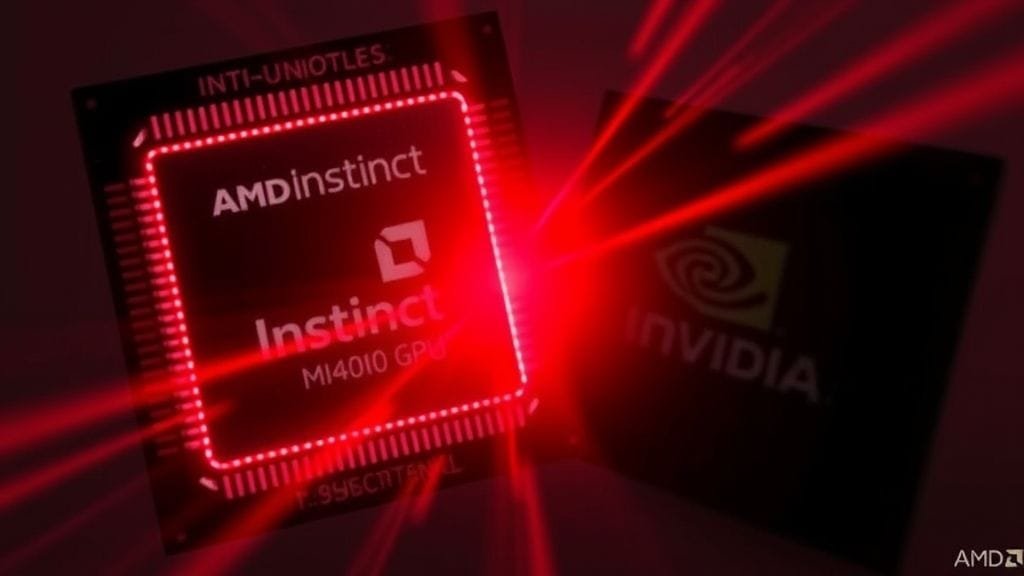
The artificial intelligence (AI) revolution is sweeping industries. Indeed, it redefines possibilities, and consequently it creates unprecedented demand for specialized computing power. At the heart of this transformation lies the AI accelerator market, a domain currently dominated by NVIDIA. However, a formidable challenger is emerging from the red corner: AMD. Specifically, AMD is gearing up for a direct confrontation with its upcoming AMD Instinct MI400 series. Ultimately, it aims to disrupt NVIDIA’s leadership and reshape the future of AI infrastructure.
Can any company truly challenge NVIDIA, given that NVIDIA commands 70-95% market share? You might wonder about this, and indeed it’s a fair question, given NVIDIA’s robust GPU architecture and its deeply ingrained CUDA software ecosystem. Nevertheless, AMD’s Instinct MI400 strategy is complex. Specifically, it aims to innovate; thus, new pathways will be opened, and strategic alliances will be forged. This article, therefore, delves into the specifications, strategies, and market dynamics that define this high-stakes battle.

NVIDIA’s Iron Grip: A Legacy of Innovation and Ecosystem Power
NVIDIA’s dominance in the AI accelerator market isn’t accidental. Instead, it shows decades of GPU innovation and strategic CUDA software development. CUDA is proprietary. However, CUDA is the de facto standard for AI development. Indeed, it offers a powerful, optimized environment. Consequently, this accelerates deep learning research and handles large-scale inference deployments. This robust ecosystem, therefore, creates a significant barrier to entry for competitors.
Consider the developer who has invested years learning CUDA. Certainly, they benefit from a vast library of optimized functions, extensive documentation, and a massive community. This creates a powerful network effect, thereby making it difficult for new platforms to gain traction. Furthermore, NVIDIA continuously pushes the boundaries of hardware. For example, NVIDIA unveiled Blackwell B200/GB200 in March 2024, delivering staggering performance gains. Specifically, estimates suggest up to a 30x increase for LLM inference over the H100. Moreover, NVIDIA’s Vera Rubin platform is next, expected in late 2026. Ultimately, it promises to triple Blackwell’s compute performance, signaling a relentless pace of innovation.
AMD’s Counterpunch: Unpacking the Instinct MI400 Series
AMD is not backing down. In fact, the company aggressively positions its Instinct MI400 series, slated for a 2026 release, as a technological powerhouse. Therefore, it tackles the most demanding AI workloads. It is built on the next-gen CDNA “Next” architecture. Specifically, this may be UDNA or CDNA 5. The AMD Instinct MI400 is projected to deliver a significant leap in AI compute performance.
AMD’s internal projections are ambitious. Indeed, they target double the MI350 series’ AI compute performance, and they aim to be 10x more powerful than MI300X for frontier models. These are bold claims that, if realized, could fundamentally shift the performance landscape. The MI400 has compelling aspects. Specifically, its sheer memory capacity and bandwidth are key, as these are critical for processing massive AI models.
Hardware Prowess: Memory, Compute, and Helios
The AMD Instinct MI400 features astonishing memory. Specifically, it has 432GB of HBM4, paired with 19.6 TB/s bandwidth. NVIDIA’s Blackwell B200 offers 192GB of HBM3E. Meanwhile, the initial Vera Rubin platform projects 288GB of HBM4; thus, this offers perspective. This memory advantage is substantial. Consequently, it positions the MI400 as a prime candidate for handling memory-intensive tasks. Moreover, this includes training colossal LLMs that push memory limits.
On the compute front, the MI400 targets significant processing power:
- 40 PetaFLOPS for FP4 workloads
- 20 PetaFLOPS for FP8 workloads
These figures, therefore, highlight AMD’s commitment to delivering raw compute performance essential for next-generation AI. Moreover, the MI400 will be an integral component of AMD’s “Helios” AI rack-scale system. This, in essence, is a fully integrated solution. Specifically, it combines MI400 GPUs with Zen 6-powered EPYC “Venice” CPUs, and Pensando NICs are also included. Furthermore, all components are built on open networking standards. For instance, a Helios rack holds 72 MI400 cards, projecting 2.9 ExaFLOPS of FP4 compute, 1.4 PB/s of memory bandwidth, and 31 TB of HBM4 memory. Ultimately, such a system could outperform NVIDIA’s Vera Rubin in bandwidth and memory capacity, thus offering a compelling solution that serves hyperscalers and large enterprises.
AMD Instinct MI400 vs. NVIDIA: A Specification Snapshot
To appreciate the impending battle, therefore, let’s compare key specifications. Specifically, this includes the AMD Instinct MI400, and we’ll also look at NVIDIA’s flagship offerings.
| Feature | AMD Instinct MI400 (Projected 2026) | NVIDIA Blackwell B200 (Current) | NVIDIA Vera Rubin (Projected 2026) |
|---|---|---|---|
| Architecture | CDNA “Next” (UDNA/CDNA 5) | Blackwell | Rubin |
| HBM Memory Capacity | Up to 432GB HBM4 | 192GB HBM3E | 288GB HBM4 |
| HBM Memory Bandwidth | 19.6 TB/s | ~8 TB/s | ~10 TB/s (estimated) |
| FP4 Compute Performance | 40 PetaFLOPS | Up to 20 PetaFLOPS (GB200) | Potentially 3x Blackwell |
| FP8 Compute Performance | 20 PetaFLOPS | Up to 10 PetaFLOPS (GB200) | Potentially 3x Blackwell |
| Rack-Scale System (FP4) | Helios: ~2.9 ExaFLOPS (72 MI400) | GB200 NVL72: ~1.44 ExaFLOPS | Rubin NVL72: ~4.3 ExaFLOPS |
| Software Ecosystem | ROCm (Open Source) | CUDA (Proprietary) | CUDA (Proprietary) |
This table clearly highlights the MI400’s aggressive memory and bandwidth targets. However, while NVIDIA’s Rubin aims for a compute leap, the AMD Instinct MI400, by contrast, stakes its claim by offering superior memory capacity and boasting an open ecosystem.

A detailed infographic comparing the memory capacity and bandwidth of AMD Instinct MI400, NVIDIA Blackwell B200, and NVIDIA Vera Rubin, using bar graphs for clear visual distinction.
A Strategic Blueprint: How AMD Plans to Compete
AMD’s challenge to NVIDIA is multi-faceted, as it extends far beyond raw hardware specifications. Instead, it’s a carefully crafted strategy built on product cadence, open-source principles, and crucial partnerships.
Accelerated Product Roadmap
AMD understands the need for sustained innovation. Therefore, they are committed to an annual cadence of Instinct accelerators:
- MI325X in Q4 2024
- MI350 series in 2025
- MI400 series in 2026
This rapid release cycle, consequently, ensures consistency, as AMD brings cutting-edge technology to market. Moreover, this prevents NVIDIA from resting on its laurels. Ultimately, this steady stream of innovation keeps the pressure on, thereby offering customers regular upgrade paths and competitive options.
ROCm: The Open-Source Weapon
Perhaps AMD’s most critical strategic pillar is its investment in the ROCm platform. Notably, unlike NVIDIA’s proprietary CUDA, ROCm is an open-source software ecosystem. Consequently, AMD aims for ROCm to achieve CUDA parity by Q3 2025. This, admittedly, is a monumental task; yet, it has significant potential rewards.
Imagine the appeal to developers and organizations wary of vendor lock-in. ROCm offers:
- Performance enhancements
- Free distributed inference
- Flexibility and transparency
This open approach, therefore, contrasts sharply with NVIDIA’s proprietary CUDA and its paid AI Enterprise software. Indeed, ROCm is a viable, high-performance alternative. Consequently, AMD hopes to attract developers, especially researchers who value openness and control over their software stack. Furthermore, for organizations running vast AI infrastructures, cost savings and flexibility are key. Ultimately, an open ecosystem offers these benefits, which can be incredibly compelling.
Forging Alliances: Hyperscalers and AI Heavyweights
AMD is not fighting this battle alone. Instead, they actively collaborate with major hyperscalers, and also work with AI companies. Therefore, technology is strategically embedded within critical infrastructure. A prime example is Meta, which, in fact, is deploying MI300X accelerators in 77% of its AI fleet. These kinds of partnerships, consequently, are invaluable, as they provide:
- Validation of AMD’s technology
- Crucial feedback for product development
- Market penetration at scale
Other key partners, moreover, include Microsoft, OpenAI, xAI, and Oracle. Indeed, these collaborations show a growing industry appetite for NVIDIA alternatives and signal confidence in AMD’s capabilities. For instance, OpenAI, which pushes AI boundaries, is evaluating AMD hardware and may potentially adopt it. Ultimately, this sends a powerful message to the market.
Cost-Effectiveness and Open Standards
While AI supremacy is a race, total cost of ownership (TCO) is also a major factor. Specifically, this is key for hyperscalers, especially since they operate at massive scales. AMD, therefore, emphasizes cost-optimized inference solutions and champions an open ecosystem built on open standards. This strategy consequently targets:
- Hyperscalers
- Sovereign AI initiatives
- Any customer seeking an alternative to NVIDIA’s integrated approach
AMD offers compelling performance; additionally, it has a potentially lower cost and provides greater flexibility. Therefore, AMD hopes to win customers who prioritize economic advantages and want independence from one vendor. Furthermore, the open standards approach also fosters greater interoperability and innovation across the industry.
Targeting Specific Verticals
Different industries have unique AI demands, and consequently, AMD recognizes this. Therefore, AMD plans MI350 and MI400 accelerators that are tailored for specific vertical markets, including:
- Healthcare
- Financial services
- Automotive
AMD offers specialized solutions. Specifically, this addresses nuanced sector needs more effectively, thereby showing deeper understanding of customer challenges and delivering optimized performance for workloads. Ultimately, this targeted approach can unlock significant market opportunities.
Learning from History: The Intel CPU Parallel
Analysts, indeed, draw parallels between AMD’s AI strategy and past Intel CPU success. For years, Intel held a dominant position in server CPUs, much like NVIDIA today. However, AMD disrupted Intel’s hegemony by using its Zen architecture. Furthermore, aggressive pricing helped AMD gain significant market share, since it offered compelling performance per watt and also provided superior value. Can AMD replicate this success in the AI arena? Indeed, the playbook shares similarities: strong hardware, competitive pricing, and a focus on TCO.

A stylized image depicting a chess board with an AMD knight piece strategically positioned to capture a larger NVIDIA king piece, symbolizing AMD’s strategic moves against NVIDIA’s dominance.
The Battle Ahead: Market Dynamics and Challenges
The AI accelerator market is exploding, as it is projected to exceed $827 billion by 2030. This immense growth, therefore, creates fertile ground for competition, and analysts are closely watching AMD’s moves.
Analyst Perspectives and Revenue Forecasts
Industry analysts are increasingly optimistic about AMD’s prospects. For example, HSBC analysts are optimistic; consequently, they raised AMD’s 2026 AI GPU revenue forecasts. They are encouraged by the MI350/MI355X’s competitiveness and the formidable potential of the AMD Instinct MI400. They anticipate AMD’s AI accelerator revenue will surge, potentially going from $5 billion in 2024 to tens of billions by 2027. Furthermore, a 13% market share capture is also projected by 2030.
AMD’s MI355X shows comparable performance; indeed, some observers suggest this, as it matches NVIDIA’s B200 in certain metrics and excels in fine-tuning workloads. These early indicators, therefore, while not a definitive victory, certainly suggest that AMD is building credible, competitive products.
NVIDIA’s Formidable Hurdles and Geopolitical Factors
Despite AMD’s advancements, significant challenges remain. Specifically, NVIDIA’s deeply entrenched CUDA ecosystem is perhaps the biggest hurdle. Consequently, migrating AI models and development workflows from CUDA to ROCm is challenging, as this requires time and resources. Developers, therefore, need a compelling reason to switch. While ROCm is maturing rapidly, overcoming years of CUDA’s head start is nevertheless no small feat.
NVIDIA innovates rapidly, with platforms like Blackwell and Rubin serving as examples. Consequently, this sets a high bar, and AMD must constantly push its limits. Indeed, competition is dynamic, not static, and therefore both companies accelerate product cycles.
Geopolitical factors also cast a shadow. For instance, U.S. export restrictions impact AMD due to China, with an estimated $1.5 billion revenue loss expected in 2025. Although this revenue loss is temporary, it nevertheless diverts resources and impacts AMD’s financial performance compared to a fully open market. Consequently, investors watch AMD keenly, wondering if its initiatives will translate into market share shifts, especially since its stock lagged NVIDIA’s stellar performance.

A chart illustrating the projected growth of the AI accelerator market from 2024 to 2030, with a segment highlighting AMD’s potential market share by 2030.
The Future of AI Acceleration: What’s at Stake?
A battle is impending between AMD Instinct MI400 and NVIDIA. However, it’s not just corporate rivalry; instead, it profoundly impacts the AI industry. Increased competition is beneficial. Specifically, it drives innovation, as both companies push technological boundaries further and faster.
For consumers and businesses, this competition could lead to:
- More diverse and cost-effective AI solutions.
- Faster advancements in AI capabilities.
- Greater flexibility and choice in AI infrastructure.
Success hinges on flawless execution for the AMD Instinct MI400 series. Moreover, it also applies to AMD’s broader AI strategy. Specifically, ROCm software must mature, AMD must leverage strategic partnerships, and championing open standards will be critical. Ultimately, can AMD attract enough developers and hyperscalers to truly chip away at NVIDIA’s stronghold?
Therefore, what will be the most significant factor in the AI supremacy competition?

A conceptual visualization of a high-performance data center server rack glowing with blue light, symbolizing advanced AI infrastructure and the intense competition in the sector.