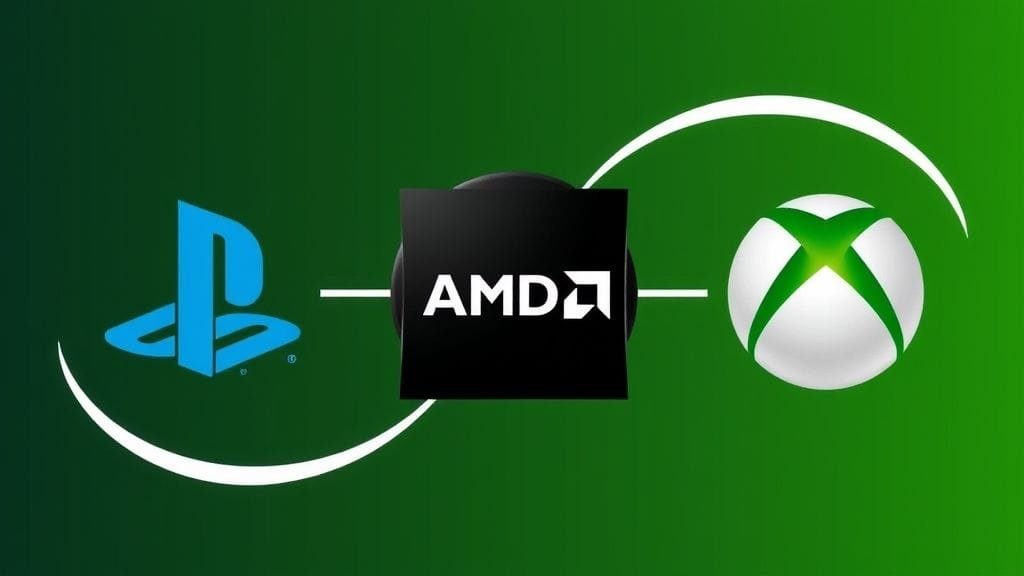
The gaming console world is fiercely competitive. However, one semiconductor giant has solidified its leadership. Indeed, AMD’s console dominance stems from strategic partnerships. It also shows technological foresight. Furthermore, it also reflects commitment to integrated solutions. You might not see their logo on your PlayStation 5 or Xbox Series X; yet, AMD silicon powers your immersive experiences. Consequently, as we gaze towards 2027, Sony and Microsoft will rely more on AMD. This subsequently powers their next gaming hardware. What does this mean for the future of your gaming? Let’s first explore the technological backbone driving these consoles. We will then also see exciting possibilities ahead.

Why AMD Reigns Supreme in the Console Arena
AMD’s journey to becoming the indispensable chip supplier for the current generation of consoles wasn’t accidental. Rather, it resulted from smart engineering and keen business acumen. Indeed, AMD deeply understands console manufacturers’ needs. Therefore, when you consider the complex dance of performance, cost, and developer experience, AMD offers an almost irresistible package.
The Power of the All-in-One APU
One of AMD’s most compelling offerings is its Accelerated Processing Unit (APU) concept. Specifically, this integrated solution combines a powerful Central Processing Unit (CPU) and a Graphics Processing Unit (GPU). Crucially, they are on a single silicon die. Think of it as a meticulously crafted engine where all critical components work in perfect harmony.
For console makers like Sony and Microsoft, this “one-stop solution” dramatically simplifies their development and manufacturing processes. Consequently, they avoid a logistical nightmare. That is, they don’t source CPUs from Intel and GPUs from NVIDIA separately. Furthermore, an APU enhances efficiency. It also reduces power and heat. Ultimately, these are critical for sleek console designs.
Mastering Cost-Effectiveness and Customization
Console manufacturing operates on razor-thin margins, especially on the hardware itself. Therefore, cost-effectiveness isn’t just a preference; it’s a fundamental requirement. In this context, AMD delivers custom-designed APUs. As a result, prices are competitive. They also meet specific performance and efficiency targets. Clearly, this isn’t a “take it or leave it” situation.
AMD co-engineers these chips with PlayStation and Xbox. Specifically, they deeply integrate silicon into each console’s architecture. Consequently, this collaborative approach fine-tunes performance. It also optimizes instruction sets to memory bandwidth. Ultimately, such deep customization sets AMD apart from potential competitors.

A detailed diagram illustrating the components of an AMD APU, highlighting the integrated CPU and GPU cores, along with memory controllers.
Built on a Foundation of Experience: AMD’s x86 Advantage
AMD didn’t just stumble into the console market. Rather, they have a rich history. For example, they developed console architectures. This actually dates to PlayStation 4 and Xbox One generations. Consequently, this extensive experience means they understand the unique demands of console development intimately. Furthermore, the current generation leverages AMD’s proven Zen 2 CPU and RDNA 2 GPU architectures. The x86 instruction set is well-understood by developers. This therefore simplifies programming. It also accelerates game creation. Overall, this continuity offers a familiar and robust platform for innovation.
Ensuring Legacy: Seamless Backward Compatibility
For gamers, few features are as cherished as backward compatibility. Specifically, playing beloved titles from past generations is possible. This indeed is a significant selling point. Moreover, AMD’s consistent use of the x86 architecture across console generations directly facilitates this. Imagine investing hundreds of hours in a game, only to find it unplayable on your new console. However, AMD’s x86 design lets PlayStation and Xbox offer smoother transitions. It also protects game libraries and fosters loyalty. Ultimately, this continuity is a powerful advantage for consumers and a testament to AMD’s foundational role.
Gazing into the Future: The Next Console Generation
The tech world is always looking forward, and the console industry is no different. Consequently, whispers and rumors are circulating. They concern the next gaming hardware iteration. It’s expected around 2027. Moreover, Sony and Microsoft will rely on AMD. Thus, performance upgrades are massive. Graphics will also be breathtaking. AI integration is likewise transformative.
PlayStation 6: Orion’s Ambitious Vision
The PlayStation 6 (PS6) is perhaps the most anticipated hardware reveal on the horizon. Indeed, rumors suggest a potential launch in November 2027, powered by a custom AMD “Orion” APU. This next-generation chip consequently promises a staggering leap in capabilities.
The “Orion” APU is anticipated. Specifically, it will be 3nm TSMC. Expect 10 Zen 6 CPU cores. Also, 52-54 RDNA 5 GPU compute units. Furthermore, expect a substantial amount of high-speed GDDR7 RAM, likely in the range of 30GB to 40GB.
These specifications point towards a monumental performance boost. For instance, rasterization could be 2.5-3x faster than PS5. Similarly, ray tracing might improve 6-12x.
Sony, working closely with AMD, is also heavily invested in AI and machine learning. Indeed, “Project Amethyst” aims to revolutionize graphics. It specifically uses super-resolution technologies like PSSR. PSSR essentially mirrors AMD’s FSR. This AI integration will consequently likely make games look sharper and run smoother than ever before. For further reading on PSSR, check out this article on [PlayStation’s commitment to graphics advancements](https://blog.playstation.com/2024/05/17/horizon-forbidden-west-pc-launch/).
Xbox’s Evolving Ecosystem: Magnus and Beyond
Microsoft has been open. Specifically, it confirmed a multi-year partnership. AMD will thus co-engineer silicon. This is for its entire future lineup. Indeed, this expansive vision is broad. It consequently includes consoles, handhelds, PCs, and cloud gaming. This therefore underscores AMD’s impact across platforms. The next-generation Xbox, internally codenamed “Magnus,” is also expected around November 2027.
“Magnus” is rumored to integrate an AMD Zen 6 CPU. It potentially features 11 cores and an RDNA 5 GPU architecture. It could also boast a significant 36GB of GDDR7 shared memory. Consequently, this hardware should boost rasterization by 20%. It will also double ray tracing performance over RDNA4. Interestingly, a notable Xbox shift is possible. Specifically, it could evolve into a “hybrid PC-console.” This would then run on Windows 12. This ultimately aims for a unified platform across devices. It thereby blurs lines between PC and console gaming. Furthermore, Microsoft emphasizes AI acceleration. Dedicated hardware consequently handles AI tasks. This therefore targets smooth 4K/120 FPS gaming. The unified experience could thus redefine how you play. Learn more about the history of Xbox on [Wikipedia](https://en.wikipedia.org/wiki/Xbox).
Next-Gen Console Spec Predictions: A Glimpse into 2027
To begin, let’s appreciate the rumored performance leaps. We will therefore compare PS6 and next-gen Xbox specs. Indeed, both heavily rely on AMD.
| Feature | PlayStation 6 (Rumored) | Next-Gen Xbox (Rumored) |
|---|---|---|
| APU Codename | AMD “Orion” | AMD “Magnus” |
| Manufacturing Node | 3nm TSMC | 3nm TSMC |
| CPU Cores | Up to 10x Zen 6 | Potentially 11x Zen 6 |
| GPU Compute Units | 52-54x RDNA 5 | RDNA 5 Architecture |
| RAM Type | 30-40GB GDDR7 | 36GB GDDR7 |
| Rasterization Boost | 2.5x – 3x (vs. PS5) | 20% (vs. RDNA4) |
| Ray Tracing Boost | 6x – 12x (vs. PS5) | 2x (vs. RDNA4) |
| Key AI Initiative | Project Amethyst (PSSR) | Dedicated AI hardware |
| Unique Feature | Advanced Super-Resolution | Hybrid PC-Console (Windows 12) |

The Broader Landscape: Challenges and Opportunities
AMD’s console dominance seems unshakeable. However, the future path has twists and turns. Indeed, the gaming industry is constantly evolving, presenting both new hurdles and exciting avenues for growth. Therefore, understanding these dynamics helps us grasp the full picture of the next console generation.
Navigating the Waters of Rising Production Costs
The shift to advanced manufacturing processes, like the cutting-edge 3nm node, represents a significant technological achievement. However, this sophistication comes at a price. As a result, chip production costs are likely to increase substantially. This could consequently mean higher console retail prices. Alternatively, it could mean smaller performance-per-dollar gains for consumers. Ultimately, console makers face a balancing act. They must deliver revolutionary technology. Yet, hardware must not be too expensive. This challenge therefore demands ingenious cost optimization strategies.
Beyond Raw Power: The Battle for Ecosystems
The “console wars” of today are no longer solely about raw hardware power. Indeed, while impressive specs remain a draw, the true battleground has shifted to ecosystems and services. For instance, exclusive game libraries are important. Xbox Game Pass subscriptions also matter. Moreover, platform experience is pivotal for consumer choice. AMD provides the engine. However, Sony and Microsoft build the car. They also shape the driving experience and road network. Ultimately, the value you perceive increasingly extends beyond the box.

The AI Revolution: Driving Next-Gen Graphics
AI is not just a buzzword. Rather, it will be a cornerstone of next-gen graphics. Indeed, both Sony and Microsoft are heavily leveraging AI for improved visual fidelity, particularly through advanced upscaling techniques. Imagine games rendering at lower resolution. AI then meticulously reconstructs them to pristine 4K or 8K quality. This is the promise of technologies. For example, PSSR and AMD’s FSR are examples. Moreover, AMD actively develops AI-enhanced graphics. It thus works with both console giants. This consequently defines tomorrow’s visual experience. This collaboration ultimately highlights a future where smart software enhances powerful hardware.
Why NVIDIA and Intel Stay on the Sidelines (for now)
You might wonder why giants like NVIDIA and Intel aren’t competing for a slice of the console pie. Essentially, both are formidable in the PC space. However, their console absence stems from several factors. For instance, NVIDIA, with its dominant position in high-end discrete GPUs, tends to focus on higher-margin products. Intel makes strides with Arc GPUs. Nevertheless, it lags in specialized AI chips. These are especially crucial for next-gen consoles. Furthermore, console makers prioritize a single, integrated CPU/GPU solution. They also need competitive pricing. Deep co-engineering support is likewise required. AMD’s ability to consistently deliver on these fronts has therefore cemented its unique and enduring AMD console dominance. Shifting from this model requires monumental change. This is specifically in console development. Such a prospect seems unlikely now.
The Indispensable Partner
AMD has undeniably cemented its position as the indispensable hardware partner for both PlayStation and Xbox. Indeed, AMD’s APU solutions are comprehensive, cost-effective, and customizable. Moreover, they offer unique performance and practicality unmatched by competitors. As we approach 2027, the collaboration deepens. It subsequently ushers in unprecedented performance. AI-enhanced graphics will also be key. An integrated, cross-device gaming ecosystem is possible. This is especially for Xbox.
Ultimately, what features excite you most in next-gen consoles? How will AMD console dominance then shape your future gaming?