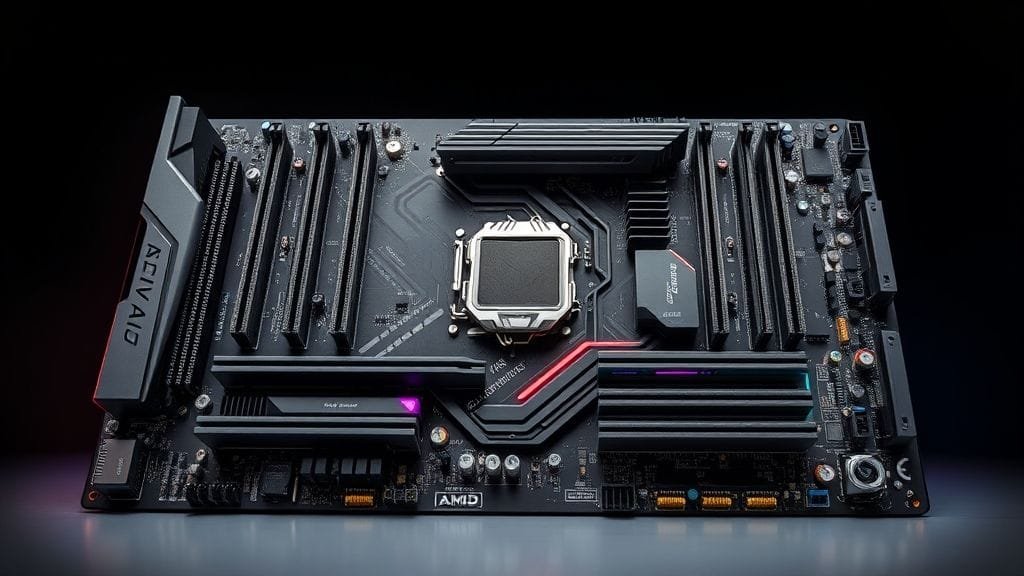
Building a new computer is always an exciting journey, especially when groundbreaking processors hit the market. For many years, AMD has been a strong contender, consistently offering powerful CPUs that often deliver excellent value. Now, with the recent launch of their Ryzen 9000 series “[Zen 5” processors](https://www.amd.com/en/products/processors/desktops/ryzen/ryzen-9000-series.html), a new wave of excitement has truly begun. Promising better performance and efficiency, these chips have captured the attention of enthusiasts and everyday users alike.
However, a key part of any new platform launch is the supporting motherboards. These crucial components connect all your PC parts—from the CPU to the memory and storage. Different motherboards offer varying features and price points, fitting a wide range of budgets. Builders often look forward to more affordable options appearing shortly after high-end parts. A recent announcement from AMD regarding new AMD B840 B850 motherboards has consequently caused a stir, altering plans for many PC builders.
AMD B840 B850 Motherboard Delay for Ryzen 9000
Recent reports indicate that AMD has decided to delay the release of its more budget-friendly AMD B840 B850 motherboards. Many builders had eagerly anticipated these AMD B840 B850 motherboards, primarily to construct new Ryzen 9000 systems without excessive cost. Thus, instead of launching alongside their high-end siblings, these boards are now expected to arrive in early 2025. This means that for a while, only the premium X870 and X870E chipsets from AMD’s 800-series lineup will be available.
This news might feel like a setback if you are planning an upgrade or a new build on a tighter budget. You might also be wondering what this delay means for you. Perhaps you are asking if you should wait, or if there are other viable options available right now. In this article, we will first examine why AMD might have made this choice regarding AMD B840 B850 motherboards. Next, we will explore how this affects you, the PC builder. Finally, we will outline what steps you can take today to get a Ryzen 9000 system.
The Anticipated Wait: What’s Happening with AMD’s B840 B850 Motherboards?
For many PC enthusiasts, new motherboard chipsets are as exciting as new processors. They specifically reveal your system’s capabilities. Moreover, these chipsets influence the number of fast storage drives you can use and impact your ability to fine-tune your CPU’s performance. AMD’s 800-series chipsets, including the upcoming AMD B840 B850 motherboards, are consequently designed to be the perfect partners for their latest Ryzen 9000 “Zen 5” processors.
When a new processor generation launches, companies typically release a range of motherboards. These typically include high-end, enthusiast-grade options, as well as mid-range and budget-friendly choices. Ideally, this staggered approach ensures that every type of builder, including those considering AMD B840 B850 motherboards, has a suitable option. However, for the 800-series, AMD appears to be taking a slightly different path, focusing first on the premium end of the market.
High-End First: The X870 and X870E Take Center Stage
The initial launch of AMD’s 800-series motherboards will now focus solely on the X870 and X870E chipsets, delaying the more budget-friendly AMD B840 B850 motherboards. These top-tier options are specifically designed for users who seek the best performance and most advanced features. Think of them as the luxury models of the motherboard world. For instance, they typically feature robust power delivery systems, abundant connectivity options, and often superior cooling solutions.
These X-series boards are built to handle the most powerful Ryzen 9000 processors. As such, they target hardcore gamers, professional content creators, and anyone requiring maximum performance. Conversely, the upcoming AMD B840 B850 motherboards will cater to different price points. Naturally, such premium features come with a higher price tag compared to what is expected from AMD B840 B850 motherboards. This strategy isn’t new; hardware manufacturers often launch their most profitable, high-margin products first. This allows them to capitalize on the excitement of early adopters. These buyers are willing to pay more for the latest technology.

The Absence of AMD’s B840 and B850 Motherboards
In contrast, the AMD B840 B850 motherboards are designed for a much broader audience. Historically, AMD’s B-series chipsets have struck an excellent balance between features and cost. Essentially, they provide many important features, including overclocking support on the B-series, all while offering them at a lower price. For example, the B850 is expected to be the successor to the popular B650, while the B840 would likely replace the entry-level A620.
The more affordable AMD B840 B850 motherboards are delayed. Consequently, those building a new Ryzen 9000 system will mostly be limited to X870 and X870E options for several months. This can be challenging for builders operating with strict budgets. Moreover, it also means that many buyers will need to wait longer, especially if they aim to acquire a full 800-series system without excessive expenditure.
Why the Delay for AMD’s B840 B850 Motherboards?
When a major tech company like AMD delays a product, it is rarely a simple oversight. Instead, such decisions are almost always made after careful planning. Often, they also involve market analysis and sometimes unexpected challenges. AMD has not explicitly stated the precise reasons for the delay of these AMD B840 B850 motherboards. However, industry observers and analysts have offered several likely reasons. Ultimately, these insights help us understand the broader picture behind the staggered release.
A Familiar Pattern: Staggered Releases
One compelling reason for the delay of AMD B840 B850 motherboards is its alignment with AMD’s past release strategies. This isn’t the first time AMD has launched its high-end chipsets ahead of its mid-range and budget-friendly offerings. For example, the X470 and X570 chipsets arrived before their respective B450 and B550 counterparts. This pattern, therefore, suggests a planned market segmentation. It is an approach that has been tried and tested.
This strategy allows the premium X-series motherboards to dominate the initial market excitement. Consequently, it affords these boards special attention. This occurs before the more affordable B-series AMD B840 B850 motherboards join the market. By implementing this approach, AMD and its motherboard partners can prioritize sales of their higher-profit products first. Furthermore, this also creates clearer market differentiation. Ultimately, it encourages early buyers to invest in top-tier solutions.
Market Dynamics and Processor Alignment
Another key reason for the delay in AMD B840 B850 motherboards might involve broader market dynamics. Specifically, it also relates to the launch timelines of future AMD processors. The Ryzen 9000 series launched with higher-end CPUs like the Ryzen 9 and Ryzen 7. These powerful processors are naturally paired with premium motherboards. This, in turn, helps them achieve their best performance. Therefore, it makes sense to offer the X870 and X870E first, as they are the ideal match for these initial high-performance CPUs.
On the other hand, the B-series AMD B840 B850 motherboards typically cater to a wider range of processors. This includes future, more affordable Ryzen 9000 models. For example, these could include Ryzen 5 or even Ryzen 3 variants that are likely to launch later. Consequently, launching the B-series motherboards concurrently with these more affordable CPUs in early 2025 could strengthen and better align the launch for AMD B840 B850 motherboards. Ultimately, it ensures that when the affordable motherboards arrive, there are also suitable affordable processors to pair them with.

Focus on Optimization and Refinement
While not directly stated, alternatively, delays in launching AMD B840 B850 motherboards can sometimes stem from the need for additional time dedicated to optimization. Bringing a new chipset to market involves extensive testing and BIOS development. Furthermore, it also means ensuring compatibility with a wide array of components. Focusing on fewer chipsets (X870/X870E) first might, therefore, allow AMD and its partners to dedicate all their efforts to perfecting these primary products.
This intense focus could lead to more stable and polished high-end products at launch. Then, subsequently, they can apply learned lessons and improved methodologies to the AMD B840 B850 motherboards when their turn comes. Ultimately, this could lead to a superior user experience across the entire 800-series lineup. However, this is more speculative and often serves as a general reason for any delay.
Navigating the Gap: Your Options for Ryzen 9000 Now
The news of the delay for AMD B840 B850 motherboards might initially feel disappointing. This is especially true if you planned a budget-friendly Ryzen 9000 build. However, this situation does not leave you without options. AMD has a history of excellent backward compatibility, which proves to be a significant advantage here. Therefore, you do not necessarily have to wait until early 2025 to experience the power of a Ryzen 9000 processor.
Embracing Existing Solutions: The 600-Series Advantage
One valuable aspect of AMD’s platform strategy, even with the AMD B840 B850 motherboards delay, is its long-term socket support. Notably, the new Ryzen 9000 “Zen 5” processors utilize the same AM5 socket as the previous Ryzen 7000 series. This is excellent news! Consequently, this means that Ryzen 9000 CPUs are fully compatible with existing 600-series chipset motherboards. These include the X670, X670E, B650, B650E, and even the entry-level A620 boards.
To enable this compatibility, you will need to perform a BIOS update on your 600-series motherboard. Most modern motherboards offer convenient methods for updating the BIOS, often even without a CPU installed. This process is usually straightforward, as motherboard manufacturers provide clear instructions. This compatibility, therefore, offers a significant solution for the delay of AMD B840 B850 motherboards. It allows you to build a powerful Ryzen 9000 system today without needing to wait for the newer 800-series B-boards.
- X670/X670E: These are the high-end 600-series options, similar to the new X870/X870E in terms of features and cost.
- B650/B650E: These are the mid-range workhorses. They offer CPU overclocking, PCIe Gen 5 for NVMe SSDs, and often PCIe Gen 5 for the main graphics card slot. They represent an excellent balance of features and price.
- A620: The most budget-friendly option, typically lacking CPU overclocking and often limited to PCIe Gen 4.

A Comparison of Chipset Features: 600-Series vs. Expected 800-Series B-Boards
To help you decide, let’s look at a quick comparison of the features you can expect from the delayed B850 and B840, compared to the readily available 600-series. This table, below, outlines some key specifications.
| Feature | A620 (Current) | B650 (Current) | B840 (Expected Early 2025) | B850 (Expected Early 2025) |
|---|---|---|---|---|
| CPU Overclocking | No | Yes | No | Yes |
| PCIe for NVMe SSDs | Gen 4 | Gen 5 | Gen 3 | Gen 5 |
| PCIe for Graphics Card | Gen 4 | Gen 5 (Optional) | Gen 3 | Gen 5 (Optional) |
| USB Connectivity | Good | Excellent | Good | Excellent |
| Target User | Basic builds | Mid-range builds | Entry-level, very budget | Mid-range, good value |
| Availability | Now | Now | Early 2025 | Early 2025 |
This table clearly shows that the B650 chipset offers a robust set of features. Indeed, these features are quite similar to what is expected from the B850. For many builders, therefore, a B650 motherboard could be the perfect solution right now. In essence, it provides modern connectivity options and solid performance. You do not have to wait.
Budget-Friendly Building: Is Waiting for AMD B840 B850 Motherboards Worth It?
If your budget is very tight, A620 motherboards are an option. However, their limitations (no overclocking, PCIe Gen 4/3) might make them less suitable for a new Zen 5 CPU. Consequently, the B650 is probably your best bet for a favorable balance, especially if you’re considering the features offered by AMD B840 B850 motherboards.
However, if you are truly looking for the absolute lowest entry point into the 800-series, waiting for the B840, one of the new AMD B840 B850 motherboards, might be tempting. But it is crucial to weigh the trade-offs. The B840 is rumored to be quite basic, with PCIe Gen 3 limitations. For many, therefore, a B650 board might offer significantly better value. This is especially true if you find it on sale. Moreover, it could also offer greater longevity for future upgrades. Ultimately, consider how much you value features like faster storage or the ability to upgrade your graphics card later without encountering a bottleneck.
Looking Ahead: What to Expect from AMD B840 B850 Motherboards in 2025
The anticipation for the AMD B840 B850 motherboards remains high, despite the delay. Many builders are eager to see what these new chipsets will offer. Additionally, they also want to know how they will integrate into the broader AMD ecosystem. Their early 2025 launch window suggests that AMD is planning a significant push for these products in the new year.
The Feature Set Unveiled: B850 vs. B840
Understanding the expected features of these chipsets, including the upcoming AMD B840 B850 motherboards, helps you decide if they are worth waiting for. The B850 is clearly positioned as a strong successor to the B650. It will likely continue to offer key features that many builders value, such as CPU overclocking support. This is a significant draw for users seeking extra performance from their processors. Furthermore, the B850 is also expected to provide PCIe Gen 5 connectivity for NVMe SSDs, which translates to incredibly fast storage speeds—a must-have for modern, high-performance PCs. Some B850 boards might also offer optional PCIe Gen 5 for the main graphics card slot, thus ensuring optimal GPU performance.
The B840, on the other hand, targets a very specific group of buyers. It aims for the entry-level of AMD B840 B850 motherboards, designed to replace the current A620 chipset. Its primary focus is on affordability. Consequently, it will likely come with greater limitations. The most significant rumored limitation for the B840 is PCIe Gen 3 connectivity. This older standard offers slower speeds compared to Gen 4 or Gen 5. Moreover, it may also lack CPU overclocking capabilities entirely. These compromises help keep costs low. Ultimately, this makes the B840 the most affordable entry point to the AM5 platform.
https://www.youtube.com/watch?v=VXXYC4FcI
CES 2025: A Glimpse into Future AMD B840 B850 Motherboards
Motherboard manufacturers are planning to showcase their new AMD B840 B850 motherboards at CES 2025. This annual consumer electronics show, held in Las Vegas, is a major event for tech companies to present their newest innovations. A CES debut would align well with the early 2025 release timeframe.
This means that early next year, we can expect to see an influx of new motherboard designs. We will indeed get our first real look at the exact features, designs, and probable prices of these B-series offerings. This exhibition will also provide a clearer idea of how manufacturers plan to differentiate their B-series offerings. Expect a wide variety of models, ranging from basic designs to more feature-rich options within the B850 category.
The Community Conversation: Debating AMD B840 B850 Motherboards’ Future
The news of the AMD B840 B850 motherboards delay has sparked considerable debate. This is especially true regarding the rumored details of the B840 within the PC building community. However, this is natural, as every builder has different needs and expectations. Understanding these discussions can help you form your own opinion. Furthermore, it can also help you make an informed choice for your next system.
PCIe Gen 3 Debate: Is the B840 Motherboard a Step Back?
The most debated point regarding the B840 is its rumored limitation to PCIe Gen 3 connectivity. For many in the community, this feels like a significant downgrade, especially in 2025. Modern graphics cards increasingly benefit from PCIe Gen 4, and Gen 5 is already prevalent for high-end GPUs and NVMe SSDs. Limiting a new chipset like the B840 to Gen 3 is seen by some as a “disgrace” or unacceptable. They argue that it hinders future upgrade potential. Furthermore, it might also bottleneck high-performance components.
However, other users offer a different perspective. They argue that for truly entry-level systems, PCIe Gen 3 might be sufficient. For instance, a budget builder might pair a B840 with a more affordable graphics card and a SATA SSD (or a basic Gen 3 NVMe). In this case, the performance difference on an AMD B840 B850 motherboard might be negligible. The focus here, consequently, is on keeping the overall system cost as low as possible. If the B840 is priced very competitively, its limitations might be acceptable for a small segment of the market. Moreover, it also serves as a bare-bones entry point into the AM5 platform.
Pricing Expectations for AMD B840 B850 Motherboards
Ultimately, the success of the AMD B840 B850 motherboards will heavily depend on their pricing. If the B840 is truly inexpensive, its PCIe Gen 3 limitation might be overlooked by some. It might even match or be lower than current A620 prices. But if its price is too close to a B650 board (which offers PCIe Gen 5), then it quickly offers less compelling value.
The B850, one of the anticipated AMD B840 B850 motherboards, needs to offer a robust feature set. Crucially, its price needs to make it a worthwhile wait compared to a current B650. If the improvements are marginal and the price is similar, many builders might opt for a B650 now. This choice would avoid the wait. AMD and its partners will need to strategically position these AMD B840 B850 motherboards. This strategic placement will ensure their success in the competitive market. The sweet spot for these chipsets lies in offering clear upgrades or significantly lower costs.
Making Your Choice: A Guide for PC Builders Considering AMD B840 B850 Motherboards
With all this information in mind, how do you make the optimal decision for your next PC build? The delay of the AMD B840 B850 motherboards creates a unique challenge. But it also provides an opportunity to think carefully about what is most important to you. Therefore, consider: Are you a patient builder, or do you need to upgrade now? What is your budget, and what level of performance do you truly need?
Your Build Path: Balancing Cost and Performance
Consider these scenarios to help guide your decision:
- I need a Ryzen 9000 system now and money isn’t the primary concern:
* Action: Opt for an X870, X870E, X670, or X670E motherboard. These will offer the most features and robust performance for your high-end Ryzen 9000 CPU.
* Benefit: No waiting, top-tier performance, maximum future-proofing.
* Consideration: Highest cost.
- I need a Ryzen 9000 system now but want a good balance of features and cost:
* Action: Opt for a B650 or B650E motherboard. Update its BIOS to support Ryzen 9000.
* Benefit: Excellent value, modern features (PCIe Gen 5, overclocking), and immediate availability. This is likely the best immediate option for most builders.
* Consideration: Might not be as feature-rich as the very highest-end X-series.
- I am on a very strict budget and want a Ryzen 9000 system now:
* Action: Consider an A620 motherboard and update its BIOS.
* Benefit: Lowest immediate cost to access the AM5 platform with a Ryzen 9000 CPU.
* Consideration: Significant feature limitations (no overclocking, PCIe Gen 4/3). May not be ideal for higher-tier Ryzen 9000 CPUs or future upgrades.
Choosing Your AMD B840 B850 Motherboards
- I am willing to wait for the most budget-friendly options:
* Action: Hold off until early 2025 for the AMD B840 B850 motherboards.
* Benefit: Potentially lower motherboard cost, especially for the B840. The B850 should offer a strong feature set at a competitive price.
* Consideration: You will have to wait several months. Market prices for current 600-series boards might drop by then, making them an even more compelling value. The B840’s PCIe Gen 3 could be a long-term limitation.
Ultimately, the choice depends on your personal situation and priorities. The good news is that AMD’s platform offers compatibility with both older and newer parts. This, consequently, provides viable choices even with the delay of AMD B840 B850 motherboards. You are not simply forced to wait. Instead, you indeed have the power to choose the path that best suits your needs and budget.

The Power of Patience (and Deals)
If you decide to wait for the AMD B840 B850 motherboards, remember that patience can sometimes pay off in the tech world. As new products launch, older ones often see price reductions. By early 2025, for example, you might find even more advantageous deals on current B650 motherboards. These deals could make them very strong rivals against the incoming B850. They could also prove to be a far superior option to a basic B840.
Keep an eye on tech news, product reviews, and sales events. Always gather all the facts. This way, when early 2025 arrives, you can make the most informed choice. Whether you buy now or wait, understanding the situation helps you build the best PC for your needs.
Conclusion
AMD’s delay of the AMD B840 B850 motherboards until early 2025 is a strategic move. Essentially, it prioritizes the high-end X870 and X870E chipsets. This provides them with their own dedicated launch window for the Ryzen 9000 series. While this means a longer wait for builders with budget constraints, it also aligns with AMD’s past strategies and possible future processor releases.
The good news is that you are not left in the lurch. Ryzen 9000 processors are fully compatible with existing 600-series motherboards after a simple BIOS update. This, consequently, offers a viable choice for those who wish to upgrade now. The B650 chipset, in particular, is an excellent option. It offers a favorable balance of features and value. It in fact rivals the expected B850, one of the upcoming AMD B840 B850 motherboards.
Ultimately, the decision rests with you. Do you choose to build now with a current 600-series motherboard? Or do you patiently wait for the arrival of the AMD B840 B850 motherboards in early 2025?
What are your thoughts on this delay? Will you be waiting for the AMD B840 B850 motherboards, or are you planning to build with a 600-series motherboard right away? Share your plans and perspectives in the comments below!