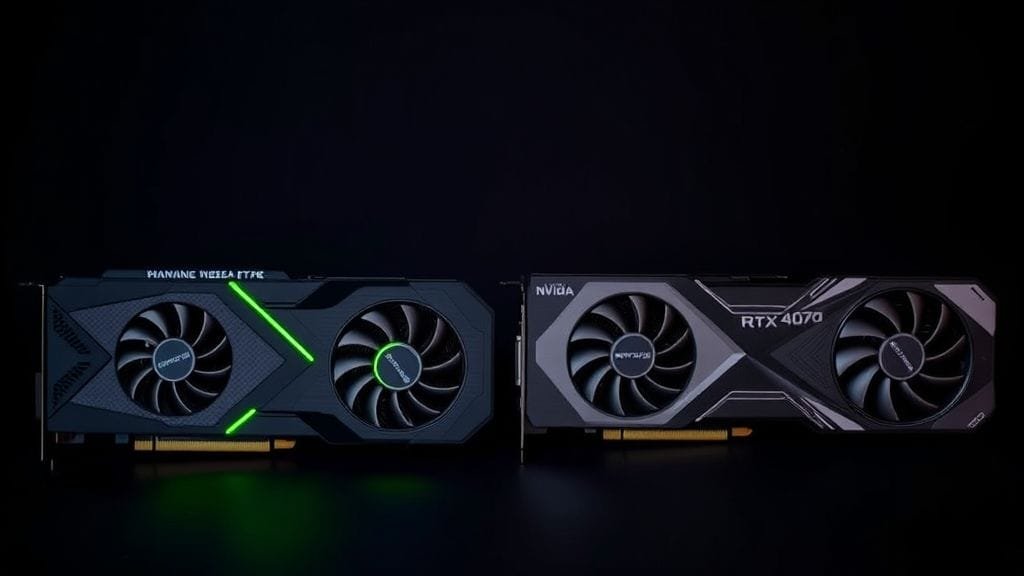
Choosing a new graphics card can be a complex decision, especially with NVIDIA’s frequent generational updates. Consequently, gamers and PC builders often find themselves weighing the merits of different series. Therefore, today, we compare two popular NVIDIA cards: the RTX 3070 and RTX 4070. Both are formidable GPUs, yet they hail from distinct architectural eras—Ampere and Ada Lovelace, respectively. Specifically, this article explores their differences, looking at performance, features, and power efficiency. Ultimately, this helps you choose the best card to suit your gaming needs and budget.
The NVIDIA GeForce RTX 3070 launched to acclaim. Indeed, it is part of the Ampere generation. Moreover, it offered strong performance for its price. Conversely, its successor, the NVIDIA GeForce RTX 4070, represents a significant leap forward with the newer Ada Lovelace architecture. This generational gap, therefore, brings improved efficiency. It also enhances feature sets. Furthermore, performance gets a notable boost, which is true for modern gaming titles. This also future-proofs your system. Consequently, understanding the nuances of the RTX 3070 vs RTX 4070 is essential for an informed purchasing decision.
Generational Leap: Unpacking Key Differences Between RTX 3070 and RTX 4070
These two graphics cards differ greatly. Primarily, their core distinction is in architecture. The manufacturing process, furthermore, also plays a role. These foundational elements, consequently, dictate everything from raw performance to power consumption and feature support. Thus, these specifics show why the RTX 4070 stands out. It is often, therefore, the more advanced option compared to the RTX 3070.
Architecture and Manufacturing Process
The NVIDIA GeForce RTX 3070 utilizes the Ampere architecture, fabricated on an 8nm manufacturing process. This architecture, at the time, was a significant step forward. It delivered, indeed, impressive gains in rasterization and ray tracing. However, technology continuously evolves.
Conversely, the RTX 4070 leverages the cutting-edge Ada Lovelace architecture, built on a more efficient 5nm process. This refinement and smaller node, in turn, help the RTX 4070 achieve higher clock speeds. It also has greater performance per watt. Ultimately, Ada Lovelace optimizes how the GPU processes data, leading to a more efficient and powerful chip overall. Consequently, this leads to an improved RTX 3070 vs RTX 4070 comparison in terms of core design.
VRAM and Memory Configuration: A Critical RTX 3070 vs RTX 4070 Factor
Memory is a vital component for any graphics card, particularly in today’s demanding gaming landscape. Indeed, a significant difference between the RTX 3070 vs RTX 4070 can be found in their VRAM specifications. For instance, the RTX 3070 has 8GB of GDDR6 VRAM with a 256-bit memory interface. This, in turn, delivers 448 GB/s memory bandwidth.
The RTX 4070, however, features a more generous 12GB of faster GDDR6X VRAM. Although it uses a narrower 192-bit interface, faster GDDR6X memory is used. This ultimately results in 504 GB/s effective bandwidth. Moreover, increased VRAM on the RTX 4070 is crucial for modern, intensive games. It especially helps at higher resolutions like 1440p and 4K, where 8GB can quickly become a limitation. Therefore, for serious gamers, understanding VRAM is paramount.
Core Clock Speeds and Power Efficiency
When examining the raw specifications, for example, the RTX 4070 boasts significantly higher boost clock speeds. It can, in fact, reach 2475 MHz. This represents a substantial increase over the RTX 3070 boost clock of 1725 MHz. Clearly, higher frequency means more calculations per second. This, consequently, contributes to the RTX 4070’s superior performance.
Despite its enhanced performance, however, the RTX 4070 is remarkably more power-efficient. Specifically, it has a Thermal Design Power (TDP) of 200W, which is lower than the RTX 3070’s 220W TDP. Thus, power consumption is reduced while the RTX 4070 performs better. This, in turn, means it draws less power, which can lower electricity bills. Furthermore, it also generates less heat in your PC case. Therefore, power efficiency highlights a clear advantage for the RTX 4070.
Ray Tracing, Tensor Cores, and AI Performance
Both the RTX 3070 and RTX 4070 are equipped with dedicated Ray Tracing (RT) Cores and Tensor Cores. Specifically, both cards feature 46 RT Cores and 184 Tensor Cores. However, their generational differences come into play here. This is because the RTX 4070 has newer Ada Lovelace architecture. It, furthermore, incorporates more advanced RT Cores—third-generation—and fourth-generation Tensor Cores.
These architectural improvements, therefore, mean that while the core count is the same, the 4070’s cores are more efficient and powerful. This, in turn, translates into enhanced performance in ray-traced games, offering more realistic lighting, shadows, and reflections. Moreover, improved Tensor Cores boost AI-driven tasks, which includes NVIDIA’s Deep Learning Super Sampling (DLSS) technology.
DLSS 3 and Advanced Features: A Key Distinction for RTX 3070 vs RTX 4070
Many gamers choose the RTX 4070. A compelling reason, in particular, is its DLSS 3 support. This proprietary NVIDIA technology, indeed, includes a revolutionary Frame Generation feature. As a result, DLSS 3 boosts frame rates significantly. It does this by generating new, high-quality frames using AI, thus creating an incredibly smooth gaming experience.
The RTX 3070 is limited to DLSS 2. While DLSS 2 is excellent for upscaling, it also improves performance; however, it lacks Frame Generation. Furthermore, the RTX 4070 incorporates an AV1 video encoder, which advantages creators and streamers. This is because AV1 offers superior compression and better quality compared to the RTX 3070’s H.264. Ultimately, this translates to higher quality streams at lower bitrates, benefiting both creators and viewers. Exploring DLSS 3 Frame Generation, moreover, further reveals its significant impact on gameplay.
Performance Showdown: RTX 3070 vs RTX 4070 in Gaming
Beyond the specifications, however, real-world gaming performance is what truly matters to most users. As we compare the RTX 3070 vs RTX 4070, a clear picture emerges in various gaming scenarios. It effectively showcases the newer architecture’s advantages.
Rasterization Performance Benchmarks
The RTX 4070 outperforms the RTX 3070 significantly in traditional rasterization games. These are games that don’t heavily use ray tracing. Indeed, performance is better by 20-30% on average. This uplift is, moreover, consistent across many modern titles. Consequently, the RTX 4070 delivers higher frame rates and offers a smoother experience. The benefits, furthermore, become particularly noticeable at higher resolutions.
The RTX 4070 shows considerable gains in 1440p gaming, often making it, therefore, the sweet spot for this resolution. It also provides a more capable entry point for 4K gaming compared to its predecessor. Conversely, the 3070’s 8GB VRAM can bottleneck games in demanding, VRAM-intensive titles. This often occurs at higher settings or resolutions, leading to performance stutters and a less fluid experience. In contrast, the RTX 4070’s 12GB VRAM is much smoother. Therefore, the memory configuration plays a crucial role in the RTX 3070 vs RTX 4070 debate.
Ray Tracing and DLSS Impact
The performance gap between the RTX 3070 and RTX 4070 widens even further when, for example, ray tracing is enabled. This is because the RTX 4070 has advanced third-generation RT Cores. Consequently, it handles ray tracing calculations more efficiently. This, therefore, means better frame rates and a more enjoyable experience in visually stunning, ray-traced environments.
DLSS 3 dramatically enhances performance. This includes, notably, Frame Generation. Since it is exclusive to 40-series cards, Frame Generation substantially boosts frame rates. In fact, games that struggle can become smooth, even when this applies at high settings or resolutions. For example, a game might run at 60 FPS on the RTX 4070 without Frame Generation, but it could jump to 90-100+ FPS with it. This significant benefit, furthermore, is absent from the RTX 3070. Ultimately, this feature alone can be a game-changer for many users.

Detailed bar chart comparing average frame rates of RTX 3070 vs RTX 4070 across 5 popular games at 1440p resolution
Cost Analysis and Value Proposition: Pricing the RTX 3070 vs RTX 4070
Price often decides consumer choices. Indeed, the financial aspect is significant when comparing the RTX 3070 vs RTX 4070. While the RTX 4070 offers superior technology, the RTX 3070, nevertheless, remains attractive. Its market position, therefore, appeals to budget buyers.
Launch and Current Market Pricing
At its launch, the NVIDIA GeForce RTX 3070 had an initial Manufacturer’s Suggested Retail Price (MSRP) of $499. Conversely, the RTX 4070, being a newer generation card with advanced features, launched at a higher MSRP of $599. These launch prices, consequently, set a precedent for their relative market positions.
As of September 2025, naturally, the market prices have evolved. A new RTX 3070, for instance, can typically be found for around $409, a considerable reduction from its original price. Furthermore, the used market offers even greater savings, with RTX 3070 cards available for approximately $219.99. In contrast, a new RTX 4070 generally retails for about $579, remaining close to its original MSRP. Similarly, used RTX 4070 cards are available, but at a higher price point of around $459.97. This pricing difference, therefore, significantly influences the value proposition for each card. If considering a tight budget for the RTX 3070 vs RTX 4070, then reviewing current pricing and specifications is essential. Finally, see the official NVIDIA GeForce RTX 3070 product page and also check the NVIDIA GeForce RTX 4070 product page.
Weighing Your Options: Pros and Cons of Each Card
Every graphics card comes with its own set of advantages and disadvantages. Therefore, understanding these points is crucial when evaluating the RTX 3070 vs RTX 4070 for your specific needs.
NVIDIA GeForce RTX 3070: Advantages and Disadvantages
The RTX 3070 remains a powerful GPU, particularly at its current market price. However, it does come with certain limitations compared to its successor.
- Pros:
* Lower Current Price: Its price is lower, especially true in the used market. Consequently, it offers a budget-friendly entry to get into high-performance gaming for less.
* Excellent 1080p and Very Good 1440p Performance: Gamers targeting these resolutions benefit. Indeed, the RTX 3070 delivers impressive frame rates when paired with DLSS 2.
* Strong Performance for Original Price: At its initial $499 MSRP, it offered, therefore, a compelling performance-to-price ratio.
- Cons:
* 8GB VRAM Limitation: 8GB VRAM can be a bottleneck, particularly in demanding games. This often occurs at higher resolutions and settings, leading to stutters and reduced texture quality.
* No DLSS 3 Support: It lacks DLSS 3, which means no Frame Generation technology. Consequently, it cannot achieve 40-series FPS boosts.
* Higher Power Consumption: With a 220W TDP, it consequently consumes more power than the RTX 4070 for less performance.
* Older Architecture: The Ampere architecture is older. Thus, its RT and Tensor Cores are less efficient than the newer, better Ada Lovelace design.
NVIDIA GeForce RTX 4070: Strengths and Weaknesses
The RTX 4070 undeniably represents a technological upgrade, bringing several enhancements to the table. However, its higher price point might not appeal to everyone.
- Pros:
* Superior Raw Performance: It’s 20-30% faster in rasterization. Furthermore, Ray tracing and DLSS 3 enhance this further.
* 12GB GDDR6X VRAM: This offers better future-proofing. It effectively handles demanding games and avoids VRAM bottlenecks at higher resolutions.
* DLSS 3 with Frame Generation: It provides substantial FPS increases. Thus, compatible games become smoother and more immersive.
* More Power-Efficient: A 200W TDP therefore means higher performance with lower power draw and less heat.
* AV1 Encoder: This is beneficial for content creators and streamers due to improved encoding efficiency and quality.
* Newer Ada Lovelace Architecture: Features improved RT and Tensor Cores for enhanced ray tracing and AI performance.
- Cons:
* Higher Price Point: Both its initial MSRP and current retail price are significantly higher than the RTX 3070.
* Narrower 192-bit Memory Bus: The memory bus is narrower (192-bit). However, faster GDDR6X memory compensates for this, though some prefer a wider bus for theoretical bandwidth.
* Value Justification for 1080p: Is the price worth it for 1080p? Often, the performance uplift might not justify the cost.

Who Should Buy Which Card? Making Your Decision Between RTX 3070 vs RTX 4070
Ultimately, the choice between the RTX 3070 vs RTX 4070 depends on your specific needs, budget, and priorities. Both are excellent cards within their respective segments. Nevertheless, they cater to slightly different user profiles.
Ideal User for the RTX 3070
The RTX 3070 is an excellent choice for:
- Budget-Conscious Gamers: You want an upgrade to move from an older card (like a GTX 10-series or RTX 20-series) and get significant performance without breaking the bank. In this scenario, the used market is a great option.
- 1080p or Light 1440p Gaming: For 1080p players and comfortable 1440p at 60 FPS, the RTX 3070 still performs strongly.
- Value Seekers: Find a great deal on an RTX 3070. Its performance-to-price ratio is compelling, thus allowing you to get substantial power for less.
Ideal User for the RTX 4070
The RTX 4070 is the preferred option for:
- Performance Enthusiasts at 1440p/Entry-Level 4K: Want high refresh 1440p gaming or a solid entry into 4K gaming? Then the RTX 4070’s power and VRAM are a better fit.
- Future-Proofing: It has 12GB VRAM. Furthermore, it supports DLSS 3, including Frame Generation, thus offering better longevity for new demanding titles.
- Ray Tracing Advocates: Experience ray tracing with minimal compromise. Indeed, the 4070’s improved RT Cores are a clear advantage.
- Content Creators and Streamers: The AV1 encoder is a bonus. Specifically, it’s for those who encode video, as it offers better quality and efficiency.
- Power Efficiency Prioritizers: If lower power consumption and cooler operation are important factors for your build, then this card is ideal.
Ultimately, choosing a gaming GPU involves balancing cost and performance. Therefore, consider what you need most from your next graphics card before making a final decision.

Final Verdict: The Evolving Landscape of RTX 3070 vs RTX 4070
In summary, the NVIDIA GeForce RTX 4070 is, without question, the technically superior graphics card. It offers, indeed, a clear generational leap, including Ada Lovelace architecture and increased VRAM. It also boasts superior power efficiency and access to cutting-edge features like DLSS 3. Frame Generation and the AV1 encoder are included. Consequently, the RTX 4070 is a robust choice for those building a new PC. It offers, moreover, the best 1440p performance and beyond, along with future-proofing and enhanced ray tracing.
However, the NVIDIA GeForce RTX 3070 should not be dismissed. At its current reduced prices, especially in the thriving used market, it offers exceptional value. Therefore, the RTX 3070 is for 1080p gamers. It also suits comfortable 1440p experiences. If you don’t need the latest ray tracing or DLSS 3, then the RTX 3070 is highly capable and a budget-friendly option. Ultimately, your decision hinges on several factors, including your budget and target resolution. Consider also how much you prioritize new features and raw performance gains.