
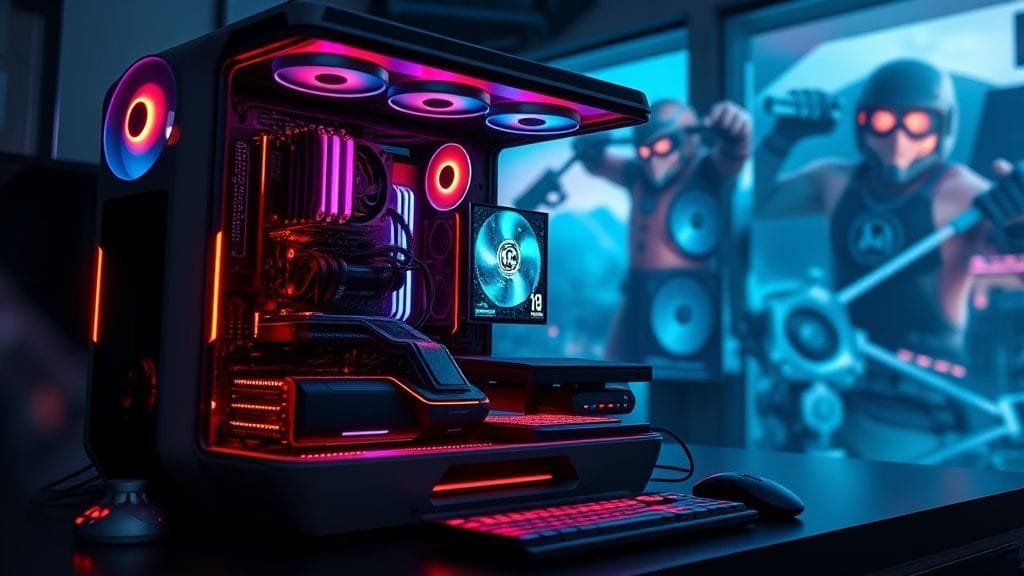
The gaming industry constantly advances, delivering generational gaming performance improvements that redefine interactive experiences. These technological leaps transform virtual worlds from simple abstractions into breathtakingly realistic landscapes. However, This evolution transcends mere hardware speed; it integrates core component advancements, innovative architectures, and intelligent software optimizations. Consequently, players now enjoy smoother gameplay, unparalleled visual fidelity, and drastically reduced load times. This article explores the multifaceted drivers behind these gains. It examines the critical roles of GPUs, CPUs, RAM, and storage solutions. Moreover, we trace their historical trajectory, comparing early gaming shifts to modern realism. We also examine the PC versus console debate, highlighting software optimizations that unlock hardware’s full potential.

The Core Engines: How Hardware Fuels Generational Gaming Performance Improvements
Every gaming system relies on specialized hardware. Each component, contributing to the overall gaming experience evolution, helps create the overall experience. Importantly, these parts do not work alone. Instead, their synergy defines a system’s true capability, leading to significant advancements in gaming performance. Furthermore, each piece of this complex puzzle has seen remarkable advancements over time. This collective progress delivers the astounding hardware performance leaps we see today. Therefore, understanding individual contributions is key. It helps us appreciate the larger picture of gaming evolution.

Graphics Processing Units (GPUs): Driving Gaming Tech Evolution
The Graphics Processing Unit (GPU) is the champion driving gaming tech evolution. It renders every pixel, texture, and animation on screen. Each new GPU generation offers significant visual upgrades, marking continuous gaming tech evolution. These new GPUs deliver more processing power and refined architectures, efficiently handling demanding graphical tasks and boosting hardware performance leaps.
These advancements allow 4K with smooth frame rates, showcasing remarkable gaming performance improvements across generations. Gamers now enjoy 4K with smooth frame rates, once impossible. GPUs enable intricate and realistic graphical effects, characteristic of next-gen gaming advancements. Real-time ray tracing, for example, simulates light’s physical behavior. It creates lifelike reflections, shadows, and global illumination, adding unprecedented depth to game environments and redefining the gaming experience evolution.

The progression from earlier GPUs to today’s titans shows a dramatic leap in overall gaming performance. The NVIDIA RTX 5090, for instance, offers 24% performance gains over the RTX 4090 in 4K benchmarks. This continuous increase in raw processing power is vital for hardware performance leaps. It empowers developers to craft increasingly detailed game worlds without sacrificing performance, solidifying gaming tech evolution.
AI-Powered Boosts for Next-Gen Gaming Advancements
Beyond sheer rendering power, modern GPUs also harness artificial intelligence (AI). This further amplifies performance, contributing significantly to next-gen gaming advancements. For instance, technologies like NVIDIA’s Deep Learning Super Sampling (DLSS) are transforming how games render. DLSS specifically employs AI. It upscales lower-resolution images to higher ones. Consequently, it delivers visual quality comparable to native rendering. At the same time, it significantly reduces the GPU’s computational load, a true hardware performance leap.
Building on this, innovative Frame Generation capabilities exist, delivering further advancements in gaming capabilities. They use AI to create entirely new frames. These frames appear between traditionally rendered ones. This effectively doubles or even triples the perceived frame rate, enhancing the gaming experience evolution. Furthermore, in supported titles, these AI features can provide 50% to over 200% higher frame rates. This allows gamers to enjoy higher visual settings. Conversely, they can opt for much smoother gameplay. Therefore, this fusion of raw power and intelligent AI optimization is critical. It solidifies the GPU’s role as the primary driver of gaming tech evolution.
Central Processing Units (CPUs): Architecting Hardware Performance Leaps
The GPU handles visuals. Meanwhile, the Central Processing Unit (CPUs) orchestrates game logic, AI behavior, and physics, crucial for overall system performance in gaming. The CPU, the computer’s “brain,” processes non-graphical data that brings game worlds to life. Faster CPUs handle complex gaming data more quickly with higher clock speeds and more cores. This leads to smoother gameplay, reducing latency and minimizing frustrating lag spikes, a continuous hardware performance leap.
CPU performance impacts CPU-intensive genres most, directly influencing gaming experience evolution. Open-world Role-Playing Games (RPGs) feature vast environments, numerous NPCs with unique AI, and intricate physics. A powerful CPU ensures these elements run smoothly, maintaining consistent frame rates during heavy calculations. Strategy games with many units and simulation titles rely heavily on CPU prowess, demanding sustained hardware performance leaps.
Crucially, a capable CPU prevents bottlenecks. A potent GPU can be held back if the CPU can’t supply data fast enough. A slow CPU, therefore, leaves a powerful GPU waiting, lowering frame rates. While GPUs get visual credit, a balanced system is vital for truly appreciating overall gaming performance increases. A strong CPU is fundamental for optimal and consistent gaming tech evolution.

Random Access Memory (RAM): Essential for Generational Gaming Performance Improvements
RAM (Random Access Memory) serves as high-speed, short-term data storage, a crucial intermediary for enhancing gaming system responsiveness. It holds data the CPU needs immediately, including game assets and OS processes. Sufficient and fast RAM is essential for a smooth and responsive gaming experience, contributing to the overall gaming experience evolution. Furthermore, it directly reduces lag and accelerates data retrieval.
Modern games demand significant RAM, a factor in next-gen gaming advancements. They feature expansive worlds and high-res textures. Thus, 16GB is generally optimal for gaming, helping most games run comfortably without constantly fetching data from slower storage. Power users, however, may need 32GB or more for modding, multitasking, or streaming, providing extra headroom and supporting further hardware performance leaps.
Beyond quantity, RAM speed is equally important for overall gaming fluidity. Measured in MHz, speed affects data transfer to the CPU. Newer RAM (DDR4 and DDR5) offers significantly higher bandwidth. Increased speed shortens game load times and improves frame rates in memory-intensive games. When the CPU accesses game data quickly, the system operates efficiently, resulting in a more fluid gaming session, contributing to gaming tech evolution.
Storage Solutions: Paving the Way for Gaming Experience Evolution
GPUs, CPUs, and RAM are crucial for raw in-game performance. However, storage drive type and speed profoundly impact gaming. Specifically, it directly influences load times and gaming experience evolution. It also affects the seamless loading of game assets. Traditional Hard Disk Drives (HDDs) use spinning platters. This makes them slow for modern gaming. In contrast, Solid-State Drives (SSDs) use flash memory. Consequently, they offer significantly faster data access speeds, a clear hardware performance leap.
NVMe (Non-Volatile Memory Express) SSDs revolutionized game loading, marking a significant step in overall gaming advancements. They connect directly to the motherboard via PCIe lanes. HDDs might take minutes to load a complex level. Conversely, NVMe SSDs complete this task in mere seconds. Therefore, this drastic reduction in loading screen time is key. It ensures a continuous and immersive flow of gameplay, defining modern gaming experience evolution.

Elevating Gameplay Fluidity Through Generational Gaming Performance Improvements
Faster storage offers clear benefits, contributing to continuous performance enhancements in gaming. These are especially evident in expansive open-world games. Here, vast environments and detailed textures must stream continuously. This happens as the player moves through the world. Faster storage ensures seamless background loading of assets. Consequently, this process prevents frustrating texture pop-in. It also minimizes stuttering. Furthermore, it creates a more cohesive and believable game world, enhancing the overall gaming experience evolution.
Storage speed does not directly influence in-game FPS; powerful GPUs or CPUs do that. However, storage significantly contributes to gaming fluidity, undeniably driving overall system responsiveness. Modern consoles, like PS5 and Xbox Series X, integrate custom high-speed SSDs. These were a cornerstone of their hardware performance leaps. This was a deliberate design choice. It eliminates loading bottlenecks. It also enables new game design possibilities that rely on near-instant asset streaming. Ultimately, the shift to SSDs offers comfort and boosts immersion, marking a key next-gen gaming advancement. Games feel more polished and responsive from launch.
Tracing the Evolution: Seismic Shifts in Generational Gaming Performance Improvements
Gaming performance history is a fascinating narrative. It shows continuous innovation, particularly in advancements across gaming generations. This is marked by distinct generational leaps. These shifts, however, have not always been uniform in impact or perceived flair. For example, early eras saw “seismic” changes that fundamentally redefined games. In contrast, more recent generations focus on refinement, pushing fidelity and speed boundaries to new heights in gaming tech evolution.
Early Eras: Laying the Foundation for Gaming Tech Evolution
Initial gaming hardware generations brought revolutionary changes, establishing the foundation for gaming tech evolution. One early and impactful shift was from 8-bit to 16-bit systems. This occurred in the late 1980s and early 1990s. Consoles like NES and Sega Master System represented the 8-bit era, laying foundational groundwork for future hardware performance leaps. However, the SNES and Sega Genesis then arrived. With 16-bit architectures, they introduced new graphical sophistication. Also, audio improved significantly. Colors became richer. Sprites grew larger and more detailed. Furthermore, parallax scrolling created depth, previously impossible. This significant increase in capabilities enhanced immersion. It also enabled more complex gameplay mechanics.
The most monumental shift came with 3D graphics, a colossal moment in gaming tech evolution. Before dedicated 3D accelerators, games were mostly 2D. The mid-1990s introduced powerful hardware like 3DFX Voodoo cards for PCs and the groundbreaking Sony PlayStation 1. These platforms democratized 3D rendering, moving gaming beyond flat sprites into fully three-dimensional environments. This represented a huge leap in gaming capabilities. Players could navigate spaces with depth, interact with polygonal characters, and witness rudimentary physics. This completely redefined game world perception and inspired an explosion of innovative gameplay, setting the trajectory for modern gaming. These were reinventions, paving the way for further hardware performance leaps and new ways to engage with digital entertainment.

Modern Generations: The Pursuit of Fidelity and Speed in Generational Gaming Performance Improvements
In contrast to early eras, recent advancements in gaming performance focus on refinement. Consoles exemplify this, with each new generation bringing significant hardware performance leaps. The PS4/Xbox One to PS5/Xbox Series X transition is a prime example: CPUs are 4-5x faster, GPUs 10x more powerful, and custom SSDs boast 100GB RAM-equivalent speeds. Still, the perceived visual jump often feels less dramatic.
This phenomenon stems from diminishing returns in graphical advancements within gaming tech evolution. Visual fidelity nears photorealism, making subsequent improvements less “wow-inducing” than the 2D to 3D jump. Instead, the focus is on higher resolutions (4K) and faster frame rates (60 FPS+), key aspects of modern gaming system evolution. Instant load times are a signature, greatly improving flow and convenience, enhancing the overall gaming experience evolution.
Despite less visual “wow,” technical advancements are profound, showcasing significant next-gen gaming advancements. Modern consoles render vast, detailed worlds with sophisticated lighting, complex models, and advanced physics, all while maintaining high performance. These subtler improvements enhance immersion, driving continuous gaming tech evolution, and optimizing the digital world instead of redefining its form.
The Battleground: Dissecting PC Console Performance
The PC versus console debate is perennial. Each platform, therefore, boasts distinct advantages. Both offer incredible gaming experiences. However, their approaches to delivering significant performance upgrades differ significantly. This, consequently, influences cost, customization, and ultimate power, ultimately shaping the landscape of PC console performance.
PC Gaming: Driving Hardware Performance Leaps
High-end gaming PCs are the pinnacle of performance and graphical fidelity, consistently driving hardware performance leaps. PCs, therefore, achieve higher resolutions and faster frame rates. They also create more realistic, densely packed virtual worlds. These surpass even the latest consoles, showcasing ongoing advancements in gaming technology. This superior performance stems from customization. PCs can use the absolute latest, most powerful components. These often exceed console fixed hardware budgets. For instance, top-tier NVIDIA RTX or AMD Radeon GPUs, paired with multi-core Intel Core or AMD Ryzen CPUs, push visual boundaries far beyond console capabilities.
Beyond raw power, PC gaming offers unparalleled customization, a key aspect of gaming tech evolution. Gamers choose every component. They tailor their setup to exact preferences. Also, they upgrade individual parts as new tech emerges, demonstrating continuous hardware performance leaps. This modularity means PCs can have a higher initial cost than consoles. However, they offer a better total cost of ownership over time. Users replace outdated GPUs or CPUs, avoiding buying entirely new systems. Furthermore, PCs excel in modding capabilities. Players alter games creatively. PCs also offer extensive backward compatibility, enabling access to vast game libraries spanning decades. Consequently, the PC market shows modest but steady growth. Enthusiasts drive this, prioritizing performance, flexibility, and personalized experiences, which define PC console performance at its peak.

Console Gaming: Experiencing Next-Gen Gaming Advancements
Console gaming, on the other hand, offers “plug-and-play” convenience, appealing to a broad audience interested in next-gen gaming advancements. Consoles like PlayStation and Xbox provide a streamlined experience. Users simply buy the device, connect it, and play. Therefore, this ease of use, combined with a lower upfront cost, makes consoles accessible. They are an entry point into cutting-edge gaming. At launch, consoles often rival mid-to-high-range PCs in performance, delivering impressive PC console performance for a fraction of the price. However, their fixed hardware cannot keep pace with continuous PC advancements.
The latest console generations, like PS5 and Xbox Series X, represent significant hardware performance leaps, driving true next-gen gaming advancements. These machines boast custom components. Specifically, they include powerful AMD Zen 2 CPUs and RDNA 2 GPUs. Also, bespoke high-speed SSDs are integrated. These optimized solutions let developers extract impressive performance even from fixed hardware. Consequently, stunning graphics, fast load times, and smooth gameplay result, enhancing the gaming experience evolution. This brings high-fidelity gaming to a wider audience. It avoids the complexities of PC building. The console market shows strong rebound and growth. This demonstrates its enduring appeal as a simplified platform. Therefore, while raw power might be outstripped by top-tier PCs, consoles excel. They deliver optimized performance and a cohesive user experience, highlighting key aspects of PC console performance.
Beyond Hardware: Software Optimization and Generational Gaming Performance Improvements
Robust hardware forms the bedrock of advancements in gaming performance. However, software optimization is the crucial architect. It maximizes hardware potential. Without intelligent software, efficient drivers, and clever algorithmic enhancements, cutting-edge hardware would fail to deliver its full promise for gaming tech evolution. This synergy between hardware and software is therefore vital. It truly unlocks next-level gaming experiences, driving continuous gaming performance evolution.
Operating System & Driver Enhancements for Gaming Tech Evolution
The operating system plays a non-trivial role in gaming, contributing to overall system performance. Modern OS, such as Microsoft Windows, include “Game Mode.” This optimizes system resources. It prioritizes game processes. It also minimizes background tasks. This ensures the CPU and RAM are dedicated to the game. Consequently, it leads to smoother frame rates and reduced latency, a testament to ongoing gaming tech evolution.
Graphics drivers are perhaps more critical for hardware performance leaps. GPU manufacturers like NVIDIA and AMD develop them. These drivers are software interfaces. They allow the OS and games to communicate with the graphics card. Therefore, regular driver updates are paramount. Each update often includes performance optimizations for new games. It also fixes bugs. Furthermore, it improves GPU efficiency. Installing the latest drivers can boost frame rates. It can also resolve graphical glitches. Technologies like Resizable BAR are optimized via updates. This allows the CPU to access the GPU’s entire video memory. Consequently, this leads to increased FPS in supported games. These behind-the-scenes developments maximize hardware capabilities, ensuring continued gaming tech evolution.
In-Game Settings and Customization for Optimal Gaming Experience Evolution
In-game settings offer vast options. Players fine-tune performance here, contributing to the ideal gaming experience evolution. Developers include graphical presets and toggles. This allows users to balance visual quality with frame rate, directly impacting overall gaming performance. Lowering game resolution boosts performance effectively. This significantly reduces pixels the GPU renders. Similarly, adjusting graphical details has a substantial impact. Consider shadow quality, texture resolution, anti-aliasing, and ambient occlusion.
Gamers pursuing highest frame rates in competitive titles prioritize performance, a key aspect of PC console performance optimization. Thus, they opt for lower settings. Conversely, single-player adventurers might tolerate lower frame rates. This ensures maximum graphical fidelity. Understanding and using these settings, consequently, empowers players. They optimize experiences to their hardware and preferences. These options, furthermore, provide flexible software control. This allows many systems to run games acceptably. It bridges the gap between high-end and modest gaming rigs, enabling a wider gaming experience evolution.
The AI Revolution: Future-Proofing Performance
AI integration is an exciting frontier in software optimization, driving significant advancements in gaming performance. AI-driven enhancements improve gaming and extend hardware longevity, enabling developers to push visual boundaries without compromising frame rates. Technologies like NVIDIA’s DLSS, AMD’s FSR, and Intel’s XeSS lead this revolution, representing a major gaming tech evolution.
These intelligent upscaling technologies use sophisticated AI, leading to substantial next-gen gaming advancements. Trained on high-resolution images, games render at lower internal resolution, then AI intelligently reconstructs them to a higher target. The result is often visual quality indistinguishable from native, yielding significantly higher frame rates. DLSS, for example, leverages RTX GPU Tensor Cores for real-time upscaling, pushing hardware performance leaps further.
Building on this, AI-powered Frame Generation delivers remarkable gaming performance enhancements. It uses AI to predict and insert new, interpolated frames, effectively doubling the frame rate. Gameplay feels incredibly smooth, even on demanding settings. These AI solutions deliver demanding visuals, like ray tracing, at playable frame rates, future-proofing existing and new GPUs. As AI models grow, their role expands, maximizing performance and enabling new visual paradigms, showcasing gaming experience evolution.
The Future of Gaming Performance: A Glimpse Ahead
Gaming performance advancements continually occur, showing no signs of slowing. Hardware innovation, refined software, and emerging technologies redefine gaming. This R&D cycle ensures captivating, immersive future games for players worldwide, marking continuous gaming tech evolution.
Hardware manufacturing advancements remain a primary driver of overall gaming performance growth. Chip foundries tirelessly pursue smaller transistors and efficient architectures. Smaller process nodes pack more transistors into the same space, creating powerful and energy-efficient GPUs and CPUs. Expect breakthroughs in parallel processing, specialized silicon for AI tasks, and innovative memory solutions to feed these powerful processors, driving further hardware performance leaps.
Software will evolve alongside hardware, contributing to next-gen gaming advancements. AI-driven upscaling and frame generation (DLSS, FSR, XeSS) are still developing. Future iterations will offer greater visual fidelity, fewer artifacts, and broader compatibility. Game engines will become smarter, dynamically optimizing resource usage and leveraging advanced rendering. Cloud gaming also offers a future where local hardware power becomes less of a barrier, democratizing high-fidelity gaming and enabling further gaming experience evolution.
The Next Frontier in Immersion
Emerging technologies hold immense promise for future gaming, marking new phases in gaming tech evolution. Haptic feedback, for instance, is already in controllers like the PlayStation DualSense. It will become more nuanced. Players will feel subtle virtual environment textures. They will also feel in-game impacts with unprecedented realism. Virtual Reality (VR) and Augmented Reality (AR) remain nascent. However, as display and processing mature, they will offer new immersion paradigms, potentially transcending traditional screen-based gaming and driving true next-gen gaming advancements.
Integrating advanced haptics with sophisticated VR/AR systems will demand greater processing power. This, therefore, fuels the continuous push for gaming performance advancements. The journey towards more realistic, responsive, and immersive gaming is far from over. Ultimately, this promises an exciting future for players worldwide, rich with continuous gaming experience evolution.

Conclusion
The journey through advancements in gaming performance reveals a dynamic saga of innovation, a testament to human ingenuity. The relentless pursuit of perfection in interactive entertainment drives advancements, leading to continuous gaming tech evolution. From early 2D to 3D graphics, to today’s photorealism and ultra-high frame rates, each era builds on the last. Thus, gamers enjoy increasingly rich and immersive experiences, marked by substantial hardware performance leaps.
Dedicated hardware components form the backbone: GPUs, CPUs, RAM, SSDs. Yet, hardware alone isn’t enough for the full scope of comprehensive gaming performance. Software optimization amplifies capabilities fully, including OS tweaks, driver updates, in-game settings, and revolutionary AI upscaling/frame generation. This synergy defines gaming’s cutting edge, influencing all aspects of PC console performance.
The technological march forward continues for gaming performance across generations for both PC gaming and consoles. The future promises more astonishing leaps, fueled by hardware miniaturization, smarter AI, and novel immersive technologies. For gamers, this means an ever-evolving canvas where each digital world is more detailed, responsive, and breathtaking. This “tech leap” ensures discovery and virtual exploration remain central to gaming experience evolution.
Frequently Asked Questions About Gaming Performance
Q1: Is a faster CPU or GPU more important for gaming?
A1: Generally, the GPU (Graphics Processing Unit) is more important for overall gaming performance. It handles rendering visuals. This is often the biggest bottleneck. A powerful GPU, therefore, allows for higher resolutions and frame rates. However, a capable CPU (Central Processing Unit) is crucial. It prevents bottlenecks, especially in CPU-intensive games, contributing to balanced PC console performance. Examples include open-world RPGs or strategy titles with many AI units. For optimal performance, a balanced system is ideal. Neither component should significantly hold back the other.
Q2: How much RAM do I really need for modern gaming?
A2: For most modern games, 16GB of RAM is optimal. It provides sufficient memory for smooth gameplay and contributes to stable gaming performance. It also prevents stuttering. However, power users may need more. If you mod games heavily, stream, or multitask frequently, 32GB+ offers benefits. This provides additional headroom and enhances system responsiveness. RAM speed (e.g., DDR4 vs. DDR5) also contributes, especially in memory-intensive titles, showcasing another aspect of hardware performance leaps.
Q3: What is ray tracing and why is it a big deal?
A3: Ray tracing is an advanced rendering technique, a significant driver of next-gen gaming advancements. It simulates light’s physical behavior. Instead of approximations, it traces individual light rays. These interact with scene objects. Consequently, this results in realistic reflections, shadows, and global illumination. Game worlds, furthermore, look significantly more lifelike and immersive. It’s a big deal because it brings CGI-level visual fidelity to real-time interactive experiences. This pushes graphical realism boundaries, marking a true gaming tech evolution.
Q4: How do AI upscaling technologies like DLSS work?
A4: AI upscaling, like NVIDIA’s DLSS, works by rendering games at lower internal resolutions. Then, sophisticated AI algorithms upscale and reconstruct the image. They bring it to a higher target resolution (e.g., 1080p to 4K). This process, often trained on vast datasets, produces comparable visual quality, contributing to significant performance gains. Importantly, it also significantly reduces the GPU’s computational load. The result is higher frame rates and smoother gameplay. All this occurs without a noticeable drop in visual fidelity. Ultimately, this effectively extends your graphics card’s performance, driving gaming experience evolution.
Q5: Will consoles ever match high-end PC performance?
A5: Consoles offer excellent performance for their price point at launch. They are also highly optimized, showcasing impressive PC console performance. However, they generally cannot match bleeding-edge high-end PC performance. PCs benefit from continuous upgrades, driving significant hardware performance leaps. They use the latest, most powerful components (like GPUs and CPUs). Consoles, conversely, have fixed hardware for their entire generation. Nevertheless, consoles offer a fantastic balance. This includes performance, convenience, and cost-effectiveness. They deliver highly immersive experiences for a broad audience, reflecting consistent advancements in gaming capabilities.