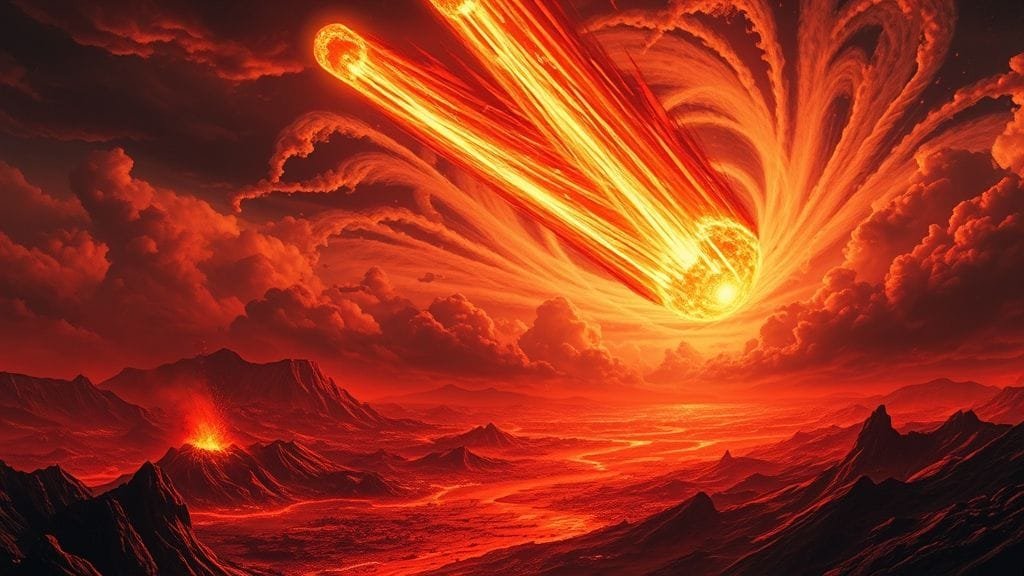
For centuries, cosmic impacts have primarily been viewed as destructive events. Imagine, for example, a colossal rock speeding through space, slamming into a planet with immense power. This image typically evokes ruin: catastrophic disasters, widespread extinctions, and ravaged landscapes. What if, however, these violent events, often perceived as harbingers of doom, actually harbored a hidden, life-giving purpose? Could the very scars left by these cosmic collisions have become cradles for new life? Could they, therefore, foster the growth of Impact Crater Life?
A pivotal study focusing on the ancient Lappajärvi impact structure in western Finland has profoundly altered this long-held perception of Impact Crater Life. For the first time ever, scientists have precisely dated the return of microbial life within such a crater. This research, in turn, reveals that these colossal events can, surprisingly, create unique, enduring habitats for life. These events were once solely considered destructive. Ultimately, this is more than merely an intriguing finding about Earth’s past. It profoundly reshapes how we might search for life beyond our home planet. Thus, the study provides novel insights for astrobiology and underscores life’s remarkable resilience.
Lappajärvi: A Window into Ancient Impact Crater Life
The narrative begins in western Finland, at a site known as Lappajärvi. Today, it manifests as a picturesque lake; however, beneath its surface and the surrounding landscape lies evidence of a truly monumental event. This event transpired millions of years ago. Indeed, this is no ordinary lake; it is a geological marvel, bearing the remnants of a powerful cosmic impact. The Lappajärvi impact structure, as designated by scientists, offers a unique opportunity to delve into Earth’s ancient history. Specifically, it illustrates how life responds to profound environmental shifts, revealing, in particular, how Impact Crater Life can originate.
Cataclysmic Impact: Creating Early Life Habitats
Approximately 78 million years ago, during the Late Cretaceous period, a massive meteorite, estimated to be about 1.6 kilometers (1 mile) in diameter, tore through Earth’s atmosphere. It then struck what is now Finland with immense force. This force was equivalent to billions of atomic bombs detonating simultaneously. The impact, consequently, instantly vaporized rock. It melted vast quantities of material. It also propagated shockwaves through the planet’s outer layer. This was far more than a mere bump; rather, it was a planet-sized punch. It excavated a colossal crater. This crater measured approximately 22-23 kilometers (13.5-14 miles) in diameter. Immediately following the impact, there would have been utter devastation. Life would have appeared utterly untenable due to the extreme heat, pressure, and atmospheric alterations. Nevertheless, this very event inadvertently prepared the ground for future Impact Crater Life.

From Destruction: The Birth of Impact Crater Life Habitats
Yet, as the dust settled and the molten rock cooled, the destruction itself paradoxically began to generate new formations. Specifically, the impact generated extensive fractures deep within Earth’s outer layer, akin to shattered glass. These ruptures were not merely simple cracks; instead, they served as crucial conduits. Magma, still superheated from the impact, began to warm the groundwater. This water, in turn, percolated into these newly formed, deep fractures. As a result, this established a vast, complex network of subsurface hydrothermal systems. These functioned like natural plumbing systems; consequently, they circulated hot, mineral-rich water deep underground.
Consider this analogy: the meteorite functioned as a cosmic sculptor. It profoundly reshaped the subsurface landscape. This alteration did not merely create a cavity; rather, it forged a distinctive geological environment. This environment was unlike anything previously encountered. These hydrothermal systems possessed warmth, circulating water, and an abundance of newly dissolving minerals. Owing to these characteristics, therefore, they offered ideal conditions for Impact Crater Life to unexpectedly return and flourish. In essence, they resembled an underground hot tub, albeit one forged by a colossal planetary catastrophe, poised to welcome life.
Pinpointing Impact Crater Life: Groundbreaking Dating
For a prolonged period, scientists have theorized that impact craters could host life. Indeed, evidence of microbial life has been previously discovered within craters. Nevertheless, one crucial piece of the puzzle consistently remained elusive: when precisely did this life initiate its growth there? Was it immediately post-impact, or much later, perhaps due to unrelated factors? Answering this question, therefore, necessitated specialized tools and a novel conceptual framework. This novel study provided both, significantly clarifying the timeline of Impact Crater Life.
The Challenge of Deep-Time Chronology
Determining the age of ancient events and the emergence of life within them is exceedingly challenging. Imagine, for example, attempting to pinpoint the exact moment a specific plant first flourished in an ancient, untamed garden, devoid of records. Established rock dating methods can ascertain the age of the crater itself. However, they frequently struggle to pinpoint the precise timing of biological processes. These processes transpired millions of years later, deep within the subsurface. This uncertainty, consequently, left a significant lacuna in our knowledge. We lacked a comprehensive understanding of how life recovers and adapts after catastrophic events. Earlier evidence might have hinted at life, but it could not definitively link life’s appearance to the immediate post-impact period. This, ultimately, impeded the advancement of Impact Crater Life studies.
Radioisotopic Dating and Isotopic Biosignatures
The team behind the Lappajärvi study resolved this challenge by employing an ingenious combination of methodologies. Initially, they utilized radioisotopic dating. This method relies on the predictable decay of radioactive elements within rocks and minerals. This method, therefore, enabled them to establish a precise timeline for the formation of various minerals within the crater’s hydrothermal system. By dating these minerals, scientists could then ascertain the age of the locations where microbial life forms had left their indelible biosignatures.

But how does one detect the subtle presence of ancient microbes within rock? This is where isotopic biosignature analysis proves invaluable. Living organisms often preferentially utilize lighter isotopes of elements over heavier ones during their metabolic processes. Sulfate-reducing bacteria, for instance, played a pivotal role in this study. They exhibit a strong preference for the lighter sulfur-32 isotope over sulfur-34. Consequently, when these microbes metabolize sulfur, they leave distinctive “fingerprints.” These manifest as anomalous ratios of these isotopes within minerals like pyrite. By analyzing these subtle chemical clues entrapped within the rock, scientists confirmed the presence and activity of ancient microbial communities. Crucially, they could link these microbes to specific geological strata. These strata, furthermore, were precisely dated using radioisotopes, thereby confirming early Impact Crater Life.
The Crucial Temperature Window
The study revealed a truly remarkable aspect regarding the timing: microbial life forms, particularly sulfate-reducing bacteria, emerged approximately 4–5 million years after the initial impact. This timeframe is significant. It corresponds to a specific thermal regime. The subsurface environment, at that juncture, had cooled to approximately 47°C (about 117°F). This temperature was not arbitrary; instead, it is optimal for numerous types of microbial life. This, for example, encompasses thermophilic (heat-loving) and mesophilic (moderate-temperature loving) bacteria.
These findings indicate that the impact initially generated an intensely hot environment. This rendered it inhospitable for life. However, as the fractured hydrothermal system gradually cooled, conditions eventually converged on a “Goldilocks zone.” Here, these resilient microbes could thrive. They were not merely surviving; rather, they were actively colonizing and establishing a thriving ecosystem. This occurred within a deeply buried, mineral-rich, and moderately warm aqueous realm. This precise correlation with geological history truly distinguishes this study. It provides a definitive answer to when Impact Crater Life returned to the crater.
The Microbes Emerge: Resilient Impact Crater Life
Once conditions became favorable, life did not merely return sluggishly; rather, it firmly established itself with remarkable resilience. The study’s meticulous examination paints a vivid picture of microbial life forms. They were not merely surviving; moreover, they were actively modifying their environment deep within the crater’s fractured rock. These invisible pioneers initiated a protracted, gradual process. They colonized the area and developed an ecosystem. This, in turn, demonstrated life’s astonishing adaptability and the persistence of Impact Crater Life.
Early Impact Crater Life: Sulfate-Reducing Bacteria
The earliest discernible life forms were sulfate-reducing bacteria. These microbial life forms are anaerobic, meaning they do not require oxygen to subsist; instead, they “breathe” sulfate, reducing it to sulfide. Furthermore, these bacteria thrive in environments rich in dissolved sulfate and organic material. They convert these chemicals into energy. The fractured, mineral-rich hydrothermal system of the Lappajärvi crater provided precisely these conditions. During the impact, fresh minerals were exhumed and exposed. The circulating hydrothermal fluid facilitated their dissolution and transport. This, consequently, established a consistent nutrient supply for the microbes.
The chemical evidence for these early colonizers was unequivocal. For example, scientists detected notably low levels of the heavy sulfur-34 isotope within pyrite crystals. These crystals formed during this period. As previously mentioned, microbes preferentially incorporate the lighter sulfur-32 isotope. Therefore, when sulfate-reducing bacteria metabolized sulfur, they left a distinct isotopic “fingerprint” in the pyrite they facilitated in forming. This signature is a robust indicator of their metabolic activity. It functions as an ancient biological receipt. This confirms their presence and activity. As a result, the 47°C temperature, abundant minerals, and circulating water collectively forged an ideal “Goldilocks zone.” These optimal conditions allowed early Impact Crater Life—the subsurface pioneers—to flourish.
Evolving Impact Crater Life: Methane Cycling
However, the narrative of life at Lappajärvi did not conclude with sulfate reducers. In fact, the study also presented evidence of a more complex, evolving deep biosphere of microbial life. Over 10 million years post-impact, novel mineral formations emerged. These formations contained isotopic clues indicative of microbial methane cycling. This, specifically, demonstrated the presence of microbes capable of either generating methane (methanogens) or consuming it (methanotrophs).
This development, therefore, signifies a substantial shift and an increase in diversity within the crater’s buried ecosystem. The transition from solely sulfate-reducing communities to those engaging in methane cycling suggests a gradual but persistent natural progression of life. The hydrothermal system’s geochemistry evolved over time. Perhaps existing minerals were depleted, or new ones became available for utilization. As a result, distinct microbial communities carved out their respective niches. In essence, this deep microbial ecosystem exhibited remarkable longevity and continuous evolution. Thus, impact structures are more than mere temporary refugia; rather, they sustain active, adaptable life forms. These forms continually adjust to evolving conditions over vast expanses of geological time. This, furthermore, exemplifies the profound resilience of Impact Crater Life.
Key Statistics at a Glance
To put the findings into perspective, here are some of the critical statistics from the Lappajärvi study:
| Characteristic | Value |
|---|---|
| Age of Lappajärvi Crater | 78 million years old |
| Original Meteorite Diameter | ~1.6 km (1 mile) |
| Crater Diameter | ~22-23 km (13.5-14 miles) |
| Time to Microbial Colonization | 4–5 million years after impact |
| Subsurface Temperature (Early Life) | ~47°C |
| Evidence of Methane Cycling | >10 million years after impact |
This table effectively summarizes the incredible timeline and conditions under which life not only returned but also adapted and diversified within the very scars of a planetary catastrophe. Furthermore, it highlights the vast stretches of time over which these subterranean habitats remained viable for Impact Crater Life.
Beyond Destruction: Impact Crater Life Nurseries
The discovery at Lappajärvi profoundly challenges a long-standing, entrenched scientific paradigm. For too long, indeed, meteorite impacts have been viewed almost exclusively as agents of destruction. They were traditionally held responsible for widespread extinctions and planetary devastation. While their destructive potential is undeniable, this study reveals a profound paradox. These colossal events can also generate enduring habitable zones. These zones, in effect, serve as nurseries for microbial life forms. They foster the development of what is known as “Impact Crater Life.”
Challenging Traditional Paradigms of Impact Crater Life
Envision our scientific understanding as a well-trodden path. For years, the trajectory for impact craters led solely to “extinction” or “environmental degradation.” Now, however, the Lappajärvi study has carved a novel, branching path—one that leads to “sanctuary for life.” This is not merely a minor adjustment; instead, it represents a significant re-evaluation of impact geology. It also alters our perception of its role in planetary habitability. Therefore, we must reconsider the entire narrative of life’s resilience. We must also re-evaluate how planets, even after violent pasts, can harbor life in unexpected locales. This paradigm shift is profound. It compels scientists to reconsider where and how Impact Crater Life might persist.
Unique Conditions for Impact Crater Life
What precisely renders these impact-generated hydrothermal systems such effective cradles for life? Essentially, it’s a confluence of several unique factors:
- Warmth: Residual heat from the impact, combined with geothermal heat from Earth’s interior, generated warm water circulation deep within the subsurface. This warmth, consequently, provides the energy requisite for chemical reactions that sustain life.
- Water Circulation: Extensive fracturing from the impact allowed water to penetrate deep into the crust. This established an active system where water could circulate, thereby transporting nutrients and removing waste products. Indeed, this circulation is vital, much akin to blood flowing through an organism.
- Mineral Availability: The impact exposed fresh rock faces. This generated novel mineral surfaces and dissolved a diverse array of chemical compounds into the circulating water. These minerals, in turn, furnish essential building blocks and energy for microbial life processes. Essentially, they serve as metabolic substrates for these subsurface ecosystems.
Consider it a self-sustaining natural incubator. These conditions bear striking resemblances to those found in deep-sea hydrothermal vents. These vents are renowned for supporting bustling ecosystems entirely independent of sunlight. Consequently, this comparison, indeed, reinforces the hypothesis that life can endure in extreme environments. Life accomplishes this by leveraging geological processes for survival. This, therefore, highlights the widespread potential for Impact Crater Life.
Why Longevity Matters
The sustained viability of these habitats for millions of years is of paramount importance. Ephemeral environments might sustain transient life, but long-lived ones, conversely, facilitate genuine evolution and diversification. Microbial communities have ample time to adapt, diversify, and forge complex interdependencies. This unfolds over millions of years, from 4-5 million to certainly beyond 10 million. Evidence of this is observable, for instance, in the transition from sulfate-reducing to methane-cycling microbes. Such prolonged existence transforms an impact crater from a temporary refuge into a durable ecosystem. It offers a stable environment for life’s protracted journey through time. Ultimately, this extended timeline significantly enhances the probability for Impact Crater Life. It implies that life can not merely survive, but truly flourish and establish itself after cosmic violence.

Astrobiological Frontiers: Impact Crater Life Beyond Earth
The findings from Lappajärvi extend far beyond Earth’s ancient history. Specifically, it compels us to examine the often-overlooked subsurface regions of impact structures. These represent prime candidates for discovering past or present extraterrestrial life. Moreover, this knowledge furnishes us with a timeline. It illustrates how life can recover and adapt after planetary devastation. These insights, therefore, serve as a guiding framework. They assist in interpreting data from future missions to Mars and beyond. The study emphasizes the necessity of investigating a planet’s deep geological history, not merely its surface. This investigative approach is crucial for comprehending life’s resilience. It also aids in assessing the potential ubiquity of life in the cosmos. The search for Impact Crater Life now possesses a clearer, more informed trajectory, guided by Earth’s own ancient scars.
Mars: A Prime Candidate for Past Impact Crater Life
Mars, our planetary neighbor, presents a landscape profoundly scarred by billions of years of impact history. Its surface is extensively pockmarked with craters of varying scales. Many are considerably older than Lappajärvi. This study posits that Mars’s tumultuous past, rather than rendering the planet lifeless, might have inadvertently generated numerous subsurface oases. Life could have originated and persisted there. If life ever emerged on Mars, for instance, these ancient impact-generated hydrothermal systems could have been crucial. Such systems, indeed, could have furnished sustained warmth, water, and chemical nutrients, even after the surface became cold and arid.
Envision future Mars missions. They could be outfitted with advanced subsurface drilling tools. They would target the deep interiors of these ancient craters. Instead of merely seeking surface water ice, scientists might be searching for the isotopic biosignatures of microbial life within the fractured rock. This, for example, would closely parallel the approach taken by the team at Lappajärvi. This shifts the focus from merely surface observation; instead, it redirects toward a deeper, more profound search within Mars’s crust. Scientists would seek evidence of deep subsurface ecosystems. Thus, the likelihood of discovering evidence of past or even present Martian Impact Crater Life within these geological features is now significantly enhanced.

Europa and Enceladus: Ocean Worlds and Impact Scars
The implications also extend to the icy moons of the outer solar system, such as Europa (Jupiter’s moon) and Enceladus (Saturn’s moon). Both are hypothesized to harbor vast oceans beneath thick ice shells. Hydrothermal activity might warm these oceans. While their impact history differs from Mars, these moons also bear evidence of cosmic collisions. Consequently, given that impacts on rocky bodies can generate hydrothermal systems, we should also consider how impacts on ice-covered ocean worlds might foster unique zones of thermal and chemical mixing. Such zones could potentially promote Impact Crater Life.
For example, impacts could fracture the ice shell. This would permit mixing between the surface and the subsurface ocean. Or, alternatively, they could even induce localized hydrothermal activity. This would occur within the rocky core beneath the ocean. This further broadens the spectrum of potential habitats for life. It reinforces the notion that life holds potential wherever there is water, energy, and requisite chemicals. The concept of “impact-induced habitability” offers a compelling new paradigm. It aids in comprehending the prospects for “Impact Crater Life” on both rocky planets and icy moons.
A New Roadmap for Exploration
Ultimately, this research provides a novel roadmap for astrobiological exploration. It directs attention to the often-overlooked subsurface regions of impact structures. These are prime locations for discovering past or present extraterrestrial life. Furthermore, this knowledge establishes a chronological framework for understanding how life can recover and adapt after planetary devastation. These insights serve as a guide for interpreting data from future missions to Mars and beyond. The study underscores the imperative to investigate a planet’s deep geological history. We cannot merely focus on its surface. This is vital for comprehending life’s persistence. It also indicates the potential prevalence of life throughout the universe. Thus, the search for Impact Crater Life now follows a clearer, more informed trajectory, guided by Earth’s own ancient scars.
Precise Geochronology: Unlocking Impact Crater Life Secrets
The Lappajärvi study transcends merely discovering life; rather, it’s about how that discovery was made and the rigorous scientific methodology underpinning it. Moreover, it resolves a long-standing problem. This problem, specifically, pertained to understanding the intricate interplay between geological events and biological entities, especially concerning Impact Crater Life.
Solving an Ancient Mystery
Prior to this research, scientists had uncovered evidence of life in other impact structures. However, they struggled to definitively link its appearance directly to the impact event itself. Was the life a direct consequence of the impact, or did it colonize much later due to other geological phenomena, perhaps even surface water contamination? This uncertainty, consequently, hindered the drawing of robust conclusions. These conclusions pertained to how impacts contribute to habitability. The Lappajärvi study, with its precise correlation to geological history, finally resolves this mystery. It elucidated when life colonized the region. It directly links this to post-impact occurrences. This, therefore, addresses a critical gap in our scientific understanding of Impact Crater Life.
This precision, notably, is highly valuable. It enables researchers to differentiate between primary and secondary colonization. Primary colonization refers to life establishing itself due to the impact’s unique conditions. Secondary colonization, conversely, implies life arriving much later, perhaps originating from exogenous sources. This distinction is crucial for comprehending life’s initiation and persistence on planets. This is particularly pertinent when considering exoplanets or ancient Martian locales.

Integrating Disciplines: Geology, Biology, Chemistry
This pivotal research exemplifies the potency of multidisciplinary science. It wasn’t merely a geologist, a biologist, or a chemist who made this discovery; rather, it was a team that ingeniously integrated methodologies and knowledge from all three fields, specifically to decipher Impact Crater Life.
- Geology, for instance, furnished the foundational understanding of impact mechanics, crater formation, and the genesis of fractured rock systems.
- Chemistry, moreover, facilitated the in-depth analysis of isotopic signatures. This revealed the metabolic processes of ancient microbes.
- Biology, furthermore, provided the framework for understanding microbial ecosystems. This encompassed their preferred environments and long-term resilience.
Through this seamless integration of expertise, the team constructed a comprehensive narrative. This narrative spanned everything from the mechanics of a cosmic impact to the precise chemical biosignatures of microbial life forms. All this was underpinned by a robust geological timeline. Such collaborative effort is, therefore, increasingly vital for addressing complex scientific questions. Ultimately, it expands the frontiers of our understanding concerning our planet and the universe.
Earth’s Deep Biosphere: Evolving Impact Crater Life
The Lappajärvi finding contributes to a broader, evolving understanding of Earth’s deep biosphere. This refers to the vast, often unseen realm of microbial life that thrives far beneath our feet. For a prolonged period, Earth’s surface was considered the primary stage for life. However, research over the past few decades has revealed a vibrant, complex, and highly resilient biosphere concealed deep within the crust, where Impact Crater Life can play a pivotal role.
Life’s Resilience: A Constant Theme
This study powerfully corroborates a consistent theme from extremophile research: life’s extraordinary resilience. It persists in exceedingly harsh environments. These encompass, for instance, scorching hot deep-sea vents, frigid polar ice, and highly acidic volcanic lakes. Now, it has also been discovered deep within the fractured rock of ancient impact craters. These microbes do not merely survive; rather, they establish thriving ecosystems. They often derive energy from chemosynthesis. This entails drawing energy from chemical reactions rather than sunlight, in stark contrast to photosynthesis.
The Lappajärvi findings add another dimension to this narrative of resilience. They demonstrate that even after planetary devastation, life is not universally eradicated. Instead, it can retreat to subsurface refugia. They adapt to novel conditions forged by the catastrophe. Then, eventually, they can re-emerge or evolve into novel forms. This resilience of life serves as a potent reminder of its profound adaptability. It also underscores its pervasive presence across Earth’s diverse environments. This is particularly evident in its capacity to form Impact Crater Life.
The Subsurface: A Sanctuary for Impact Crater Life
The subsurface environment, particularly the fractured zones of impact craters, offers a unique form of sanctuary. It affords protection from surface stressors. These encompass, for example, atmospheric fluctuations, solar radiation, and even subsequent meteorite impacts. Deep within the subsurface, conditions tend to be more stable. They exhibit consistent temperatures, pressures, and chemical provisions. This, consequently, renders them ideal for sustained habitation. The circulating hydrothermal fluids, moreover, serve as a consistent delivery mechanism for nutrients. They also facilitate waste removal.

This concept of the subsurface as a stable, protective environment is crucial not only for comprehending Earth’s deep biosphere but also for envisioning life on other planets. On worlds like Mars, which long ago lost its surface water and atmosphere, the subsurface might represent the sole locale where liquid water could persist, protected from the harsh surface conditions. Therefore, the Lappajärvi study furnishes compelling, dated evidence. This evidence, in turn, demonstrates that such sanctuaries can form and sustain Impact Crater Life for millions of years. This holds true despite their violent genesis.
Future of Impact Crater Life Research
The Lappajärvi study constitutes a monumental achievement, yet it also represents merely the beginning. Like any truly transformative research, it elicits numerous new questions. Moreover, it also forges exciting new avenues for future exploration, both terrestrial and extraterrestrial, concerning Impact Crater Life. It expands the boundaries of our knowledge. Furthermore, it inspires the next generation of scientific inquiries.
What’s Next for Lappajärvi and Beyond?
For the Lappajärvi crater itself, the precise dating provides a robust framework for more detailed investigations. Scientists can now delve deeper into the specific mineralogy and geochemistry of different time periods. This, consequently, would aid in comprehending how the microbial communities evolved. What other microbial taxa were present? How did their metabolic processes shift over millions of years? Could even more ancient evidence of life be uncovered at deeper levels, revealing further secrets of Impact Crater Life?
Beyond Lappajärvi, the logical next step is to apply these advanced dating and biosignature analysis methods to other impact structures globally. Numerous ancient craters on Earth await the revelation of their secrets. By investigating these diverse sites, therefore, scientists can construct a more comprehensive picture of how impacts contribute to habitability. They can identify common patterns and unique distinctions. This comparative analysis, moreover, will strengthen predictive models. These models are employed for astrobiological predictions. As technology advances, furthermore, on-site analysis for life detection within extraterrestrial craters becomes increasingly feasible. Robotic drills on Mars or future human missions could facilitate this.
Inspiring the Next Generation of Scientists
Perhaps one of the most profound, yet often immeasurable, impacts of such research lies in its power to inspire. The notion that colossal events can, unexpectedly, foster life, and moreover, that a hidden, ancient ecosystem exists deep beneath the surface, truly captivates the imagination. Such findings, for example, prompt young individuals to view the world, and indeed the cosmos, with renewed curiosity. They also become willing to challenge established notions. This “hard-won wisdom” stems from the understanding that our knowledge is perpetually evolving. It also implies that the universe holds more enigmas than we can fathom. This is precisely what propels scientific advancement. It reminds us that even amidst the most destructive events, there might reside a silent, enduring promise of life—life that awaits discovery. The universe, it seems, is far more nuanced and intricate than we often conceive. Impact Crater Life stands as its profound testament.
Conclusion
The Lappajärvi study stands as a monumental achievement. It fundamentally reshapes our perception of planetary impacts. It clearly demonstrates that these once-devastating events can engender unique, long-lasting subsurface habitats. They serve as improbable cradles for microbial life forms. Specifically, scientists employed meticulous radioisotopic dating and isotopic biosignature analysis. This confirmed the presence of life within the 78-million-year-old Lappajärvi crater. They also precisely dated life’s return to this locale. It revealed life thrived as Impact Crater Life within warm, mineral-rich hydrothermal systems. This occurred merely 4-5 million years post-impact.
This fundamental paradigm shift — from impacts as solely destructive forces to potential drivers of life — carries profound implications for astrobiology. It suggests that the cratered surfaces of Mars, Europa, and numerous other celestial bodies might harbor, or once harbored, life within their subsurface environments, generated by impacts. Consequently, this research, therefore, offers a novel avenue for exploring the universe. Furthermore, this study provides a deeper understanding of life’s remarkable resilience. It demonstrates life’s capacity to emerge and persist under the harshest conditions. The precise geological timeline established in this study serves as a powerful tool. It aids our search for extraterrestrial life. It also deepens our comprehension of Earth’s concealed deep biosphere. This includes the potential for Impact Crater Life.
What other unexpected environments might hold clues to life’s endurance, both on Earth and beyond?