Have you thought about how much your sleek, powerful laptop has changed over time? The history of laptops shows more than just tech progress. It proves how clever people are. This journey always aims to make computers easier to use, stronger, and most important, easy to carry. Laptops started as heavy “luggables” that needed power cords. Today, they are light, smart, and run on AI. This change has greatly altered how we work, learn, and connect. Seeing this amazing progress gives us a great look at the constant push for new ideas that shapes our digital world.

The Start of Portable Computers: The “Luggable” Era (1970s-Early 1980s)
Before laptops were common, the idea of a personal, portable computer seemed far off. In the 1970s, computers were huge. They filled entire rooms. But even then, smart thinkers imagined a different future. These first tries were often heavy. They still needed outside power. Yet, they set the stage for personal computers to become popular.
Imagining Portable: The Dynabook Dream
Imagine a device so new it inspired a whole industry. But it was never actually built. That’s the story of Alan Kay’s Dynabook. Kay thought of the Dynabook in 1976 at Xerox PARC. He pictured a “personal computer for children of all ages.” This portable, interactive device was for learning and creating. The Dynabook stayed just an idea. But its advanced design changed how later portable computers looked. It had a flat screen and a keyboard. It clearly showed what could be done.
IBM 5100: The First Truly Portable Computer
The Dynabook was an idea. But IBM made the first real step toward portable computers with its IBM 5100. IBM released it in September 1975. This machine was a huge success for its time. It weighed a heavy 55 pounds (25 kg). So it was not light like a laptop. But it was much smaller than any computer before it. The IBM 5100 had a keyboard, a small 5-inch screen, and saved data on magnetic tape. It was mostly sold to scientists and engineers. They needed computers they could take with them. Even with its new features, the 5100 always needed to be plugged in. This kept it from being truly portable. It became known as a “luggable” computer. You could move it, but not use it anywhere.
Osborne 1: Sales Hit and the Rise of “Luggables”
The world first saw a useful portable computer in April 1981. This was the Osborne 1. It was not just portable; it was a huge sales hit. Adam Osborne made it. He smartly put a computer, keyboard, screen, and two floppy disk drives into one unit. It was the size of a briefcase. It weighed 24.5 pounds (11.1 kg) and cost $1,795. Businesses loved it. It sold well because it came with helpful programs. These included word processing and spreadsheets. Users got value right away.
The Osborne 1 proved that people really wanted portable business tools. But like the IBM 5100, it had no built-in battery. You had to plug it in to use it. So, you could move it, but you couldn’t use it anywhere you wanted. These devices were a big step in the history of laptops. But people called them “luggables.” This was because they were heavy and needed power cords.

A photograph of an Osborne 1 computer with its screen displaying basic text, next to a floppy disk.
The New Clamshell Design: GRiD Compass 1101
A key moment in the history of laptops came in 1982. This was with the GRiD Compass 1101. This device showed off a design that became famous: the clamshell. For the first time, a flat screen folded over the keyboard. This new idea kept the screen safe. It also made the device much smaller when closed. Important to note, the GRiD Compass was more than just good-looking. It was one of the first portable computers with a battery. This meant you could truly use it without being plugged in.
Its new features were great. But the GRiD Compass was very costly. It sold for $8,150 to $10,000. This high price meant only certain fields used it. NASA famously used it on the Space Shuttle for important tasks. The U.S. military used it for tough jobs in the field. The GRiD Compass showed that truly portable computers were possible. But they were not yet cheap enough for everyone. It set a new standard for how laptops looked and worked.
The Laptop and Notebook Age (Mid-1980s to 1990s)
The mid-1980s brought a clear change in portable computers. Devices got much lighter and cheaper. They also ran fully on batteries. This led to the terms “laptop” and “notebook” as we know them today. This time saw fast changes. Makers raced to build smaller, faster, and cheaper devices for more people.
What is a Laptop? The Gavilan SC and Early Laptops
The word “laptop” became well-known around 1983. This was mostly due to machines like the Gavilan SC. It was clearly sold as the first “laptop” computer. It had a floppy disk drive, an LCD screen, and an early touchpad-like device. It didn’t sell huge numbers. But its ads and features helped make “laptop” a common word. It set these new, lighter devices apart from the older “luggables.”
Light Wonders: TRS-80 Model 100 and Color Screens
The Radio Shack TRS-80 Model 100 came out in 1983. It made the idea of a light, personal portable computer even stronger. Journalists and writers loved this battery-powered device. It had a flat, notebook-like design. It also had a full keyboard and a built-in modem. It was truly portable. Users could type stories and send them from far-off places. This was a huge new feature back then. Soon after, in 1984, the Commodore SX-64 made history. It was the first portable computer with a full-color screen. It was still heavy, like a “luggable.” But it showed that people wanted better colors and pictures on the go. This was a key trend in the ongoing history of laptops.
What is a Notebook? Compaq LTE and Apple’s First Step
The late 1980s truly brought in the “notebook” age. People often call the Compaq LTE the first real “notebook” computer. It came out in 1989. It had an internal hard drive and a built-in floppy drive. These fit into a small, light package that weighed less than 7 pounds (3.1 kg). This was a huge step forward. It offered desktop computer power in a truly portable form. Suddenly, workers could take their whole digital office with them. They carried documents and programs wherever they went.
Apple also joined the new laptop market in 1989. It did this with the Macintosh Portable. It had some new ideas. But its heavy weight (over 16 pounds or 7.2 kg) and high price ($6,500) made it a sales flop. It proved that even Apple, a leader in design, could get it wrong. They misjudged what people wanted in terms of how light and cheap a portable computer should be.
Famous Designs: PowerBook and IBM ThinkPad
In the early 1990s, two big names came forward. They greatly shaped the history of laptops:
- Apple PowerBook 100 (1991): This was Apple’s comeback. The PowerBook 100 series changed how laptops looked. The small 100 model was especially key. It smartly put the keyboard at the back. This made room for palm rests in the front. It also had a built-in trackball to move the cursor. Its easy-to-use design and great features made it a new hit product. It sold very well. It proved that good design and ease of use were as vital as power in this growing market.
- IBM ThinkPad (1992): IBM’s ThinkPad line soon became the best for business laptops. Models like the 700C (1994) had bright color screens. They set high standards for how reliable, strong, and comfortable a laptop should be. Its special red “TrackPoint” stick was placed between the G, H, and B keys. It became a famous feature. Many business users liked it for its exactness and easy use. It let them move around the screen without lifting their hands from the keyboard.
These devices set the modern laptop shape. They also built the base for the many strong computers we use now.
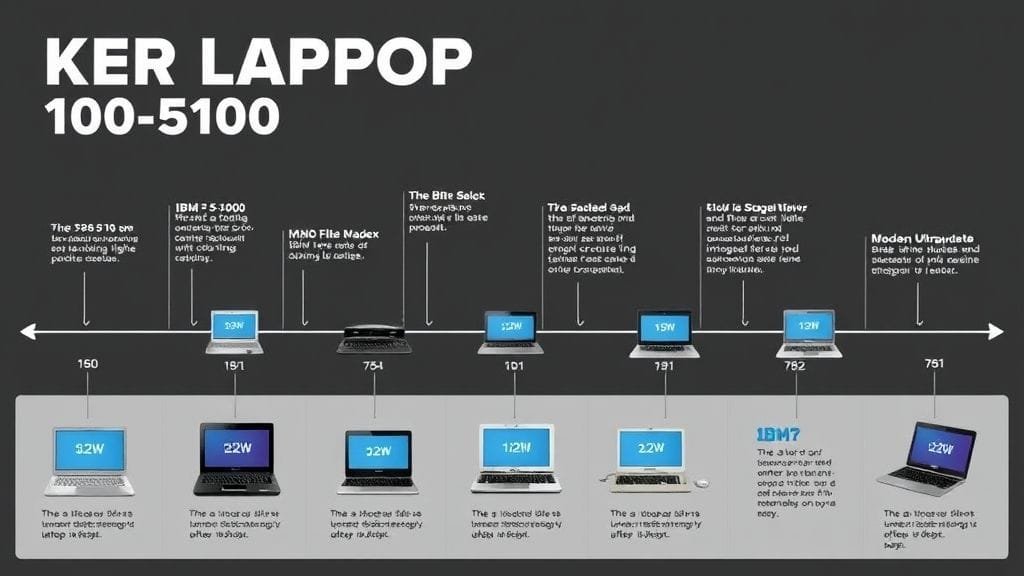
To better show the key steps and fast changes in early laptops, let’s look at a table of important models and their main features:
| Year | Model | Key Innovation(s) | Weight (approx.) |
|---|---|---|---|
| 1975 | IBM 5100 | First truly portable, all-in-one computer | 55 lbs (25 kg) |
| 1981 | Osborne 1 | First commercially successful portable, bundled software | 24.5 lbs (11.1 kg) |
| 1982 | GRiD Compass 1101 | Clamshell design, first battery-powered portable | 10 lbs (4.5 kg) |
| 1983 | Gavilan SC | First marketed as “laptop,” integrated touchpad | 9 lbs (4.1 kg) |
| 1989 | Compaq LTE | First “notebook,” internal HDD, compact | 6.2 lbs (2.8 kg) |
| 1991 | Apple PowerBook 100 | Integrated trackball, palm rests, user-friendly design | 5.1 lbs (2.3 kg) |
Powering the Progress: Key Tech Changes in Laptops
Laptops kept changing fast. This would not have happened without new ideas always flowing into their main parts. Every change, even small ones, helped make these devices faster, lighter, more able, and much easier to use. Let’s look at the key advances that shaped the history of laptops.
The Brains: Better Processors
The processor, or CPU, is the brain of every laptop. Early portable models used simple 8-bit chips. These offered little computer power. But soon, special laptop processors came out. For example, Intel made the 386SL chip just for laptops. It focused on saving power and working well in a portable device. Later, strong Pentium processors brought desktop power to laptops. This allowed for more complex programs and better handling of many tasks at once. More recently, Apple’s M1 chip, released in 2020, was a huge step forward. It put the CPU, GPU, and memory all on one chip. This gave amazing speed and used less power. This set a new bar for portable power. It changed what was possible in thin, light designs. This constant race for faster, better processing power keeps moving the laptop market ahead.
Seeing the World: Screen Changes
The screen is your window into the laptop’s world. Its changes have been huge. Early portable computers often had small, black and white screens. You could sometimes only see a few lines of text. Moving to full-color CRT (Cathode Ray Tube) screens was a big step. But these screens were naturally big and heavy. The real change for portable screens came with LCD (Liquid Crystal Display) tech. It allowed for thin, flat screens. Makers could easily build these into the clamshell design. Active matrix LCDs then gave brighter, sharper pictures. They also offered wider viewing angles. This made using the laptop much better. Today, we have high-resolution LED and OLED screens. They give amazing color, sharp contrast, and great brightness. Many also have touchscreens. These changes have fully changed how we use and view things on our devices.
Saving Our Digital Lives: From Floppy to SSD
How we save our data has changed a lot in the history of laptops. Early models often used magnetic tape or simple built-in memory. They could not hold much data. Floppy disk drives became standard. First 5.25-inch, then smaller 3.5-inch ones. They let you save, load, and move data between computers. Then Hard Disk Drives (HDDs) became common everywhere. Their size got smaller. They went from 3.5-inch desktop drives to 2.5-inch ones that fit laptops better. They held gigabytes of data.
But the biggest jump came with Solid State Drives (SSDs). SSDs use flash memory. This makes them much faster and stronger. They also have no moving parts and are totally quiet, unlike old HDDs. Today’s NVMe SSDs offer super-fast storage. Operating systems start almost at once. Programs also feel very quick. This change has been key in making laptops truly powerful and strong for use on the go. For more on this, check out our article on the [/blog/evolution-of-ssd-technology/].
Using Power Freely: Battery Tech Advances
Battery technology is perhaps the most important change for true portability. Without good batteries, laptops would still be “luggables.” They would need to be plugged in all the time. Early batteries were heavy lead-acid types. They gave very little use time, often less than an hour. Then came nickel-cadmium (NiCd) and nickel-metal hydride (NiMH) batteries. These gave lighter, better power. But lithium-ion, and later lithium-polymer, batteries truly changed the game. These new types of batteries held much more power. This meant more power could fit in a smaller, lighter package. This let laptops run for 8-12 hours or more, instead of just one or two. It truly freed users from power outlets. It also made real mobile work possible.

Staying Connected: How We Connect
A laptop becomes far more useful when it can connect to the world. Early portables sometimes had a built-in modem for slow internet. This was often clumsy and didn’t always work. But Wi-Fi changed how we connected. It let us get online almost anywhere there was a signal, without wires. Bluetooth then made it easy to connect to devices like mice, keyboards, and headphones. This got rid of messy cables. Many universal ports appeared, like USB. There were also video outputs like HDMI for other screens. Faster Thunderbolt ports grew common. These made laptops great for talking and adding more devices. Now, some laptops have built-in 5G. This means they are always online. They are becoming more like cell phones and less like old computers. You stay connected all the time.
Laptops Change Society: How They Affect Work, Learning, and Life
Laptops are everywhere now. They have greatly changed almost every part of modern life. They are not just tools anymore. They are a core part of our daily lives. They change how we talk, create, and get info. The impact of the history of laptops shows impacts far beyond just tech.
Boosting Business and Work
For businesses, laptops were a huge discovery. They brought a time of new flexibility. They helped remote work grow. This let people work together and do their jobs from anywhere with internet. This new freedom helps people balance work and life better. It also opens up talent pools from all over the world, leading to new ideas. Laptops make work smoother. They make business meetings easier and more active. They also let you give great presentations anywhere. Also, they greatly boost how much work one person can do. You can carry your whole digital office in a bag. Every cafe, airport lounge, or home office can become your workspace. Read more about the rise of remote work trends on our blog: (/blog/remote-work-trends/).
Changing Education
Laptops have changed education deeply and fully. They have fueled the fast growth of online courses, e-learning, and digital books. This makes learning easier to get than ever, no matter where you live. Students can now reach many learning tools. They can do deep research. They can also work on projects together very easily. In schools, laptops help with active learning. They offer lessons made for each student. They also help students learn key digital skills. This gets them ready for a future run by tech.
Connecting the World: How We Talk
Laptops have clearly changed how people talk around the world. Email was once the main business tool. Now, instant messages and HD video calls are everywhere. Laptops have made it faster, more personal, and closer to connect with people far away. They have made the world feel smaller. They help people work and understand each other across countries. This was not possible before. Think how much easier it is to video call someone far away. You can share moments live. This is all thanks to how easy laptops are to carry and how powerful they are.
Making Fun Better
Laptops are also key to our fun. They have become all-around devices for movies, music, and more. They give instant access to huge numbers of movies and songs online. They turn your computer into a portable movie theater or music hall. Stronger models are just for gamers. They offer deep gaming fun on the go. You can take your favorite game worlds with you. Also, they are the main way we browse the web and use social media. They help us follow many hobbies. They make free time more fun and personal.
Lessons from the Past: Business Problems and the “Osborne Effect”
The history of laptops is mostly about success and new ideas. But it also has lessons from products that failed. One of the most well-known tech warning stories is the “Osborne effect.” This happens when a company announces a new, better product too early. They do this long before it is ready to sell. What happens? Customers stop buying the old model right away. They choose to wait for the new one they heard about. But this waiting harms current sales. It often causes serious money problems for the company.
For example, the new Osborne 1 model was announced too soon. This caused sales of the old model to drop fast. It ended up helping lead the company to go broke. It’s a clear reminder of the fine line between new ideas and sales plans. Apple’s Macintosh Portable also had great features for its time. But it failed badly because it was too heavy and too costly. This showed that even a big brand can get it wrong. A product won’t sell if it doesn’t meet users’ real needs and price expectations. These past mistakes offer important lessons for today’s tech companies.
The Future of Laptops: Smarter, More Flexible, and AI-Driven
The laptop’s journey is not over. In fact, it’s entering one of its most exciting stages. The future holds even bigger changes. These will push what these powerful portable devices can do. In 2023, the world laptop market was worth about $127.6 billion. People bought 188.1 million units. Growth still comes from more remote work, new online learning, and strong devices for gaming and creative tasks. Big companies like Lenovo, HP, Dell, and Apple keep bringing new ideas. They make sure the history of laptops stays active and changes.

The Rise of AI-Powered Laptops
One exciting thing coming is AI-powered laptops. People often call them “Copilot+ PCs.” These devices have special AI chips built in. This means they can do hard AI tasks right on the laptop. They don’t need help from far-off cloud services. This points to a new time of very thin machines. They will have much longer battery life. They will also offer smarter, better ways to use them. Imagine a laptop that knows what you need. It sums up long papers right away. It also makes your video calls better with smart, live features. All this happens smoothly and privately on your device. For more on this, consider researching the (/blog/future-of-ai-in-computing/).
New Designs: Foldable Screens and Dual Displays
Laptops’ physical design is also set for big changes. Foldable screens and dual displays will change how flexible and useful laptops are. These are things we’ve only dreamed of. These new designs offer “shapeshifting screens.” They can turn from small tablets into big, multi-screen work setups. Or they can become portable studio computers. All from one device. This new level of changeability will let users set up their workspace for almost any task or place. It will blend tablets, laptops, and even desktop computers.
The Next Generation of Laptop Screens
Expect more progress in screen tech. It will keep making laptops better to use. Mini LED and OLED screens keep getting better. They promise even brighter, sharper, and more power-saving pictures than ever. These new screens will show perfect colors. They will have amazing contrast and true blacks. This will make creative work or fun games truly stunning. Also, new ideas like cameras under the screen will create screens without thick edges. This will give you more screen space for a smooth viewing experience.
New Ideas for Future Laptops
Beyond AI and screens, several other big new ideas are coming for future laptops:
- Quantum Computing: This is still new. But adding quantum computing ideas could bring huge power for special tasks.
- Better Batteries: Users can expect laptops to run longer without being plugged in. Fast charging will also cut down wait times and make true mobile use better.
- Green Materials: People care more about the Earth. This will push laptop makers to use recycled and eco-friendly materials. It will cut down on waste.
- Holographic Screens: Imagine showing clear 3D images right from your laptop. This would open up totally new ways to design, play games, and talk.
- Better Security: Signing in will be easier and safer. Advanced face and fingerprint scans will become normal.
Your Portable Future: What’s Next for Laptops?
Laptops went from big, fixed machines in the 1970s to today’s thin, strong, smart devices. The history of laptops truly shows constant new ideas. Each new type built on the last. This was driven by a constant push to make them smaller, work better, and be more useful. They changed from special tools for experts into vital helpers for billions globally.
Looking ahead, the path is clear. Laptops will become even more personal, easy to use, and smoothly part of our lives. AI will be at their heart. New designs like foldable screens are coming. Portable computers will stay at the lead of tech progress. They will keep surprising and pleasing us with new things they can do.
What do you envision as the most exciting next step for laptops? Share your thoughts on what future portable computing might bring!