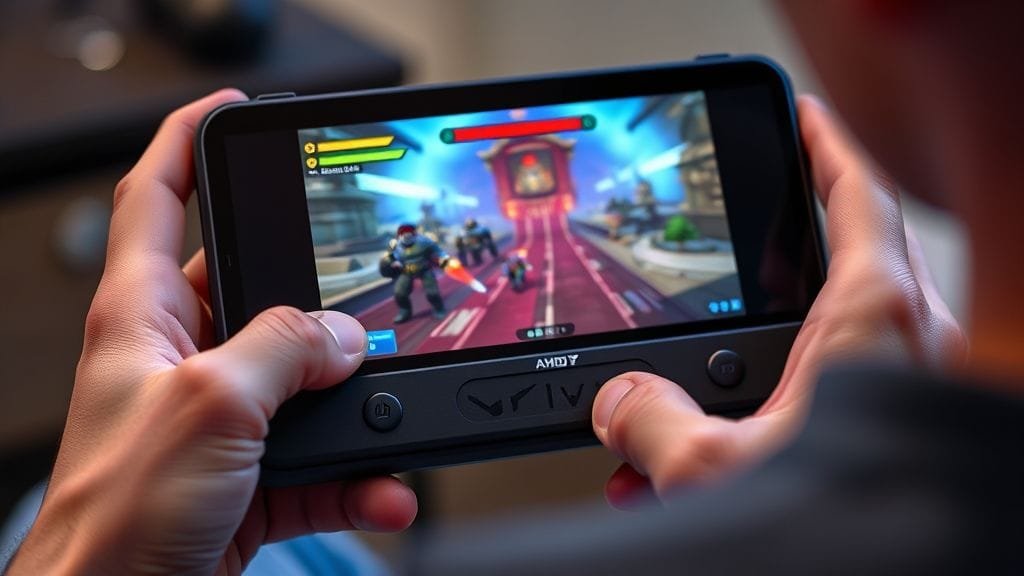
Imagine your most demanding PC games in your backpack. Play them anywhere, anytime. Indeed, this isn’t fantasy; rather, it is present reality. We owe this to AMD handheld gaming technology advancements. Previously, for years, portable gaming meant compromises—smaller screens, simplified graphics, or limited game selections. A true revolution swept the industry. Consequently, it transformed handhelds into powerful, versatile PC-grade machines. At the heart of this transformation? Undoubtedly, AMD’s specialized processors.
Devices like the Valve Steam Deck, ASUS ROG Ally, and Lenovo Legion Go are popular. Indeed, they redefined portable gaming expectations. These are not mere upgrades; instead, they mark a fundamental shift. PC gaming now fits into your hand. Therefore, this article explores AMD’s role. It is the engine of this handheld gaming revolution. Specifically, we will delve into its core technologies. Market dominance and future promises for gamers are also covered.

The Explosive Growth of AMD Handheld Gaming Devices
The landscape of portable gaming has changed dramatically in just a few short years. For instance, the Valve Steam Deck debuted in 2022. Subsequently, since then, AMD-powered handhelds captivated millions. Moreover, they bridge the gap between consoles and powerful desktop PCs. Indeed, this wasn’t a gradual evolution but a sudden, impactful surge that continues to gain momentum.
Market Dominance and Expanding Horizons
The numbers tell a compelling story of market dominance. Specifically, between 2022 and 2024, nearly 6 million handheld units running Windows and SteamOS shipped globally. Furthermore, projections forecast this figure will climb to almost 8 million by the end of 2025. Crucially, AMD processors lead this segment by a significant margin. Consequently, the handheld gaming console market is expanding. Initially, it was valued at US$8.7 billion in 2024; however, it should reach US$17.3 billion by 2033. Indeed, this reflects a 7.9% compound annual growth rate (CAGR). This growth is more than just more devices; rather, a new gaming category is becoming mainstream, and AMD overwhelmingly powers it.

An infographic illustrating the market growth projections for handheld gaming consoles from 2024 to 2033, highlighting AMD’s commanding market share within the segment.
Why AMD Became the Go-To Processor
So, what propelled AMD into this leading position? Essentially, the answer lies in their strategic focus on Accelerated Processing Units (APUs). Whereas traditional setups use separate CPU and GPU components, AMD’s APUs integrate both onto a single chip. Indeed, this integration is paramount for portable devices. Specifically, it allows a smaller physical footprint, power consumption is reduced, and CPU and GPU communication is optimized. Clearly, this is crucial for smooth gameplay on battery power. Moreover, AMD understands unified architectures deeply; years of work honed this, thus giving AMD an advantage. Subsequently, demand for powerful handheld PCs then surged. Furthermore, they did not just adapt desktop chips; instead, they designed custom silicon that met the unique demands of AMD handheld gaming.
Inside the Engine: AMD’s Core Technologies
AMD’s handheld gaming success isn’t just integration; rather, it stems from cutting-edge architectures. Specifically, these make up their APUs. Moreover, AMD combines Zen CPU cores with powerful RDNA graphics. Consequently, they engineered chips that deliver desktop-class performance in compact and power-efficient packages.
Zen and RDNA: The Perfect Blend
AMD’s APUs leverage two distinct but perfectly harmonized architectures, namely:
- Zen CPU Architecture: This forms the “brain” of the APU, primarily handling game logic, physics, and operating system tasks. For example, Zen 2 cores are in the original Steam Deck. However, subsequent iterations like Zen 4 and the upcoming Zen 5 provide higher performance. Crucially, AMD pushes CPU performance boundaries while operating within strict power limits.
- RDNA GPU Architecture: This is the “muscle” for graphics rendering, thus bringing vivid worlds and smooth frame rates to life. Specifically, RDNA 2, RDNA 3, and RDNA 3.5 architectures provide the graphical horsepower needed for modern PC games, as well as being scaled expertly for handhelds.
Indeed, this combination is synergistic. Consequently, it allows efficient resource allocation and power management. Ultimately, this is vital for sustained performance, especially during intense gaming sessions on the go.
Pioneering Processors: From Steam Deck to Next-Gen
Furthermore, AMD’s commitment to innovation is evident in the evolution of its handheld processors:
- Valve Steam Deck (Custom AMD APU): This groundbreaking device features a bespoke 6nm AMD APU. Specifically, it combines Zen 2 CPU cores with 8 RDNA 2 Compute Units. Moreover, the APU is meticulously engineered to operate efficiently within a tight 4-15W power envelope. Ultimately, this custom design was a game-changer, thereby demonstrating the viability of portable PC gaming.
- ASUS ROG Ally & Lenovo Legion Go (AMD Ryzen Z1 & Z1 Extreme): ASUS ROG Ally and Lenovo Legion Go devices boost performance. Indeed, they feature Zen 4 CPU and RDNA 3 graphics architectures. Consequently, they offer significantly higher capabilities, thereby catering to gamers demanding more power and running the most graphically intensive titles. Furthermore, these chips show AMD’s ability to scale performance for different tiers of handheld devices.
- Next-Generation Processors (Ryzen Z2 Series & Ryzen AI Max Plus 395): However, AMD isn’t resting on its laurels. Instead, the upcoming Ryzen Z2 series will feature Zen 5 and RDNA 3.5 architectures, consequently promising greater performance and extended battery life. Additionally, the Ryzen AI Max Plus 395 is also anticipated. Specifically, it has a 16-core, 32-thread CPU and RDNA 3.5 GPU. Ultimately, this chip will redefine portable gaming performance, and it may even integrate advanced AI capabilities into gaming.
Thus, this continuous cycle of innovation ensures that AMD handheld gaming devices remain at the forefront of technological capability.

Performance, Efficiency, and Gamer Experience
However, raw power isn’t the only measure of a gaming device; rather, it’s how power creates a seamless, enjoyable player experience. In this regard, AMD’s APUs excel, as they balance high performance with power efficiency. Crucially, this is critical for portable form factors.
The Power-Efficiency Paradox Solved
Creating a powerful gaming machine that runs on a battery requires more than just cramming in strong components; indeed, it demands intelligent design and optimization. Despite this challenge, AMD’s APUs deliver impressive frame rates and visual fidelity while consuming minimal power. Specifically, this is achieved through:
- Integrated Design: The single-die APU design is integrated. Consequently, it reduces latency and energy loss that otherwise occurs between separate CPU and GPU components.
- Dynamic Power Management: AMD chips use dynamic power management. Specifically, they adjust power consumption intelligently, thereby saving battery life during less intensive moments and ramping up power when needed.
- Custom Silicon Expertise: AMD creates custom chips for partners like Steam Deck. This, therefore, shows a deep understanding of tailoring hardware for optimal performance within tight thermal and power constraints.
Ultimately, this ensures that each handheld gets a processor perfectly suited for its intended use.
Boosting Your Frames: Software Enhancements
Furthermore, beyond hardware, AMD invests in software. Indeed, these technologies enhance the AMD handheld gaming experience:
- AMD FidelityFX Super Resolution (FSR): FSR is an open-source upscaling technology. Essentially, it renders games at a lower internal resolution, and then it intelligently upscales them. Crucially, visual impact is often minimal. Consequently, the result is dramatically higher frame rates while image quality sees minimal hit, thus making demanding games playable on handhelds.
- Radeon Super Resolution (RSR): Similarly, RSR is similar to FSR. However, it works at the driver level, meaning it applies to thousands of games without individual game integration being required. Therefore, it provides a quick and easy way to boost performance across your entire game library.
- AMD Fluid Motion Frames (AFMF): AFMF is a frame generation technology. Specifically, it inserts interpolated frames between rendered frames. Consequently, this boosts perceived frame rates and smooths out gameplay. This, in turn, benefits games, making them feel more fluid. Furthermore, this is vital on smaller screens, especially where every frame counts.
Ultimately, these software innovations are game-changers. As a result, gamers enjoy higher frame rates and improved visual quality on portable devices. Thus, this directly addresses balancing performance with handheld limitations.
A Broad Ecosystem and Future Partnerships
Indeed, AMD’s influence extends beyond handhelds; in fact, it is a central pillar of modern gaming. This, therefore, solidifies its position. Moreover, this broad presence provides crucial advantages, particularly as it helps continuous development and optimizes handheld gaming solutions.
Powering the Gaming World
You might not realize it, but AMD is the unsung hero behind many of your favorite gaming experiences. For example, their custom silicon powers major home consoles like the PlayStation 5 and Xbox Series X|S. Clearly, this widespread integration is key. Specifically, AMD understands gaming-specific needs, including graphics rendering and power management, thereby ensuring sustained play. Consequently, this deep expertise directly translates into better-optimized APUs for handheld devices. Furthermore, this broad ecosystem offers a big advantage: game developers optimize titles for AMD hardware across different platforms. Therefore, when a game comes to an AMD handheld gaming device, optimization is key, as much underlying work for AMD’s architecture is often ready. Ultimately, this leads to a smoother player experience.
Strategic Alliances and Next-Gen Visions
Moreover, AMD’s partnerships signal a strong future for its handheld dominance. For instance, Microsoft, a key player in the gaming world, has confirmed a multi-year partnership with AMD. Notably, this collaboration focuses on co-engineering silicon for next-gen Xbox consoles and future gaming handhelds. Consequently, this strategic alliance suggests exciting possibilities, specifically hinting at deeper integration and optimization for Xbox Game Pass and Windows gaming, all running on portable AMD hardware. Ultimately, these partnerships keep AMD at the forefront, pushing gaming innovation and redefining what’s possible in portable form factors. Indeed, the future looks bright for portable AMD power.
Navigating the Challenges and Future Outlook
While AMD leads in handheld gaming, the market is dynamic, and challenges certainly exist. Therefore, understanding this offers a complete picture, also showing the landscape and future innovation focus.
The Rise of Competition
However, AMD’s success has not gone unnoticed. Consequently, Intel, a long-standing rival, actively works to gain market share using its own chips. For example, devices like the MSI Claw 8 AI+, featuring Intel’s Lunar Lake processors, represent a direct challenge. While early benchmarks offer suggestions that AMD-powered handhelds maintain an edge, especially at lower wattages where efficiency is key, Intel can also be competitive in specific scenarios. Ultimately, this competition is good for consumers, as it drives innovation and offers more choices in portable gaming.
Software and User Experience Nuances
Indeed, many powerful AMD handheld gaming devices, for instance ROG Ally and Legion Go, run Windows 11. This, in turn, offers access to a vast PC game library, including platforms like Steam, GOG, and Xbox Game Pass. However, Windows 11’s desktop isn’t optimized for small, touch-first screens, which can sometimes lead to navigation frustrations for users accustomed to more console-like experiences. Nevertheless, solutions are emerging. For example, some devices, like Lenovo Legion Go, offer custom launchers and also software overlays, thereby improving the handheld user experience. Conversely, SteamOS runs on some devices; it is Linux-based and designed for handhelds, like the Steam Deck, and thus offers a highly optimized, console-like experience starting from power-on. Ultimately, specialized software can enhance hardware.
The Enduring Quest for Battery Life
Balancing high-performance gaming with extended battery life is crucial; indeed, this remains the “holy grail” for handheld devices. While newer AMD APUs are optimized for efficiency, demanding AAA titles still drain batteries quickly. Consequently, this is an ongoing engineering challenge, therefore requiring innovations in chip design, battery technology, and power management software. As AMD refines its architectures, however, gamers can expect improvements in playtime, thus making long journeys more enjoyable.
Innovation and Differentiation in a Dominant Market
Although AMD chips prevail across most handhelds, thus proving their leadership, it also raises questions about hardware stagnation that could happen without robust competition. Furthermore, while AMD evolves its architectures, some devices may still feature similar designs, potentially limiting differentiation. However, AMD’s custom silicon approach, as is evident with Steam Deck, suggests unique optimizations tailored to specific OEM needs. Ultimately, this ensures innovation continues.
AMD Handheld Gaming: Charting the Course for Portable Play
The AMD handheld gaming revolution is more than a trend; rather, it attests to AMD’s strategic foresight and relentless innovation. By developing specialized APUs that meticulously balance performance, power efficiency, and advanced graphics, AMD enabled groundbreaking portable gaming devices. Consequently, it established itself as the primary engine driving a transformative shift. From the pioneering Valve Steam Deck to high-performance ASUS ROG Ally and Lenovo Legion Go, and with Zen 5 and RDNA 3.5 architectures showing future promises, AMD pushes boundaries. Although portable gaming grows in your hand and competition is emerging, along with battery optimization and software integration posing challenges, AMD’s leadership still ensures a dynamic future. Indeed, portable gaming will be powerful and engaging. Ultimately, the dream of taking your entire PC gaming library with you without significant compromise is realized for millions of gamers, as AMD continues to innovate. Therefore, what portable gaming experiences will become mainstream? Envision this for the next five years and share your thoughts in the comments below!