
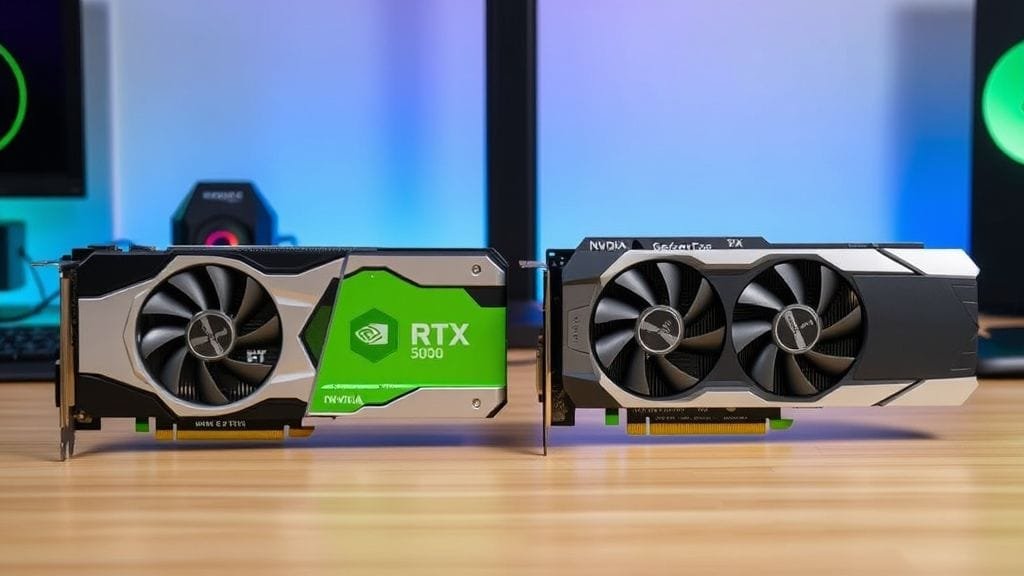
Choosing the right graphics card is crucial for any PC builder or gamer. Indeed, two notable contenders in NVIDIA’s performance-segment lineup are the GeForce RTX 3060 and the recently launched GeForce RTX 5060. Naturally, these cards represent different generations of GPU technology. Therefore, they offer distinct features, performance profiles, and value propositions. Consequently, understanding the core differences between the RTX 3060 vs 5060 is essential. In this guide, we will delve into their architectures, specifications, and the practical implications for gaming and content creation.
The NVIDIA GeForce RTX 3060, an Ampere-based GPU, debuted in early 2021. At that time, it quickly became a popular choice for 1080p and 1440p gaming due to its balanced performance and generous 12 GB VRAM capacity. However, fast forward to May 2025, and NVIDIA released its successor, the RTX 5060, built on the cutting-edge Blackwell architecture. This newer card, consequently, promises a significant leap in raw performance and efficiency. Nevertheless, it also introduces a critical change in its memory configuration. Now, let’s explore how these two GPUs stack up against each other.
Understanding the Generational Leap: RTX 3060 vs 5060 Architectures
NVIDIA’s graphics card generations bring forth substantial advancements. Specifically, these changes impact everything from performance to power efficiency. The leap from the RTX 3060 to the RTX 5060 is no exception; rather, it highlights significant progress in GPU design.
Blackwell vs. Ampere: Core Architectural Enhancements
The NVIDIA GeForce RTX 3060 relies on the Ampere architecture. This architecture, more precisely, using the GA106 processor, was manufactured on an 8 nm process. Ampere, furthermore, delivered notable improvements over its predecessor, Turing. For instance, it introduced second-generation RT Cores and third-generation Tensor Cores. These enhancements, in turn, significantly boosted ray tracing and AI-accelerated features like DLSS. Ampere, therefore, proved to be a robust foundation for high-refresh-rate gaming and creative tasks.
In contrast, the NVIDIA GeForce RTX 5060 leverages the brand-new Blackwell architecture. This architecture, specifically, utilizes the more advanced 5 nm GB206 processor. Blackwell, as a result, represents a major technological step forward. Indeed, it brings greater transistor density and enhanced processing capabilities. This refined manufacturing process and architectural design consequently translate directly into better performance per watt. They also furthermore enable higher clock speeds and more efficient core utilization. Moreover, Blackwell introduces fourth-generation RT Cores with double the ray-triangle intersect rates. It also features enhanced GPU shaders for Neural Shaders, thereby paving the way for advanced rendering techniques. You can learn more about NVIDIA’s GPU architectures on [Wikipedia](https://en.wikipedia.org/wiki/Nvidiagraphicsprocessing_units).
Key Specifications: RTX 3060 vs 5060 at a Glance
A detailed comparison of specifications, therefore, reveals the technical differences between these two GPUs. Crucially, it highlights the strengths and weaknesses of each. Here’s a breakdown:
- Architecture & Manufacturing Process:
* RTX 3060: Ampere (GA106), 8 nm process
* RTX 5060: Blackwell (GB206), 5 nm process
- CUDA Cores (Shading Units):
* RTX 3060 (12GB): 3584
* RTX 5060: 3840
- Tensor Cores:
* RTX 3060 (12GB): 112 (3rd Gen)
* RTX 5060: 120 (Newer Gen)
- RT Cores:
* RTX 3060 (12GB): 28 (2nd Gen)
* RTX 5060: 30 (4th Gen, enhanced)
- VRAM & Memory Type:
* RTX 3060 (12GB): 12 GB GDDR6
* RTX 5060: 8 GB GDDR7
- Memory Interface:
* RTX 3060 (12GB): 192-bit
* RTX 5060: 128-bit
- Effective Memory Speed:
* RTX 3060 (12GB): 15 Gbps
* RTX 5060: 28 Gbps
- Base Clock Speed:
* RTX 3060 (12GB): 1320 MHz
* RTX 5060: 2280 MHz
- Boost Clock Speed:
* RTX 3060 (12GB): Up to 1777 MHz
* RTX 5060: Up to 2497 MHz
- Total Design Power (TDP):
* RTX 3060 (12GB): 170 W
* RTX 5060: 145 W
- PCIe Interface:
* RTX 3060 (12GB): PCI-Express 4.0 x16
* RTX 5060: PCI-Express 5.0 x8
- Launch Price:
* RTX 3060 (12GB): $329
* RTX 5060: $299

NVIDIA RTX 5060: Pros and Cons for Modern Gaming
The launch of a new generation often brings excitement. This is certainly true for the RTX 5060. Overall, this card offers a blend of cutting-edge technology and improved performance. However, it also comes with certain compromises that merit careful consideration.
Advantages of the RTX 5060
The RTX 5060 presents several compelling advantages. First and foremost, it offers higher raw performance. The aggregate performance score of the RTX 5060 is significantly higher, indeed. It can be around 22-36% faster than the RTX 3060, depending on the specific variant of the 3060 being compared. This substantial uplift primarily stems from the newer Blackwell architecture. It also benefits from improved core counts and higher clock speeds. Thus, for gamers prioritizing pure frame rates in competitive titles, this performance boost is highly attractive.
Furthermore, the RTX 5060 boasts improved efficiency. Built on a more advanced 5 nm process, it consequently consumes less power. Its maximum power draw is 145 W, meaning it is more power-efficient than the RTX 3060’s 170 W. This lower TDP, therefore, means cooler operation and potentially quieter systems. It also translates into reduced energy bills over time. Moreover, another major benefit is its support for newer technologies. The RTX 5060 seamlessly integrates the latest NVIDIA innovations. These include DLSS 4 with Multi Frame Generation. This feature, for instance, can dramatically boost frame rates using AI. It also features enhanced ray tracing capabilities. The 4th-Gen RT Cores and Neural Shaders, in addition, offer better visuals and higher frame rates in ray-traced games.
The lower launch price of $299 consequently makes advanced NVIDIA technologies more accessible. This is, indeed, a crucial factor for budget-conscious gamers. Lastly, PCIe 5.0 x8 support offers a more modern interface. While PCIe 4.0 x16 provided ample bandwidth for the RTX 3060, the new standard nevertheless ensures future compatibility. This can potentially unlock greater performance in data-intensive applications down the line.
Disadvantages: The VRAM Conundrum of the RTX 5060
Despite its many advancements, the RTX 5060 has one significant drawback. This is, namely, its limited VRAM capacity of 8 GB GDDR7. This is less than the 12 GB found in the original RTX 3060. While GDDR7 memory is significantly faster (28 Gbps effective for the RTX 5060 vs. 15 Gbps for the RTX 3060), the sheer quantity of VRAM is also increasingly important. Modern games, particularly demanding AAA titles, consume vast amounts of VRAM. This is especially true at higher settings or resolutions (1440p and above).
An 8 GB VRAM buffer can quickly become a bottleneck. Consequently, it can lead to performance issues, stuttering, and even game crashes. This limitation, then, makes the RTX 5060 a questionable choice for playing many games at “High” or “Ultra” settings in 2025 and beyond. The narrower 128-bit memory interface, furthermore, despite faster GDDR7, could further compound this issue. When VRAM capacity is constrained, a wider bus helps mitigate bottlenecks by allowing more data to be transferred simultaneously. Therefore, this limitation is the most debated aspect of the RTX 5060. Indeed, many experts agree that with 12 GB of VRAM, it would be an undisputed champion in its price segment.

NVIDIA RTX 3060 (12GB): Strengths and Weaknesses
The RTX 3060, especially its 12 GB variant, has been a staple in many gaming PCs. While it’s an older card now, it nevertheless still holds significant value. Specifically, it particularly shines in specific scenarios.
Why the 12GB RTX 3060 Still Holds Value
The most compelling advantage of the NVIDIA GeForce RTX 3060 12GB is its higher VRAM capacity. The 12 GB of GDDR6 memory is, therefore, a substantial benefit. Modern games are becoming increasingly VRAM-intensive. This larger memory buffer, consequently, allows the RTX 3060 to handle these demands more gracefully. As a result, you can play games at higher texture settings and resolutions. Crucially, it does so without encountering VRAM-related performance degradation or crashes. This ultimately makes it a more “future-proof” option for those concerned about upcoming game requirements.
Furthermore, its wider 192-bit memory interface provides more bandwidth. This indeed surpasses both the 8 GB RTX 3060 variant and the new RTX 5060’s 128-bit interface. This extra bandwidth, when combined with ample VRAM, ensures smoother data flow. It also reduces potential bottlenecks. As an established and mature card, its drivers are highly optimized. Its performance characteristics are, moreover, well-understood within the gaming community. Consequently, finding reliable benchmarks and community support is easy. The RTX 3060 is also more readily available on the used market. This in turn allows savvy shoppers to find it at significantly lower prices than its original launch MSRP. This therefore makes it a highly cost-effective option for many builders.
Limitations of the RTX 3060 in 2025
Despite its VRAM advantage, the RTX 3060 does show its age. It is built on the older Ampere architecture. This utilizes an 8 nm process. This consequently means it is less efficient and offers lower raw performance compared to the Blackwell-based RTX 5060. On average, the RTX 3060 delivers fewer frames per second in direct performance benchmarks. This is furthermore particularly noticeable in newer, graphically demanding titles.
The RTX 3060 also has higher power consumption. Its TDP of 170 W, for example, makes it less power-efficient than the RTX 5060. For users building compact systems or aiming for lower electricity bills, this can be a minor disadvantage. Moreover, it does not support the latest DLSS 4 with Multi Frame Generation. While it supports DLSS 2, the advancements in AI upscaling and frame generation available on the 50-series cards are a clear generational leap it misses. Finally, it uses the older PCI-Express 4.0 x16 standard. While this is perfectly adequate for its performance tier today, the RTX 5060’s PCIe 5.0 x8 conversely offers better future-proofing and slightly higher theoretical bandwidth.

Performance Benchmarks: Raw Power vs. Real-World Gaming
When comparing GPUs, raw specifications only tell part of the story. Instead, real-world gaming performance, including frame rates and visual fidelity, provides the complete picture. The RTX 3060 vs 5060 debate therefore often boils down to this practical application.
Gaming Performance Comparison: RTX 3060 vs 5060
The RTX 5060, with its newer architecture and higher core counts, thus generally delivers a noticeable uplift in gaming performance over the RTX 3060. In many titles, particularly those that are not VRAM-bound, the RTX 5060 can achieve significantly higher frame rates. This consequently makes it a strong contender for competitive gaming at 1080p. It furthermore provides the smooth, high-refresh-rate experience that esports players crave. The Blackwell architecture’s improvements ensure, moreover, that its CUDA cores, Tensor Cores, and RT Cores are more efficient. They ultimately contribute to a better overall gaming experience.
However, the RTX 5060’s 8 GB VRAM limitation becomes evident in graphically intensive AAA titles. These games often push texture quality and resolution to their limits. When playing demanding games like Cyberpunk 2077, Alan Wake 2, or Starfield at high or ultra settings, especially at 1440p, the RTX 5060 may struggle. It could potentially experience stuttering, texture pop-in, or even outright crashes. This is precisely where the RTX 3060 12GB shines. Its larger VRAM buffer specifically allows it to load higher-resolution textures without issue. It also maintains smoother frame pacing even if its raw FPS numbers are lower than the 5060’s. This trade-off between raw processing power and VRAM capacity is ultimately the crux of the RTX 3060 vs 5060 comparison for many gamers.
Ray Tracing and DLSS: Next-Gen Features on the RTX 5060
Ray tracing and DLSS (Deep Learning Super Sampling) are two of NVIDIA’s most impactful technologies. Indeed, they enhance visual realism and boost performance. The RTX 5060, being a newer generation card, therefore features superior implementations of these technologies. Its 4th-Gen RT Cores offer significant improvements in ray tracing performance. They subsequently deliver more accurate lighting, reflections, and shadows with less performance overhead. Moreover, the RTX 5060 supports DLSS 4 with Multi Frame Generation. This advanced AI upscaling technique can intelligently generate entirely new frames. It consequently further boosts frame rates beyond what traditional DLSS can achieve. This can ultimately make ray-traced games much more playable, even on a mid-range card.
In contrast, the RTX 3060 supports DLSS 2 and second-generation RT Cores. While still effective, these are nevertheless not as advanced or efficient as the technologies in the RTX 5060. The performance uplift from DLSS 2 is substantial. However, it cannot match the frame generation capabilities of DLSS 4. Therefore, for gamers who prioritize cutting-edge visual effects and want to experience the latest in AI-powered performance enhancements, the RTX 5060 holds a distinct advantage.

Which GPU is Right for You? Making Your Decision
The choice between the NVIDIA RTX 3060 and the RTX 5060 ultimately depends on your specific needs, budget, and gaming habits. Both cards, despite their differences, offer solid performance for their respective price points. However, their distinct characteristics make them suitable for different user profiles.
Ideal Scenarios for the RTX 5060
The RTX 5060 is an excellent choice for gamers who prioritize raw frame rate performance. It is also ideal for those who play competitive esports titles like Valorant, CS2, or League of Legends at 1080p, where every frame counts. Its superior architecture, higher clock speeds, and advanced DLSS 4 technology consequently ensure smooth, high-refresh-rate gameplay. This further allows it to push past 144 FPS in many popular titles. For users who don’t mind dialing down texture settings in AAA games to stay within the 8 GB VRAM limit, the RTX 5060 nevertheless offers a compelling performance-per-dollar ratio.
Furthermore, if you are building a new system and want the latest NVIDIA features, including enhanced ray tracing and DLSS 4, the RTX 5060 is a clear winner. Its improved power efficiency also makes it attractive for compact builds or users concerned about energy consumption. Moreover, given its lower launch price, it offers accessible entry into the newest generation of NVIDIA’s GPU technology. Its PCIe 5.0 support likewise adds a layer of future-proofing. This can be beneficial for those planning long-term upgrades.
When to Consider the RTX 3060 12GB
The RTX 3060 12GB remains a strong contender, especially for specific use cases and budget constraints. It is an excellent option for gamers who play graphically intensive AAA titles and demand high texture quality. This is indeed particularly true at 1080p or even lighter 1440p gaming. Its generous 12 GB VRAM capacity consequently allows it to handle modern games’ memory requirements much better than the 8 GB RTX 5060. This can ultimately prevent stuttering and crashes in VRAM-heavy scenarios.
If you are looking for value, especially in the used market, the RTX 3060 12GB can be an absolute steal. It offers a mature platform with stable drivers and proven performance. For those who already own an RTX 3060, upgrading to an RTX 5060 might not be a clear-cut decision however, if your current usage heavily relies on VRAM. Therefore, consider your specific game library. If it includes many titles known for high VRAM usage, the 3060 might indeed still offer a more consistent experience. For creative professionals working with larger textures or complex 3D models, the additional VRAM of the RTX 3060 could also prove beneficial. Explore further details on building a balanced gaming PC by reading our guide on [/blog/choosing-a-gaming-pc/].

%20and%20one%20slightly%20older%20but%20robust%20(RTX%203060)%2C%20sitting%20side%20by%20side?width=1280&height=720&seed=28311&nologo=true&referrer=testwebapp.com)
Conclusion
The comparison between the NVIDIA GeForce RTX 3060 and the RTX 5060 highlights a classic generational trade-off. The RTX 5060, powered by the Blackwell architecture, unquestionably delivers a significant leap in raw performance and energy efficiency. Furthermore, it integrates cutting-edge features like DLSS 4 and advanced ray tracing. This consequently makes it a compelling choice for competitive gaming and those seeking the latest technological advancements, especially given its competitive $299 launch price.
However, the RTX 5060’s primary Achilles’ heel is its 8 GB of GDDR7 VRAM. This is, notably, a reduction from the 12 GB found in the original RTX 3060. This VRAM limitation consequently can severely hinder performance in demanding modern games. It can also cause stuttering or crashes when playing at high or ultra settings, especially at resolutions beyond 1080p.
Conversely, the NVIDIA RTX 3060 (12 GB variant), while an older card with lower raw performance and power efficiency, nevertheless benefits immensely from its larger 12 GB VRAM buffer. This capacity therefore allows it to handle the ever-increasing memory demands of contemporary games more gracefully. It often indeed provides a smoother experience at higher texture settings.
Ultimately, the choice hinges on your priorities. For gamers focused on raw frame rates in esports and lighter titles, or those wanting the latest features and efficiency, the RTX 5060 is an excellent upgrade. Nevertheless, for those who primarily play graphically intensive AAA games at higher settings and resolutions, or for future-proofing against rising VRAM requirements, the RTX 3060 12GB remains a remarkably strong and potentially more consistent option. This is especially true if found at a good price on the used market. The VRAM capacity thus stands out as the critical differentiating factor for long-term usability in modern gaming.