In today’s fast-paced digital world, applications rarely exist in isolation; instead, they need to communicate, sharing data and functionality seamlessly. This “conversation” between different software components occurs through Application Programming Interfaces, or APIs. Within this crucial area of communication, two architectural styles, REST and GraphQL, have become dominant. Think of an API as a waiter in a restaurant: you, the customer (client), tell the waiter (API) what you want from the kitchen (server), and the waiter brings it back to you. This vital communication powers everything from your favorite mobile app to complex enterprise systems.
Both architectural styles are powerful tools for exchanging data between clients and servers. However, REST and GraphQL approach this task in distinctly different ways. Each offers unique strengths and presents distinct challenges. Therefore, choosing the right API style is not just a technical decision; it’s a strategic one. This choice impacts your project’s flexibility, performance, and long-term maintainability. In this article, we will thoroughly explore REST and GraphQL to help you understand their core concepts, practical benefits, common challenges, and ultimately, how to make an informed choice for your next development project.
Understanding RESTful APIs: The Enduring Standard for APIs
REST, short for Representational State Transfer, is an architectural style that has formed the foundation of web API design for over two decades. Roy Fielding introduced it in 2000. Essentially, REST leverages the web’s existing infrastructure, primarily HTTP, to facilitate communication. For instance, if you’ve ever used a web address to get information, you’ve likely used a RESTful approach without even knowing it. Thus, it’s a proven methodology that many developers find straightforward to understand.
The Foundations of REST: Core Principles for API Architecture
RESTful APIs follow a set of core principles that guide their design. Understanding these principles is key to comprehending REST’s enduring popularity. They also underscore its continued importance in API development. Moreover, each principle contributes to creating a robust, scalable, and dependable system for data exchange.
Client-Server Architecture
This principle ensures a clear separation of concerns. The client, like a web browser or mobile app, manages the user interface and overall user experience. The server, meanwhile, handles data storage, security, and processing. Ultimately, this separation enhances the system’s scalability. Client and server components can evolve independently. Such flexibility also enhances portability, allowing clients to operate across diverse platforms.
Statelessness
Statelessness is a fundamental concept. Specifically, every client request to the server must contain all the information necessary to complete that request. The server does not store any client session data between requests. Imagine a conversation where each sentence is a complete thought, not relying on previous sentences. Consequently, this statelessness enables APIs to handle a high volume of users, as any server can process any request. Moreover, APIs become more resilient, as a server crash does not result in lost session data.
Cacheability
Server responses can be explicitly marked as cacheable or non-cacheable. When a response is cacheable, clients can store that data and reuse it for subsequent, similar requests. As a result, this significantly reduces server load and network traffic. This caching, in turn, provides faster response times for users. Essentially, it’s like remembering a common answer instead of asking the same question repeatedly.
Core Principles of RESTful APIs for Data Exchange
Uniform Interface
The Uniform Interface principle emphasizes consistency. REST establishes clear rules for client-server interaction with resources. This includes using standard HTTP methods (like GET, POST, PUT, DELETE) for specific actions. Additionally, it mandates identifying resources with unique URIs (Uniform Resource Identifiers). Ultimately, a uniform interface simplifies the overall design. This consistency, therefore, streamlines the learning curve and usability for new developers.
Resource-Based
In REST, every piece of information is treated as a resource. A resource could represent a user, a product, an order, or any discrete piece of data or functionality. Each resource has a unique URI, much like a website page has a unique URL. Therefore, clients then perform actions on these resources using standard HTTP methods. For example, `GET /products` would retrieve a list of products.
Layered System
This principle permits the inclusion of intermediary layers between the client and the server. These layers can include proxies, load balancers, or caches. In doing so, they can enhance security, improve performance, or distribute requests across multiple servers. The client remains unaware of these intermediary layers. Consequently, this flexibility enhances the system’s scalability and robustness.

Where REST Excels: Key Advantages Over GraphQL
REST’s adherence to these principles has provided it with a robust foundation. This has resulted in several significant benefits that account for its widespread adoption. As a result, choosing REST often means benefiting from a predictable and mature ecosystem.
Simplicity and Ease of Use
For many developers, REST is straightforward to understand and implement. Its direct mapping to HTTP methods for CRUD (Create, Read, Update, Delete) operations makes it inherently intuitive. For example, if you need to get a list of users, you simply use `GET /users`. Similarly, if you want to add a new user, you use `POST /users` with the user’s data. Ultimately, this simplicity lowers the barrier to entry, making it an excellent choice for new projects or teams.
Widespread Adoption and Mature Ecosystem
REST’s longevity in the industry has consequently fostered a vast community, extensive documentation, and a plethora of tools. Indeed, almost every programming language offers libraries and frameworks that simplify the development and consumption of RESTful APIs. Furthermore, established security protocols, such as OAuth for authentication and SSL/TLS for data encryption, are well-understood and readily available. Thus, this mature ecosystem provides confidence and streamlines troubleshooting.
Excellent Caching Support
Because REST leverages standard HTTP methods and resource-based URLs, it naturally integrates seamlessly with HTTP caching mechanisms. Consequently, web proxies and client-side browsers can cache responses from `GET` requests. This, in turn, significantly boosts performance for frequently accessed data. In essence, this built-in caching can substantially reduce server load and accelerate user experience without requiring complex custom code.
Key Benefits of RESTful API Design
Scalability
The stateless nature of RESTful APIs offers a significant advantage for scalability. Specifically, as the server does not retain any client-specific data, requests can be easily distributed across multiple servers (horizontal scaling). Therefore, any server can handle any request. This capability, moreover, simplifies the process of scaling up resources as your application expands. Ultimately, this flexibility ensures your API can seamlessly accommodate increased demand.
Standardized Error Handling
REST utilizes standard HTTP status codes (e.g., 200 OK, 404 Not Found, 500 Internal Server Error) to convey the outcome of a request. As a result, this standardization makes error handling predictable. Moreover, it is also more comprehensible for clients. For instance, developers immediately know what a `401 Unauthorized` or `400 Bad Request` means. Such clarity then accelerates the identification and resolution of errors.

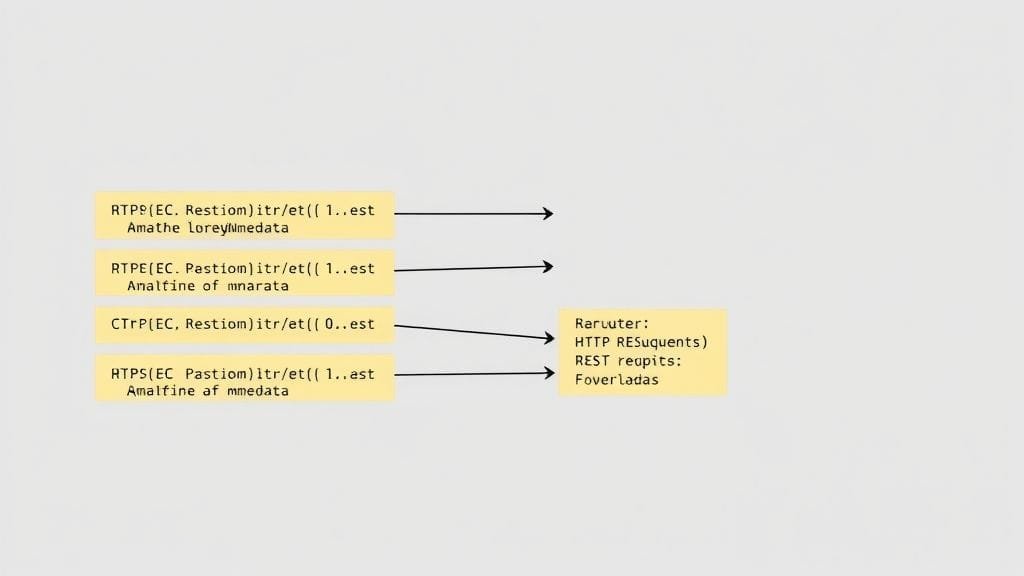
Diagram of a client making multiple HTTP requests to various REST endpoints for specific data, illustrating an pre-existing interaction pattern relevant for understanding both REST and GraphQL.
Navigating REST’s Challenges: Pitfalls to Consider with GraphQL Alternatives
Despite its numerous advantages, REST presents certain limitations. As applications grow more complex and client needs become more varied, some of REST’s design choices can lead to inefficiencies or resource wastage. Therefore, understanding these challenges is crucial for mitigating them, especially when considering REST versus GraphQL.
Over-fetching and Under-fetching
This is perhaps REST’s most prevalent issue.
- Over-fetching: Clients frequently receive more data than they actually require. For instance, an endpoint like `/users/123` might return a user’s ID, name, email, address, and profile picture URL, even if the client only needs their name and email for a specific display. Consequently, this leads to wasted bandwidth and processing power. This is particularly problematic for mobile devices operating on limited data plans.
- Under-fetching: Conversely, a client might need to make multiple requests to acquire all the necessary information for a single view. For example, to show a user’s details along with their last five orders, a client might first call `/users/123` and then `/users/123/orders` or `/orders?userId=123`. Ultimately, this “chatty” communication increases latency and the number of round trips, thereby slowing down the application.
Multiple Endpoints
As applications grow in complexity, the number of resources and, in turn, the number of separate API endpoints can proliferate rapidly. For instance, managing endpoints such as `/users`, `/products`, `/orders`, `/categories`, `/reviews`, and various sub-resources (e.g., `/products/{id}/reviews`) can pose a significant design challenge. As a result, this can lead to unwieldy API documentation and increased maintenance effort as the API expands.
Limitations of REST and How GraphQL Addresses Them
Versioning Complexity
APIs are inherently subject to change and evolution over time. Therefore, when significant modifications are necessary (e.g., altering a field name, removing an endpoint), API versioning is typically required. This prevents breaking existing client integrations. Common ways include using version numbers in the URL (e.g., `/v1/users`, `/v2/users`) or custom HTTP headers. Consequently, simultaneously managing multiple versions can be complex and resource-intensive. This approach thus necessitates managing separate codebases for distinct API versions.
Rigid Data Structures
With REST, the server dictates the structure of the data an endpoint returns. Clients have limited control over the shape of the response. Consequently, if a front-end team requires a slightly different data format, they often face a dilemma. They can either accept the superfluous data and filter it on their end. Alternatively, they can request a backend modification to create a new, specific endpoint. Ultimately, this lack of adaptability can hinder front-end development velocity.

Best Practices for Robust RESTful APIs
To maximize REST’s benefits and mitigate its drawbacks, adhering to best practices is crucial. These guidelines help create APIs that are intuitive, performant, and maintainable.
Use Nouns for Resource Paths
Maintain clear and self-descriptive URIs. For instance, use nouns for resources, such as `/users` or `/products`, not verbs, like `/getUsers` or `/createProduct`. Verbs are, instead, represented by HTTP methods.
Employ Appropriate HTTP Methods
Match the HTTP method to the intended action:
- `GET` for retrieving data.
- `POST` for creating new resources.
- `PUT` for completely replacing an existing resource.
- `PATCH` for partially updating an existing resource.
- `DELETE` for removing a resource.
Handle Errors Gracefully
Always utilize standard HTTP status codes to indicate request success or failure. Furthermore, provide clear, machine-readable error messages within the response body. These should clearly articulate the issue and suggest potential remedies.
Improving REST API Operations and Maintainability
Allow Filtering, Sorting, and Pagination
For collections of resources, enable clients to control the data they receive. Specifically, use query parameters for:
- `filtering` (e.g., `/products?category=electronics`)
- `sorting` (e.g., `/products?sort=price,desc`)
- `pagination` (e.g., `/products?page=2&limit=10`)
Maintain Good Security Practices
Always employ SSL/TLS for all API communication to safeguard data in transit. Additionally, implement robust authentication (e.g., JWT, OAuth) and authorization mechanisms. These ensure that only authorized users and applications can access specific resources.
Version APIs Thoughtfully
When breaking changes are unavoidable, implement a clear versioning strategy. URL versioning (`/v1/users`) is common and simple. Header versioning can be more flexible. Moreover, plan for the graceful deprecation of older versions, allowing clients ample time to migrate.
Ensure Consistency and Documentation
Adhere to consistent naming conventions throughout your API. Additionally, provide comprehensive and up-to-date documentation (e.g., using OpenAPI/Swagger). This empowers developers to effectively utilize your API.
Avoid Over-fetching on the Client Side
While GraphQL inherently prevents the server from over-fetching data, clients can still request more fields than they genuinely need. Therefore, educate client developers to request only the data truly essential for a specific UI component. This contributes to maintaining optimal performance.
Exploring GraphQL’s Power: A Modern Alternative to REST
GraphQL, developed by Facebook in 2012 and later open-sourced in 2015, represents a significant departure from the traditional RESTful approach. It’s not merely an API design style; rather, it functions as an API query language and a runtime for fulfilling those queries with your existing data. GraphQL empowers clients to request precisely what they need and nothing more. Consequently, this fundamental design aims to address many of the inefficiencies commonly encountered in REST. This is a key difference when comparing REST and GraphQL.
How GraphQL Reimagines API Interaction: Principles and Design Beyond REST
GraphQL introduces several core concepts that fundamentally alter client-server interaction. For instance, instead of relying on multiple, fixed endpoints, GraphQL centralizes data access. It empowers the client with unprecedented levels of control. This fundamentally differentiates its approach from conventional REST and GraphQL paradigms.
Single Endpoint
Unlike REST, which can involve numerous specific endpoints, GraphQL typically operates through a single HTTP endpoint. All client requests, regardless of their complexity, are directed to this sole URL, typically via a `POST` request. Ultimately, this single entry point streamlines API discovery and consumption for the client.
Client-Defined Queries
This is arguably GraphQL’s most distinctive feature. Clients don’t merely request a resource; rather, they submit a precise query specifying the exact data fields they require and their desired nested structure. As a result, the server then responds with only that requested data. This effectively eliminates the issues of over-fetching and under-fetching. Think of it like ordering a very specific meal with custom ingredients, rather than picking from a fixed menu.
Strongly Typed Schema
At the heart of every GraphQL API is a schema. This server-side document defines all available data types, their fields, and the relationships between them. Consequently, it serves as a contract between the client and the server. It explicitly outlines what data can be requested and how. Furthermore, it enables powerful client-side tooling (such as auto-completion and validation). Moreover, this also inherently helps prevent common errors. In essence, it’s like having a detailed map of all the data you can get from your API.
Core Concepts of GraphQL API Design
Operational Aspects of GraphQL: Resolvers and Beyond REST Architectures
Resolvers
When a client submits a GraphQL query, the server utilizes “resolvers” to fulfill it. Resolvers are functions responsible for fetching the data corresponding to a specific field in the schema. For example, if a client queries for `user { name email }`, a resolver for the `user` type would retrieve the user’s data from a database. Then, resolvers for `name` and `email` would extract those specific fields. Moreover, resolvers can source data from diverse locations – databases, other REST APIs, microservices, and so forth.
Queries, Mutations, and Subscriptions
GraphQL supports three main types of operations:
- Queries: Used for fetching data (similar to `GET` in REST). Clients can request simple fields or complex nested data.
- Mutations: Used for modifying data (akin to `POST`, `PUT`, `PATCH`, `DELETE` in REST). Notably, mutations explicitly declare their intent to alter data.
- Subscriptions: Enable real-time, bidirectional communication. Clients can subscribe to specific events and receive updates automatically when data changes on the server, ideal for live dashboards or chat applications.
The Transformative Benefits of GraphQL for Modern APIs
GraphQL’s innovative approach offers compelling benefits, particularly for modern data-intensive applications. This prompts many organizations to evaluate REST and GraphQL for their API strategies. These benefits often directly translate into improved developer workflow and an enhanced user experience.
Efficient Data Fetching
By empowering clients to specify precisely what data they require, GraphQL virtually eliminates over-fetching and under-fetching. Consequently, this results in smaller data payloads and fewer network requests. This makes it exceptionally efficient, particularly for mobile applications or environments with constrained network bandwidth. Ultimately, your application loads faster and consumes less data, leading to enhanced user satisfaction. Such efficiency in data fetching is a key strength when considering REST and GraphQL side-by-side.
Flexibility and Rapid Front-End Iteration
Front-end development teams can independently adapt their data requirements. They are not dependent on backend modifications. For example, if a UI component requires an additional field, the client simply modifies its query. Therefore, this decoupled development accelerates front-end iteration cycles and boosts team velocity. In effect, it’s like having a custom data tap where you can adjust the flow and content yourself.
Simplified API Evolution
GraphQL’s schema-first approach significantly streamlines API evolution. Specifically, new fields can be added to the schema without introducing breaking changes for existing clients. Old clients will simply ignore the new fields. Moreover, when a field becomes deprecated, it can be marked as `outdated` in the schema. This provides clients with a clear deprecation warning before its eventual removal. The entire approach facilitates simpler API evolution compared to traditional REST API versioning. Consequently, this is a key point when choosing between REST and GraphQL.
Key Advantages of GraphQL
Aggregation of Multiple Data Sources
GraphQL excels at aggregating data from disparate sources. Resolvers can, for instance, retrieve data from numerous microservices, legacy databases, or even other REST APIs. Then consolidate it all through one unified GraphQL interface. Ultimately, this simplifies complex system architectures. GraphQL provides a single “API gateway” that centralizes data retrieval and management. Therefore, clients find it significantly easier to consume. GraphQL’s ability to unify data from various sources contrasts sharply with the often fragmented data access model in RESTful designs. This capability, then, provides a key point of difference for REST and GraphQL.
Improved Developer Experience
The strongly-typed schema serves as self-documenting, living documentation. For example, tools like GraphiQL (a popular GraphQL IDE) can introspect the schema. They provide features such as auto-completion, validation, and real-time documentation directly within the developer’s workspace. Consequently, this significantly simplifies API comprehension and usage. Furthermore, it also accelerates the onboarding process for new team members.
Overcoming GraphQL’s Hurdles: Complexity and Caching Challenges vs. REST
While GraphQL offers substantial advantages, it also introduces new complexities and challenges. Developers must be prepared to address these when evaluating REST and GraphQL. Therefore, it is not a silver bullet and requires thoughtful consideration.
Increased Server-Side Complexity
Building a GraphQL API can be more complex than a simple REST API, particularly for straightforward applications. Specifically, it requires defining a comprehensive schema, encompassing all types and relationships, and then developing resolvers for every field. This initial setup can be time-consuming. Furthermore, it also demands a deeper understanding of GraphQL’s distinct architectural paradigm. In contrast, for very basic CRUD operations, REST often remains simpler to set up quickly compared to GraphQL. Ultimately, this influences architectural decisions between REST and GraphQL.
Caching Challenges
Traditional HTTP caching mechanisms, highly effective for RESTful `GET` requests, are less straightforward to apply directly to GraphQL. This is because all GraphQL requests typically traverse a single `POST` endpoint with dynamic queries. Thus, generic HTTP caches struggle to interpret and cache granular data segments. Consequently, implementing caching in GraphQL often necessitates more sophisticated client-side (e.g., Apollo Client’s normalized cache) or custom server-side caching solutions. These advanced solutions require an understanding of the nuances of GraphQL queries. This notable difference in caching strategies is a critical consideration when deciding between REST and GraphQL for your application’s performance optimization.
Operational Challenges for GraphQL: Security, Learning Curve, and Monitoring Compared to REST
Rate Limiting and Security
GraphQL’s flexibility, while advantageous, can also pose security concerns. For example, a client could construct overly complex or deeply nested queries. These could inadvertently or maliciously overwhelm server resources. Such an overload, for instance, could lead to a Denial-of-Service (DoS) attack. Therefore, implementing robust rate limiting and security measures is vital. These protective measures include limiting query depth, analyzing query complexity, and thoroughly validating inputs. Additionally, this introduces an extra layer of security design that might not be as apparent in a standard REST setup. The situation thus shows a key difference in security for REST and GraphQL.
Learning Curve
Developers accustomed to the familiar HTTP methods and resource-centric paradigm of REST will find GraphQL to be novel. It introduces new concepts (schema definition language, resolvers, mutations, subscriptions) and a distinct query language. As a result, this can present a steeper learning curve for teams adopting GraphQL for the first time. While the initial learning investment can yield substantial returns, it’s a crucial factor to consider in project planning when comparing REST and GraphQL.
Monitoring and Debuging
Monitoring and debugging GraphQL APIs can be more challenging than with REST APIs. Specifically, traditional API monitoring tools are often designed to track requests to distinct endpoints. With GraphQL’s single endpoint, however, gaining granular insights into the performance of individual fields or resolvers can be more difficult. Therefore, specialized GraphQL-aware tools are frequently necessary. These specialized tools facilitate effective performance tracking, bottleneck identification, and field-level problem resolution. This difference clearly shows how monitoring differs for REST and GraphQL.
Implementing GraphQL Effectively: Best Practices for Robust APIs
To harness GraphQL’s power while navigating its complexities, adhering to best practices is crucial. These guidelines help ensure your GraphQL API is performant, secure, and developer-friendly. This is much like the best practices for REST and GraphQL.
Design a Clear and Descriptive Schema
Your schema serves as the contract for your API. Therefore, design it meticulously. Employ clear, intuitive names for types and fields. Consider a Domain-Driven Design approach. Align your business domain directly with your GraphQL schema. Ultimately, a well-designed schema is self-documenting and facilitates client consumption.
Optimize Queries Through Techniques
Ensure your resolvers are optimized for performance. For instance, use techniques like:
- Batching: Consolidate multiple database requests or HTTP calls into a single operation, thereby reducing network overhead (e.g., using `DataLoader`).
- Caching: Implement caching strategies at the resolver level to store frequently accessed data.
- N+1 Problem Prevention: Ensure that fetching nested data does not result in an excessive number of database queries.
Ensuring GraphQL API Security and Maintainability
Implement Robust Authentication and Authorization
Secure your GraphQL API by implementing authentication (e.g., JWT, OAuth) to verify client identity. Additionally, integrate authorization checks (e.g., Role-Based Access Control) to govern what data specific users can access or modify. Ideally, every resolver should check permissions.
Apply Input Validation
Strictly validate all input arguments for mutations and queries on the server-side. This is because this protects against malicious input and maintains data integrity. While the schema’s strong typing provides a baseline, additional business rule-based validations are often necessary.
GraphQL API Best Practices for Performance
Provide Comprehensive Documentation
Even though the schema is largely self-explanatory, provide comprehensive, human-readable documentation. Specifically, this documentation should elucidate common queries, mutation examples, error handling, and any specific business logic or constraints. Tools can, furthermore, automatically generate documentation from your schema.
Consistent Naming Conventions
Adhere to consistent naming conventions for your types, fields, arguments, and enums (e.g., `camelCase` for fields, `PascalCase` for types). Ultimately, this enhances API predictability and learnability.
Avoid Over-fetching on the Client Side
While GraphQL inherently prevents the server from over-fetching data, clients can still request more fields than they genuinely need. Therefore, educate client developers to request only the data truly essential for a specific UI component. This contributes to maintaining optimal performance.
A Head-to-Head Comparison: REST vs. GraphQL
When comparing REST and GraphQL, the objective is not to determine which is inherently “better.” Rather, it involves understanding their fundamental distinctions. Furthermore, it’s about how those distinctions influence various aspects of API development. This aids in identifying the optimal application for each. Ultimately, each excels in different contexts, and a direct comparison illuminates these disparities.
Design Philosophy Differences: REST vs. GraphQL
Data Fetching: Precision vs. Predictability
- REST: Provides predictable data payloads for each endpoint. A `GET /users/123` request will consistently return the complete user object (or a predefined subset). This predictability is suitable for straightforward, well-defined data requirements. However, it leads to over-fetching (getting too much data) or under-fetching (needing many requests for all data). While REST offers predictability, GraphQL emphasizes precision. Such a contrast highlights a core difference in how REST and GraphQL approach data retrieval. Indeed, this fundamental contrast in data fetching is a primary consideration when evaluating REST and GraphQL for an application.
- GraphQL: Offers granular control over data fetching. The client specifies precisely which fields and related data it requires. This eliminates over-fetching and under-fetching with a single request. Consequently, this is highly advantageous for complex UIs that need to display diverse data from various sources.
Architecture: Multiple Endpoints vs. Single Entry Point
- REST: Employs multiple endpoints for specific resources. Each resource (e.g., users, products) has its own URL. Actions are performed using HTTP methods on these distinct URLs. This can result in a proliferation of endpoints in complex applications. Such an abundance of endpoints can complicate management and discovery, increasing the overhead.
- GraphQL: Operates via a single endpoint, to which all queries, mutations, and subscriptions are directed. As a result, this simplifies client-side configuration. In addition, GraphQL provides a centralized mechanism for interacting with the entire data graph. The complexity moves from managing endpoints to defining the schema. Therefore, the contrast between multiple endpoints for REST versus a single endpoint for GraphQL profoundly impacts API design and consumption. Grasping this fundamental distinction is crucial when deciding between REST and GraphQL for your project’s architecture.
Key Differences Between REST and GraphQL
Evolution and Versioning: Managing Change
- REST: API evolution often necessitates explicit versioning (e.g., `/v1`, `/v2`) for significant modifications. Consequently, maintaining multiple versions concurrently can be resource-intensive. This situation arises because older clients require continued support while new features are developed for newer versions.
- GraphQL: Facilitates smoother API evolution. New fields can be added to the schema without impacting existing clients. Deprecated fields can be marked as such, furthermore, providing a clear migration path. GraphQL, conversely, significantly reduces the need for rigid API versioning (e.g., `/v1`, `/v2`). It offers a distinct advantage for GraphQL over REST in managing API changes. Ultimately, the paradigms for API evolution diverge significantly between REST and GraphQL. Furthermore, GraphQL often provides a more seamless path for non-breaking changes.
Practical Development and Performance Trade-offs: REST vs. GraphQL
Caching Strategies: Leveraging HTTP vs. Custom Solutions
- REST: Benefits significantly from built-in HTTP caching mechanisms. Web proxies, CDNs, and browser caches can effectively store and serve `GET` request responses. This reduces server load and enhances performance. Indeed, this is a mature and widely understood aspect of web architecture.
- GraphQL: Caching presents greater complexity. Due to the single endpoint and dynamic nature of queries, traditional HTTP caching is less effective. Therefore, GraphQL APIs typically necessitate more advanced client-side caching solutions (e.g., normalized caches that store data by ID). Alternatively, they require custom server-side caching logic that comprehends the intricacies of GraphQL queries. As a result, such custom solutions demand greater effort in development and maintenance. This notable divergence in caching strategies is a critical consideration when deciding between REST and GraphQL for your application’s performance optimization.
Server-Side Complexity: Setup vs. Ongoing Management
- REST: For straightforward CRUD APIs, REST can be relatively quick to implement. You define your resources and corresponding HTTP handlers. Complexity often escalates with the number of endpoints and the necessity to aggregate data from multiple sources.
- GraphQL: The initial setup for GraphQL can be more intricate. It requires designing a comprehensive schema, defining types, and creating resolvers for all fields. However, once the schema is in place, adding new features or data fields might be simpler. The client can immediately access them without backend changes. In short, the complexity shifts from managing numerous endpoints to meticulous schema design and resolver optimization. Understanding the difference in server-side complexity is key to choosing between REST and GraphQL for your development team.

The Evolving Landscape: Adoption Trends for REST and GraphQL
The landscape for choosing between REST and GraphQL is continually evolving. The API ecosystem is in a state of constant flux, with emerging trends shaping their utilization. Many organizations are strategically leveraging both architectural styles. Consequently, understanding current adoption statistics and prevalent use cases for each helps inform the decision-making process when considering REST and GraphQL. Indeed, the future of API development increasingly involves the intelligent integration of REST and GraphQL.
Who’s Using REST and GraphQL? Industry Insights
While REST remains the predominant API style, GraphQL’s adoption is rapidly gaining momentum. This is primarily due to its ability to address specific modern development challenges.
According to Postman’s 2023 State of the API report, 86% of developers use REST. This underscores its enduring prevalence. However, the report also notes that 29% of developers use GraphQL, a figure indicative of substantial growth.
Looking ahead, a Gartner report predicted that by 2025, over 50% of companies will use GraphQL in their live systems. This projected figure represents a significant increase from less than 10% in 2021. Current research further corroborates this trend. It further indicates a 40% rise in GraphQL use among developers since 2023.
Leading Companies Adopting GraphQL
Leading enterprises are increasingly adopting GraphQL, often in conjunction with their existing REST APIs:
- GitHub: Famously moved its public API to GraphQL, citing benefits for complex queries and evolving client requirements.
- Shopify: Uses GraphQL for its Admin API, providing developers with enhanced control over the data they retrieve for their e-commerce stores.
- Amazon (AWS AppSync): Offers a managed GraphQL service, demonstrating its commitment to the technology.
- Pinterest: Uses GraphQL to power its mobile applications, leveraging efficient data retrieval for superior user experiences.
- Netflix: Uses GraphQL for certain internal needs, aggregating data from numerous microservices.
This data suggests that while REST maintains its stronghold, GraphQL is gaining recognition as a powerful alternative and complement. This is particularly evident for organizations addressing complex data challenges. It illustrates the evolving landscape of REST and GraphQL.
| Feature | REST (2023 Postman Report) | GraphQL (2023 Postman Report) | Gartner Prediction (by 2025) | Growth Trend (since 2023) |
|---|---|---|---|---|
| Developer Usage | 86% | 29% | N/A | +40% (GraphQL) |
| Enterprise Adoption | High (established) | <10% (2021) | >50% | Significant |
When to Choose REST: Ideal Scenarios for Your Project
REST continues to be an excellent choice for numerous projects. Its simplicity, maturity, and broad support, indeed, make it a dependable tool for a wide array of applications. This positions REST as a viable option when comparing REST and GraphQL alternatives. Therefore, consider REST when your project exhibits these characteristics:
Simpler Applications with CRUD Operations
For applications primarily performing straightforward CRUD (Create, Read, Update, Delete) operations on resources, REST’s direct mapping to HTTP methods is often the simplest and most effective approach. This is particularly true when evaluating REST and GraphQL for less complex requirements. Therefore, it represents an optimal fit.
Microservices Architectures with Clear Resource Boundaries
If your system comprises numerous discrete microservices, each managing specific resources (e.g., a “users” service, a “products” service), REST can be highly effective. Specifically, each microservice can expose its own REST API. Clients then interact with these distinct APIs for targeted data. This provides a clear architectural pattern for REST and GraphQL in distributed systems.
When to Choose REST for Your Project
Effective Caching is Critical
When an application frequently requests static or infrequently changing data, REST’s natural synergy with HTTP caching offers significant performance advantages. For instance, public APIs serving frequently accessed, immutable or partially immutable content are ideal candidates. This highlights a fundamental distinction between REST and GraphQL.
Public APIs Needing Broad Accessibility
REST’s widespread adoption makes it a dependable choice for public APIs requiring broad accessibility across diverse clients and platforms. This is especially true since many clients may have simpler integration requirements or utilize legacy tooling. This makes REST a strong choice when choosing between REST and GraphQL.
New Teams or Simpler Learning Curves
For development teams new to API design, REST often provides the most accessible starting point. This is largely attributable to its shallower learning curve. Moreover, it boasts abundant resources and extensive community support. Consequently, this makes it an ideal precursor before exploring alternatives like GraphQL.
When to Opt for GraphQL: Complex and Dynamic API Needs
GraphQL truly shines when confronted with intricate data relationships, diverse client requirements, and the imperative for highly efficient data retrieval. Therefore, if your project exhibits these characteristics, GraphQL might be the superior choice. This highlights its strengths when comparing REST and GraphQL.
Prioritizing Client Needs and Data Efficiency
Dynamic, Client-Heavy Applications (Especially Mobile)
Mobile applications often require highly specific and efficient data retrieval. This is attributable to constrained network bandwidth and dynamic UI requirements. Consequently, GraphQL enables mobile clients to fetch precisely what they need for a particular screen. This reduces data transfer and enhances speed, leading to a more responsive user experience. This is a pivotal consideration when deciding between REST and GraphQL for mobile development.
Complex Data Relationships and Nested Data
When your application involves a rich, interconnected network of data (e.g., a user has posts, posts have comments, comments have authors), GraphQL’s ability to query deeply nested data in a single request is exceptionally beneficial. Ultimately, it simplifies the client-side logic required to assemble this data. This makes GraphQL highly effective in scenarios where REST might necessitate multiple requests.
Leveraging GraphQL for Architectural Advantages
Multiple Client Requirements
When diverse front-end clients (such as web, iOS, Android, or internal tools) require distinct subsets of data from the same backend, GraphQL provides an adaptable solution. It empowers each client to specify its unique data requirements. This flexibility, in turn, obviates the need for specialized backend endpoints for every variation. Furthermore, this represents a significant differentiation between REST and GraphQL in supporting varied client demands.
When Consolidating Multiple Microservices
For complex enterprise systems composed of multiple microservices or even legacy data sources, GraphQL can serve as an API gateway. In this capacity, it provides a single, unified interface. Moreover, it aggregates data from these disparate backends. This capability, therefore, presents a unique approach to data consolidation. Overall, this constitutes a primary strength of GraphQL when considering REST and GraphQL architectures for microservices.
Front-End Agility
Front-end teams frequently require agility and rapid UI iteration. As such, with GraphQL, they can modify their data requests without dependence on backend alterations. This significantly accelerates development cycles. This represents a key differentiator when comparing REST and GraphQL for front-end velocity.
The Future is Hybrid: Blending REST and GraphQL
The discourse surrounding REST versus GraphQL often frames it as an “either/or” proposition. However, in the practical realm of software development, this often proves to be an oversimplification. Many practitioners discover a synergistic balance between REST and GraphQL. Many organizations, especially large enterprises with legacy systems, are discovering that a blended approach. This blended approach leverages the respective strengths of REST and GraphQL. It offers the most practical and robust solution. Indeed, the future of API development increasingly involves the intelligent integration of REST and GraphQL.
Why a Hybrid Approach to REST and GraphQL Makes Sense
A hybrid strategy acknowledges that no single API design style is universally optimal. Therefore, by strategically deploying REST and GraphQL, you can optimize different components of your system for specific requirements. This underscores the value of a balanced approach to REST and GraphQL.
Leveraging Existing REST API Investments with GraphQL
Most organizations have already invested substantial effort and capital into RESTful APIs. Consequently, it is often neither practical nor necessary to rewrite everything in GraphQL. A hybrid approach allows for the incremental adoption of GraphQL for new features or specific client requirements. While retaining your stable REST APIs. This illustrates how REST and GraphQL can be leveraged in practice.
Strategic Advantages for REST and GraphQL Adoption
Optimizing for Specific Use Cases with REST and GraphQL
Certain components of your application might benefit more significantly from REST (e.g., simple, public resources that are readily cacheable). Other components are ideally suited for GraphQL (e.g., complex dashboards, mobile applications requiring adaptable data). Thus, this demonstrates the flexibility afforded by choosing between REST and GraphQL.
Gradual Adoption of GraphQL Alongside REST
Adopting a new technology like GraphQL entails an initial learning curve and potential complexities. However, a hybrid approach enables teams to incrementally integrate GraphQL into their system. This helps mitigate risks and foster expertise over time. Also, it avoids a complete, disruptive overhaul. Ultimately, this method is often more pragmatic than a swift, wholesale transition.
Unified Data Access for Clients Using REST and GraphQL
Even with a hybrid backend, you can present a unified client experience. For instance, a single client application might leverage both REST and GraphQL to optimize data access.
Strategies for Coexistence: Practical Implementations of REST and GraphQL
Implementing a hybrid strategy requires thoughtful consideration. It revolves around identifying where each API style provides the greatest benefit. Therefore, here are some practical ways to make REST and GraphQL work together:
REST for Public-Facing APIs, GraphQL for Internal or Specific Clients
Many organizations successfully employ REST for their broad, public-facing APIs. Here, discoverability, simplicity, and HTTP caching are paramount. Conversely, they might opt for GraphQL for internal dashboards, mobile applications, or partner integrations. In these cases, dynamic data retrieval and flexibility are prioritized. Such an approach effectively balances the strengths of REST and GraphQL.
GraphQL as a “BFF” (Backend for Frontend)
A prevalent strategy involves using GraphQL as a “Backend for Frontend” (BFF). In this model, existing REST APIs continue to power individual microservices or legacy systems. A GraphQL layer then acts as an aggregation layer on top of these REST APIs. Ultimately, front-end clients query the GraphQL API. Consequently, it orchestrates data retrieval and returns a precisely shaped response. Furthermore, this abstracts away the complexity of multiple REST calls from the client. Thus, it offers a sophisticated method for integrating REST and GraphQL within a single architecture.
REST for Simple CRUD, GraphQL for Complex Queries
One might utilize REST for straightforward resource-oriented tasks (e.g., creating a new user, retrieving a single product by ID). However, for more complex data retrieval, GraphQL would be the appropriate tool. This is suitable for requirements involving fetching data from multiple related resources or highly dynamic data needs. This illustrates a practical division of labor between REST and GraphQL.
Practical Ways to Combine REST and GraphQL
Phased Migration from REST to GraphQL
If your long-term objective is a greater adoption of GraphQL, a phased migration can be implemented. Specifically, commence by building all new features with GraphQL. Allow existing features to remain on REST. Eventually, however, you can selectively migrate older REST endpoints to GraphQL as required. Alternatively, you can simply let them coexist indefinitely. This strategy aids in maintaining the equilibrium between REST and GraphQL.
The “best” API style is rarely universal; instead, it is entirely contingent on your project’s specific requirements, your team’s expertise, and your long-term maintenance objectives. This is true when choosing between REST and GraphQL. While GraphQL provides potent solutions to many modern API challenges, REST’s enduring simplicity and maturity ensure its continued relevance. Ultimately, the prevailing trend indicates that API development will continue to embrace diverse solutions. Consequently, GraphQL will often augment, rather than entirely supplant, REST. Such an approach illustrates a nuanced future for REST and GraphQL.
The Journey Ahead: Choosing Your API Path with REST and GraphQL
As we’ve explored, both REST and GraphQL represent robust architectural styles for building APIs. Each embodies a distinct philosophy and a unique set of advantages and disadvantages. REST, with its mature ecosystem, simplicity for CRUD operations, and strong caching support, remains a dependable choice for many traditional applications and microservices. Indeed, it is the robust, reliable tool that has powered much of the web for decades.
Strategic Considerations for Your REST and GraphQL Project
The decision is not about declaring one definitively superior to the other. Rather, it is about making an informed choice. Moreover, it involves understanding your project’s precise requirements, your team’s proficiencies, and your architectural objectives. Do you require the predictability and extensive tooling of REST for a well-defined public API? Conversely, do you necessitate the flexibility and efficiency of GraphQL for a rapidly evolving client application that aggregates data from diverse sources? These questions guide the choice between REST and GraphQL. Ultimately, an increasing trend suggests that the optimal answer might not be one or the other, but rather a strategic blend of both, intelligently leveraging their respective strengths within a unified design that incorporates both REST and GraphQL.
As you embark on your next API project, remember the overarching objective. It is to construct a robust, efficient, and maintainable system that effectively serves your users. Therefore, carefully weigh the advantages and disadvantages. Consider the long-term implications of adopting REST and GraphQL. Choose the architectural path that best aligns with your strategic vision.

What factors will be most critical for your next API decision: simplicity, data efficiency, or architectural flexibility? Share your thoughts below!