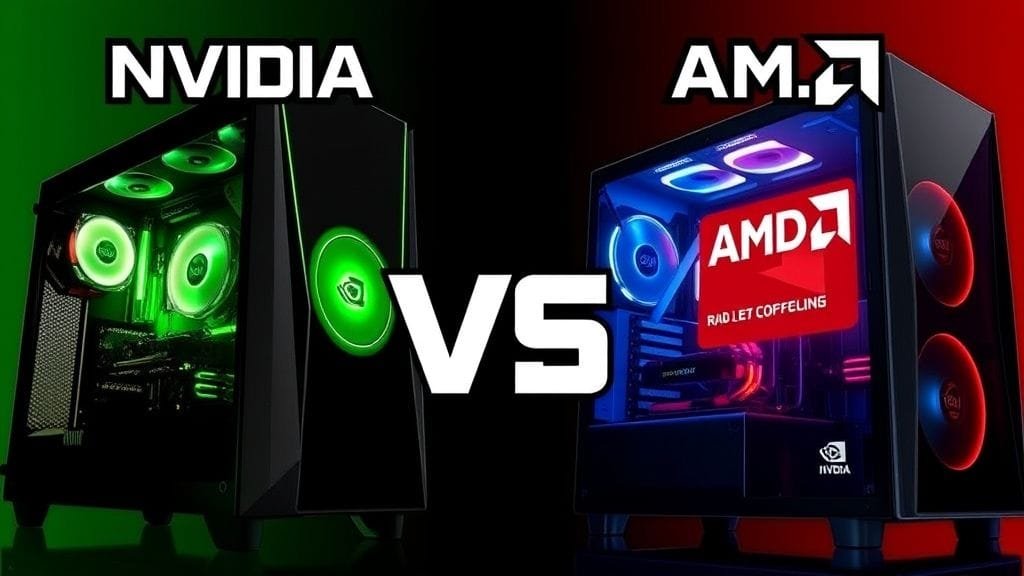
The rivalry between Nvidia and AMD has greatly changed modern computing. For many years, these two big chip makers have fiercely competed. They mostly fought in the graphics processing unit (GPU) market. But now, their fight also includes central processing units (CPUs) and the fast-growing area of AI chips. This strong competition drives new ideas. It keeps pushing technology forward and helps people and businesses everywhere.
Think of it like a big chess game. It plays out around the world with chips and software. Every move and every new product launch is a planned answer to the other company. This creates a lively place where only the most inventive companies do well. This article will look at different parts of this rivalry. We will explore their plans, new technologies, and how well they stand in the market.
A Legacy of Innovation: The Core of the Nvidia vs AMD Rivalry
The fight between Nvidia and AMD is not just about who sells more. It shows how much they keep creating new things. From the start, both companies have worked hard to make computers faster, better, and look amazing. This effort led to big changes we now use every day. These include real 3D graphics and strong parallel processing for hard science jobs.
Diving into the Battlegrounds: Where Nvidia and AMD Compete
Their rivalry is not in just one place. Instead, it covers many key market areas. Each area needs its own plans and strong tech. Knowing about these areas helps us understand how deep the Nvidia vs AMD rivalry runs.
Gaming: The High-Stakes Arena
For many buyers, the gaming world truly shows the Nvidia vs AMD rivalry. Both companies sell strong GPUs. These chips show the toughest games with amazing graphics. Nvidia’s GeForce RTX series and AMD’s Radeon RX series are the main products here.

- Nvidia’s Approach: Nvidia often aims for the expensive, top-tier market. They focus on giving the best performance and creating new tech. This is true for things like ray tracing. If you want the very highest frame rates and the best looks, Nvidia’s top cards often win.
- AMD’s Strategy: On the other hand, AMD competes well everywhere. But it often focuses on lower prices and good value. They often give great performance for the money, especially in the middle price range. This makes AMD a good choice for gamers who want strong performance without spending too much.
Professional Visualization: Powering Creation
Outside of games, both companies also help professionals. Nvidia’s Quadro and AMD’s Radeon Pro chips are made for tough professional visual work. This includes computer design (CAD), 3D animation, video editing, and making virtual reality. These cards give strong performance, better stability, and special features for work computers.
Data Centers and AI: The Future Battleground
The most important future battle is likely in data centers and Artificial Intelligence (AI). Here, the Nvidia vs AMD rivalry becomes hugely important. AI and deep learning programs need huge computing power. This makes special AI chips a must-have.
Right now, Nvidia leads with its Tesla and A100/H100/Blackwell GPUs. Many people around the world use these for AI and deep learning work. A big reason for Nvidia’s success is its strong CUDA platform. This has become the main tool for AI work in the industry. At the same time, AMD is quickly catching up. They offer strong choices with their EPYC processors and Radeon Instinct GPUs. An example is the powerful Instinct MI300X. AMD uses its open-source ROCm platform. This gives strong solutions for data center and AI programs. Experts generally expect AMD to become the clear second-place player in data center GPUs. They will follow Nvidia’s lead.
The Technological Arms Race: Features and Architectures
The core of the Nvidia vs AMD rivalry is their constant new tech. Both companies spend a lot on research and development. They do this to bring new designs, features, and better performance to buyers.
Core Architectures and Design Philosophy
At a basic level, their GPUs use different design ideas:
- Nvidia’s Architectures: Nvidia’s designs, like Ada Lovelace (in the RTX 40 series) and the coming Blackwell for AI, aim to get the most raw computing power. They aim for strong performance and efficiency in hard math.
- AMD’s RDNA: AMD’s RDNA (Radeon DNA) design is now in its third version (RDNA 3). RDNA 4 is also coming. It focuses on better performance per watt and using less power. This method often gives good performance in a balanced way.
Ray Tracing: Illuminating the Digital World
Ray tracing is a way to draw graphics. It acts like real light, making pictures look very lifelike.
- Nvidia’s Lead: Nvidia generally stays ahead in ray tracing performance. This is mostly because of their special RT (Ray Tracing) cores. These cores are made just for these tough math jobs. Gamers who want the best-looking graphics often choose Nvidia. They get better ray tracing experiences.
- AMD’s Progress: AMD has made big steps forward in its ray tracing power. But its performance can still drop a lot in the toughest games with heavy ray tracing. This is true when compared to what Nvidia offers.
https://www.youtube.com/watch?v=N9t5fMfzRM4
Upscaling Technologies: Boosting Frame Rates
To make things run better, both companies offer smart upscaling tech. These tools draw a game at a lower picture quality. Then they smartly boost it to a higher quality. This raises frame rates while trying to keep the picture looking good.
- Nvidia DLSS: Nvidia’s Deep Learning Super Sampling (DLSS) uses AI to do its upscaling. DLSS 3 is a newer version. It includes Frame Generation, which smartly makes new frames. This further boosts frame rates. But this feature only works on newer RTX 40-series GPUs. People often praise DLSS for stable images and how it handles small details better.
- AMD FSR: AMD offers FidelityFX Super Resolution (FSR) in return. This is an open-source choice. It works with more GPUs, including older Nvidia and even Intel cards. FSR keeps getting better with each new version. But most people think DLSS gives a slightly clearer picture.
Software Ecosystems: The Enduring Moat
Nvidia has a big edge, especially in AI. This is its CUDA platform. This strong software system has built a ‘software moat.’ It made a common and well-used place for AI and machine learning work.
AMD’s ROCm platform is its open-source choice. It is becoming more popular and works well for many jobs. But it still needs to beat CUDA’s strong hold and large number of users. The availability of tools, libraries, and community help often affects hardware choices in professional jobs.

Power Efficiency: Balancing Performance and Consumption
In the past, Nvidia often used a bit less power, especially for its top cards. This meant more power for less energy used. But AMD has made big improvements with its RDNA designs. Newer Radeon cards now use about the same amount of power. So, the choice is less about power and more about other features.
Pricing and Value: The Consumer’s Dilemma
When buying, the Nvidia vs AMD rivalry often comes down to price and what you feel is worth it.
- AMD’s Value Proposition: AMD often gives more performance for your money. This is true especially in the mid-range GPU market and at certain prices. This makes them a good choice for buyers on a budget who want strong gaming power.
- Nvidia’s Premium Tier: Nvidia, on the other hand, usually costs more. This is especially true for its best graphics cards. These cards often give top performance and special features. These include better DLSS versions. This makes their higher price worth it for some users.
In the end, the “best” value depends on what you care about most. Do you want the fastest frame rates no matter the cost? Or do you want the most for your money, balancing power with features and your budget?
Market Dynamics: Who Holds the Lead?
Recent market numbers show how active the Nvidia vs AMD rivalry is.
Discrete GPU Market Share
Let’s look at the overall market for separate GPUs. This includes cards sold for desktops and laptops.
| Company | Q1 2025 Market Share (Desktop Discrete GPU) | Key Strengths/Notes |
|---|---|---|
| Nvidia | ~92% | Dominant in high-end, strong ray tracing, CUDA ecosystem. |
| AMD | ~8% | Value-oriented, strong mid-range, improving power efficiency. |
| Intel | ~0-1% | Newer entrant, growing presence with Arc series. |
Source: Jon Peddie Research (Q1 2025 estimates)
This data shows Nvidia’s big lead in the market for separate GPUs. AMD’s share went down. This was partly because they had trouble guessing how many GPUs people would want. Also, AMD had to carefully split its valuable TSMC (Taiwan Semiconductor Manufacturing Company) factory space. It needed to share it between its popular Zen CPUs and its Radeon GPUs.

AI Processors Market Share
In the fast-growing AI chip market, Nvidia’s lead is even clearer. The company now has over 80% of the market. This shows how early it invested in AI hardware and its strong CUDA software.
Analyst Insights and the Future of the Rivalry
Industry experts share helpful views on the Nvidia vs AMD rivalry. They also talk about what the future might bring. Their views often show the complex mix of tech, market trends, and smart choices.
Nvidia’s Unwavering Dominance in AI
Experts are very hopeful about Nvidia’s future in AI. They point to several reasons:
- Market Leadership: Nvidia was the first to act. It remains the clear leader in AI hardware.
- CUDA’s Strength: The CUDA software platform acts as a strong wall. This makes it hard for rivals to copy Nvidia’s combined hardware and software edge.
- Explosive Growth: Nvidia’s expected income growth is huge. This is almost totally due to the massive demand for its AI GPUs in data centers. For fiscal year 2024, growth was set at 126% to $58.1 billion. Another 91% growth is expected in fiscal 2025, hitting about $116 billion. This growth clearly shows their lead in the AI market.
AMD’s Strategic Play for Market Expansion
AMD’s plan has many parts. It means selling strong products at good prices. They especially use their unique position as a maker of both CPUs and GPUs. Experts are more and more hopeful about AMD’s chance to gain market share in two main areas:
- Server CPUs: Against Intel, AMD’s EPYC processors are very strong. They are taking a big part of the profitable server market.
- Data Center GPUs: As said before, AMD is set to be the clear second player in data center GPUs. They offer a real choice to Nvidia’s top products.
Intel’s Role: A New Contender
Intel is a huge chip company with many resources. It has also joined the separate GPU market with its Arc series. Intel is still a new player. But it could challenge both Nvidia and AMD in the long run. Also, Nvidia and Intel recently teamed up. They will create special data center and PC products. Experts see this as a ‘small negative’ for AMD. This partnership could bring better x86 CPUs from Intel. It could also lead to better CPU-GPU setups that might help Nvidia’s system.
Challenges and Opportunities for AMD
Even with its smart steps forward, AMD faces big challenges in the Nvidia vs AMD rivalry:
- Market Share Struggles: As the Q1 2025 GPU data shows, AMD’s desktop GPU market share faced problems.
- Production Scaling: AMD must increase its production to meet the huge demand for its products. This is especially true in the data center field. Balancing its supply chain and getting enough space from TSMC are key challenges.
- CUDA’s Software Moat: Nvidia’s strong CUDA system is still a tough challenge for AMD’s ROCm platform to beat.
But many chances await AMD:
- AI Landscape Evolution: The fast-changing AI world makes room for many companies. Nvidia cannot deliver enough, and demand is high. This means customers often look for other choices. AMD is in a good spot to get these customers.
- Value Proposition: AMD’s chips give strong performance at better prices. This makes them a good choice for customers. These are customers who cannot get Nvidia’s chips or want a cheaper but powerful option.
The Consumer’s Advantage
In the end, the constant Nvidia vs AMD rivalry helps you, the buyer. This strong fight makes both companies keep creating new things. They must improve performance, lower costs, and bring out new features. Without this rivalry, progress would likely slow down. Your choices would also be fewer. This ongoing battle pushes technology forward. It helps gaming, professional visuals, and the changing field of artificial intelligence.
What do you prioritize most in a GPU – raw performance, value, or specific features like ray tracing or upscaling? Share your thoughts in the comments below!