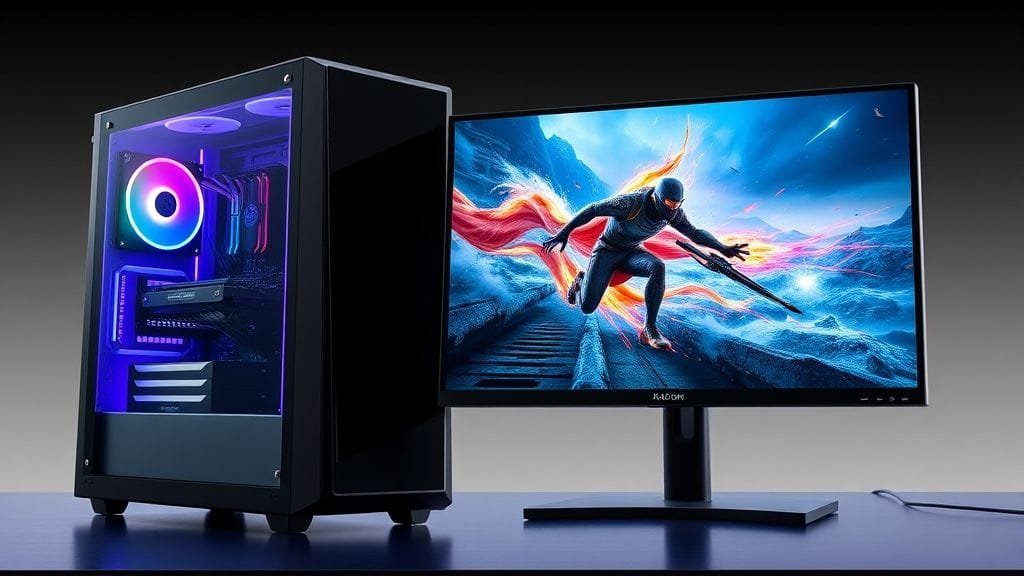
Dream of a powerful gaming PC? Or a robust workstation? Imagine one that fits neatly on your desk, perhaps tucked away. Therefore, the Mini-ITX build offers exactly this blend of high performance and elegant compactness. These small form factor (SFF) systems are not niche curiosities; instead, they are reshaping personal computing. In fact, you don’t need a hulking tower for computational prowess.

A Mini-ITX PC uses a tiny motherboard; specifically, it measures just 170mm x 170mm. VIA Technologies introduced this standard in 2001. Consequently, this tiny footprint offers incredible versatility, thus appealing to many users. They, for instance, prioritize aesthetics, portability, and space efficiency. Furthermore, significant performance sacrifices are not required. Explore the captivating world of these small powerhouses with us. Is a Mini-ITX build your next ultimate computing solution?
Why Choose a Mini-ITX Build? The Allure of Compact Power
Small form factor PCs have undeniable charm; particularly, this is true for a Mini-ITX build. Indeed, it comes from clever engineering and lifestyle advantages. Moreover, it’s more than just fitting into tight spaces; rather, it reimagines what a powerful computer can be. Consequently, this market segment is growing rapidly, specifically reflecting a desire for discrete, integrated technology.
Space-Saving Design and Aesthetics
A Mini-ITX build offers immediate benefits; primarily, it has an incredibly compact size and sleek design. Imagine a PC that doesn’t dominate your workspace, but rather complements it. For example, these systems are perfect for small apartments, minimalist desks, or integrated into living room entertainment centers. The reduced footprint, moreover, makes them less intrusive and often more aesthetically pleasing than their larger ATX counterparts. Furthermore, modern Mini-ITX cases use premium materials and thoughtful designs; thus, they transform your PC from a bulky box into, instead, a statement piece.
Unmatched Portability for Modern Lifestyles
Furthermore, beyond just fitting into your home, a Mini-ITX build offers exceptional portability. Do you attend LAN parties frequently? Do you move your setup between rooms? Perhaps you even travel with your computer. In such cases, a Mini-ITX build makes a night and day difference. Conversely, an ATX tower is cumbersome; however, a Mini-ITX system is significantly easier to transport. Indeed, it often fits into a backpack or small carry-on. It’s great for competitive gamers; similarly, content creators on the go also benefit. Therefore, anyone needing a portable, powerful machine will appreciate it.
Surprisingly Powerful Performance
Despite their diminutive stature, modern Mini-ITX PCs are anything but underpowered. Indeed, component miniaturization has advanced greatly. You can house top-tier graphics cards; furthermore, fast processors and ample memory fit inside. Consequently, all this goes into compact enclosures. Thus, high-performance gaming is within reach, allowing you to play at demanding resolutions. Likewise, efficient content creation is possible, and moreover, intensive applications run seamlessly. Building a robust system is satisfying, namely, one that delivers substantial power in a small footprint. Therefore, this offers a unique sense of achievement: you’re not compromising on speed; instead, you’re simply optimizing space.

Navigating the Challenges of a Mini-ITX Build
A compact powerhouse is very appealing. However, a Mini-ITX build also has hurdles. Therefore, these systems need a considered approach; specifically, it differs from traditional ATX builds. Consequently, meticulous planning and component selection are required. Understanding these challenges upfront, however, can help you prepare for a rewarding building experience.
The Price of Premium Compactness
One of the first considerations for any builder is cost. Specifically, Mini-ITX components and cases cost more; in other words, they are pricier than full-sized counterparts. Indeed, this premium reflects intricate engineering where specialized manufacturing shrinks powerful components. Consequently, these must fit into tight dimensions. For instance, you might pay more for a compact power supply; similarly, specially designed Mini-ITX motherboards also cost more. Therefore, budget planning is crucial when contemplating this type of system.
Limited Expansion Options
Expansion capabilities are significantly curtailed in a Mini-ITX build. For example, most Mini-ITX motherboards feature only one PCIe slot, effectively ruling out multi-GPU setups. Furthermore, you typically find only two RAM slots; consequently, this limits extensive memory upgrades. In contrast, larger ATX motherboards offer four or eight slots. While modern RAM capacities are impressive, however, future-proofing for extreme memory needs can be a concern. Therefore, this limitation requires wise component choices, so consider your long-term needs from the start.
Taming the Thermals: Cooling in Confined Spaces
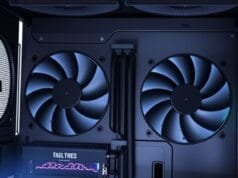
Thermal management stands as one of the most critical challenges in a Mini-ITX build. Namely, confined space causes concentrated heat. Moreover, airflow is restricted in small cases; consequently, maintaining optimal temperatures is difficult, particularly for high-TDP CPUs and GPUs. Indeed, inadequate cooling can cause performance throttling; in other words, components reduce speed to prevent overheating. Thus, this negates some of the system’s power.
To combat this, careful component selection is paramount. Invest in efficient cooling solutions. For example, consider AIO liquid cooling for CPUs; alternatively, specialized low-profile air coolers are another option. Furthermore, strategically placed, high-quality fans are also essential. However, powerful fans can increase noise levels; indeed, this is a common SFF trade-off. Enthusiasts mitigate this with thoughtful fan curves. Additionally, careful component choices also help. Learn more about cooling strategies; check our guide on PC thermal management: [/blog/optimizing-pc-cooling-solutions/].

The Intricacies of Component Compatibility and Cable Management
Building a Mini-ITX build often feels like solving a complex puzzle. Specifically, component compatibility can be a “nightmare” if you’re not meticulous. Carefully check component dimensions; for instance, verify your graphics card, CPU cooler, and power supply. Match them against the case’s specific constraints. Indeed, a millimeter can make all the difference, leading to frustrating fitment issues. Therefore, always consult your case’s specifications and user reviews for known compatibility challenges.
Furthermore, cable management in smaller enclosures is significantly more intricate. Every cable needs to be routed precisely to maximize airflow and avoid obstructing components. Consequently, modular power supplies are almost a necessity because they let you use only needed cables; thus, this greatly reduces clutter. Mastering cable management isn’t just about aesthetics; rather, it directly impacts cooling efficiency and overall system stability. Indeed, Mini-ITX builders pride themselves on this skill, as it transforms a potential mess into a clean and functional interior.
Essential Components for Your Mini-ITX Build
A successful Mini-ITX build needs careful component selection. Primarily, components must fit physically and functionally; moreover, they must work within the constrained space. Therefore, understand specific requirements for PSUs, CPUs, and GPUs; ultimately, this ensures a smooth build and optimal performance.
Power Supplies: SFX and SFX-L
Standard ATX builds use larger ATX PSUs; however, Mini-ITX builds need smaller SFX or SFX-L power supplies.
- SFX PSUs are the most compact, ideal for the smallest cases.
- Conversely, SFX-L PSUs are slightly longer than SFX; yet, they are still smaller than ATX units. Consequently, they often offer higher wattage or larger fans for quiet operation.
Furthermore, most modern SFX and SFX-L PSUs are fully modular; therefore, this helps with cable management in tight Mini-ITX chassis. Choose a reputable brand for reliability and efficiency; especially, these are critical when heat dissipation space is limited.
CPUs and GPUs: Finding the Right Fit
Contemporary Mini-ITX cases are beautiful. Indeed, they accommodate powerful CPUs; moreover, they also fit full-length, two- or three-slot graphics cards. However, this isn’t universally true for all cases, and careful consideration of clearances is paramount.
- CPUs: High-performance processors from Intel and AMD are readily available in forms compatible with Mini-ITX motherboards. Nevertheless, the main challenge lies in pairing them with an effective cooler that fits within your case’s height restrictions.
- GPUs: Many SFF cases are designed to support even the beefiest graphics cards. However, before purchasing, verify the maximum GPU length and thickness your chosen case can handle. For example, some cases support long cards; yet, they allow only a two-slot design. Conversely, others handle thicker, three-slot cards.

Performance and Power Efficiency
One common misconception about smaller PCs is that they inherently compromise on performance. However, for a Mini-ITX build, this isn’t necessarily true, but thermal considerations do play a significant role. Furthermore, understanding its power consumption characteristics is also key to a well-balanced system.
Performance: Identical Specs, Unique Challenges
A Mini-ITX build matches an ATX build in raw performance; namely, this is true for identical specifications. CPU, GPU, and RAM operate at the same speeds. Indeed, motherboard size does not change capabilities. However, confined space can affect performance; namely, thermal limitations in smaller cases are a factor. Therefore, effective management prevents issues.
If cooling is insufficient, components might “throttle” – reducing their operating frequency to prevent overheating. Thus, hardware can perform at a high level; yet, it might not always do so, especially under sustained heavy loads in poorly cooled Mini-ITX systems. Consequently, this underscores the importance of intelligent component selection and robust cooling solutions. A well-optimized SFF PC can truly rival its larger counterparts. You can learn more about performance throttling on Wikipedia: [https://en.wikipedia.org/wiki/Throttling_(computing)]
Understanding Mini-ITX Power Consumption
Mini-ITX motherboards are generally quite energy-efficient. For instance, basic boards with low-power processors might consume as little as 5-15 watts during normal operation. However, more capable systems, including the CPU and basic peripherals, typically range from 25-30 watts. Consequently, this makes them excellent choices for always-on servers or low-power HTPCs (Home Theater PCs).
However, a full gaming Mini-ITX build with a powerful GPU will have a significantly higher power draw. Specifically, such systems can consume 340 watts or more under load; therefore, they demand a robust SFX or SFX-L power supply. Select a PSU with sufficient wattage and efficiency; indeed, it must handle your specific component configuration. Ultimately, this ensures stable power and prevents instability.
The Booming Market of Small Form Factor PCs
The global market for SFF PCs is booming. Specifically, this applies particularly to Mini-ITX cases. Indeed, it shows continuous, robust expansion. Furthermore, this is not a fleeting trend; rather, it reflects a shift in consumer preferences. Moreover, technological advancements also play a role; consequently, the market growth figures paint a clear picture of this burgeoning segment.

In 2023, the small Mini-ITX case market was USD 1.91 billion. Then, it grew to USD 1.97 billion in 2024. Furthermore, projections show it will reach USD 2.5 billion by 2032. The CAGR is about 3.01% for 2024-2032. However, some sources predict a higher CAGR of 7.5%, potentially going from USD 0.26 billion in 2024 to reaching USD 0.49 billion by 2033. Therefore, this consistent growth underscores the increasing popularity and viability of the Mini-ITX build.
Driving Factors Behind Mini-ITX Growth
Several key factors are fueling the expansion of the SFF market:
- Increasing Popularity of SFF PCs: Namely, more users are realizing the benefits of compact systems without sacrificing performance.
- Rising Demand from the Gaming Industry: Similarly, gamers are increasingly seeking portable yet powerful rigs for events and smaller setups.
- Advancements in Cooling Technologies: Furthermore, improved cooling solutions are mitigating the thermal challenges inherent in compact designs.
- Enhanced Component Compatibility: Manufacturers design more SFF components; thus, this simplifies the building process.
The Mini-ITX segment holds the largest market share; specifically, this applies within small Mini-ITX cases. It generated USD 1.2 billion in 2023, and indeed, revenue is projected to reach USD 1.5 billion by 2024. Consequently, this dominance highlights the segment’s maturity and widespread adoption.
Key Trends and Future Outlook
The Mini-ITX market isn’t just growing; it’s evolving. Current trends, for example, include:
- Aesthetically Pleasing Designs: Emphasis on sleek lines, premium materials, and compact footprints that complement modern interiors.
- Tool-less Assembly: Moreover, cases are becoming easier to work with, reducing the frustration often associated with SFF builds.
- Integration of Features like RGB Lighting: Furthermore, customization options are expanding to cater to personal preferences.
Therefore, the Mini-ITX build has a bright future. As innovation continues in compact component design and also, as cooling solutions are improving, thus, this promises powerful, user-friendly SFF systems.
Is a Mini-ITX Build Right for You?
Choose between ATX and Mini-ITX build. Ultimately, it depends on your needs and preferences. Be willing to embrace unique challenges; for instance, some find Mini-ITX systems difficult to assemble. Similarly, thermal management can also be hard. Yet, many enthusiasts find the process rewarding.
Enthusiast’s Reward vs. Practical Considerations
Overcoming small chassis constraints is satisfying. Indeed, successfully packing powerful hardware brings immense satisfaction; namely, it’s a testament to clever engineering and patient building. Consequently, this “hard-won wisdom” of optimizing every cubic inch creates a unique bond with your machine.
Do you prioritize maximum expandability? For instance, this means multiple graphics cards, or numerous storage drives, or perhaps you want extensive RAM upgrades. Therefore, for the easiest build, an ATX case is more practical. However, the Mini-ITX build is for those who value compactness; furthermore, aesthetics and portability are also key. Be prepared for a slightly more involved build.
Popular Mini-ITX Cases to Consider
Ready to explore SFF? Then, several cases are highly recommended because they offer an excellent balance of size and cooling; furthermore, component compatibility is also strong. Here are a few notable examples:
- Fractal Design Terra: Known for its premium materials and minimalist design, offering good cooling in a small footprint.
- Cooler Master NR200P: A highly popular choice; namely, it offers fantastic value and versatile cooling. Moreover, component support is excellent for its compact size.
- Lian Li Q58/A4-H2O: Furthermore, these are stylish and compact cases designed for liquid cooling, providing impressive performance in tiny builds.
- Hyte Revolt 3: Moreover, this is a unique, vertically oriented case with a built-in handle, emphasizing portability and easy access.
- NZXT H1 V2: An all-in-one solution; for example, it includes a power supply and AIO cooler. Thus, this simplifies the build process significantly.
These cases represent Mini-ITX design’s forefront; indeed, they show how diverse and capable these small powerhouses are.
Your Compact Powerhouse Awaits
The Mini-ITX build stands as a compelling testament to how far personal computing has evolved. Indeed, you no longer need a bulky tower to house a high-performance system. However, careful planning is key; make smart component choices and embrace unique challenges. Then, you can build a compact, powerful, and pleasing PC; ultimately, it will perfectly fit your space and lifestyle. Furthermore, the growing market and continuous innovation in this segment only confirm its bright future.
Have you considered building a Mini-ITX PC, or do you already own one? What challenges or triumphs did you experience during your Mini-ITX build journey? Share your thoughts and insights in the comments below!