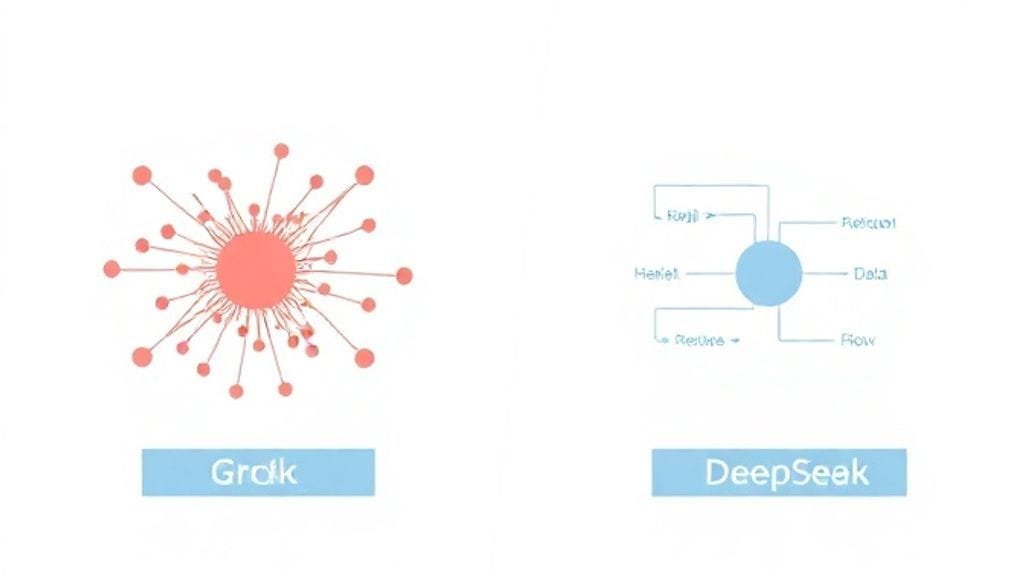
The artificial intelligence landscape, indeed, evolves rapidly. Consequently, new models constantly reshape how we use technology. Among these, Grok vs DeepSeek are two powerful new AI models. However, they have distinct philosophies, capabilities, and target audiences. Grok, from Elon Musk’s xAI, for instance, emphasizes real-time data and a unique personality. DeepSeek, from the Chinese research community, conversely, prioritizes structured reasoning and cost-effectiveness. Furthermore, it also offers open-source accessibility. Ultimately, understanding Grok vs DeepSeek is crucial. This knowledge, therefore, helps businesses and developers leverage cutting-edge AI for many applications.
This article, therefore, explores Grok’s and DeepSeek’s core features. Specifically, it covers their performance metrics and strategic implications. To that end, we offer a detailed comparative analysis. Ultimately, this helps you determine which model best aligns with your needs. Moreover, we will examine their architectural foundations. Unique functionalities, benchmark performance, and economic factors will also be explored.

Grok: The Real-Time, Witty, and X-Integrated Powerhouse
Grok, indeed, stands out as a distinctive AI model. Primarily, it is known for its direct access to real-time information. Additionally, it also has a characteristic “witty and bold personality.” XAI, Elon Musk’s AI venture, developed Grok. Consequently, it is engineered for up-to-the-minute responses. Therefore, this makes it valuable for tasks needing immediate insights. For instance, it excels with current events and trending topics. Grok’s underlying Large Language Models (LLMs) include Grok-1, Grok 3, and finally the more advanced Grok 4. Collectively, these form the backbone of its sophisticated capabilities.
Real-Time Data and X Platform Integration
Grok’s unparalleled integration with the X platform (formerly Twitter) is, thus, a compelling feature. Specifically, direct access to live information allows Grok to process trends. Moreover, it responds to unfolding events instantaneously. Consequently, Grok offers a significant advantage in certain scenarios. For example, these include rapid market responsiveness, real-time news analysis, or dynamic customer engagement. Indeed, its ability to tap into global conversations is key. Therefore, this positions it as an ideal tool for time-sensitive applications.
Distinct Personality and Interaction Modes
Grok is, primarily, designed for a unique conversational experience. Its personality is often described as sarcastic and humorous; sometimes, indeed, it is “rebellious.” Ultimately, this creates more engaging and human-like interactions for users. Thus, this distinct tone aims to make AI interactions less robotic. Instead, it makes them more dynamic. Grok also provides different interaction modes. Notably, these suit varying user preferences. For example, users can choose “Regular Mode” for factual answers. Alternatively, they can switch to “Fun Mode” for more playful responses.
Furthermore, beyond these basic modes, Grok has advanced functionalities. Specifically, these enable deeper analysis. “For instance, Deep Search” allows for in-depth information retrieval. It also synthesizes this information. “Moreover, Big Brain Mode” tackles complex computational and reasoning tasks. Grok 4 is the latest iteration; consequently, it expands these capabilities further with multimodal features. This, for example, includes Grok Vision for image analysis. A voice mode also allows for real-time conversational speech. Ultimately, this makes interactions even more intuitive and comprehensive.
Grok’s Performance in Benchmarks
Grok has, indeed, demonstrated impressive raw performance. Specifically, it excels across various academic benchmarks. Consequently, Grok 3 and 4 achieved strong results. This is true, particularly, in reasoning, mathematics, and coding. Grok 3, for instance, scored highly on rigorous examinations. These, notably, include the American Invitational Mathematics Examination (AIME). It also scored well on GPQA, a benchmark for graduate-level expert reasoning. Furthermore, it also showed competitive performance on LiveCodeBench. This was for code generation.
Independent evaluations consequently suggest Grok 3 operates at a state-of-the-art level. Indeed, it often performs comparably to OpenAI’s strongest models. Furthermore, in specific reasoning tasks, it even performs slightly better. Grok 4, especially its “Heavy” configuration, shows significant improvements. This, for example, is evident in reasoning stress-tests. Ultimately, this further solidifies its competitive standing. It performs well in coding and mathematical problem-solving. Overall, these results highlight Grok’s robust capabilities. They apply to complex analytical and generative tasks.
Accessibility and Cost Considerations
Grok’s accessibility, therefore, is managed through X Premium+ subscriptions. Consequently, this positions it as a premium AI market offering. Moreover, this access model implies higher API costs. Indeed, it is more expensive than budget-friendly or open-source alternatives. Thus, organizations or individuals considering Grok should budget for its premium pricing. This is especially true for high-volume or extensive deployments. For more insights into premium AI services, furthermore, explore content on [/blog/premium-ai-models/](https://example.com/blog/premium-ai-models/).
DeepSeek: Efficiency, Open-Source, and Reasoning Prowess
DeepSeek AI is, indeed, a formidable platform. Specifically, it specializes in natural language processing. It also handles advanced computer vision-language tasks and robust code generation. A dedicated Chinese research team developed DeepSeek. Consequently, it has gained attention for its strong commitment to open-source technology. It also offers cost-effectiveness and innovative training methods. Ultimately, its design philosophy focuses on efficiency and precision. Therefore, this offers a compelling alternative in the competitive AI landscape.

Commitment to Open-Source and Cost-Efficiency
DeepSeek’s dedication to open-source technology, therefore, offers significant advantages. Indeed, these benefit developers and businesses alike. Specifically, DeepSeek makes its core AI models openly accessible. Consequently, this fosters innovation. It also allows for greater flexibility in deployment and customization. Moreover, this approach significantly reduces entry barriers. Thus, it helps startups and individual researchers. DeepSeek’s pricing strategy is also very aggressive. In fact, it provides substantial cost savings over many premium competitors. Its primary chatbot interface is often free. Its pay-as-you-go API services are competitively priced. Ultimately, this makes it highly attractive for projects with budget constraints.
Specialized Models and Architectural Innovations
DeepSeek thus offers a diverse portfolio. Specifically, it includes specialized models tailored for various applications. These, for example, include:
- DeepSeek-VL: Designed for multimodal understanding. It processes and interprets both visual and linguistic information.
- DeepSeek-Coder: An AI coding assistant. It is optimized for generating, debugging, and refactoring code.
- DeepSeek-R1 and V3: Models engineered for efficient processing. They handle complex reasoning, mathematical problem-solving, and advanced programming tasks.
A notable architectural innovation is found in DeepSeek-V3. Specifically, it features a Mixture-of-Experts (MoE) system. Crucially, this advanced design activates only necessary sub-networks for specific queries. Consequently, this leads to highly efficient resource utilization. It also significantly reduces computational costs. Additionally, DeepSeek-R1 uses pure reinforcement learning (RL). It does so moreover without supervised fine-tuning. Ultimately, this dramatically cuts down data annotation and training expenses. Therefore, this contributes to its overall cost-effectiveness.
DeepSeek’s Performance in Key Areas
DeepSeek models, indeed, consistently show strong capabilities. Specifically, they excel in structured reasoning, coding, and mathematics. This is often highlighted in performance benchmarks. DeepSeek R1, for instance, has outperformed Grok 3. This occurred in several evaluations. These, notably, related to Python code generation and web search accuracy. It provided direct, clickable source links. It also excelled in logical reasoning tasks. Its proficiency in mathematical reasoning is particularly impressive. Consequently, it achieves high scores on benchmarks like MATH-500 and AIME. Sometimes, in fact, it even surpasses models like OpenAI’s o1 in this domain.
Furthermore, in coding benchmarks, DeepSeek’s performance is highly competitive. Indeed, it often matches or exceeds models such as Gemini 2.5 Pro. Notably, these models are praised for handling complex tasks. This, for example, includes long-form text generation. They provide accurate code suggestions. They also solve intricate problems with improved accuracy and efficiency. Ultimately, this makes DeepSeek a robust choice. It is ideal for technical and analytical applications. You can learn more about various LLM benchmarks at [/blog/llm-benchmarks/](https://example.com/llm-benchmarks/).
Key Differentiators in the Grok vs DeepSeek Comparison
Ultimately, several key differentiators emerge when evaluating Grok vs DeepSeek. Clearly, these reflect their distinct design philosophies. They also show their ideal applications. Therefore, understanding these differences is crucial. It helps make an informed decision. Specifically, this decides which AI model best suits a particular use case.
Real-time Data vs. Structured Reasoning
- Grok’s Strength: Grok’s main advantage is real-time data access. This primarily comes from the X platform. Consequently, this makes it well-suited for dynamic tasks. It is ideal for current event-driven tasks. It also excels in customer-facing content. Here, indeed, up-to-the-minute information is critical.
- DeepSeek’s Strength: DeepSeek, conversely, excels in structured reasoning. Therefore, it handles complex analytical tasks well. Its robust architecture and training methods make it a strong choice. It is good for internal analysis and academic research. It also suits technical problem-solving. These, crucially, require precision and logical coherence.
Personality, Tone, and Interaction Style
- Grok: Grok is known for its witty, sarcastic, and “rebellious” personality. Indeed, many users find this engaging and unique. It thus adds entertainment and distinct branding to interactions. Its “Fun Mode” furthermore enhances this personalized experience.
- DeepSeek: DeepSeek can generate creative responses. However, its default interaction style is more direct. It is concise and academically rigorous. The model primarily focuses on delivering accurate and efficient answers. Unlike Grok, however, it does not feature overt personality elements.
Cost and Accessibility of Grok vs DeepSeek
- DeepSeek’s Advantage: DeepSeek thus offers a more cost-effective solution. It is also open-source. Consequently, this appeals to developers and startups. Businesses prioritizing flexibility and lower infrastructure costs therefore benefit. Its open models and aggressive pricing ultimately provide substantial financial benefits.
- Grok’s Positioning: Grok is conversely positioned as a premium service. Access is typically bundled with X Premium+ subscriptions. This generally means higher overall costs. This is true, especially, for enterprise-level deployment or extensive API usage.

Performance Nuances and Specific Strengths
Both models show strong performance. This is particularly true in coding and mathematical reasoning. However, their specific strengths vary by benchmark:
- DeepSeek’s Edge: DeepSeek R1 is noted for superior accuracy. This includes, for example, logical reasoning and code generation, especially Python. It also provides verifiable answers with source links. Indeed, this is crucial for reliability. Its mathematical capabilities are consistently high.
- Grok’s Advancements: Grok 3 and 4 have shown impressive advancements. This is true both in overall reasoning and mathematics. They also handle complex problems well. This is particularly due to enhanced compute modes like “Big Brain Mode.” Grok 4’s multimodal capabilities furthermore expand its performance scope.
Ideal Use Cases for Each AI
The choice between Grok vs DeepSeek ultimately often depends on your specific problem:
- Grok’s Ideal Applications:
* High-speed market responsiveness and trend analysis.
* Customer support requiring real-time context and dynamic interaction.
* Creative writing, content generation, and social media management with a distinct, engaging tone.
* Journalism or media monitoring for live event updates.
- DeepSeek’s Ideal Applications:
* Academic research and scientific analysis requiring precise, structured reasoning.
* Robust coding assistance, including debugging, unit test generation, and complex code refactoring.
* Complex data analysis and technical problem-solving.
* Multilingual AI responses and cross-cultural communication due to its efficiency.
* Developing custom AI applications with open-source flexibility. For insights into the benefits of open-source AI, furthermore, visit [/blog/open-source-ai-benefits/](https://example.com/blog/open-source-ai-benefits/).
Making the Choice: Grok vs DeepSeek for Your Needs
The decision between Grok vs DeepSeek ultimately depends heavily on several factors. These, for example, include specific requirements, budget, and strategic priorities. Both models, however, represent significant AI advancements. Furthermore, each carves out a distinct niche. This is within the rapidly evolving digital landscape. Therefore, your choice should align with your core objectives. It should also match the nature of the tasks at hand.
When to Choose Grok
Choose Grok if your primary need involves real-time information. This is especially true from the X platform. It is also ideal if you value a conversational AI. Grok, indeed, offers a distinctive, engaging personality. Consequently, it excels in dynamic environments. Rapid response to current events is paramount; similarly, so is creative, human-like interaction. Companies seeking cutting-edge customer engagement will thus benefit. Those leveraging real-time social sentiment will also find Grok useful. Therefore, consider Grok for applications demanding immediacy and character.

When to Choose DeepSeek
DeepSeek is, thus, the preferred choice for many. These, for example, include organizations and developers. Indeed, they prioritize efficiency, structured reasoning, and cost-effectiveness. Its open-source nature provides unparalleled flexibility. It also offers control. Consequently, this makes it ideal for custom development. It integrates well into existing systems. DeepSeek performs strongly in coding and mathematical reasoning. This, coupled with aggressive pricing, makes it powerful. It is, therefore, a tool for technical teams and research institutions. Startups operating under budget constraints also benefit. DeepSeek offers a compelling proposition. This is especially if you require robust analytical capabilities, precise code generation, and economic scalability.
The Power of a Multi-Vendor AI Strategy
The choice doesn’t always have to be either/or. Instead, many organizations find significant benefits. Specifically, they adopt a multi-vendor AI strategy. This approach therefore leverages the unique strengths of both Grok vs DeepSeek. It addresses different operational needs. For instance, an enterprise might deploy DeepSeek. This would be for high-volume batch processing. It would also handle complex internal data analysis and technical development tasks. This is due to its efficiency and cost-effectiveness. Concurrently, Grok could be utilized. It would be for real-time intelligence gathering. It would also handle dynamic customer-facing applications. Content generation requiring its distinct personality and current context is yet another use.
By strategically combining these powerful AI models, businesses can indeed thrive. Ultimately, they can build a more resilient AI ecosystem. It can be versatile and high-performing. Moreover, this optimizes workflows. It also maximizes return on investment across various functions. Both Grok’s and DeepSeek’s dynamic capabilities, therefore, offer exciting opportunities. They drive innovation and efficiency in the modern digital era.