CES 2025 in Las Vegas launched the next wave of tech innovation, with the AI PC era taking center stage. Major semiconductor players like AMD, Intel, NVIDIA, and Qualcomm showcased groundbreaking CPU and GPU advancements. This CES 2025 AI PC hardware clearly redefined personal computing, ranging from powerful desktop systems to efficient mobile processors. Indeed, AI integration and performance leaps were a consistent theme, promising users intelligent, responsive, and powerful devices. This article explores the most significant CES 2025 AI PC hardware announcements, innovations that will shape our digital future.
The Dawn of the AI PC Era at CES 2025
The “AI PC” concept became a tangible reality at CES 2025, dominating almost every new hardware announcement. The widespread CES 2025 AI PC hardware confirms this major shift. Manufacturers are now embedding dedicated AI acceleration directly into their processors. This strategic change promises better performance in creative work, gaming, and daily tasks with smart assistants. For instance, devices will perform AI inference locally, reducing cloud reliance and thus improving privacy and responsiveness. Advanced CES 2025 AI PC hardware makes this possible.
Integrated NPUs, or Neural Processing Units, truly transform CES 2025 AI PC hardware. These powerful NPUs deliver tens or even hundreds of TOPS (trillions of operations per second). This specialized hardware frees the CPU and GPU from AI tasks, ensuring smoother multitasking and better power efficiency. A clear message emerged from AMD, Intel, NVIDIA, and Qualcomm offerings: personal computing is becoming smarter. These innovations will undoubtedly transform how we use devices, making systems more intuitive, powerful, and personal.
AMD’s Comprehensive Offensive: Driving CES 2025 AI PC Hardware Innovation
AMD impressed at CES 2025, cementing its leadership in desktop and mobile computing with diverse CES 2025 AI PC hardware. Their announcements covered many products, from high-performance desktop gaming chips to new AI-enabled mobile processors. AMD’s strategy clearly involves pervasive AI integration, ensuring all users benefit from intelligent capabilities. Furthermore, AMD focused on both raw power and smart efficiency. Their reveals targeted a broad market, from hardcore gamers to everyday users seeking advanced CES 2025 AI PC hardware.
Ryzen 9000X3D Series: Powering Next-Gen AI PC Components
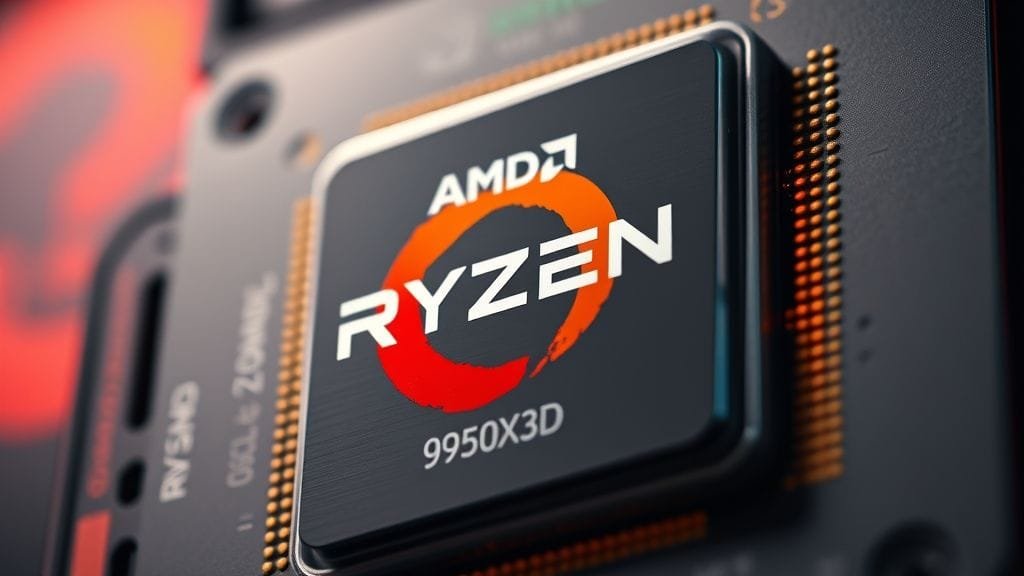
AMD expanded its Ryzen 9000-series with new X3D processors, a clear highlight for desktop enthusiasts and a key piece of CES 2025 AI PC hardware. These chips utilize AMD’s innovative 2nd generation 3D V-Cache technology, delivering unparalleled performance in specific workloads. The flagship Ryzen 9 9950X3D and its sibling, the Ryzen 9 9900X3D, are set to redefine the high-end desktop experience and establish new benchmarks for CES 2025 AI PC hardware.
The Ryzen 9 9950X3D truly shines among CES 2025 AI PC hardware. This chip features 16 cores and 32 threads, hitting a rapid 5.7GHz boost clock. However, its huge 144MB of L3 cache truly distinguishes it. This large cache, a benefit of 3D V-Cache stacking, greatly lowers latency, thus excelling in gaming and data-heavy tasks. Previously, X3D chips like the Ryzen 7 9800X3D were known mostly for gaming. Now, AMD positions the 9950X3D as a versatile powerhouse for creators and gamers, broadening its role in CES 2025 AI PC hardware. The chip operates within a 170W TDP, reflecting its strong performance.
AMD claims impressive performance gains for the 9950X3D. For example, it offers an 8% average gaming performance boost over its predecessor, the 7950X3D, across various titles. Furthermore, it delivers up to 20% faster gaming on average than Intel’s Core Ultra 9 285K. Creative workloads benefit from core count, clock speed, and cache; here, the 9950X3D performs about 10% faster than the Intel Core Ultra 9 285K. These numbers suggest a compelling option for professionals demanding gaming excellence and robust application performance from their CES 2025 AI PC hardware.
AMD Ryzen 9000 X3D: CES 2025 AI PC Hardware

The Ryzen 9 9900X3D accompanies the flagship. This option, though slightly more constrained, remains incredibly potent CES 2025 AI PC hardware. It features 12 cores, 24 threads, and a 5.5GHz boost clock. Furthermore, with 140MB of L3 cache and a 120W TDP, the 9900X3D balances performance and efficiency. It will likely appeal to users seeking X3D benefits at a lower power and price point. Both the Ryzen 9 9950X3D and 9900X3D are slated for release in March 2025, giving enthusiasts a clear timeline for their next-gen builds, which will feature cutting-edge CES 2025 AI PC hardware.
Mobilizing AI: The Expansive Ryzen AI Series for New AI Laptops 2025
AMD’s commitment to the AI PC was evident in its expanded Ryzen AI CPU portfolio. This mobile lineup forms a cornerstone of their CES 2025 AI PC hardware strategy. The multi-tiered approach introduces three series: Ryzen AI Max, Ryzen AI 300, and Ryzen 200. Each series targets different AI PC market segments, ranging from high-end creators to mainstream consumers. This granular approach ensures on-device AI benefits reach many laptop types and price points, driven by new CES 2025 AI PC hardware.
The Ryzen AI Max Series represents the pinnacle of AMD’s CES 2025 AI PC hardware. It targets high-performance laptops for professional creators and serious gamers. These processors are true powerhouses, featuring up to 16 Zen 5 CPU cores, offering incredible multi-threaded performance. Up to 40 RDNA 3.5 graphics compute units handle graphics, promising a significant boost in integrated graphics capabilities.
AMD’s Multi-Tiered Ryzen AI Mobile Processors

Crucially, the Ryzen AI Max series integrates an AMD XDNA 2 NPU. This Neural Processing Unit delivers an astonishing 50 TOPS of AI processing power. Such NPU performance makes these chips ideal for complex AI-driven tasks, for example, advanced video editing, AI-accelerated 3D rendering, and highly interactive intelligent assistants. They also support up to 128GB of unified memory, further enhancing capabilities for demanding applications. Additionally, a PRO version offers enhanced security and enterprise management features, allowing businesses to use this advanced CES 2025 AI PC hardware in corporate deployments.
The Ryzen AI 300 Series aims at everyday AI PCs for consumers and businesses, forming a key part of CES 2025 AI PC hardware. For example, the series includes models like the Ryzen AI 7 350 and Ryzen AI 5 340. These processors feature up to 8 Zen 5 CPU cores, handling daily tasks and demanding apps well. Notably, they also have a 50 TOPS NPU, delivering high AI performance, similar to the Max series. As a result, users can fully leverage advanced AI features, powering tools such as Microsoft’s Copilot+ PCs. Therefore, AMD plans to make strong on-device AI widely available, with many upcoming laptops including powerful NPUs.
Beyond the Core: Other AMD CES 2025 CPU GPU Innovations
Finally, the Ryzen 200 Series targets more affordable consumer and enterprise laptops, providing entry-level CES 2025 AI PC hardware that makes AI experiences accessible to a wider audience. These processors offer up to 8 CPU cores and RDNA 3 graphics, providing solid performance for daily computing. Although their NPU reaches 16 TOPS, this is sufficient to support introductory AI experiences and basic intelligent assistant functions. Look for systems powered by the Ryzen 200 and 200 PRO series to hit the market in Q2 2025, giving budget-conscious consumers a taste of the AI PC future.
AMD’s presence at CES extended beyond CPUs. Several other announcements hinted at a robust future for CES 2025 AI PC hardware. For example, the company introduced the “Fire Range” series for laptops, bringing acclaimed 3D V-Cache technology to mobile platforms. This innovation promises to revolutionize mobile gaming, offering desktop-class performance in a portable form factor, especially for titles benefiting from large L3 caches. Thus, it demonstrates the versatility of CES 2025 AI PC hardware.
AMD also unveiled the Ryzen Z2 series processors for the growing handheld gaming PC market. These new chips build on the success of the original Z1 series, delivering console-class gaming experiences in ultra-portable devices. This indicates AMD’s continued commitment to expanding gaming across various form factors using specialized CES 2025 AI PC hardware.
Intel’s Strategic Push: Core Ultra 200 and Next-Gen CES 2025 AI PC Hardware
AMD also hinted at its next-generation Radeon RX 9070 XT and RX 9070 GPUs for discrete graphics. These will utilize the highly anticipated RDNA 4 architecture. Specific details were scarce; however, the company promised significant improvements in ray tracing and dedicated AI acceleration. These advancements are crucial for high-end graphics, ensuring AMD’s GPUs can handle modern games and AI-driven applications. Thus, they represent a significant part of future CES 2025 AI PC hardware. Furthermore, AMD unveiled FidelityFX Super Resolution 4.0, its latest upscaling technology that enhances gaming visuals and performance across more hardware.
Mobile Dominance: Core Ultra 200 Series for Laptops
Intel, a processor giant, continues its strong pivot, focusing on AI integration and improved efficiency. This became clear with its new Core Ultra (Series 2) processors. This significant CES 2025 AI PC hardware unveiling builds on the first-gen Core Ultra chips, thus reinforcing Intel’s AI PC vision. The series delivers enhanced performance and sophisticated on-device AI for both mobile and desktop platforms alike. Intel still aims for a balanced computing approach; therefore, it integrates dedicated AI engines with powerful CPU and GPU cores in its new CES 2025 AI PC hardware.
Intel unveiled a full range of Core Ultra 200 Series mobile processors. These chips are carefully segmented for different laptop users, including the 200HX, 200H, and 200U series, serving enthusiasts, premium users, and thin-and-light laptop owners, respectively. Overall, these chips improve upon the Lunar Lake (Core Ultra 200V series), offering more processing power and better efficiency. Therefore, they are a key part of the CES 2025 AI PC hardware showcase. For instance, the Core Ultra 200HX series brings desktop-level performance, targeting high-performance gaming laptops and mobile workstations.
Desktop Evolution: Core Ultra 200S Processors
The Core Ultra 200H series powers premium laptops, featuring Intel Arc graphics, offering good visuals and light gaming. Conversely, the HX and U series utilize basic Intel Graphics, focusing on efficiency and longer battery life. Intel also showcased the Core Ultra 200V series, which set new battery life records for ultrathin laptops, reaching 20.3 hours. Moreover, these chips significantly boost AI application speeds, showing the strength of their integrated AI accelerators. Therefore, these improvements are vital for CES 2025 AI PC hardware, as battery life and AI performance are indeed key for mobile computing.
Intel also entered the desktop market, launching new 65-watt and 35-watt models for its Core Ultra 200S desktop lineup. These processors expand the CES 2025 AI PC hardware range. Additionally, they bring Core Ultra’s efficiency and AI features to regular desktops, so users get strong choices for building or upgrading systems. For example, the 20-core Core Ultra 9 285 shines, reaching a top speed of 5.6GHz. This high core count ensures great multi-threaded performance, easily handling tough tasks like heavy multitasking and content creation. Clearly, it offers powerful CES 2025 AI PC hardware.
NVIDIA’s RTX 50 Series: Dominant CES 2025 AI PC Hardware for Graphics and AI
Crucially, these desktop processors also integrate AI-specific compute engines—new P-cores (Performance Cores) and Intel AI Boost. This dedicated hardware ensures desktop users can leverage on-device AI acceleration. For example, it helps with creative apps using AI for generative design and supports smart features within operating systems. Furthermore, 65-watt and 35-watt TDP options are available, providing flexibility for system builders. It allows for more compact, energy-efficient designs without losing significant power, showcasing the diverse applications of CES 2025 AI PC hardware.
Blackwell Unleashed: GeForce RTX 50 Series GPUs
NVIDIA, famous for high-performance graphics, made a massive splash at CES 2025. They officially announced the GeForce RTX 50 series for desktop and mobile devices. This eagerly anticipated CES 2025 AI PC hardware leverages the highly anticipated Blackwell architecture, representing the cutting edge of graphics processing. The series promises unprecedented realism, speed, and AI integration for gamers and creators. Therefore, the RTX 50 series will dominate the high-end market, continuing NVIDIA’s legacy of pushing visual computing boundaries with advanced CES 2025 AI PC hardware.
The RTX 50 series launched with the high-end RTX 5080 and RTX 5090. These cards immediately elevated graphics and performance benchmarks for CES 2025 AI PC hardware. NVIDIA built these GPUs using fourth-gen RT Cores, allowing amazing real-time ray tracing, making in-game lighting and shadows look very realistic. Fifth-gen Tensor Cores also improve these capabilities. NVIDIA designed them for deep-learning tasks; importantly, these Tensor Cores drive NVIDIA’s AI strategy, powering features like DLSS and new AI tools. Thus, they shape modern CES 2025 AI PC hardware.

The Blackwell architecture is manufactured by TSMC on a custom 4N process node. This architecture promises significant improvements in performance per watt. For laptop users, NVIDIA’s Blackwell architecture introduces new Max-Q features, extending battery life by up to 40% compared to the GeForce 40 series. These innovations include Advanced Power Gating and an “ultra” low-voltage state for GDDR7 memory. Consequently, high-performance laptops remain efficient and long-lasting on the go, making for incredibly versatile CES 2025 AI PC hardware.
Enhancing the Visual Pipeline: NVIDIA’s Encoder/Decoder Advancements
The new GPUs have generated much excitement. RTX 50 series laptops will launch in March 2025, starting at $1,299. For desktop users, the RTX 5080 will cost $999. Notably, this matches its predecessor’s price despite a major generational improvement. NVIDIA CEO Jensen Huang further boosted anticipation, claiming the RTX 5070 could achieve “RTX 4090 performance” for just $549. However, this relies heavily on DLSS 4 upscaling and Multi Frame generation, rather than raw power. Still, it highlights NVIDIA’s confidence that their AI-powered technologies offer excellent value and performance among CES 2025 AI PC hardware.
Beyond raw graphics, the RTX 50 series also upgrades NVIDIA’s video encoding and decoding. These improvements are crucial for streamers, content creators, and professional editors. The new GPUs feature a ninth-gen NVENC encoder and a sixth-gen NVDEC video decoder. These enhancements further cement their role as leading CES 2025 AI PC hardware. Additionally, these updated engines offer improved efficiency and quality for video processing, reducing CPU load, allowing for smoother, higher-quality streams and faster video exports.
Qualcomm’s Ascendancy: Expanding Snapdragon X for CES 2025 AI PC Hardware
A notable advancement is the new support for 4:2:2 color format video, allowing encoding and decoding. This significantly enhances capabilities for professional videographers and editors, who often work with high-quality, color-critical footage. This feature helps them maintain color fidelity throughout their workflow. Overall, these improvements highlight NVIDIA’s holistic approach to graphics, addressing not just gaming but also the wider digital content creation and consumption ecosystem, thanks to comprehensive CES 2025 AI PC hardware.
Affordable AI PCs: The Snapdragon X Processor
Qualcomm, a mobile chipset powerhouse, solidified its aggressive push into the AI PC market during CES 2025. Its Snapdragon X series now showcases the immense potential of Arm-based chips for laptops. These chips excel in energy efficiency and integrated AI processing. Qualcomm’s strategy focuses on a compelling alternative to x86 architectures, specifically emphasizing superior battery life and dedicated AI performance. This meets the demanding requirements of next-gen AI PCs. Ultimately, its offerings stand out among CES 2025 AI PC hardware.
Qualcomm unveiled the Snapdragon X processor. This chip targets more affordable Copilot+ PCs, a strategy that brings advanced AI to more users. Indeed, it aims for a $600 price point for AI notebooks, which will feature powerful CES 2025 AI PC hardware. The Snapdragon X processor includes an 8-core CPU. For instance, it provides strong performance for daily tasks and multitasking. However, its NPU truly shines, delivering an impressive 45 TOPS of AI performance. This easily meets the NPU requirements for Copilot+ PCs. Consequently, it ensures smooth integration with Microsoft’s AI-powered Windows.

Next-Gen Performance: Snapdragon X2 Elite & X2 Elite Extreme
Qualcomm made bold performance claims for the Snapdragon X chip. It asserted up to 163% faster performance at ISO-power compared to unnamed competitors. This highlights the Arm architecture’s inherent efficiency advantages, promising exceptional battery life without compromising responsiveness. Laptops powered by the Snapdragon X chip will ship in early 2025, signaling a rapid expansion of the AI PC market at more accessible price points. This expansion is driven by new CES 2025 AI PC hardware.
These cutting-edge chips are manufactured on a 3nm process node, a testament to Qualcomm’s commitment to leading-edge fabrication. They feature a new third-generation Oryon design, delivering substantial performance improvements across the board. Qualcomm claims 39% improved per-core performance, 50% faster peak multi-threaded CPU performance, 2.3x peak GPU performance, and an impressive 78% more NPU performance compared to their predecessors.
Qualcomm introduced its second-generation Arm-based PC chips at Snapdragon Summit 2025, with further details revealed during CES discussions. These chips, including the Snapdragon X2 Elite and X2 Elite Extreme, offer a major step forward. They will compete directly with top Intel and AMD processors. Therefore, they showcase advanced CES 2025 AI PC hardware. For example, the Snapdragon X2 Elite Extreme features up to 18 cores. Qualcomm reports it is the first Arm chip to reach 5 GHz, pushing Arm’s performance limits. Furthermore, it challenges x86’s long lead in computing power, expanding hardware choices for CES 2025 AI PC hardware.
The Broader Impact: Trends and What it Means for Consumers
Furthermore, Qualcomm presented direct comparisons against x86 competitors. It asserted the X2 Elite delivers 44% more CPU performance per watt than an Intel Core Ultra 9 285H. It also offers 75% more performance per watt than AMD’s Ryzen 9 AI HX 370. These power efficiency claims are a significant selling point for mobile devices, promising powerful and incredibly long-lasting laptops. Systems featuring the Snapdragon X2 Elite will ship in the first half of 2026, marking another crucial step in Qualcomm’s ambition to redefine the PC landscape with innovative CES 2025 AI PC hardware.
CES 2025 offered more than just product showcases. It powerfully affirmed overarching industry trends. These trends will reshape personal computing for years ahead. Undeniably, AI’s ubiquity stands as the most dominant trend. The vast array of CES 2025 AI PC hardware exemplifies this. Every major chip manufacturer now integrates dedicated AI acceleration (NPUs) into their CPUs and GPUs. This shifts AI inference from the cloud to devices, bringing significant benefits. These include enhanced privacy, reduced latency, and the ability to perform complex AI tasks offline. Advanced CES 2025 AI PC hardware drives all these advantages.
Key Trends and Benefits of CES 2025 AI PC Hardware
The competitive landscape is driving unprecedented advancements, resulting in more powerful, efficient, and intelligent devices for consumers. All segments stand to benefit from the continued development of CES 2025 AI PC hardware. As we anticipate product releases in 2025 and beyond, the future of personal computing appears vibrant and intelligent. It will offer experiences once only found in science fiction. Clearly, CES 2025 AI PC hardware announcements represent more than new products; they form the building blocks of a truly transformative computing era.
Key AI PC Hardware Trends at CES 2025
This comprehensive array of CES 2025 AI PC hardware lays the foundation for an exciting new chapter in personal computing, one where devices are not just tools but intelligent partners in our digital lives.
Conclusion
A key overarching trend is strong multi-vendor competition, which is great for consumers looking for the best CES 2025 AI PC hardware. AMD, Intel, NVIDIA, and Qualcomm push each other to innovate quickly. This is driving rapid improvements in speed, power efficiency, and features. Such competition not only lowers prices in some areas but also boosts the overall value proposition for new CES 2025 AI PC hardware. Moreover, the proliferation of specialized hardware like NPUs indicates a future where different chip parts work best for specific jobs. Finally, this creates a more efficient and powerful computer experience.
CES 2025 showed a clear trend: the AI PC revolution has begun. AMD, Intel, NVIDIA, and Qualcomm drive this with new innovations. Indeed, advanced CES 2025 AI PC hardware leads this shift. Significantly, this year’s show marked a key moment. It revealed major changes, not just small improvements. For example, manufacturers now design and optimize processors and graphics cards uniquely. Moreover, direct AI acceleration in CPU and GPU chips is changing computing. This impacts many areas, from desktop gaming and content creation to mobile work. Ultimately, new CES 2025 AI PC hardware exemplifies all these changes.
Frequently Asked Questions
What was the main theme of CES 2025 regarding CPUs and GPUs?
The overwhelming main theme was the strong focus on AI integration and significant performance enhancements across all CES 2025 AI PC hardware. All major manufacturers introduced CPUs and GPUs with dedicated AI accelerators (NPUs) and features designed to power the next generation of “AI PCs.”
What are AMD’s key CES 2025 processor news announcements?
AMD unveiled its Ryzen 9 9950X3D and 9900X3D desktop processors, featuring 2nd generation 3D V-Cache for gaming and creation. They also expanded their mobile lineup with the Ryzen AI Max, Ryzen AI 300, and Ryzen 200 series, all incorporating NPUs for various AI PC segments, marking a strong showing of CES 2025 AI PC hardware.
How do NVIDIA’s new RTX 50 series GPUs improve performance and AI capabilities?
NVIDIA’s GeForce RTX 50 series, based on the Blackwell architecture, features fourth-gen RT Cores for enhanced ray tracing and fifth-gen Tensor Cores for deep learning, significantly boosting real-time rendering and AI acceleration for features like DLSS 4. These are crucial components of high-performance CES 2025 AI PC hardware.
What is a “Copilot+ PC” and which companies are supporting it?
A “Copilot+ PC” is a new category of Windows PCs that feature dedicated AI processing capabilities (typically 40+ TOPS NPU performance) to run Microsoft’s advanced AI features and intelligent assistants locally. AMD’s Ryzen AI 300 series and Qualcomm’s Snapdragon X processors are specifically designed to meet or exceed the requirements for Copilot+ PCs, showcasing their contributions to CES 2025 AI PC hardware.
When can consumers expect to see these new products available for purchase?
Availability varies by product. AMD’s Ryzen 9000X3D desktop chips and NVIDIA’s initial RTX 50 series laptops are expected in March 2025. AMD’s Ryzen 200 series mobile chips and Qualcomm’s Snapdragon X laptops are anticipated in Q2 2025 and early 2025, respectively, while the more advanced Snapdragon X2 Elite chips are slated for the first half of 2026. This comprehensive rollout of CES 2025 AI PC hardware promises exciting developments throughout the year.