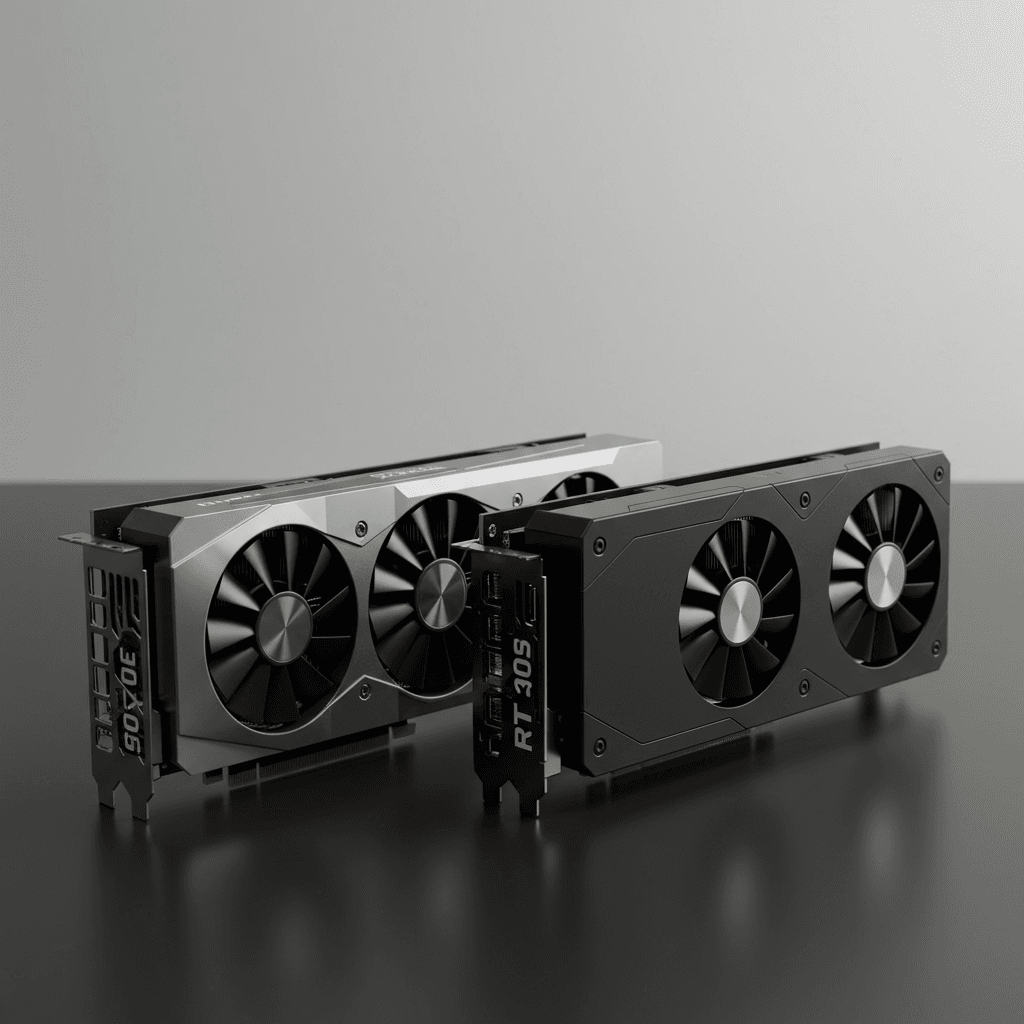
Deciding between two graphics cards from the same manufacturer can be a complex task. Indeed, this is certainly true when comparing the NVIDIA GeForce RTX 3060 vs 4060. Both cards aim for the mainstream market, consequently offering solid gaming experiences at 1080p and 1440p resolutions. However, these two GPUs come from different generations. Specifically, they feature distinct architectures, performance characteristics, and unique feature sets. Therefore, understanding these differences is crucial for making an informed purchasing decision.
The NVIDIA GeForce RTX 4060, for instance, arrived with the newer Ada Lovelace architecture. Subsequently, it generally provides better overall performance and also boasts significantly improved power efficiency. Conversely, the older RTX 3060, based on the Ampere architecture, holds a notable advantage in video memory (VRAM). Ultimately, this deep dive explores all the critical distinctions and helps you determine which card best fits your gaming needs and budget.
Key Architectural and Feature Differences Between RTX 3060 and 4060
A direct comparison of the specifications thus reveals much about these graphics cards. The RTX 3060 vs 4060 debate, therefore, often boils down to generational improvements versus raw specifications. Indeed, each card brings unique strengths to the table. Let’s explore the fundamental differences that set them apart.

Architecture and Process Node
The architecture forms the foundation of any GPU. For instance, the RTX 4060 leverages NVIDIA’s advanced Ada Lovelace architecture, built on a custom TSMC 4N process node. Notably, this 5nm-class manufacturing process is incredibly efficient, allowing for more transistors in a smaller space. Ultimately, this design translates directly to better performance per watt.
In contrast, the RTX 3060 uses the Ampere architecture. This older design, meanwhile, relies on Samsung’s 8N process node, which is a 10nm-class process. While still powerful, it is less efficient than the Ada Lovelace generation. Therefore, this difference in process technology greatly influences power consumption and thermal performance.
CUDA Cores and Clock Speeds
Surprisingly, the RTX 3060 actually has more CUDA cores, featuring 3584 CUDA cores. The RTX 4060, conversely, despite being newer, comes with 3072 CUDA cores. This might seem counterintuitive for a generational upgrade. However, the Ada Lovelace architecture significantly improves performance per CUDA core.
Moreover, the RTX 4060 compensates for its lower core count with much higher clock speeds. Its boost clock can reach up to 2460 MHz, whereas the RTX 3060 boosts up to 1777 MHz. Crucially, these higher frequencies, combined with architectural enhancements, allow the RTX 4060 to generally outperform its predecessor, even with fewer raw cores.
VRAM Capacity: A Critical Factor for RTX 3060 vs 4060
Video Random Access Memory (VRAM) is one of the most significant distinctions. Specifically, the RTX 3060 typically offers a generous 12GB of GDDR6 VRAM. This larger buffer is a key advantage for certain users. The RTX 4060, however, comes with 8GB of GDDR6 VRAM. Consequently, this difference in VRAM capacity can be a critical factor. It matters for modern, demanding games, and furthermore, it impacts performance at higher resolutions. Ultimately, VRAM capacity is important for future-proofing your system.
Memory Bus and Bandwidth
The memory bus interface width affects how quickly data can move between the GPU and its VRAM. For example, the RTX 3060 boasts a wider 192-bit memory bus, resulting in higher theoretical memory bandwidth of 360 GB/s. The RTX 4060, conversely, employs a narrower 128-bit memory bus. Consequently, it has lower memory bandwidth at 272 GB/s.
However, the RTX 4060 uses a clever trick to mitigate this. Namely, it incorporates a much larger L2 cache, which is 24MB compared to the 3MB on the RTX 3060. The enlarged L2 cache effectively reduces the need for constant access to the main VRAM, thus helping maintain performance despite the narrower bus. Learn more about GPU architectures on [Wikipedia](https://en.wikipedia.org/wiki/Graphicsprocessingunit).
Power Consumption (TGP)
Power efficiency is a major win for the RTX 4060. Indeed, it has a Total Graphics Power (TGP) of just 115W, making it a very efficient card. The RTX 3060, by comparison, has a TGP of 170W. Therefore, the RTX 4060 offers significantly more performance per watt, delivering roughly 50% higher performance per watt than the RTX 3060. This can lead to lower electricity bills and less heat generation, allowing for smaller, quieter cooling solutions.
DLSS and Other Features
The RTX 4060 introduces support for DLSS 3, a technology which includes Frame Generation. Notably, Frame Generation uses AI to create entirely new frames, significantly boosting FPS in compatible games. The RTX 3060 supports DLSS 2. However, DLSS 2 is powerful but does not include Frame Generation. Consequently, the difference is substantial in supported titles.
Additionally, the RTX 4060 includes AV1 video encoding support. This is a big plus for content creators and streamers, since AV1 offers superior compression efficiency. Ultimately, this results in higher quality streams at lower bitrates. The RTX 3060, however, lacks AV1 encoding. Thus, this feature gap is notable for certain use cases.
Pricing Considerations for RTX 3060 vs 4060
When both cards first launched, their original prices were slightly different. The RTX 3060 launched at $329, while the RTX 4060 debuted at a slightly lower $299. However, current retail prices for new cards are often very similar. Typically, you can find both cards in the $290-$300 range. This makes the price less of a distinguishing factor. Therefore, the decision leans heavily on performance and feature sets rather than initial cost. For current pricing, check major retailers like Newegg or Amazon.
Performance Benchmarks: RTX 3060 vs 4060 in Gaming
The theoretical specifications only tell part of the story. Instead, real-world gaming performance provides the clearest picture. Specifically, when comparing the RTX 3060 vs 4060 in benchmarks, a consistent pattern emerges. The newer RTX 4060 generally takes the lead.
Rasterization Performance
In traditional rasterization tasks, which means rendering standard 3D graphics, the RTX 4060 typically outperforms the RTX 3060. Indeed, it shows an average lead of 10-20% across various games. This performance advantage, moreover, holds true at both 1080p and 1440p resolutions. Consequently, this makes the RTX 4060 a more powerful card for raw gaming speed.
However, there are specific scenarios where the 12GB VRAM of the RTX 3060 can be beneficial. For example, in some highly demanding games, especially at 1440p with ultra settings, the 8GB VRAM of the RTX 4060 can become a bottleneck. In these rare cases, the RTX 3060 might perform on par; it could even show slightly better 1% lows, which indicate smoother gameplay without stutters. This effect is not widespread but is worth noting for users pushing the limits of graphical fidelity.
Ray Tracing Capabilities
Ray tracing is a demanding graphical technique. Essentially, it simulates how light behaves in the real world. The RTX 4060, therefore, demonstrates superior ray tracing performance. Its Ada Lovelace architecture, in fact, includes improved RT cores that handle ray tracing calculations more efficiently. Ultimately, gamers looking to enjoy realistic lighting and reflections will find the RTX 4060 more capable, offering a smoother experience in ray-traced titles.
DLSS 3 with Frame Generation
One of the RTX 4060’s biggest advantages is DLSS 3, which includes Frame Generation technology. Significantly, when enabled in compatible games, Frame Generation can deliver substantial FPS boosts, often leading to a smoother, more fluid gaming experience. The performance gap between the RTX 3060 vs 4060 thus widens significantly in titles that support DLSS 3. The RTX 3060 supports DLSS 2, which also boosts performance. Yet, it cannot generate entirely new frames. This generational leap in upscaling technology, consequently, gives the RTX 4060 a significant edge.
Pros and Cons of Each Card
Understanding the pros and cons of each card furthermore helps clarify the RTX 3060 vs 4060 decision. Each GPU, after all, serves different priorities. Evaluate what matters most for your specific setup and usage patterns.
NVIDIA GeForce RTX 4060
The RTX 4060 embodies NVIDIA’s latest generation of mainstream GPUs, thereby offering a compelling package for many users.
Pros of the RTX 4060:
- Higher Overall Performance: Generally, the RTX 4060 is 10-20% faster in rasterization, which provides a better gaming experience at 1080p and 1440p.
- Exceptional Power Efficiency: It consumes significantly less power. Indeed, its TGP is only 115W. Thus, it offers around 50% better performance per watt. This means lower energy bills and cooler operation.
- DLSS 3 with Frame Generation: This feature provides a substantial performance boost, thereby enhancing smoothness in supported titles. Clearly, this is a major generational leap.
- Superior Ray Tracing: Enjoy better performance in games utilizing ray-traced effects, since the improved RT cores make a noticeable difference.
- AV1 Encoding Support: This is a valuable feature for streamers and content creators, as it offers more efficient and higher-quality video encoding.
- Similar New Price: Often, you can find the RTX 4060 at a similar or even slightly lower price point than the RTX 3060.
Cons of the RTX 4060:
- Less VRAM (8GB): This is the most significant drawback. Consequently, 8GB can be a limitation in new, demanding games, potentially impacting performance at higher settings or resolutions like 1440p. Therefore, this might affect the card’s longevity.
- Narrower Memory Bus: The 128-bit bus and lower memory bandwidth can be a bottleneck in some memory-intensive scenarios, even though this is true despite the larger L2 cache.
- Modest Generational Performance Leap (without DLSS 3): The raw rasterization performance increase over the RTX 3060 is not as dramatic as some expected, especially when considering it’s a full generational upgrade.
NVIDIA GeForce RTX 3060
The RTX 3060, while older, still holds its own in specific areas. Its strengths are particularly appealing to users with certain priorities.
Pros of the RTX 3060:
- More VRAM (12GB): This larger memory buffer is the card’s strongest suit. Indeed, it can be highly beneficial for specific memory-intensive games or applications. Such capacity, furthermore, supports high-resolution textures. Additionally, it offers better longevity in scenarios where 8GB might struggle.
- Wider Memory Bus: It features a 192-bit memory bus, which provides higher theoretical bandwidth. Consequently, this can be advantageous in certain data-heavy workloads.
- More CUDA Cores: The RTX 3060 has a higher raw CUDA core count (3584 vs. 3072). However, this might appeal to users who value raw processing units, though architectural efficiency often trumps raw numbers.
Cons of the RTX 3060:
- Lower Overall Performance: Generally, the RTX 3060 is slower than the RTX 4060 in most gaming scenarios, especially true without DLSS 3.
- Higher Power Consumption: It is significantly less power-efficient. Specifically, it draws 170W compared to the RTX 4060’s 115W. This means, ultimately, higher operating costs and more heat.
- No DLSS 3 Frame Generation: It lacks this key feature of the Ada Lovelace architecture, and therefore, this absence impacts potential FPS boosts in modern titles.
- Older Architecture: It is based on an older, less efficient process node, which affects both performance and power draw.
- Limited Availability (New): As an older card, new stock may be less common. While used cards are available, finding new units can be challenging. For comparisons with other GPUs, check tech review sites like [TechRadar](https://www.techradar.com/news/best-graphics-cards).
The Verdict: Which GPU is Right for You?
The decision between the RTX 3060 vs 4060 ultimately depends on your specific priorities. Both cards offer compelling experiences for their target market. However, one generally stands out for new buyers.
For New GPU Buyers: The RTX 4060 is Generally Superior
For most users buying a new GPU today, the RTX 4060 is generally the better option. Its superior power efficiency, for example, is a significant benefit, offering lower operating costs and less heat output. Furthermore, its higher raw performance, typically 10-20% faster in rasterization, provides a more fluid gaming experience. The most compelling advantage, however, is DLSS 3 with Frame Generation. This technology can deliver substantial FPS boosts in compatible titles, consequently making it a strong contender for 1080p gaming and even moderate 1440p gaming. Its advantage is especially pronounced in titles that support DLSS 3. Given that new prices for both cards are often similar, the RTX 4060 delivers better value for money, providing improved performance, efficiency, and next-generation features.
When the RTX 3060 Still Shines
Despite the RTX 4060’s advantages, the RTX 3060’s 12GB VRAM remains a compelling factor. This larger memory buffer is crucial for users concerned about future game requirements. It is also important for playing at higher settings or resolutions. Certain applications that are heavily VRAM-intensive may likewise benefit from the 3060. If you prioritize maximum VRAM capacity above all else, the RTX 3060 could still be a reasonable choice. This is especially true if you find it at a significantly cheaper price.
Current RTX 3060 Owners: Is an Upgrade Worth It?
If you already own an RTX 3060, the performance upgrade to an RTX 4060 is not dramatic enough to warrant an immediate upgrade. This is based solely on rasterization performance. Indeed, the 10-20% increase might not feel like a groundbreaking leap. However, if you frequently play games that support DLSS 3 with Frame Generation, the upgrade could offer a more noticeable improvement in smoothness.
Ultimately, consider your budget, power supply, and specific gaming habits. The RTX 3060 vs 4060 decision, therefore, hinges on what you value most. The RTX 4060 offers modern efficiency and features. Meanwhile, the RTX 3060 provides a larger VRAM buffer for specific demanding scenarios. Choose wisely to enhance your gaming experience. For further reading on GPU comparisons, consider internal blog posts like `(/blog/graphics-card-buying-guide/)` or `(/blog/understanding-dlss-frame-generation/)`.