A powerful CPU is key to a great gaming experience. As technology constantly advances, gamers consistently seek top-tier components. For 2025, the AMD Ryzen 7 9800X3D stands out. This processor launched in late 2024. It quickly set new benchmarks for both frame rates and system responsiveness. Our AMD 9800X3D gaming review will explore these features in detail.
This AMD 9800X3D gaming review delves into this CPU’s extraordinary gaming potential. We will examine its innovative Zen 5 architecture and game-changing 3D V-Cache technology. Furthermore, we will scrutinize its real-world performance against its rivals. This guide covers everything from core specifications to platform compatibility and power consumption. Ultimately, you will understand why the Ryzen 7 9800X3D stands as a top contender for 2025 gaming.
The Architecture Behind the Power: Zen 5 and 3D V-Cache for the AMD 9800X3D Gaming Review
The AMD Ryzen 7 9800X3D combines cutting-edge design with revolutionary caching technology. Understanding these core elements is indeed crucial. They explain the processor’s exceptional gaming prowess. This section, therefore, explores the Zen 5 architecture. It also details the transformative impact of advanced 3D V-Cache, a key focus of our AMD 9800X3D gaming review.
Unpacking Zen 5 “Granite Ridge”: A New Foundation for 9800X3D Benchmarks
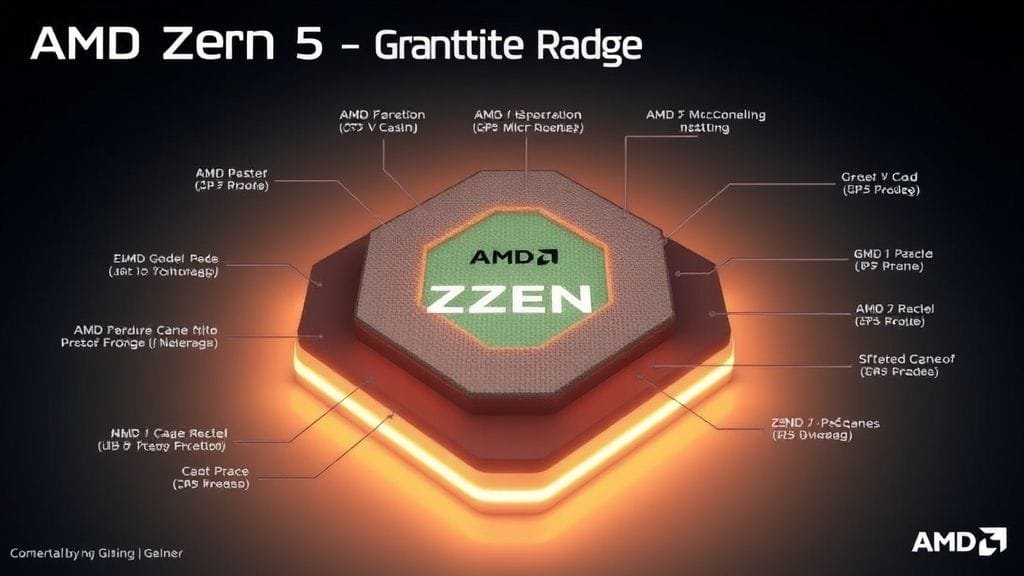
The Ryzen 7 9800X3D uses AMD’s state-of-the-art Zen 5 “Granite Ridge” microarchitecture. This design marks a significant leap forward. It brings major improvements in instructions per clock (IPC) and overall efficiency. Furthermore, “Granite Ridge” signifies a new generation of AMD CPUs. These are engineered to handle demanding workloads more effectively. Indeed, it represents a complete overhaul, not merely a minor update. Our AMD 9800X3D gaming review will demonstrate this.
This CPU offers 8 cores and 16 threads. This core count proves ideal for gaming. It provides parallel processing power without excessive overhead for most game engines. Moreover, the 9800X3D boasts impressive clock speeds. Its base clock is 4.7 GHz, boosting up to 5.2 GHz. These high frequencies ensure rapid processing for game threads. Consequently, this translates into smoother gameplay and higher frame rates. The Zen 5 architecture also improves core communication and task execution. This minimizes potential performance bottlenecks. This is a key finding of this AMD 9800X3D gaming review.
The 3D V-Cache Advantage Explained: Redefining Latency
The Zen 5 architecture offers a strong foundation. However, the Ryzen 7 9800X3D’s true strength lies in its advanced 3D V-Cache technology. This is more than just additional cache; it fundamentally changes how memory is accessed. For instance, the 9800X3D features a substantial 96MB of ultra-fast L3 cache. This large cache is vital. Many modern games, therefore, demand low memory latency. Games often access a significant amount of data, such as textures and models. If this data loads from slow system RAM, the CPU waits. This causes delays and drops in frame rates. Our AMD 9800X3D gaming review highlights this point.
AMD’s 3D V-Cache technology is truly innovative. It stacks an additional L3 cache layer directly onto the CPU. This unique design places the cache closer to processing cores. Consequently, data access becomes significantly faster. The CPU retrieves game assets quickly. As a result, gaming performance receives a substantial boost. The CPU spends less time idling. Instead, it processes more game logic. For gamers, this means higher average frame rates. Furthermore, it also notably improves 1% low frame rates. This ensures a smoother, more consistent gaming experience, even during intense action. Our AMD 9800X3D gaming review highlights this key feature.
3D V-Cache: Elevating AMD 9800X3D Gaming Performance
The “on-bottom” V-Cache location marks a significant evolution. This new placement further boosts the 9800X3D’s performance gains. AMD optimized the physical layout, thereby extracting greater efficiency from this potent technology. This design highlights AMD’s continuous innovation in processor packaging. Indeed, it demonstrates their commitment to pushing gaming CPU boundaries. Consequently, Zen 5’s architectural enhancements and optimized 3D V-Cache synergistically work together. This synergy propels the Ryzen 7 9800X3D to the forefront. Our AMD 9800X3D gaming review details this in depth.

Beyond the Specs: Real-World AMD 9800X3D Gaming Performance
While specifications outline a CPU’s theoretical capabilities, its true merit emerges in real-world gaming scenarios. The AMD Ryzen 7 9800X3D has exceeded expectations, thereby solidifying its position as a premier choice for 2025 gamers. This section delves into empirical evidence of its gaming dominance. We will showcase its performance against key rivals. This is a core aspect of any AMD 9800X3D gaming review.
A New Gaming King Emerges: Ryzen 7 9800X3D Performance
The Ryzen 7 9800X3D launched in November 2024. Reviewers quickly lauded it as the premier gaming CPU. This praise stemmed from its consistent performance in demanding games. Indeed, gamers need consistent results, not just high average frames. Hence, a stable gaming experience proves crucial. For example, the 9800X3D ensures smooth gameplay. It delivers robust 1% low frame rates. These maintain high frame rates even during busy scenes. As a result, frustrating stutters disappear. Players thus remain fully immersed. Its stable operation makes it an excellent chip. Moreover, players rarely see sudden drops, as this AMD 9800X3D gaming review confirms.
Head-to-Head: Ryzen 7 9800X3D Performance vs. The Competition
The most compelling evidence of the Ryzen 7 9800X3D’s prowess comes from direct comparisons with its closest rivals. It consistently outperforms both its predecessor and Intel’s high-end offerings, establishing a clear lead in the gaming arena. Our AMD 9800X3D gaming review puts these comparisons front and center.
Vs. Intel Core i9-14900K
The Intel Core i9-14900K is a formidable rival. It boasts a high core count and robust clock speeds, often serving as a benchmark. However, the Ryzen 7 9800X3D demonstrated remarkable superiority in gaming. Indeed, across 45 diverse games, the 9800X3D led the Intel i9-14900K by 18% on average. This is not a minor victory; rather, it’s a significant improvement gamers can truly feel. An AMD 9800X3D gaming review like ours reveals these critical details.
Performance improved significantly in specific games. For instance, consider Hogwarts Legacy. This graphically rich game truly demands strong CPU power. The 9800X3D boosted frame rates by 37% there. These gains resulted in smoother and clearer visuals. Thus, they significantly benefited demanding titles. Furthermore, the chip also excelled in Assetto Corsa Competizione. This challenging racing game saw a substantial 61% frame rate increase. Players therefore enjoyed superior smoothness and rapid responses. These features are vital for sim racing. Overall, these examples underscore the effectiveness of 3D V-Cache. Our AMD 9800X3D gaming review details this improved game performance.
Ryzen 7 9800X3D Gaming Benchmarks
Vs. Intel Core Ultra 9 285K
The Ryzen 7 9800X3D continued to impress against Intel’s Core Ultra 9 285K. This is Intel’s next-generation offering. Hence, the 9800X3D maintained a robust 35% performance advantage in benchmarks. Indeed, this comparison underscores AMD’s strategic success with Zen 5 architecture and V-Cache integration. Furthermore, it outmaneuvers even Intel’s newest competitors in crucial gaming metrics. These consistent leads reaffirm the 9800X3D as a top-tier gaming CPU. This AMD 9800X3D gaming review confirms this.
Vs. Ryzen 7 7800X3D
The Ryzen 7 9800X3D offers a compelling upgrade for AMD enthusiasts. Its predecessor, the Ryzen 7 7800X3D, was a fantastic gaming chip. However, the 9800X3D introduces significant performance uplifts. This is attributable to its Zen 5 architecture and refined 3D V-Cache. Consequently, this generational improvement ensures genuinely enhanced gaming capabilities. It further exemplifies AMD’s commitment to continuous innovation. The advancements are clearly noticeable. Therefore, they provide a tangible reason for AM5 users to opt for the newer model. This is a key takeaway from any thorough AMD 9800X3D gaming review.

The Gaming Ecosystem: Platform Compatibility and Features
A powerful CPU is only part of the solution. Indeed, its true potential necessitates robust platform compatibility and synergistic features. The AMD Ryzen 7 9800X3D integrates seamlessly into AMD’s current ecosystem. This offers current performance benefits and long-term upgradeability. Therefore, this aspect is crucial for a complete AMD 9800X3D gaming review.
AM5 Socket and Next-Gen Motherboards
The 9800X3D uses the AM5 socket. This forms the cornerstone of AMD’s modern desktop platform. This choice is significant for several reasons. Firstly, it ensures forward compatibility. Consequently, users invest in a platform that supports future AMD CPUs. This commitment to socket longevity greatly benefits consumers. It reduces the need for full system overhauls with each new processor. The AM5 socket thus provides a robust foundation for high-performance computing. It handles the power and data demands of the latest CPUs. This AMD 9800X3D gaming review details these crucial points.
The AM5 platform is compatible with a wide array of motherboards. These utilize various chipsets, catering to different budgets and needs. High-end choices include the X670 and X870 series. They provide extensive connectivity, robust power delivery, and advanced overclocking capabilities. For mainstream users, however, B650 and B850 chipsets offer good performance and value. These still retain key features essential for a great gaming PC. Furthermore, the budget A620 chipset also provides an entry point. This broad support thus ensures gamers can build a tailored system. They are not forced into one expensive motherboard type. This detail is elaborated upon in our AMD 9800X3D gaming review.
Memory and PCIe Support
The 9800X3D platform boasts robust memory support. It utilizes fast DDR5-5600 memory. This memory offers high bandwidth. Additionally, it transfers data faster than DDR4. Thus, DDR5 proves crucial for modern gaming. It sends data quickly to the CPU and GPU, reducing bottlenecks. Furthermore, the AM5 platform accommodates large memory configurations. It supports up to 192GB of DDR5 RAM. While gamers may not require 192GB currently, this capacity facilitates future growth. It also ensures smooth performance for upcoming apps and content creation. Therefore, the platform provides long-term value. This AMD 9800X3D gaming review confirms this significant benefit.
Both the Ryzen 7 9800X3D and the AM5 platform support PCIe 5.0. This next-gen standard effectively doubles PCIe 4.0 bandwidth. It offers unparalleled speeds for compatible graphics cards and NVMe SSDs. For instance, compatible GPUs communicate more efficiently with the CPU. This may lead to slight gains in GPU-bound tasks. Importantly, PCIe 5.0 NVMe SSDs deliver blazing-fast read/write speeds. This greatly reduces game load times. It also speeds up large file transfers. Therefore, this feature set not only ensures powerful systems today, but also primes them for tomorrow’s cutting-edge hardware. Our AMD 9800X3D gaming review evidences this.
Power, Heat, and Overclocking: Essential for Ryzen 7 9800X3D Performance
The AMD Ryzen 7 9800X3D delivers unparalleled gaming performance. However, users must understand its operational characteristics. Factors such as power consumption, thermal design, and overclocking potential are crucial. They are vital for maximizing the CPU’s capabilities and ensuring a stable, long-lasting system. This AMD 9800X3D gaming review would be incomplete without this section.
TDP and Cooling Requirements
The Ryzen 7 9800X3D has a 120W Thermal Design Power (TDP) rating. TDP indicates the maximum heat a CPU generates under typical workloads. Cooling systems, therefore, must effectively dissipate this heat. A 120W TDP means a moderately power-hungry chip. This holds true, especially when compared to lower-TDP processors. Consequently, adequate cooling is not just recommended. Rather, it is essential for both optimal performance and system longevity. This is a critical recommendation from our AMD 9800X3D gaming review.
Large dual-tower air coolers can handle 120W or more. However, many enthusiasts opt for liquid cooling, specifically All-in-One (AIO) solutions. This choice is crucial for maintaining peak performance during extended gaming sessions or overclocking. Thus, a 240mm or 280mm AIO cooler is often sufficient to manage heat effectively. It keeps CPU temperatures safe. Moreover, robust cooling prevents thermal throttling. This occurs when the CPU reduces its clock speed to prevent overheating, causing performance degradation. Effective heat removal helps the 9800X3D maintain high boost clocks. Indeed, this ensures steady, high frame rates. Consequently, our AMD 9800X3D gaming review underscores the need for quality cooling.

Efficiency Nuances
Power consumption for the 9800X3D can vary. Its efficiency depends on the workload and specific game. While it has a 120W TDP, for instance, its predecessor, the 7800X3D, demonstrated slightly better efficiency in games like Starfield. This was attributable to lower overall power consumption. This does not imply the 9800X3D is inefficient. Rather, performance uplift often accompanies a higher power draw. Nevertheless, the 9800X3D consistently delivers higher performance. It does so even with slightly more power. This is a point worth noting in any AMD 9800X3D gaming review.
Balancing power consumption and performance presents a crucial engineering challenge. AMD, however, has optimized the 9800X3D for maximum gaming performance. For serious gamers, slightly more power consumption is a small trade-off. This yields significant gains in frame rates and overall smoothness. Therefore, while cooling is important, the power draw is justified. It provides a demonstrably superior gaming experience. This is a key conclusion of this AMD 9800X3D gaming review.
Unlocked Potential: Overclocking the Ryzen 7 9800X3D
The Ryzen 7 9800X3D introduces a significant improvement: its fully unlocked status. This particularly benefits enthusiasts. Previous X3D chips often featured limited or no overclocking capabilities due to 3D V-Cache complexities. However, the 9800X3D now offers this capability. Consequently, enthusiasts can overclock for further performance gains. This newfound flexibility allows users to push the CPU beyond factory settings. They can potentially achieve higher frame rates in optimized scenarios. Therefore, this flexibility adds significant value. Our AMD 9800X3D gaming review highlights this.
Overclocking increases the CPU’s clock speed and voltage. This naturally boosts power consumption and heat generation. Therefore, robust cooling solutions become critical. This is especially true for those keen on exploring the 9800X3D’s overclocking headroom. However, users willing to experiment will find a rewarding pathway. They can personalize and maximize their gaming rig’s potential. This highlights AMD’s engineering advancements. Indeed, they have integrated complex 3D V-Cache without compromising enthusiast features. This is a crucial detail for this AMD 9800X3D gaming review.
Beyond Gaming: Productivity and Multithreaded Tasks
The AMD Ryzen 7 9800X3D truly excels in gaming. However, understanding its capabilities and limits in other areas is essential. CPUs often handle diverse tasks, from office work to content creation. Therefore, recognizing its specialized design helps set proper expectations. This is especially true for users with needs beyond pure gaming. Our AMD 9800X3D gaming review aims to provide this balanced perspective.
Gaming-First Design: Acknowledging the Ryzen 7 9800X3D Performance Specialization
The Ryzen 7 9800X3D boasts a “gaming-first” design philosophy. Every architectural decision, especially 3D V-Cache optimization, targets maximum frame rates. It also aims for minimal latency in gaming. This specialized focus translates to immense CPU power. However, its primary strength lies in adeptly handling game engine demands. For instance, the large, low-latency L3 cache benefits games immensely. Yet, it may not equally benefit applications requiring raw core count or floating-point power. Our AMD 9800X3D gaming review confirms this specialized focus.
The 9800X3D performs admirably for the majority of everyday tasks. This includes tasks such as web browsing, document editing, and light photo editing. Its Zen 5 cores, moreover, deliver excellent single-threaded performance. This ensures snappy responsiveness across most common applications. Therefore, it is not slow for general use. However, its gaming superiority is so pronounced that it tends to overshadow other benchmarks. Those non-gaming results are respectable, yet not record-breaking. This AMD 9800X3D gaming review emphasizes the chip’s core strength.
Multithreaded Performance Trade-offs
For highly multithreaded productivity tasks, other CPUs might perform better. Some Intel chips or higher-core Ryzen CPUs without 3D V-Cache, for example, often demonstrate stronger results. Applications like video rendering, 3D modeling, and scientific simulations demand numerous cores. Heavy software compilation also thrives on numerous simultaneous threads. While the 9800X3D’s 8 cores and 16 threads suit many professional applications, CPUs with 16 or more cores can pull ahead. This applies to tasks that fully saturate every available thread. Our AMD 9800X3D gaming review addresses this for a well-rounded evaluation.
For example, the Intel Core Ultra 9 285K led in 7-Zip compression benchmarks. This is a common test for multithreaded power. Its lead grew further with optimized memory. 7-Zip and similar applications utilize high core counts effectively. They don’t benefit much from 3D V-Cache’s low latency. Processors like Intel’s high-core offerings or AMD’s Ryzen 9 series are designed for such workloads. These typically have more cores but sometimes less V-Cache. Their architecture prioritizes raw parallel processing. This comes at the expense of gaming-specific cache optimization. This AMD 9800X3D gaming review duly notes this.

The Verdict for Different Users
Ultimately, the choice depends on your primary objectives. For gamers, whether competitive or casual, the Ryzen 7 9800X3D is exceptional. Indeed, it is arguably unmatched. Its specialized design delivers an unrivaled gaming experience. This AMD 9800X3D gaming review strongly supports this fact.
However, for hybrid users, the consideration is more nuanced. These users frequently engage in both intensive gaming and demanding productivity. While the 9800X3D offers a stellar experience, some might find better value elsewhere. This applies if their priority for productivity surpasses that of maximum gaming frame rates. Such users might prefer a CPU with a higher core count. They might also choose one optimized for a broader range of tasks. Even so, the 9800X3D remains a highly capable all-rounder, though it is profoundly specialized for gaming. It stands as a highlight of any AMD 9800X3D gaming review.
Pricing and Value Proposition: Is the AMD 9800X3D Gaming Review Worth It?
Price and value are critical considerations for any high-performance component. This is especially true for flagship CPUs. The AMD Ryzen 7 9800X3D entered the market as a premium product. It boasts advanced technology and leading gaming performance. However, its capabilities offer significant returns on investment, particularly for dedicated gamers. Our AMD 9800X3D gaming review will now detail this.
The Ryzen 7 9800X3D launched on November 7, 2024, with an MSRP of $479. This price point places it firmly in the upper-mid to high-end CPU market. While not a budget option, it is not the most expensive processor, especially considering its performance tier. For context, some top-tier Intel chips often cost similarly or more. Yet, they sometimes deliver less gaming dominance. This makes a thorough AMD 9800X3D gaming review vital for budget-conscious performance seekers.
Performance-per-Dollar: The Ryzen 7 9800X3D for Gamers
For gamers, the 9800X3D offers compelling performance-per-dollar. It consistently outperforms its rivals, sometimes by substantial margins. Every dollar spent thus directly enhances the in-game experience. When evaluating a gaming CPU, value often means FPS per cost. In this regard, the 9800X3D truly shines. Its specialized 3D V-Cache effectively boosts gaming performance. This achieves performance levels that normally require higher clock speeds or more cores. Thus, its premium price is justified. This is a key finding of this AMD 9800X3D gaming review.
Furthermore, the Ryzen 7 9800X3D belongs to the AM5 platform. This brings crucial long-term value through future-proofing. Investing in an AM5 motherboard offers multi-generational CPU compatibility. Therefore, users can simply upgrade CPUs to newer models later. They might not need to replace the motherboard or RAM. Consequently, this reduces the total cost of ownership over time. It makes the initial AM5 investment more attractive. Our AMD 9800X3D gaming review highlights this.
Long-Term Value with the AM5 Platform
Support for DDR5 memory and PCIe 5.0 further significantly boosts the 9800X3D’s long-term value. Games and applications are, moreover, increasingly demanding. Faster GPUs and NVMe SSDs are becoming standard. Thus, a platform fully leveraging these advancements is vital. The 9800X3D helps prevent bottlenecks stemming from older technologies. It allows your system to remain competitive for many years. This long-term perspective is crucial for a comprehensive AMD 9800X3D gaming review.
The initial $479 might seem substantial. However, the Ryzen 7 9800X3D represents a smart investment for serious gamers. This holds true when considering its stellar gaming performance and AM5 platform longevity. It delivers a premium experience. Yet, it does not demand the market’s highest price tag. Thus, it’s an excellent choice for ultimate gaming in 2025 and beyond. This AMD 9800X3D gaming review concludes this point.
The Future of Gaming CPUs: Where Does the Best Gaming CPU 2025 Stand?
Technology innovates at a rapid pace. Today’s cutting-edge hardware can quickly become legacy. However, the AMD Ryzen 7 9800X3D is not a transient leader. Indeed, it represents a pivotal milestone in gaming CPU development. It also offers a glimpse into high-performance gaming’s future. Its design choices and technologies position it at the forefront. This sets a formidable bar for competitors. Our AMD 9800X3D gaming review explores this aspect further.
Reinforcing Its Position as the Best Gaming CPU 2025
The 9800X3D consistently outperforms its rivals, including newer Intel offerings. Therefore, its gaming dominance will likely extend throughout 2025. The refined Zen 5 architecture and optimized 3D V-Cache, moreover, create a powerful synergy. This synergy uniquely benefits game workloads. Furthermore, game developers continually push graphical fidelity and complex simulations. These increasingly necessitate efficient data access and low-latency processing. The 9800X3D is perfectly poised for these evolving demands. This design strength is highlighted in this AMD 9800X3D gaming review.
Its 8-core, 16-thread configuration is ideal for current and future games. While CPUs with higher core counts exist, gaming performance often plateaus beyond 6-8 cores. Therefore, the 9800X3D leverages superior per-core performance. Crucially, it uses its massive on-die cache. This delivers a smoother, more responsive experience. It achieves this without needing excessive core counts. Consequently, this design efficiency makes it intelligently powerful. Our AMD 9800X3D gaming review demonstrates its intended purpose.
Brief Outlook on AMD’s Strategy with 3D V-Cache
The 9800X3D’s success underscores AMD’s commitment to 3D V-Cache. This technology serves to differentiate its gaming CPUs. Indeed, this innovative caching approach is, quite literally, a game-changer. It suggests future AMD processors, especially for gamers, will integrate and refine 3D V-Cache. We can therefore expect further optimizations in cache placement, density, and architectural integration. This continuous evolution promises that AMD will remain a formidable contender. This point is often emphasized in any comprehensive AMD 9800X3D gaming review.
AMD’s choice to unlock 9800X3D overclocking signals the maturity of 3D V-Cache technology. This suggests AMD is overcoming thermal and power challenges. Consequently, this paves the way for more flexible X3D variants. Clearly, AMD is invested in delivering top-tier gaming experiences. The 3D V-Cache, moreover, enables that vision. Ultimately, the Ryzen 7 9800X3D is more than just a powerful CPU; it’s a statement. It shows how chip design innovation, especially in cache architecture, transforms gaming results. For 2025 PC builders, the 9800X3D represents a wise present choice. It also offers a solid future foundation. This AMD 9800X3D gaming review confirms this.
Conclusion: The Dominant Gaming Force of 2025 – An AMD 9800X3D Gaming Review
The AMD Ryzen 7 9800X3D has carved out an exceptional niche. This occurred in the fiercely competitive gaming hardware market. Launched in November 2024, this CPU quickly became a leading contender. Many regard it as the definitive choice for 2025 gamers. Its blend of cutting-edge technology and robust architecture clearly demonstrates its dominance. Undeniable real-world results further reinforce this. This AMD 9800X3D gaming review explores this thoroughly.
AMD’s Zen 5 “Granite Ridge” microarchitecture and 3D V-Cache technology synergize to deliver success. The Zen 5 foundation provides immense processing power. It features 8 cores, 16 threads, and up to 5.2 GHz clock speeds. However, the substantial 96MB of ultra-fast L3 cache truly sets the 9800X3D apart. Its refined “on-bottom” placement is key. This technology dramatically reduces memory latency. It translates directly into higher average frame rates. Crucially, it also provides superior 1% low frame rates for smooth gaming. This is a consistent highlight of this AMD 9800X3D gaming review.
The Ryzen 7 9800X3D consistently outperforms its rivals. It demonstrated an 18% average lead over the Intel Core i9-14900K in many titles. Moreover, gains reached up to 61% in games like Assetto Corsa Competizione. Even against Intel’s newer Core Ultra 9 285K, it held a compelling advantage. Furthermore, its AM5 socket provides excellent platform longevity. It supports DDR5 memory and PCIe 5.0 for future-proof connectivity. This ensures compatibility with the latest GPUs and NVMe SSDs. While its 120W TDP necessitates adequate cooling, its newfound overclocking capability offers greater flexibility. This AMD 9800X3D gaming review strongly reinforces these points.
AMD 9800X3D: The Gaming Champion
The 9800X3D primarily excels in gaming. Therefore, it may be less dominant in highly multithreaded productivity. This is a minor trade-off for its unparalleled in-game power. At $479 MSRP, the 9800X3D offers a compelling performance-per-dollar ratio. This is especially true given the AM5 platform’s long-term value. This AMD 9800X3D gaming review considers this a key conclusion.
For those who prioritize ultimate frame rates, minimal stutter, and future-ready systems, the AMD Ryzen 7 9800X3D is an undeniable champion. Moreover, it is more than merely a powerful processor. Rather, it forms the cornerstone of a premium 2025 gaming PC. It delivers an experience truly second to none. This AMD 9800X3D gaming review firmly attests to this.
Frequently Asked Questions
Is the Ryzen 7 9800X3D good for gaming?
Yes, this AMD 9800X3D gaming review concludes that the AMD Ryzen 7 9800X3D is exceptionally good for gaming. It was widely recognized as the fastest gaming CPU upon its release, consistently outperforming rivals in gaming benchmarks due to its Zen 5 architecture and advanced 3D V-Cache technology, which significantly boosts frame rates and smooths gameplay.
What motherboards are compatible with the 9800X3D?
The Ryzen 7 9800X3D uses the AM5 socket. This AMD 9800X3D gaming review clarifies that it is compatible with motherboards featuring AMD X670, B650, X870, B850, and A620 chipsets, offering a wide range of options for different budgets and feature needs.
Does the 9800X3D support overclocking?
Yes, unlike some previous X3D chips, the Ryzen 7 9800X3D is fully unlocked. As highlighted in this AMD 9800X3D gaming review, this means enthusiasts can overclock the processor to potentially achieve further performance gains, provided they have an adequate cooling solution.
How does the 9800X3D compare to Intel’s top CPUs for gaming?
This AMD 9800X3D gaming review demonstrates that the Ryzen 7 9800X3D consistently outperforms Intel’s high-end gaming CPUs, such as the Core i9-14900K and Core Ultra 9 285K, in numerous gaming benchmarks. It demonstrated an average lead of 18% over the i9-14900K across 45 games and up to a 35% advantage against the Core Ultra 9 285K in some tests.
What cooling solution is recommended for the 9800X3D?
With a Thermal Design Power (TDP) of 120W, good cooling is recommended for the Ryzen 7 9800X3D. As this AMD 9800X3D gaming review advises, a high-end air cooler or a 240mm/280mm All-in-One (AIO) liquid cooler is recommended to ensure optimal performance and prevent thermal throttling, especially during extended gaming sessions or if overclocking.