
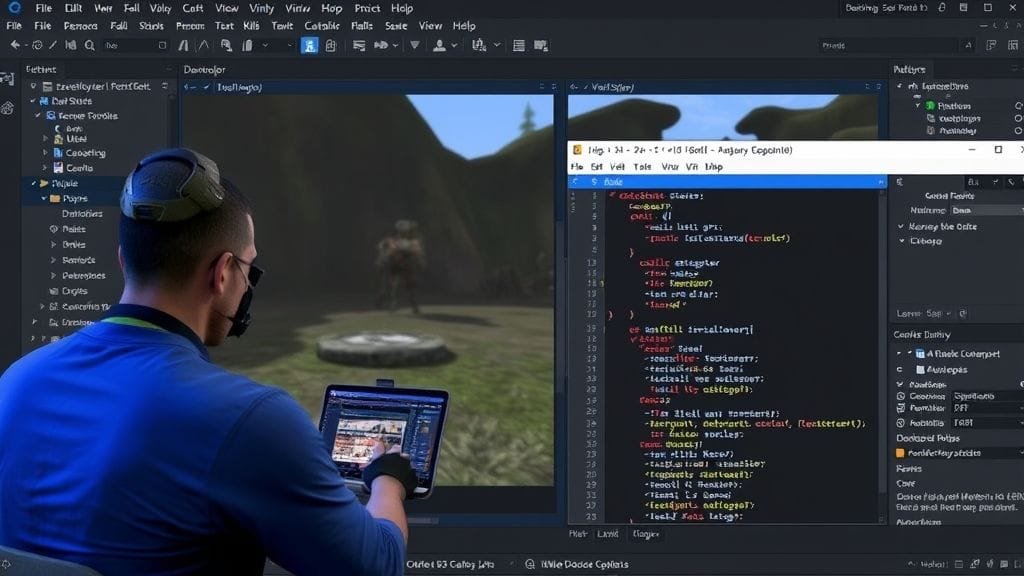
Imagine C# as a master craftsman, possessing a versatile toolkit capable of building both a captivating virtual world and a robust, mission-critical business system. This powerful language, underpinned by the expansive .NET ecosystem, empowers developers across two vastly different domains: game development with Unity and enterprise application development. Understanding the distinct priorities and challenges inherent in C# Game Development vs Enterprise is crucial for any aspiring or current developer. This article aims to explore these differences thoroughly.
Have you ever wondered what makes your favorite mobile game tick, or how a complex banking application handles millions of transactions daily? Often, the answer lies in C# and its extensive capabilities. We will delve into both facets, exploring the unique strengths, challenges, and architectural philosophies that define C#’s role in these two flourishing industries, thereby illuminating the core distinctions of C# Game Development vs Enterprise.
The Dual Powerhouse: C# at the Core
C# stands as a testament to modern programming language design. It is an object-oriented, type-safe language that combines the power of C++ with the rapid development capabilities of languages like Java. Microsoft introduced C# as part of the .NET initiative, creating a holistic ecosystem for developers. This ecosystem isn’t just about syntax; rather, it encompasses a rich runtime environment, extensive libraries, and world-class tooling.
For many developers, C# offers a comfortable learning curve, particularly if they have a background in other C-style languages. Its readability and strong typing help prevent common errors, fostering more reliable codebases. Furthermore, the constant evolution of C# with new features and performance enhancements ensures its continued relevance. From asynchronous programming to advanced pattern matching, C# continually adapts to modern computing demands.
The .NET framework itself has transformed, evolving from a Windows-centric platform to a fully cross-platform, open-source powerhouse with .NET Core (now simply .NET 5+). This strategic shift has dramatically broadened C#’s appeal and applicability, making it a truly versatile choice for virtually any software project. This versatility is precisely why exploring C# Game Development vs Enterprise is so compelling, as it demonstrates the language’s adaptability.
Crafting Worlds: C# in Unity Game Development
Unity, a prominent real-time 3D development platform, leverages C# as its primary scripting language. This pairing allows developers to bring intricate game mechanics, interactive simulations, and stunning visual effects to life. Unity’s component-based architecture aligns perfectly with C#‘s object-oriented principles, making it intuitive to build and manage complex game objects. Consequently, the principles for C# Game Development vs Enterprise begin to diverge here.

(https://learn.microsoft.com/en-us/dotnet/csharp/) script open in Visual Studio.]C# scripts directly interact with Unity’s powerful engine, enabling developers to manipulate GameObjects, script sophisticated animations, handle user input, and manage game events—all within the C# environment. This deep integration is a key reason why Unity and C# have become the go-to combination for countless game studios, from indie developers to large-scale enterprises, thus solidifying the foundation for C# Game Development vs Enterprise.
The Allure of Unity: Ease, Community, and Rich Features for C# Game Development
One of Unity’s most compelling attributes is its relative ease of use, especially for newcomers to game development. The visual editor simplifies scene creation, asset management, and level design. You can drag and drop assets, position objects, and configure components with minimal coding. Consequently, this accessibility means creators can quickly prototype ideas and see their visions come to fruition.
C#‘s smooth learning curve complements Unity’s user-friendliness. If you are familiar with object-oriented programming, picking up C# for Unity will feel natural. Moreover, both Unity and C# boast incredibly active and supportive communities. This vibrant ecosystem translates into a wealth of resources: tutorials, forums, open-source projects, and direct support from experienced developers. Therefore, this community aspect significantly lowers the barrier to entry and accelerates learning, a distinct advantage in C# Game Development vs Enterprise.
The .NET framework provides rich library support for C# in Unity, enabling developers to tackle complex tasks such as networking, data management, and file I/O. Unity’s vast Asset Store further enhances this by offering pre-made assets, tools, and plugins. Developers can leverage these resources to accelerate development, saving valuable time and effort, especially during rapid prototyping phases. This approach further distinguishes the considerations for C# Game Development vs Enterprise.
Performance and Cross-Platform Prowess in C# Game Development
In game development, performance is always a critical consideration. C# in Unity supports various optimization techniques to ensure smooth gameplay. You can employ asynchronous programming to prevent your game from freezing during intensive operations. Furthermore, understanding Unity’s frame budget and managing allocations carefully is crucial for a responsive experience. This highlights a key difference in C# Game Development vs Enterprise.
Perhaps one of Unity’s most significant advantages is its robust cross-platform deployment capabilities. A single C# codebase can be deployed to a wide array of platforms. This includes major operating systems like iOS, Android, Windows, macOS, and Linux. Additionally, Unity supports deployment to popular game consoles such as PlayStation, Xbox, and Nintendo Switch, alongside emerging platforms like VR headsets. This flexibility allows developers to reach a broad audience without needing to rewrite their game for each platform, making it a highly cost-effective solution. This makes C# Game Development vs Enterprise a fascinating comparison.

A diagram illustrating Unity’s cross-platform deployment options for various devices and operating systems.
Navigating the Challenges in C# Game Development
Despite its many advantages, C# in Unity does come with its own set of considerations. For games demanding extremely high performance, such as AAA titles with intricate physics or massive open worlds, C# might not always match the raw efficiency of lower-level languages like C++. Languages like C++ offer more direct memory control and less overhead, which can be critical in highly optimized scenarios, a key point in C# Game Development vs Enterprise.
A common concern in Unity development is higher memory consumption compared to highly optimized native code. C#‘s garbage collector, while excellent for memory management, can introduce occasional pauses. These pauses are often imperceptible in enterprise applications, but they can be detrimental to a game’s frame rate. Limited native device access can also be a hurdle, though Unity provides plugins and interfaces to bridge some of these gaps. Additionally, mastering Unity’s advanced features and optimization techniques requires a significant learning curve, presenting unique challenges for C# Game Development vs Enterprise.
Finally, while the Asset Store is a boon, relying too heavily on purchased assets can lead to costs that accumulate over time. Licensing models for Unity itself can also become a factor for larger studios or successful titles. Consequently, these are all considerations game developers must weigh against the platform’s incredible flexibility and speed of development. This discussion highlights aspects of C# Game Development vs Enterprise that developers need to consider.
The Market Landscape of C# Game Development
Unity’s market presence is undeniably strong and continues to grow. By 2025, Unity is projected to command a significant 26.17% market share, positioning it as a leading game development tool globally. It is a testament to its widespread adoption and versatility.
Consider these impactful statistics: In 2024, an impressive 51% of all games released on Steam, one of the largest digital distribution platforms for PC games, were crafted using Unity. By 2025, Unity is projected to power over 50% of all mobile games, highlighting its dominance in the burgeoning mobile gaming sector. Globally, over 13,727 companies currently leverage Unity for their projects, ranging from independent studios to major publishers. This robust market presence indicates a healthy ecosystem and sustained demand for Unity skills, making the C# Game Development vs Enterprise choice a compelling one.
Building Empires: C# in .NET Enterprise Applications
Beyond the thrilling world of games, C# and the .NET framework are the bedrock for building robust, scalable, and secure enterprise-level applications. This encompasses a vast spectrum of software, including complex web applications, powerful desktop utilities, business-critical mobile apps, cloud services, IoT solutions, and even artificial intelligence systems. Therefore, the considerations for C# Game Development vs Enterprise dramatically shift here.
(https://learn.microsoft.com/en-us/dotnet/csharp/) .NET enterprise application development examples]
The .NET ecosystem has been at the forefront of innovation, with recent releases like .NET 8 (an LTS version, released in November 2023) and the upcoming .NET 9. These advancements, coupled with the latest C# 13, continue to push boundaries. They offer enhanced performance, cross-platform compatibility, open-source transparency, and increasingly sophisticated AI integration, making .NET an ever-evolving platform for businesses worldwide. This contrasts sharply with the demands of C# Game Development vs Enterprise.
Foundations of Enterprise: Robustness and Scalability for C# Enterprise Solutions
In the enterprise world, applications must be reliable, maintainable, and able to handle vast amounts of data and users. C# excels in these areas due to its inherent design principles. Strong typing ensures that your code is less prone to errors and more predictable. Language Integrated Query (LINQ) provides a powerful, unified way to query data from various sources, simplifying complex data manipulations. Furthermore, asynchronous programming is crucial for responsive enterprise applications, preventing UI freezes or service bottlenecks during lengthy operations.
The .NET framework’s efficient memory management, particularly through its garbage collection, significantly reduces the likelihood of memory leaks. This automatic process reclaims unused memory, allowing developers to focus on business logic rather than manual memory handling. Just-In-Time (JIT) compilation further optimizes application performance by compiling C# code into native machine code at runtime. Ultimately, C# and .NET are engineered for scalability, adapting seamlessly from small business tools to large, distributed enterprise systems that serve millions. This is a fundamental aspect of C# Game Development vs Enterprise.
The Expansive .NET Ecosystem and Integration in C# Enterprise Application Development
The true power of C# in enterprise applications comes from the expansive .NET ecosystem. This framework provides a rich set of components designed to accelerate development. For instance, ASP.NET is a comprehensive framework for building dynamic web applications and APIs. Entity Framework simplifies database interactions, allowing developers to work with data using C# objects rather than raw SQL queries.

An architectural diagram showing .NET Core applications integrating with Azure services, SQL Server, and other Microsoft technologies.
The Framework Class Library (FCL) offers an unparalleled collection of reusable types, classes, and interfaces that support a wide range of common programming tasks. This extensive library means developers rarely have to “reinvent the wheel.” Moreover, C# and .NET offer natural and deep integration with other Microsoft technologies. Services like Azure for cloud computing, SQL Server for robust databases, and Microsoft 365 for productivity suites all work cohesively within the .NET environment. This integration streamlines development and offers comprehensive, end-to-end solutions for businesses, contrasting with considerations for C# Game Development vs Enterprise.
Visual Studio, Microsoft’s flagship Integrated Development Environment (IDE), stands as a powerful tool for C# developers. It offers unmatched features for coding, debugging, testing, and deployment, significantly streamlining the entire software development lifecycle. Its comprehensive toolset and rich extensions make it an indispensable asset for enterprise developers.
Cross-Platform Reach and High Demand in C# Enterprise Applications
The advent of .NET Core, now unified into .NET 5+, marked a pivotal moment for C#’s cross-platform capabilities. Developers can now build applications that run natively on Windows, macOS, and Linux from a single codebase. This flexibility is invaluable for enterprises seeking to deploy applications across diverse IT infrastructures without significant refactoring. This cross-platform reach is another factor in C# Game Development vs Enterprise comparisons.
The demand for C# and .NET developers remains consistently high across various sectors. Startups, mid-sized companies, and large tech giants alike actively seek skilled C# professionals. Businesses recognize the stability, security, and scalability that C# and .NET bring to their critical applications. Therefore, developing expertise in this ecosystem opens up numerous career opportunities in a stable and growing job market. This contrasts with the often more volatile landscape of C# Game Development vs Enterprise.
Understanding C# Enterprise Market Dynamics
The global enterprise application market is a vast and rapidly expanding sector. In 2024, it was valued at an impressive USD 308.08 billion. Projections indicate that this market will surge to USD 662.78 billion by 2033, demonstrating a compound annual growth rate (CAGR) of 9.05%. This remarkable growth underscores the critical role enterprise software plays in modern business operations.
North America stands as a dominant market within this global landscape, leading in innovation and adoption of enterprise solutions. A significant driver for this market growth is the ongoing shift towards cloud-based deployment solutions. Businesses are increasingly migrating their applications to the cloud for enhanced flexibility, scalability, and cost-efficiency. C# and .NET, with their strong ties to Azure and other cloud platforms, are perfectly positioned to capitalize on this trend, influencing the trajectory of C# Game Development vs Enterprise.
Looking ahead, projections for March 2025 estimate a global population of over 7 million C# developers. Approximately 2 million of these talented professionals are based in the United States alone. These figures highlight a robust and substantial talent pool, further solidifying C#’s standing as a premier language for enterprise development. This talent pool further strengthens the ecosystem for both C# Game Development vs Enterprise.
Bridging the Divide: C# Game Development vs Enterprise Prioritization
While C# is the common thread, the journey through game development with Unity and enterprise applications with .NET branches off into distinct paths. The fundamental distinction often boils down to performance and memory management priorities. What’s acceptable in one domain can be catastrophic in another. This section directly addresses the core of C# Game Development vs Enterprise.

A comparative chart illustrating key differences in priorities and approaches for [C#
(https://learn.microsoft.com/en-us/dotnet/csharp/) Game Development vs Enterprise application development.]
In enterprise applications, occasional garbage collection pauses are generally tolerable. A momentary hiccup of 50-100 milliseconds might go unnoticed by a user navigating a web portal. However, in game development, even a tiny pause—say, 10-20 milliseconds within a single frame—is highly noticeable. It can manifest as a jarring stutter, disrupting the immersive experience and frustrating players. Consequently, game developers meticulously focus on minimizing heap allocations and favor value types (structs) over reference types (classes) to optimize data locality and avoid GC spikes. This is a critical divergence in C# Game Development vs Enterprise.
Conversely, enterprise developers often prioritize code maintainability, robustness, and development speed, where the overhead of an object allocation is a minor concern compared to the clarity and modularity it provides. This fundamental difference shapes many other architectural and design decisions across both fields, truly highlighting the comparison of C# Game Development vs Enterprise.
The Performance Paradox: Memory Management and GC in C# Game Development vs Enterprise
Consider memory management. In enterprise applications, the .NET garbage collector (GC) diligently manages memory, automatically cleaning up unused objects. This frees developers from complex manual memory management, leading to faster development cycles and fewer memory-related bugs. Developers often accept the occasional, brief pauses introduced by the GC in exchange for this convenience, a hallmark of C# Game Development vs Enterprise distinctions.
However, in real-time game development, a GC pause can cause a “hitch” or “frame drop,” which is highly detrimental to user experience. Therefore, game developers meticulously profile their code, striving for “zero allocations” during critical gameplay loops. They employ techniques like object pooling, struct usage, and `Span` to manage memory directly and precisely. This performance-first mindset is a constant battle against unexpected allocations and the GC, which is a stark contrast to enterprise methodologies in C# Game Development vs Enterprise.
Architectural Philosophies: From ECS to ORMs in C# Game Development vs Enterprise
Architectural patterns also diverge significantly between the two domains. Dependency Injection (DI), for instance, is a cornerstone in modern enterprise .NET development. It promotes modular, testable, and maintainable code by decoupling components. While DI is gaining traction among experienced Unity developers, it’s not as universally applied or as natively supported as it is in frameworks like ASP.NET Core, marking a key distinction in C# Game Development vs Enterprise.
Object-Relational Mappers (ORMs) such as Entity Framework are indispensable in enterprise applications for simplifying complex database interactions. They allow developers to work with database tables as C# objects, abstracting away SQL specifics. However, ORMs are largely absent in game development. Games typically rely on custom data structures, serialization formats, or specialized asset pipelines for data persistence and loading, prioritizing raw performance and memory layout over database abstraction, highlighting a core divergence in C# Game Development vs Enterprise needs.
Game development often leans heavily towards composition over inheritance, and innovative patterns like Entity Component Systems (ECS) are gaining prominence. ECS promotes a data-oriented design, organizing data and behavior into highly efficient, cache-friendly structures, which is paramount for game performance. This can sometimes lead to avoiding traditional design patterns common in enterprise software that might introduce additional abstraction layers or increase memory allocations, which are performance trade-offs in a game’s critical path. This further differentiates C# Game Development vs Enterprise.
Career Pathways and Compensation Realities in C# Game Development vs Enterprise
From a career perspective, the paths in game development and enterprise software engineering present different landscapes. Game development jobs are often perceived as more competitive, given the passionate nature of the industry, and can sometimes involve more variable employment patterns. The infamous “crunch time,” periods of extended working hours to meet deadlines, is also more prevalent in game development, offering another lens for C# Game Development vs Enterprise.
Average Salary Comparison (US, May 2024 – 2025 Projections):
| Role | Median/Average Annual Wage |
|---|---|
| General Software Developer | $133,080 |
| Game Developer | $116,251 (2025 projection) |
| Mid-level C# Developer | $100,000 – $126,000 |
Note: These figures are averages and can vary significantly based on experience, location, company size, and specific responsibilities.
It’s important to note that while general software developers often command higher average salaries, C# developers are broadly in high demand across both fields. Mid-level C# salaries in the U.S. typically range from $100,000 to $126,000 annually, underscoring the value placed on C# proficiency regardless of the specific domain. Your specialized C# skills are highly transferable, allowing for flexibility in your career trajectory, thereby offering significant flexibility within C# Game Development vs Enterprise careers.
The Evolving Future of C# and .NET
The journey of C# and .NET is far from over; instead, it’s a narrative of continuous innovation. Microsoft’s unwavering investment in this ecosystem ensures its enduring relevance across diverse application landscapes. With each new release, C# becomes more expressive and powerful, while the .NET framework expands its capabilities and performance.
The shift towards cloud-native architectures, serverless computing, and microservices continues to be a major trend. C# and .NET are exceptionally well-equipped to thrive in this environment, particularly with robust support for Azure services. Imagine building highly scalable, cost-efficient cloud solutions with the same language you use for other critical applications. This versatility underscores its importance in C# Game Development vs Enterprise.
Moreover, the increasing integration of artificial intelligence (AI) and machine learning (ML) capabilities directly into the .NET ecosystem presents exciting opportunities. Libraries and frameworks for AI/ML development in C# allow developers to build intelligent applications with relative ease. This will continue to blur the lines between traditional software and smart systems, with C# poised at the center. Whether enhancing game AI or building predictive analytics for an enterprise, C# offers the tools relevant to both sides of C# Game Development vs Enterprise.
Making Your Mark with C#
Ultimately, C# and .NET provide an incredibly powerful, versatile, and evolving platform. They empower developers to craft everything from immersive, interactive game experiences to robust, mission-critical enterprise solutions. While the core language remains the same, the specific considerations, architectural patterns, and development priorities are carefully tailored to meet the unique demands of each domain, effectively encapsulating the core differences in C# Game Development vs Enterprise.
Your journey with C# is one of continuous learning and adaptation. Whether you aspire to animate virtual characters or engineer secure financial systems, C# provides a solid foundation. You gain valuable skills that are highly sought after across industries, offering flexibility and growth in your career. The choice between game development and enterprise applications often comes down to your personal passion and the types of challenges that energize you most. Therefore, understanding the distinct demands and rewarding opportunities in both game development and enterprise applications, especially through the lens of C# Game Development vs Enterprise, is paramount.
Considering the distinct demands and rewarding opportunities in both game development and enterprise applications, which path are you more inclined to explore, and what aspects of C# development excite you the most? Reflect on the comprehensive insights gained regarding C# Game Development vs Enterprise.