
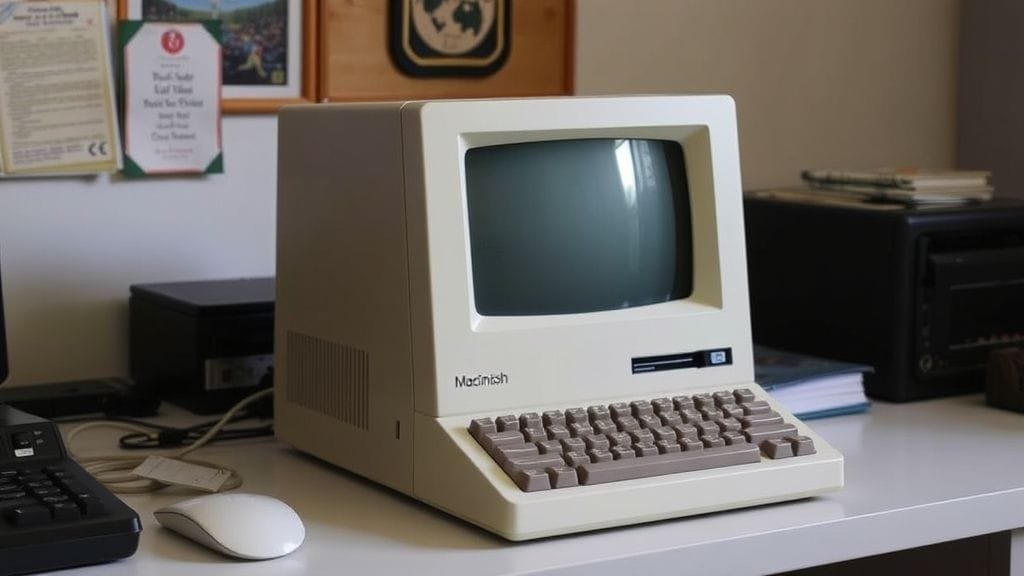
Imagine a world where using a computer felt like understanding a secret code. You typed complex commands and navigated through endless lines of text. Often, this left users feeling more frustrated than productive. This was the reality for most people before January 24, 1984. On that important day, Apple Inc. introduced something groundbreaking: the original Macintosh personal computer. This pivotal moment ushered in the “Macintosh era,” a period that profoundly transformed personal computing, user interface design, and many creative fields.
The Macintosh was more than just a machine. It embodied a profound idea. It promised to bring computing “for the rest of us,” making technology easy to use, accessible, and even fun. In this article, we explore the Macintosh era. We will focus on the Mac’s key contributions, the problems it faced, and its lasting impact. Its influence continues to shape our digital world today. Get ready to discover how one computer truly changed everything.
A Revolution Begins: Unveiling the Original Macintosh
The launch of the Macintosh 128K in 1984 was a monumental event. It wasn’t merely about showcasing new hardware; it introduced a revolutionary approach to personal computing. Steve Jobs, Apple’s co-founder, passionately championed the idea of an “elegant, everyday appliance.” He imagined a computer that felt natural to use and fit easily into daily life. Instead, it aimed to be an intuitive tool rather than a mere display of technological prowess.
This vision was a stark departure from the norm before the Macintosh era. Previously, most computers were for engineers, scientists, or hobbyists, making them challenging to learn and operate. The Macintosh, however, aspired to be different. It aimed to feel like a natural extension of its user. It was approachable and user-friendly. This ambitious goal soon catalyzed fundamental changes. These innovations ultimately redefined computing.

The famous “1984” Super Bowl ad, directed by Ridley Scott), masterfully set the stage. It also hinted at a rebellion against a monolithic, controlling computing establishment. Later, when Jobs unveiled the Macintosh from its carrying bag on stage, the world saw a compact, inviting machine. It didn’t have intimidating dials or myriad ports. Instead, it presented an approachable interface, inviting users into a new paradigm of interaction. This initial demonstration, therefore, heralded a significant shift in technology’s trajectory, truly inaugurating the Macintosh era.
GUI Innovations of the Macintosh Era
Perhaps the most profound innovation of the Macintosh era was the popularization of the Graphical User Interface (GUI) and the mouse. Before the Macintosh, personal computers mostly used complex, text-based commands. Specifically, users had to memorize command-line instructions just to open files or run programs. Consequently, this made computing a daunting task for the average user. This inherent difficulty limited widespread computer adoption.
However, the Macintosh revolutionized this by introducing its intuitive [desktop metaphor](/blog/understanding-desktop-environments-in-uis). Imagine a virtual desk on your screen, with icons for documents, folders, and programs. For instance, you could “open” a folder by double-clicking it, or “move” a file by simply dragging it. You could also “throw away” unwanted items into a trash can icon. This was a radical departure from the command line interface, where every action required precise textual commands.
This new way of working, a cornerstone of the Macintosh era, made computers accessible to a vastly wider audience. Suddenly, you didn’t need to be a programmer to use a computer. The Mac’s point-and-click actions, made easy by the mouse, were intuitive and remarkably efficient. These innovations transformed the computer. It went from a specialized tool to a universally usable device, irrespective of technical expertise. Consequently, this fundamental shift established the paradigm for all later personal computing, a paradigm that originated in the Macintosh era.
The Mac’s Impact on Desktop Publishing
The Macintosh was instrumental in catalyzing the “desktop publishing revolution.” This period within the Macintosh era profoundly altered how documents were made, designed, and printed. Before the Mac, for example, making high-quality publications was expensive and time-consuming. Moreover, it often required specialized equipment, skilled typesetters, and professional designers.
However, everything changed around 1986. That’s when Apple released the LaserWriter printer and groundbreaking software like PageMaker. Suddenly, users could connect their Macintosh to a laser printer. This allowed them to produce professional-quality documents right from their office or home. This powerful combination empowered individuals and small businesses to create newsletters, brochures, and even books with unprecedented ease and quality.

A vintage advertisement showing a Macintosh, LaserWriter, and Aldus PageMaker software, emphasizing creative control
A pivotal feature underpinned this revolution within the Macintosh era: It was the Mac’s “What You See Is What You Get” (WYSIWYG) feature. With programs like MacPaint, users could see on their screen exactly what would appear in print. This eliminated the guesswork from design and layout. Consequently, this democratized creativity. Artists, designers, and musicians, for example, quickly embraced the Mac, transforming it into an an indispensable tool for their craft. The Macintosh era, therefore, fostered a vibrant culture of creativity and innovation. Furthermore, it showed that computers could be more than mere computational machines. Indeed, they could be powerful instruments for artistic expression.
Early Challenges and Market Realities
Despite its innovative design and exceptional user experience, the early Macintosh era encountered significant initial challenges. Its internal specifications were modest for its price point. For instance, it had only 128K of RAM. Crucially, it lacked a built-in hard disk drive. Consequently, users were forced to rely entirely on floppy disks for storage and program loading. This often meant frequent disk changes, which, in turn, resulted in sluggish operation.
Also, the Macintosh was expensive. It cost US$2,495 at its launch, which is about $7,600 in today’s money (2024, after inflation). This high price, combined with its limited hardware, made it a substantial investment for both homes and businesses. Despite these drawbacks, initial sales were strong. They were greatly fueled by considerable excitement and its groundbreaking features during the nascent Macintosh era.
However, following this initial surge, sales fell sharply. Monthly sales dropped to about 5,000 units. While this showed that early buyers were happy, it proved challenging to attract a broader customer base. Thus, this reality underscored that innovation alone could not sustain market leadership for the Macintosh era. It also needed competitive pricing and robust hardware.
Macintosh’s Initial Market Challenges
In 1984, the Macintosh, in its inaugural year, commanded only 6% of the personal computer market. It lagged significantly behind its rivals. These, for example, included the affordable Commodore 64, ubiquitous DOS-based computers, and even Apple’s older Apple II series. By 1986, its market share fell even more to 4.2%. However, it wasn’t until 1991 that the Macintosh finally gained a larger share of the market, reaching 11.2%. This trajectory, therefore, illustrates the challenging path the Mac navigated in its formative years—a period of considerable struggle for the Macintosh era.
Here’s a quick look at the Macintosh’s market share evolution:
| Year | Macintosh PC Market Share | Contextual Note |
|---|---|---|
| 1984 | 6% | Trailed Commodore 64, DOS PCs, Apple II. |
| 1986 | 4.2% | Continued struggle for broader adoption. |
| 1991 | 11.2% | Achieved more significant market presence. |
Technical Hurdles and OS Evolution in the Macintosh Era
The Macintosh operating system, while innovative, presented several technical limitations. While its user interface was groundbreaking for the Macintosh era, a significant limitation was its lack of pre-emptive multitasking. This meant it could not safely execute multiple processes concurrently. If one program crashed, it could often cause the entire system to crash, necessitating a complete restart. Consequently, this issue led to significant user frustration. It also reduced productivity and system reliability.
Competitors, such as Microsoft Windows, implemented pre-emptive multitasking earlier. They thereby offered a more stable computing experience in this regard. Interestingly, it wasn’t until Mac OS X, released in 2001, that Apple finally integrated this crucial feature. This significantly enhanced system stability and responsiveness. This showed that innovation is not a singular event but an ongoing process. Indeed, iterative refinement is often an inherent aspect of the Macintosh era’s evolution.
Also, in the mid-1990s, Apple experimented with “Macintosh clones.” The initiative aimed to license its Mac OS software to other manufacturers, allowing them to produce their own Mac-compatible computers. This was an effort to expand the Macintosh market share. However, the program was subsequently discontinued. Apple became concerned that the clones were cannibalizing sales of its own more profitable machines. This led Apple to reassert its stringent control over both hardware and software. The episode underscored Apple’s deep conviction in integrated design, where hardware and software seamlessly coalesce. This philosophy continues to shape Apple’s product strategy today, long after the initial Macintosh era.
The Macintosh Era’s Enduring Legacy
The Macintosh (and so the Macintosh era) is widely recognized as a seminal product for its pioneering user experience concepts. However, perceptions of its true market impact vary. Indeed, Apple has never been the dominant player in the personal computer world by market share. For instance, the Mac’s share rarely exceeded 12% for sustained periods. Consequently, it has consistently trailed Windows PCs.
However, judging the Macintosh era only by market share would be to overlook its profound impact. Instead, consider the profitability of the Mac line for Apple itself. It made $29.4 billion in 2023. Nevertheless, its share of Apple’s total revenue has declined significantly over time. For example, in 2000, Mac sales accounted for a staggering 86% of Apple’s total revenue.

This decline is not indicative of the Macintosh era’s failure. Rather, it testifies to the enormous success of Apple’s subsequent breakthrough products. The iPod, iPhone, and iPad succeeded the Macintosh. These products became immensely popular globally. They generated unparalleled revenue and profoundly transformed entire industries. Therefore, this contextualizes the Mac’s foundational role. It truly laid the groundwork, even if it did not generate the largest revenues in later years of the Macintosh era.
Foundation for Apple’s Empire
Despite its changing market share, the Macintosh era stands unequivocally as Apple’s foundation. Apple built its formidable empire and iconic brand upon this era. Indeed, the core emphasis on user experience and design, pioneered by the Macintosh, proved immensely profitable. This way of thinking emphasized that technology should be aesthetically pleasing, user-friendly, and seamlessly integrated into one’s life.
This core philosophy, forged in the Macintosh era, is precisely what distinguishes Apple’s highly successful products today. For example, the clean lines, ease of use, and meticulous attention to detail in the iPhone, iPad, and Apple Watch all directly derive from the original Macintosh. The Mac taught Apple the importance of exercising end-to-end control over the user experience, encompassing both hardware and software. This combined approach, therefore, cultivates a product that is both functionally superior and aesthetically pleasing.
Also, the Macintosh era established Apple’s brand as synonymous with exemplary design and intuitive interfaces. This sterling reputation, forged during the desktop publishing revolution, enabled Apple to command premium pricing. Also, it fostered unparalleled brand loyalty. Without the Macintosh, it’s unclear if Apple could have garnered the brand equity and design prowess to make the iPhone such a monumental success. Therefore, it wasn’t just a computer; it was truly the blueprint for Apple’s future.
Continuous Innovation: From Intel to Apple Silicon
The Macintosh era did not conclude with the original 1984 model. Instead, it has been a continuous journey of innovation and refinement. Over the decades, Apple has consistently pushed the boundaries of Mac performance, quality, and design. This unwavering commitment to improvement has maintained the Macintosh’s relevance and desirability. This is true even in a rapidly evolving technological landscape.
For example, we’ve seen significant design evolutions throughout the years. Consider the vibrant, translucent iMac G3 of 1998. It resurrected Apple’s fortunes and revitalized the perception of personal computers as joyful tools. Likewise, think about the ultra-thin MacBook Air, introduced in 2008, which redefined laptop portability. Together, these iconic designs unequivocally demonstrate Apple’s enduring pursuit of aesthetic excellence and functional utility within the Macintosh era.

Beyond aesthetics, the Macintosh era has seen fundamental architectural shifts. In 2006, Apple made a bold strategic decision. It switched all its Macintosh computers from PowerPC to Intel chips. This move significantly boosted their performance. Also, it allowed Macs to run Windows natively, which enhanced their appeal. This pivotal transition enabled the Mac to compete more effectively in terms of raw processing power and software compatibility.
Continuous Innovation in the Macintosh Era
More recently, however, Apple embarked on an even more ambitious project. It introduced its proprietary Apple Silicon chips, custom-designed for its ecosystem, starting with the M1 chip in 2020. This internal architectural shift once again fundamentally transformed the Mac, initiating a new chapter in the Macintosh era. For instance, it delivered remarkable power efficiency. This enabled exceptional performance without compromising battery life or thermal management. These innovations vividly demonstrate Apple’s sustained commitment to pushing technological boundaries. This philosophy, originating with the original Mac, remains central to its approach to computer design.
The Macintosh Era’s Profound Cultural Impact
The deep cultural impact of the Macintosh era extends far beyond its market share figures or financial contributions. It fundamentally altered workflows across numerous industries, particularly creative ones. Before the Mac, for example, graphic design was a specialized and costly field. Likewise, musicians used specialized, often analog equipment. Video editing, furthermore, was exclusively conducted in professional studios.
So, the Macintosh, a pivotal product of the Macintosh era, had an intuitive interface and robust software. It democratized access to these professional tools. Also, it empowered individual creators, enabling them to design, compose, and edit with unprecedented ease and affordability. As a result, this widespread availability of creative tools fostered a new generation of artists, designers, and multimedia producers. Indeed, many might never have entered these fields without its influence.
The Mac also transformed our daily interaction with technology. Fundamental concepts like the GUI, the mouse, and the desktop metaphor became ubiquitous. The Macintosh popularized them during its tenure. Consequently, they became the norm for almost every personal computer that came after. Today, for example, when you click an icon on your smartphone or drag a file on your laptop, you are using something pioneered by the Macintosh. This legacy, therefore, became emblematic of innovation, exceptional design, and user-centric thinking. Its influence is deeply ingrained in today’s digital landscape.
Reflecting on the Macintosh’s Timeless Influence
Reflecting on the Macintosh era, it becomes clear that its impact transcends mere sales figures or market share data. The Macintosh was not just a computer. It represented a fundamental philosophy. It marked a significant departure from arduous, text-based computing. Instead, it offered a visually intuitive, user-friendly experience. This fundamental shift democratized technology. Also, it made technology accessible and functional for millions who were previously excluded.
The Macintosh era’s pivotal role in popularizing the Graphical User Interface and the desktop publishing revolution is undeniable. This period transformed industries, ignited creativity, and established a new paradigm for human-computer interaction. Importantly, the Macintosh era also laid the crucial groundwork for Apple’s subsequent successes. The company refined its core focus on elegant design, seamless user experience, and integrated hardware-software ecosystems. Ultimately, these foundational principles culminated in the creation of the iPod, iPhone, and iPad—products that subsequently revolutionized their respective markets.
Ultimately, the Macintosh era proved that a computer could be more than just a tool. It could be an extension of human creativity and intelligence. Its visionary approach continues to shape today’s technology. For instance, it influences everything from operating systems to smartphone interfaces. Therefore, the enduring impact of the Macintosh underscores the power of thoughtful design and, furthermore, an unwavering dedication to user-centricity.
What is your fondest memory of the Macintosh, or how do you think its early innovations continue to influence the technology you use today? Share your thoughts in the comments below!