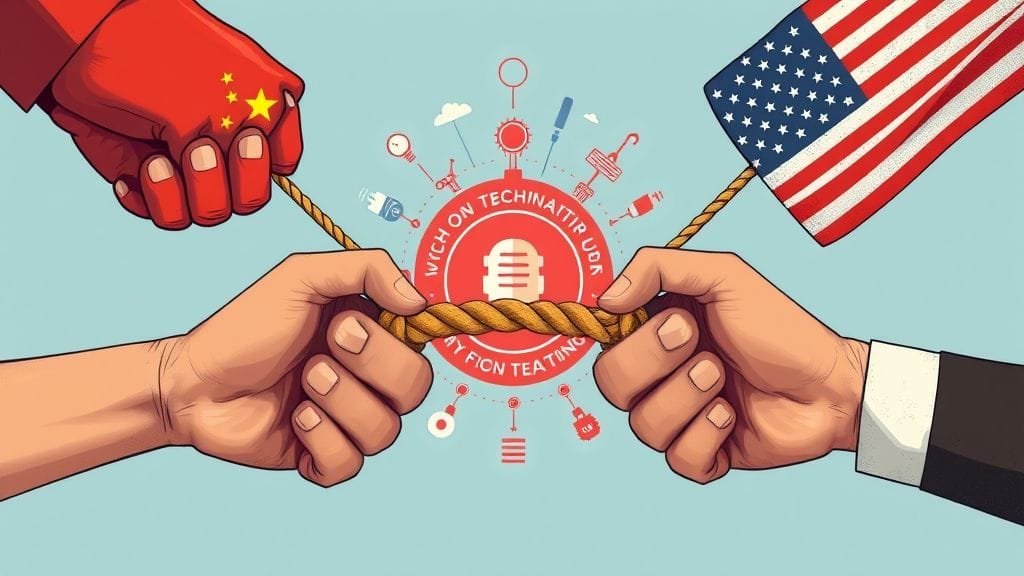
Clearly, the technological competition between China and the United States has escalated into a defining rivalry of the 21st century. Indeed, this multifaceted contest, often framed as a “New Fragmentation,” holds profound implications for global security, economic stability, and international politics. Consequently, both nations are intensely striving for global leadership across numerous critical and emerging technologies. Thus, understanding the dynamics of this China vs US technology race reveals a landscape of shifting dominance, strategic maneuvers, and intense innovation.
The Evolving Technological Landscape
Initially, a comprehensive 2023 report by the Australian Strategic Policy Institute (ASPI) paints a compelling picture of the current technological standings. Specifically, it indicates China currently leads in a remarkable 37 out of 44 tracked technologies. Notably, these areas include cutting-edge fields such as electric batteries, hypersonics, and advanced radio-frequency communications like 5G and the burgeoning 6G. Therefore, this substantial lead suggests a deliberate and successful strategy by China to dominate future tech frontiers.
Conversely, the same ASPI report found the United States holding a lead in only seven key technologies. Notably, these include vital sectors such as vaccines, quantum computing, and space launch systems. Furthermore, researchers suggest China is at a high risk of establishing monopolies in eight technologies. Specifically, these critical areas encompass nanoscale materials, hydrogen and ammonia for power generation, and synthetic biology. Indeed, many analyses predict China could ultimately surpass the U.S. in innovation and advanced-industry output in both proportional and absolute terms.

However, American perspectives often argue that the U.S. maintains its advantage in key areas like advanced AI, quantum technology, and hypersonics. Even so, these assessments frequently acknowledge China’s rapid advancements and the shrinking gap between the two nations. Moreover, the intense rivalry is actively disrupting global supply chains. Consequently, it heightens geopolitical tensions and compels other nations to align with either the U.S. or China. Ultimately, this alignment pressure could potentially lead to increased international conflict, further fragmenting the global technological ecosystem. For more context on geopolitical shifts, see this [Wikipedia article on the US-China trade war](https://en.wikipedia.org/wiki/China%E2%80%93UnitedStatestrade_war).
Key Technology Sectors in Focus
Indeed, the China vs US technology competition plays out across several pivotal sectors, each representing a unique battleground for innovation and dominance.
Artificial Intelligence (AI)
Primarily, the United States largely remains a dominant force in Artificial Intelligence. Also, it is home to global tech giants such as Google, OpenAI, Microsoft, Amazon, and Meta. Specifically, the U.S. benefits from robust private investment, world-class academic research, and an exceptional talent pool. For instance, in 2024, U.S.-based institutions produced 40 notable AI models, significantly more than China’s 15. Clearly, this output demonstrates a strong capacity for cutting-edge AI development.
However, China has rapidly narrowed the AI development gap with the U.S. from over a year to approximately three months. Specifically, this rapid progress is driven by a surge in AI talent, aggressive technology iteration, and a booming application market within China. Furthermore, China leads globally in the number of AI-related academic papers and patent filings. Moreover, its vast population and a less stringent regulatory environment allow for the collection and utilization of massive datasets. Therefore, these datasets are crucial for training sophisticated AI systems, giving China a unique advantage in data-intensive AI applications. Despite China’s advancements, the U.S. still maintains a clear lead in computing power, a fundamental requirement for developing the most complex AI models.

A stylized brain with circuit patterns, representing Artificial Intelligence innovation
Semiconductors: A Strategic Flashpoint
Significantly, the semiconductor industry stands as a major flashpoint in the China vs US technology rivalry. In fact, the U.S. and its allies collectively dominate over 90% of global semiconductor equipment manufacturing. Consequently, this dominance makes China heavily reliant on foreign sources for advanced chips, which are essential for virtually all modern technologies. Indeed, since 2019, the U.S. has imposed extensive export controls, specifically targeting China’s access to cutting-edge chips and manufacturing equipment. Thus, these measures aim to slow China’s advancements in AI and military modernization, highlighting the strategic importance of this sector.
Evidently, these U.S. restrictions have significantly impacted China’s high-end chip production capabilities. In fact, experts estimate China’s semiconductor capabilities are currently 5 to 10 years behind the U.S. In response, China has intensified its efforts to achieve semiconductor self-sufficiency. Notably, its ambitious goal is to create an “all-Chinese supply chain” and produce mature-node 28nm chips at scale without U.S. reliance by 2025. Consequently, China’s chip imports saw sharp declines in both 2022 and 2023, reflecting both the impact of sanctions and its domestic production push. Moreover, China controls a significant portion of the world’s rare earth minerals, which are vital for chip manufacturing. Furthermore, it has used export restrictions on these materials as a retaliatory measure, adding another layer of complexity to the tech rivalry. Conversely, these U.S. controls also pose substantial financial risks and potential job losses for American chip companies due to reduced access to the massive Chinese market.

5G and 6G Communications
China has clearly established a lead in advanced radio-frequency communications, particularly with its widespread deployment of 5G infrastructure. Furthermore, it is also aggressively pursuing the development of 6G technology, aiming to shape the future standards of global connectivity. The U.S. is similarly looking ahead to 6G, recognizing its strategic importance. The United States has concurrently worked to counter the deployment of Chinese 5G technology, notably from companies like Huawei, in various allied countries. Ultimately, this effort aims to mitigate security concerns and prevent China from setting global communication standards.
Quantum Technology: The Next Frontier
Overall, the U.S. holds superiority in quantum computing and quantum sensing capabilities. Essentially, these are incredibly complex fields with the potential to revolutionize computing power and sensitive measurements. However, China leads in quantum communications, an area crucial for secure data transmission, and the total number of quantum technology patents. Indeed, some sources even suggest China could be a decade ahead in quantum computing due to its focused, state-driven investment. Clearly, reported government investments of approximately $15 billion in quantum information technologies underscore China’s commitment.
While the U.S. relies heavily on private sector funding and research for quantum advancements, China’s approach is more centralized and state-dominated. Consequently, this difference in investment strategy can lead to varied paces and areas of progress. Therefore, recognizing the strategic importance, U.S. export controls now extend to components necessary for building quantum computers. Thus, this further restricts China’s access to critical technology in this nascent but transformative field. For more insights on the future of computing, visit our blog on quantum advancements (/blog/future-of-quantum-computing/).

Biotechnology: A Race for Life Sciences
Historically, the U.S. has been an undisputed leader in biotechnology discoveries, driven by its robust pharmaceutical industry and leading research institutions. However, China has made significant, long-term investments in its biotech sector. Currently, it is making rapid advancements and openly aiming for dominance in areas like synthetic biology, gene editing, and biomanufacturing. For example, in 2024, China conducted over 7,100 clinical drug trials, surpassing the U.S. in sheer research activity.
Furthermore, experts warn that the U.S. risks losing its biotech edge without substantial, prioritized federal investment and crucial policy changes. Specifically, recommendations often include allocating at least $15 billion over five years to bolster American biotech capabilities. Biotechnology is also recognized as a dual-use technology, meaning it has both civilian and potential military applications. Consequently, this raises serious concerns about the development of weaponizable biotechnologies, adding another layer of urgency to the China vs US technology rivalry in this sector.
Space Technology: The New Celestial Race
Notably, a “new space race” is firmly underway between the two nations, with both pursuing ambitious lunar exploration programs and broader space agendas. While the U.S. maintained a significant lead in 2022 with a larger space budget ($69 billion, including $43 billion for military activities, compared to China’s $16 billion) and more active satellites (3,415 vs. China’s 535), China is rapidly catching up. Indeed, China’s integrated civilian and military space approach, coupled with its growing international partnerships, poses a formidable challenge to long-standing U.S. dominance.
Consequently, China’s space policy explicitly aims to surpass U.S. leadership by 2045. Specifically, it is demonstrating impressive progress in critical areas like positioning, navigation, time synchronization, and “game-changing” in-orbit refueling capabilities. Furthermore, concerns are also rising significantly over China’s aggressive development of counter-space weapons. Furthermore, its increasing number of intelligence, surveillance, and reconnaissance satellites represents a substantial expansion of its space-based military capabilities.

Policy, Investment, and Talent Dynamics
Ultimately, the current state of China vs US technology competition is profoundly shaped by divergent government policies, investment strategies, and approaches to talent development.
China’s State-Driven Strategy
Notably, China’s remarkable technological progress is largely a direct result of deliberate, long-term policy planning and significant state-backed investment. For instance, initiatives like “Made in China 2025” and the “New Generation AI Development Plan” clearly outline its ambitions for technological self-sufficiency and global leadership. Furthermore, in 2024, China announced a substantial 10% surge in its research and development (R&D) investment, dedicating an estimated $52 billion. Clearly, this aggressive funding reflects a clear national priority to accelerate innovation across critical sectors.
United States’ Strategic Response
In response, the U.S. has responded with a “small yard, high fence” strategy. Specifically, this involves implementing targeted export controls to selectively restrict critical technology supply chains and slow China’s progress, particularly in areas with clear military applications. Moreover, these controls are not limited to hardware; they also include restrictions on human capital, aiming to limit U.S. persons from working in China’s semiconductor industry. Paradoxically, for the same fiscal year 2024, the U.S. saw a 2.7% cut in its total R&D investment. Conversely, this contrasts sharply with China’s increased spending and raises questions about sustained long-term competitiveness.

Talent Pipeline: A Critical Factor
In terms of talent, China graduates a significantly higher number of scientists and engineers each year compared to the U.S. Consequently, this demographic factor is widely expected to drive its continued innovation and technological advancement in the coming decades. The U.S., conversely, has faced challenges with lagging training of its own scientists and engineers. Additionally, it has experienced impacts from post-9/11 immigration barriers, which have historically restricted the influx of international talent crucial for its innovation ecosystem.
Implications and Future Outlook
Overall, the intense China vs US technology competition carries far-reaching implications for the global order. Specifically, the “New Fragmentation” actively disrupts established global supply chains, fostering economic nationalism and forcing nations to reconsider their dependencies. Moreover, it heightens geopolitical tensions, creating an environment where technological advantage is intertwined with national security. Consequently, other nations often feel compelled to align with either the U.S. or China, leading to potential international instability. Learn more about global tech trends and their impact on our dedicated page here (/blog/global-tech-trends/).
However, different perspectives exist on the best path forward for the U.S. Indeed, some view the competition as a necessary measure to preserve U.S. national security and economic leadership. Specifically, they advocate for continued aggressive policies to maintain a technological edge. Conversely, others express concern that overly aggressive decoupling policies could inadvertently accelerate China’s drive for technological self-sufficiency. Furthermore, such policies could also harm U.S. companies by limiting their access to the vast Chinese market, leading to a fragmented and less efficient global technology landscape. Therefore, there are increasing calls for the U.S. to proactively increase public investment in critical research, liberalize immigration policies to attract top global talent, and foster greater international collaboration to maintain its competitive edge.
Conclusion
In conclusion, the China vs US technology rivalry is undeniably complex and far-reaching. Furthermore, China has made remarkable strides, leading in numerous emerging technologies and demonstrating a clear strategy for global dominance, particularly in areas like AI, 5G, and biotechnology. However, the United States, while still strong in areas like advanced AI models, quantum computing, and semiconductors, faces the challenge of maintaining its lead amidst China’s rapid advancements and substantial state-backed investments. Ultimately, the outcome of this tech race will profoundly shape the global economy, security, and the future of innovation for decades to come.