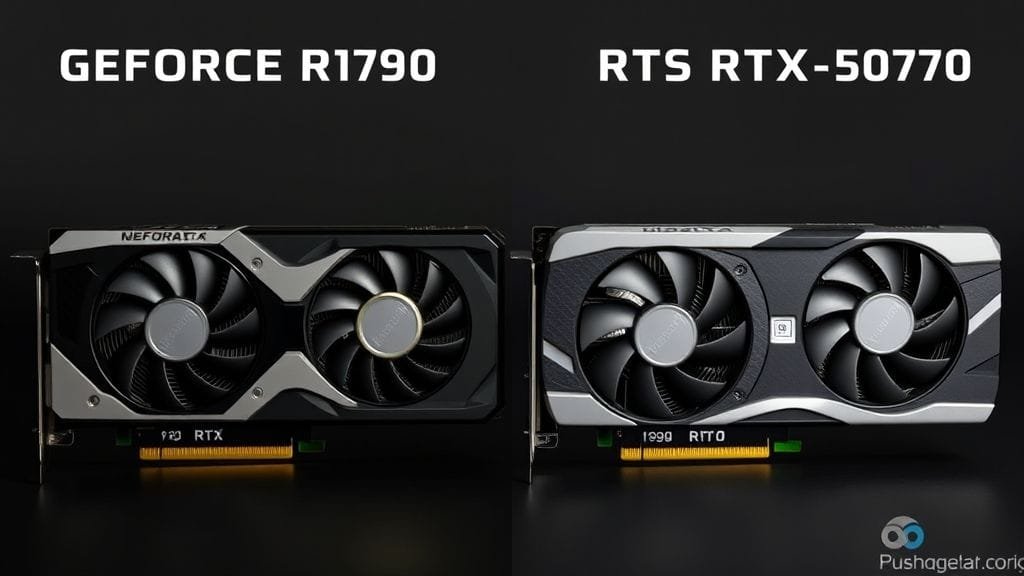
The landscape of PC gaming and content creation continually evolves, primarily driven by rapid advancements in graphics card technology. NVIDIA’s GeForce RTX series GPUs, for instance, are central to this evolution. Indeed, they are renowned for ray tracing, and they also offer AI-powered upscaling. Notably, two significant contenders from different eras are the NVIDIA GeForce RTX 3070 vs RTX 5070. While the RTX 3070 was a pinnacle of performance for its generation, the RTX 5070, conversely, brings a new era with substantial architectural and performance upgrades.
The NVIDIA GeForce RTX 3070 was released in September 2020, and it quickly became a favorite. Specifically, it offered strong 1440p gaming prowess, along with competitive pricing. However, fast forward to March 2025, and the NVIDIA GeForce RTX 5070 arrives, promising a significant generational leap. Therefore, this article delves into core differences, as it covers performance disparities. Moreover, we will compare each card’s pros and cons, which helps you understand what sets these GPUs apart. Furthermore, we will explore why the RTX 5070 is a compelling upgrade for many users.
Understanding the Generational Divide
The RTX 3070 and RTX 5070 gap is not merely numerical; instead, it shows a fundamental shift in NVIDIA’s graphics architecture. Crucially, the RTX 3070 is built on the Ampere architecture, which introduced second-generation RT Cores and third-generation Tensor Cores. Consequently, this design greatly enhanced ray tracing capabilities, and it propelled DLSS (Deep Learning Super Sampling) into widespread adoption. Thus, it delivered exceptional performance for its time.
Conversely, the RTX 5070 leverages the much newer Blackwell 2.0 architecture. This advanced design, therefore, incorporates further refined RT and Tensor Cores, and it also uses a more efficient manufacturing process. These improvements, consequently, boost raw processing power, and they introduce next-generation features. Ultimately, this ensures a smoother and more immersive gaming experience. Clearly, this generational gap is evident across various metrics, ranging from core specifications to real-world performance benchmarks.

Core Specifications: A Detailed Comparison
Indeed, examining the specifications side-by-side clearly illustrates the technological advancements between the two cards. The RTX 5070 uses a smaller manufacturing process, and it has more advanced memory. Furthermore, it features higher clock speeds; all contribute to its superior performance.
| Feature | NVIDIA GeForce RTX 3070 | NVIDIA GeForce RTX 5070 |
|---|---|---|
| Architecture | Ampere (GA104) | Blackwell 2.0 (GB205) |
| Process | 8 nm (Samsung) | 5 nm (TSMC 4N FinFET) |
| CUDA Cores | 5888 | 6144 |
| RT Cores | 46 | 48 |
| Tensor Cores | 184 | 192 |
| Memory | 8 GB GDDR6 | 12 GB GDDR7 |
| Memory Interface | 256-bit | 192-bit |
| Memory Bandwidth | 448 GB/s (14 Gbps effective) | 672 GB/s (28 Gbps effective) |
| Boost Clock | 1725 MHz | 2512 MHz |
| TBP (Power) | 220 W | 250 W |
| PCIe Interface | PCIe 4.0 x16 | PCIe 5.0 x16 |
| Launch Price | $499 USD | $549 USD |
| Release Date | September 1, 2020 | March 4, 2025 |
Architectural Advancements
Crucially, the transition from Ampere (RTX 3070) to Blackwell (RTX 5070) signifies a leap in efficiency and capability. Blackwell 2.0 utilizes a cutting-edge 5 nm TSMC process, thereby enabling higher transistor density and improved power efficiency per transistor. In contrast, Ampere relied on Samsung’s 8 nm process. This foundational shift, then, directly translates to more powerful and efficient processing. For instance, the RTX 5070 boasts increased CUDA, RT, and Tensor Cores. While these numbers might seem modest on paper, the true impact stems from their enhanced generational efficiency and specialized functions.
Memory Configuration and Speed
Significantly, one of the most critical upgrades for the RTX 5070 is its memory subsystem. The RTX 3070 offers 8 GB of GDDR6 memory, which was ample for its time. However, modern AAA titles frequently push this limit, especially true at higher resolutions and texture settings. In contrast, the RTX 5070 boasts 12 GB of the much faster GDDR7 memory. This memory upgrade, consequently, boosts bandwidth significantly; it jumps from 448 GB/s on the RTX 3070 to a remarkable 672 GB/s on the RTX 5070.
Although the RTX 5070 has a narrower 192-bit memory interface, compared to the RTX 3070’s 256-bit, GDDR7’s speed more than compensates. Indeed, this increased bandwidth mitigates potential bottlenecks, and it ensures smoother data flow for complex graphical workloads. Thus, the enhanced memory is a major differentiator in the RTX 3070 vs RTX 5070 comparison.
Processing Power and Clocks
Beyond the core counts, the boost clock speed tells another story of generational improvement. The RTX 5070 has a much higher boost clock, as it operates at 2512 MHz. Essentially, this is a substantial increase over the RTX 3070’s 1725 MHz. Consequently, this higher frequency directly translates to more operations per second, thereby contributing to the RTX 5070’s superior raw performance. Additionally, the RTX 5070 uses PCIe 5.0 x16, which offers double the theoretical bandwidth, whereas the RTX 3070 uses PCIe 4.0 x16. Ultimately, this provides future-proofing and ensures maximum data throughput with compatible motherboards.
Performance Benchmarks and Real-World Impact
The theoretical advantages of the RTX 5070 translate into tangible performance gains, especially seen in real-world applications and games. Users running an RTX 3070 can upgrade, and the RTX 5070 offers a dramatically improved experience. Indeed, this is true across various titles and resolutions, particularly when considering the advanced features of the newer card.
Raw Rasterization Performance
Primarily, in traditional rasterization tasks—the bread and butter of most games—the RTX 5070 delivers a substantial performance uplift. Indeed, it offers about 50% higher rasterization performance, compared to the RTX 3070, while also maintaining a similar power budget. Benchmarks at 1440p resolution show results: for example, the RTX 5070 can be 31% to 49% faster without upscaling. Thus, it outperforms its predecessor, which means consistently higher frame rates and a smoother, more responsive gaming experience. In particular, this is especially true in demanding modern titles. Furthermore, the RTX 5070 approaches playable 4K frame rates, whereas the RTX 3070 often struggled at 4K.
Ray Tracing and Upscaling Technologies
Secondly, ray tracing performance also sees worthwhile gains with the RTX 5070. NVIDIA’s Blackwell architecture refines the dedicated RT Cores, which leads to more efficient and faster ray tracing calculations. While the RTX 3070 introduced excellent hardware ray tracing, the RTX 5070 pushes this further, thereby allowing more immersive and stunning graphics with less performance penalty.
A key differentiator is DLSS 4, as the RTX 5070 exclusively supports NVIDIA’s Multi Frame Generation. In contrast, the RTX 3070 supports DLSS 2, which is still a fantastic upscaling solution. Multi Frame Generation builds on DLSS 3, and it uses AI to generate new frames, which significantly boosts frame rates. Consequently, in compatible titles, the RTX 5070 can achieve high performance with DLSS 4 enabled. It can reportedly match an RTX 4090, and this boost is incredible. However, it relies on game support, and a decent base framerate is also needed. Ultimately, it represents a paradigm shift in performance, and this is a major advantage in the RTX 3070 vs RTX 5070 debate.
NVIDIA GeForce RTX 3070: Pros and Cons Revisited
Still, despite its age, the RTX 3070 remains a capable card. However, its limitations are becoming increasingly apparent with new game releases. Therefore, understanding its strengths and weaknesses helps contextualize the value proposition of the RTX 5070.
Advantages of the RTX 3070
- Strong 1440p and Entry 4K Performance (for its generation): At launch, the RTX 3070 was lauded, since it offered performance comparable to the RTX 2080 Ti, which was the previous generation’s flagship. Yet, it cost nearly half the price. Thus, it was excellent for high-refresh-rate 1440p gaming, and the card was even capable of 4K gaming, albeit at medium-to-high settings.
- Good Value at Launch: The $499 MSRP was highly competitive, making it accessible to many gamers who sought premium performance.
- Energy Efficiency: The RTX 3070 has a 220W TBP (Total Board Power), meaning it was power-efficient for its class. This, in turn, allowed for integration into smaller form factor PCs and required less robust power supply units.
- Features: It supported DirectX 12 Ultimate, and hardware-accelerated ray tracing was included. DLSS 2 and HDMI 2.1 were also supported, thereby ensuring compatibility with modern displays and gaming technologies. Furthermore, for more details on the Ampere architecture, you can read about it on [Wikipedia](https://en.wikipedia.org/wiki/Ampere_(microarchitecture)).
Disadvantages of the RTX 3070
- Limited VRAM: The 8GB GDDR6 VRAM has emerged as a significant bottleneck, especially true in many modern AAA titles. This limitation is noticeable at 1440p and 4K with high texture settings, as it often causes performance dips and stutters.
- Aging Architecture: As an Ampere card, it lacks newer architectural improvements and specialized cores found in the Blackwell generation. Consequently, it misses advanced AI-driven features, such as Multi Frame Generation (DLSS 4), which can significantly boost performance in newer titles.
- Lower Performance in Ray Tracing: While it introduced improved RT cores, its ray tracing performance is substantially outmatched by newer generations. Therefore, maintaining playable frame rates with ray tracing enabled often requires more aggressive use of DLSS.
- Older PCIe Standard: The RTX 3070 utilizes PCIe 4.0 x16, which provides ample bandwidth for most scenarios. But, it is an older standard, whereas the RTX 5070’s PCIe 5.0 offers double theoretical throughput.

NVIDIA GeForce RTX 5070: Pros and Cons Evaluated
The RTX 5070 brings a fresh set of capabilities, but it also has potential drawbacks to the market. Its strengths are numerous, yet it also presents certain considerations for prospective buyers. Therefore, understanding these points is crucial when evaluating the RTX 3070 vs RTX 5070.
Advantages of the RTX 5070
- Significant Performance Leap (over RTX 3070): The RTX 5070 offers a substantial raw performance increase, which makes it a compelling upgrade. Indeed, it is good for both 1440p and 4K gaming, as it consistently delivers higher frame rates and smoother gameplay.
- Enhanced VRAM and Memory Technology: The RTX 5070 has 12 GB of faster GDDR7 memory, thereby providing higher bandwidth (672 GB/s vs. 448 GB/s). This directly addresses VRAM limitations that the RTX 3070 faced in many games, and it ensures better long-term performance.
- Blackwell Architecture and DLSS 4 (Multi Frame Generation): It benefits from NVIDIA’s latest architecture, which includes advanced RT and Tensor Cores. Moreover, the RTX 5070 introduces Multi Frame Generation (DLSS 4). This technology drastically boosts frame rates in supported titles, with performance levels sometimes claimed to be on par with an RTX 4090. Ultimately, this offers unprecedented performance scaling.
- PCIe 5.0 Support: The RTX 5070 has the latest PCIe interface, making it future-proofed. This ensures maximum bandwidth for upcoming games and also helps applications that might leverage it.
- Competitive Launch Price: The RTX 5070 launched at $549, thus offering strong value. Furthermore, it is priced lower than its predecessor, the RTX 4070, which launched at $599.
Disadvantages of the RTX 5070
Performance and VRAM Concerns
- Limited Raw Performance Uplift (over RTX 4070 Super): While it is a monumental jump from the RTX 3070, its native rasterization performance shows marginal improvements over the RTX 4070 Super. This, therefore, might be a concern for those seeking purely raw performance without relying on DLSS.
- Dependency on DLSS 4/Multi Frame Generation: Much of its claimed performance superiority depends on DLSS 4, including the “RTX 4090 performance” claim. Indeed, it relies on Multi Frame Generation, but this technology is not universally supported, and it may introduce slight latency, which some competitive gamers find undesirable.
- 12GB VRAM Still a Concern: Although 12GB VRAM is a big improvement over 8GB, some analysts still express concern that it might limit future high-end gaming at very high resolutions and settings. Especially, this becomes relevant when competing AMD cards sometimes offer more VRAM at similar price points.
Architectural and Future Considerations
- 192-bit Memory Bus: It has a narrower 192-bit memory interface, which is despite faster GDDR7. This is a step down from the RTX 3070’s 256-bit bus, and some see this as a cost-cutting measure. Consequently, it could impact performance in memory-intensive scenarios, although GDDR7 often mitigates this.
- Power Consumption Increase: In addition, with a TBP of 250W, the RTX 5070 draws slightly more power than the RTX 3070 (220W). While not a massive increase, it requires a slightly more robust power supply and can generate more heat.
- Potential for Super Variants: Rumored RTX 5070 “Super” and “Ti Super” variants exist, and they may have more VRAM (18GB, 24GB). Alternatively, they could also have higher core counts. These might release later in 2025 or 2026, which might make the standard RTX 5070 less attractive and could overshadow its initial launch. Therefore, users might consider waiting for these potentially more robust versions for ultimate longevity. For instance, news about future GPU releases is available; check, for example, tech sites like [Tom’s Hardware](https://www.tomshardware.com/news/nvidia-rtx-5000-series-gpus-release-date-price-specs).

Who Should Upgrade? Making the Decision
Should you upgrade from RTX 3070 to RTX 5070, or buy the RTX 5070 for a new build? Ultimately, it depends on your hardware, budget, and gaming priorities. Therefore, consider these scenarios:
Current RTX 3070 Owner Seeking Major Performance Boost
RTX 3070 users may see performance limits in newer titles, especially at 1440p. Moreover, ray tracing also taxes it. However, the RTX 5070 offers a substantial upgrade. The raw performance gain, coupled with DLSS 4, will provide a dramatically improved experience. Indeed, this is particularly true if you play games that support DLSS 4’s Multi Frame Generation.
New PC Builder Targeting High-End 1440p or Entry 4K
Are you building a new PC? Aim for excellent 1440p performance with high refresh rates, or venture into 4K gaming. In this case, the RTX 5070 is a strong contender. Moreover, its modern feature set and enhanced VRAM make it a future-proof choice for several years.
Budget-Conscious Gamer
While the RTX 5070 is competitively priced at $549, it still represents a significant investment. Does your RTX 3070 still meet your needs? Is your budget tight? If so, waiting for price drops might be wise, as further advancements could also arrive. Alternatively, check previous generation mid-range options, though they won’t offer the same features.
Competitive Gamer (Concerned About Latency)
DLSS 4 offers incredible frame rate boosts, yet frame generation adds latency. Specifically, this concerns highly competitive esports titles. If ultra-low latency may be paramount for you, prioritize raw performance. Instead, focus on high native frame rates, or consider GPUs with higher baseline performance without frame generation.

Final Verdict on the RTX 3070 vs RTX 5070
In summary, the NVIDIA GeForce RTX 5070 represents a significant generational leap over the RTX 3070. It boosts raw gaming performance substantially, and it features cutting-edge technologies. Multi Frame Generation (DLSS 4) is one example, while it also offers improved future-proofing, including PCIe 5.0 and 12GB GDDR7 VRAM. For RTX 3070 owners, the RTX 5070 is a compelling upgrade, especially true in titles using latest DLSS technologies.
However, the choice between RTX 3070 vs RTX 5070 isn’t entirely straightforward for everyone. RTX 5070 native performance gains are modest, especially over the RTX 4070 Super. Its headline performance relies on DLSS 4, which introduces a dependency on game support. Furthermore, 12GB VRAM is an improvement, yet long-term viability concerns persist, particularly for demanding future titles. “Super” refreshes could come later, and this adds complexity for early adopters.
Ultimately, the RTX 5070 is a powerful, modern graphics card. It sets a new standard for mid-to-high-range performance, and it offers a clear, substantial upgrade for those coming from an RTX 3070. It promises higher frame rates and better visuals, and users also get NVIDIA’s latest advancements. For new buyers, it’s a competitive option, given its good price point. It balances performance with innovative features, and it has a strong market presence.