
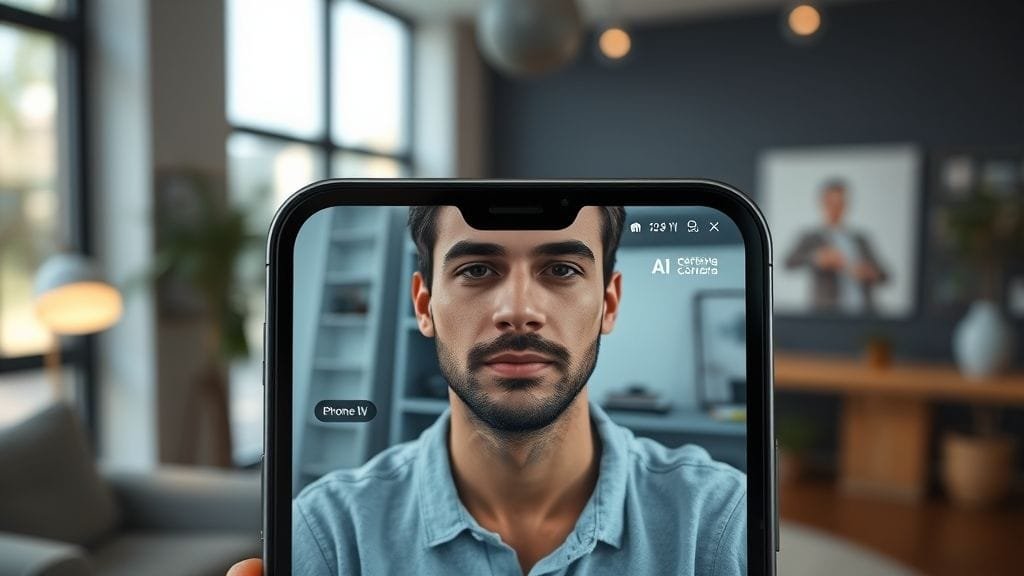
Tired of constantly adjusting your phone during video calls? Now, the innovative iPhone Center Stage features debut on the new iPhone 17 lineup. This solves a common frustration for mobile users. Video calls and content creation are daily essentials in our connected world. However, static camera angles often disrupt this experience. Center Stage intelligently anticipates movement, effortlessly keeping you centered. Consequently, it seamlessly includes everyone in the shot without any manual adjustments. This AI-driven technology transforms the front-facing camera into a dynamic videographer. Indeed, previously a standout on iPads, its arrival on iPhone promises a hands-free, professional-grade visual experience. This guide explores how this groundbreaking innovation works, enhancing your communication and content creation.

Elevating Mobile Video Calls with iPhone Center Stage Features
Apple consistently introduces technology to improve the user experience, and its auto-framing capabilities perfectly exemplify this philosophy. Initially, this Apple auto-framing launched on the iPad Pro, quickly becoming a popular feature there. Specifically, this innovative intelligent camera technology automatically frames users during video calls, consequently keeping them perfectly centered within the shot. Subsequently, the functionality later expanded to other iPad models; furthermore, it even came to select Mac computers. Overall, users consistently praise its intelligent and seamless operation, especially its dynamic framing capabilities for mobile video calls.
Bringing this advanced capability to the iPhone, however, represents a very important strategic move. Users already appreciate the Apple auto-framing on larger devices like the iPad and Mac. Nevertheless, its presence on iPhones promises a much greater impact for everyday interactions and mobile video calls. Since iPhones are our constant companions, we frequently use them for spontaneous video calls, quick social media content, and dynamic moments. Therefore, this intelligent camera with dynamic framing on the iPhone becomes a truly transformative feature, significantly enhancing user experience.

Understanding the Core of iPhone Center Stage Features
The iPhone, by its very nature, has diverse usage scenarios. Thus, this auto-framing technology addresses an even broader range of user needs. iPads are typically used in stationary settings; iPhones, however, support dynamic, on-the-go interactions, making mobile video calls a natural fit. This strategic move, consequently, highlights Apple’s overarching vision: it aims to integrate advanced innovations like Apple auto-framing across its entire ecosystem. Ultimately, this ensures a consistent and elevated experience, regardless of the chosen device.
Furthermore, the iPhone now gains a sophisticated intelligent camera companion, a feature previously exclusive to its larger siblings. This evolution is more than a simple technical port; rather, it represents thoughtful re-engineering, meticulously tailored for the smartphone’s distinct demands and dynamic usage patterns. As a result, Center Stage ultimately enhances numerous activities, ranging from casual FaceTime calls to professional vlogging, all of which now benefit from intelligent AI assistance and robust dynamic framing.
The Revolutionary 18MP Selfie Camera Behind Center Stage
To truly understand the brilliance of these auto-framing capabilities, one must look deeper, revealing a sophisticated interplay of hardware and software. This is not merely a digital zoom feature; instead, it constitutes a holistic system specifically designed for dynamic, real-time framing during video calls. Critically, the underlying magic lies in Apple’s reimagining of the front camera tech, transforming it into an “active participant” in your visual communication. This ingenious combination keeps you perfectly centered, even as you move, thanks to this advanced intelligent camera.
AI and Machine Learning Driving Apple Auto-Framing
The new iPhone 17 series features groundbreaking hardware, centered on an 18MP selfie camera with a unique square front-facing sensor. This marks a significant departure from previous rectangular cameras and is foundational to Center Stage‘s capabilities. This innovative front camera tech enables advanced Apple auto-framing.

Unlike traditional fixed-orientation sensors, this square sensor offers a much larger, more symmetrical canvas. It provides ample visual real estate around the primary subject, crucial for effective dynamic framing during video calls. This intelligent camera captures an ultra-wide field of view, often exceeding 120 degrees, granting Center Stage significant “digital headroom.”
This headroom allows the software to intelligently crop, pan, and zoom within the captured image without compromising resolution or causing pixelation. The front camera tech inherently “sees” much more than the screen displays. This flexibility ensures smooth frame adjustments and crisp detail, forming the indispensable physical basis for high-quality dynamic framing in all mobile video calls.
Beyond Hardware: Software Intelligence in iPhone Center Stage Features for iPhone Center Stage Features
While the square sensor provides the necessary hardware for this auto-framing system, its true intelligence originates from sophisticated AI. Specifically, it employs advanced machine learning algorithms. Crucially, this Apple auto-framing feature operates entirely on-device, which ensures superior privacy, speed, and reliability by completely avoiding cloud dependence for all video calls.
Real-Time AI Processing for iPhone Center Stage Features
Once active, Center Stage immediately uses the iPhone’s powerful on-device machine learning. It constantly analyzes the 18MP selfie camera’s live video feed. It precisely identifies and tracks human faces within the ultra-wide field of view, understanding position, movement, and relationship for fluid following and precise dynamic framing.
The AI dynamically calculates optimal adjustments, digitally cropping, panning, and zooming to keep individuals perfectly centered. This enhances all video calls. For multiple participants, this feature intelligently expands the view to include everyone, preventing anyone from being cut out, and smoothly reframes when someone leaves. This ensures seamless, natural group interactions with superior Apple auto-framing.
This entire process unfolds seamlessly and instantaneously, leveraging Apple’s Neural Engine for real-time, lag-free performance. This intelligent adaptability distinctly differentiates Center Stage from basic digital zoom features, creating the illusion of a dedicated human camera operator.
Effortless Apple Auto-Framing for iPhone Video Calls
Apple’s dedication to integrated hardware and software is clear in this auto-framing technology. The advanced software, integrating deeply with the iPhone’s operating system, leverages the square sensor’s potential. It works tirelessly yet invisibly for every video call, enhancing the user experience.
The iPhone’s Neural Engine, a dedicated hardware accelerator for AI/ML tasks, plays a crucial role. It enables sophisticated machine learning for Apple auto-framing, processing complex algorithms for lightning-fast face detection, tracking, and predictive dynamic framing.
Furthermore, the software applies advanced video stabilization, ensuring stable and smooth footage even with digital panning and zooming, mitigating handheld shakes. This intelligent combination makes the auto-framing system a robust enhancement to the iPhone’s front camera tech. It allows users to focus on conversation, not camera settings, showcasing a truly intelligent camera experience.
Key iPhone Center Stage Features Explored
Center Stage in the iPhone 17 lineup introduces truly transformative capabilities; indeed, it fundamentally changes how users interact with their front camera tech. These features are not merely for novelty; rather, they solve real-world problems and significantly enhance usability in many scenarios. Let’s explore these core functionalities to understand how each contributes to a more fluid, intuitive, and professional mobile experience, especially for mobile video calls.
Dual Capture Compatibility: Expanding iPhone Center Stage Features with iPhone Center Stage Features with Dynamic Framing with iPhone Center Stage Features
The cornerstone of the Center Stage system is undeniably its intelligent auto-framing and centering. This feature continuously tracks the primary subject, typically a person’s face. It then adjusts the visible frame to keep them perfectly in the middle. It is, therefore, akin to having a personal camera operator, dedicated solely to maintaining you as the focal point during video calls. This is achieved primarily through the innovative 18MP selfie camera square sensor, which crucially captures a much wider field of view than traditionally displayed. As you move, on-device machine learning algorithms dynamically pan, zoom, and crop within this larger canvas, thereby creating the illusion of a moving camera and excellent dynamic framing.
This functionality is incredibly beneficial for numerous activities. For instance, imagine giving a presentation while walking around your office, or cooking a meal while video chatting with family. You could even record a hands-free video diary, thanks to Apple auto-framing. Without this technology, however, you would constantly shift your phone, inevitably interrupting your flow and risking cutting yourself out. With Center Stage, conversely, you gain the freedom to move naturally, confident that the iPhone will consistently keep you in frame. This feature, therefore, removes a significant cognitive load, allowing users to focus entirely on their conversation or creative output without worrying about camera management.
Dynamic Group Shot Management with Apple Auto-Framing
Beyond individual framing, this auto-framing technology truly shines when expertly managing multiple subjects within a single frame. This marks a crucial advancement for group video calls, and it is also excellent for family gatherings or collaborative content creation. When Center Stage detects additional people, it doesn’t just stick to the original subject; instead, this intelligent camera intelligently and seamlessly expands the frame to include everyone, effectively preventing anyone from being cut out.

This dynamic adjustment, furthermore, ensures all participants remain visible and optimally centered with robust Apple auto-framing. If someone leaves the frame, the system gently reframes, refocusing on the remaining individuals and effectively eliminating awkward shuffling to fit into a static frame. Crucially, it prevents the frustration of someone being cut out of a family video call. For remote team meetings, virtual family dinners, or group vlogs, this dynamic framing feature profoundly transforms the experience, making interactions far more inclusive and natural. The algorithms, moreover, are highly sophisticated; they prioritize human faces to ensure framing is always centered around the scene’s most important elements, adapting in real-time to changing group conversation dynamics.
The Core Advantages of Apple’s Intelligent Camera Features for iPhone Video Calls
The 18MP selfie camera square sensor and Center Stage’s intelligence together offer powerful orientation flexibility. Traditional rectangular sensors often required physical phone rotation for switching between portrait and landscape video, sometimes even necessitating restarting the recording or call. The square sensor, however, captures enough visual information; therefore, it inherently supports both orientations without requiring physical device rotation, thus maintaining high resolution throughout, ideal for video calls.
For instance, you can seamlessly start a video call or recording in portrait mode. Without physically turning the phone, you can then switch to a landscape view for a wider perspective. Center Stage will intelligently adjust the crop and field of view accordingly, all without any need to physically turn the device. The system, indeed, intelligently switches orientation and recalibrates the frame. If you prefer vertical videos for platforms like TikTok and Instagram Reels, or traditional horizontal videos for YouTube, you can capture high-resolution footage in either orientation with unparalleled ease, thanks to this intelligent camera and its dynamic framing. This flexibility, consequently, greatly benefits content creators, who often adapt content for different platforms or simply desire the freedom to choose their preferred orientation.
Comparing iPhone Center Stage features: Apple’s Edge
Center Stage is not just about framing; critically, it also significantly contributes to overall video quality and professionalism, ultimately elevating your video calls. Intelligent panning and zooming combine seamlessly with Apple’s advanced video stabilization technology. This synergy, as a result, leads to remarkably stable and smooth footage, even when the subject moves or when the phone is handheld, thanks to the advanced front camera tech.

Gone are the days of jerky, distracting camera movements that often plague self-recorded videos. Its algorithms meticulously smooth out unintentional shakes and jitters. As a result, your video calls appear more polished, and your recorded content looks much more professional. For vloggers and influencers, this means less time spent in post-production, allowing them to focus entirely on their message. Likewise, for casual users, it simply translates to clearer, more enjoyable video memories and communications, powered by this intelligent camera. Ultimately, the combination of intelligent framing with robust stabilization creates a truly premium video experience, elevating the standard for mobile video capture on the iPhone.
Who Benefits Most from iPhone Center Stage Features?
This auto-framing technology further expands utility, working seamlessly with the iPhone’s Dual Capture mode. Dual Capture allows simultaneous recording from both front and rear cameras, opening new avenues for creative expression and dynamic storytelling. When Center Stage is enabled during Dual Capture, it specifically manages the front camera tech’s framing for you.
While your rear camera captures the main scene, your front camera, empowered by Center Stage, keeps you perfectly framed and centered as you narrate, react, or interact. For example, a travel vlogger captures sights with the rear camera, while Apple auto-framing ensures their commentary remains perfectly framed. This enhances Dual Capture, transforming it into a powerful tool for creators to capture both perspectives with precision, especially for mobile video calls.
Collectively, these advanced auto-framing capabilities represent a significant leap forward. They profoundly enhance mobile camera technology, effectively transforming the iPhone into an active, intelligent partner in visual communication. This empowers users to create, connect, and express themselves with unprecedented ease and quality, thanks to this advanced intelligent camera.
The Core Advantages of iPhone Center Stage Features
The introduction of Center Stage to the iPhone 17 series is more than a mere technical upgrade; fundamentally, it is a functional enhancement. It effectively solves everyday problems for diverse users. Its intelligent Apple auto-framing capabilities, moreover, cater to a wide array of needs, ranging from professional content creation to casual family interactions. Identifying who benefits most from these advanced features highlights their widespread utility and significant impact.
An Intuitive and Seamless Experience with Apple Auto-Framing
Perhaps no group benefits more directly from this innovative technology than content creators, including vloggers and social media influencers. For them, consistently high-quality footage is paramount. Center Stage, therefore, acts as an invaluable assistant in several ways, delivering exceptional Apple auto-framing.
- Hands-Free Recording: Creators can set up their iPhone and then move freely within the frame while talking, demonstrating, or reacting, without having to worry about staying in shot. This is ideal for cooking tutorials, fitness routines, unboxing videos, or DIY projects, where their hands are otherwise busy. The intelligent camera handles the framing.
- Consistent Framing: This feature consistently ensures the creator is always centered and well-composed. This, consequently, eliminates the need for constant manual adjustments or retakes, thereby elevating production value.
- “Always-on” Personal Camera Operator: It effectively replaces the need for a second person to operate the camera, thus giving solo creators newfound independence and efficiency, especially when paired with a tripod, powered by front camera tech.
- Higher Production Value: Smooth panning, intelligent zooming, and enhanced video stabilization combine to contribute to more polished and engaging content. This, in turn, allows creators to focus on their narrative and creativity, thanks to dynamic framing.
Maximizing the Potential of iPhone Center Stage Features
Remote work and online learning are on the rise; consequently, video calls and video conferencing have become an integral part of professional and academic life. Center Stage, therefore, significantly enhances this experience for all participants.
- Professional Presence: During virtual meetings, presentations, or online classes, Center Stage meticulously keeps the speaker perfectly framed, even if they shift, stand up, or gesture. This, as a result, projects a more professional and engaged image.
- Freedom to Move: Students in online discussions or presenting projects can move naturally, without fear of drifting out of view. This, in turn, makes their interactions more dynamic and less constrained, due to intelligent Apple auto-framing.
- Reduced Distractions: Automatic framing minimizes fiddling with the phone’s position, thereby allowing participants to concentrate fully on the discussion or lecture, a core benefit of this intelligent camera.
The Foundation of Intelligent Camera Technology for iPhone
Center Stage is often highlighted for professional applications; however, it also offers immense convenience for everyday iPhone users and benefits families alike. Its dynamic framing capabilities enhance personal interactions.
- Easier Video Calls with Children or Pets: Capturing dynamic subjects like children or pets during a video call can be particularly challenging. Center Stage, however, ensures that even if they wiggle or move, they consistently remain in the frame. This, consequently, makes family calls more inclusive and less stressful.
- Effortless Group Photos/Videos: Imagine effortlessly getting everyone into a spontaneous group selfie video, or a quick family video call. Center Stage automatically expands the frame to include everyone, thus simplifying the process and ensuring no one is left out, thanks to the front camera tech.
- Enhanced Memories: Recording everyday moments becomes simpler and more effective. For instance, parents can capture their kids playing, knowing the iPhone’s intelligent camera will track their movement, which results in more complete and engaging video memories, thanks to Apple auto-framing.

Anyone Who Values Convenience and Quality
Center Stage is designed for anyone frustrated by a static front camera tech. It represents a significant step forward, making technology work smarter for us instead of requiring us to constantly adapt to its constraints. It effectively simplifies common smartphone frustrations and enhances video quality, especially for video calls. Crucially, it provides an intelligent, hands-free experience. This intelligent camera ultimately caters to a universal desire for more seamless interactions, empowering users to focus on what truly matters, including their communication, content, or connection, without having to worry about being out of frame.
Comparing Center Stage: Apple’s Edge
Innovation drives progress in the competitive smartphone market. While many devices feature intelligent framing concepts, Apple’s Center Stage distinctly distinguishes itself. It leverages a unique combination of dedicated hardware, sophisticated on-device AI, and seamless ecosystem integration for superior Apple auto-framing.
Many smartphones offer digital zoom or face tracking with notable limitations. Basic digital zoom often leads to detail loss and pixelated images. Generic face tracking frequently lacks the fluid, predictive panning, zooming, and intelligent multi-subject management that defines Center Stage and its superior dynamic framing.
A common comparison arises with the Samsung Galaxy Z Flip 7’s ultrawide camera. While the Z Flip 7 can achieve a wide capture, sometimes exceeding Center Stage’s field of view, its detail can appear softer, contrasting sharply with the consistent quality this intelligent camera delivers. This includes the high performance of the 18MP selfie camera.

The Core Advantages of Center Stage
Center Stage stands out. At its core is a dedicated 18MP selfie camera square sensor, engineered for optimal framing. This unique shape offers maximum flexibility for cropping and panning without sacrificing resolution, delivering sharp, detailed image quality even with dynamic adjustments for video calls.
Beyond hardware, Apple’s powerful Neural Engine fuels Center Stage’s real-time intelligence. This on-device machine learning instantly handles face detection, tracking, and framing adjustments, eliminating lag and removing cloud dependence. Local processing enhances user privacy and maintains high performance, distinguishing its Apple auto-framing from competitors.
The system also balances a generous field of view with impeccable detail. Center Stage provides a robust 120-122 degree capture area. Its intelligent algorithms meticulously preserve image detail, preventing pixelation common with digital zoom, characteristic of this advanced intelligent camera and its dynamic framing.
An Intuitive and Seamless Experience
Center Stage embodies Apple’s profound commitment to an invisible and intuitive user experience. True to Apple’s design philosophy, users never need to manually activate complex settings, nor do they have to learn intricate controls. Instead, it simply works automatically in the background, allowing individuals to focus entirely on their communication or content without needing to manage the camera. This intuitive, “it just works” approach, consequently, stands as a significant market differentiator for Apple auto-framing and video calls.
While other devices offer various intelligent camera functionalities, Apple’s Center Stage, however, delivers a refined, robust, and thoughtfully integrated solution. It expertly leverages custom hardware alongside advanced AI, thus providing a consistently superior and high-quality user experience for video calls. Its true strength, moreover, lies not merely in its capabilities, but also in how effortlessly and effectively it accomplishes them, thanks to its front camera tech.
Limitations and What to Expect
While Apple’s auto-framing technology greatly enhances mobile camera technology, understanding its inherent limitations is crucial. This helps set realistic expectations and maximize utility, as Center Stage operates within defined parameters. Its primary constraint stems from the ultra-wide front camera tech’s physical capabilities. This auto-framing system cannot maintain framing beyond its typical 120-122 degree field of view (FOV). While offering considerable freedom, this range is not limitless. Moving too far back, quickly out of peripheral vision, or turning away will cause the system to lose track. Users, therefore, must remain within this defined operational area when using the intelligent camera.
Maximizing Center Stage’s Potential
Center Stage interacts uniquely with manual camera controls. As an automatic system, specific manual overrides temporarily disable it. Manual zoom or aspect ratio adjustments, for instance, during a video call deactivate Center Stage. This occurs because manual input signals direct intent, overriding AI adjustments. Once manual action ceases, however, Center Stage typically re-engages automatically, resuming its Apple auto-framing.
Understanding these limitations does not diminish this technology’s value; instead, it guides its most effective application. This knowledge empowers users to know when to trust its automatic brilliance and when to assume manual control. Center Stage’s expansive FOV and intelligent tracking are sufficient for most uses. Respecting operational boundaries allows users to fully leverage its transformative capabilities. These minor trade-offs enhance the convenience and quality Center Stage adds to the iPhone experience.
Future Implications and Beyond
Center Stage on the iPhone 17 represent far more than just a new camera feature. It showcases Apple’s profound vision for mobile imaging. This innovation, moreover, sets a new standard, illustrating precisely how future iPhones will perceive and engage with their environment. It actively builds a crucial foundation for even more sophisticated capabilities. Its influence, consequently, extends far beyond simple video calls, hinting at a future where our devices become truly intuitive, proactive, and seamlessly integrated into our daily digital lives.
This advancement strongly propels us toward AI-driven computational photography and videography. Future iPhone cameras will increasingly harness artificial intelligence, empowering them to profoundly understand scenes, subjects, and user intent. They will leverage dedicated Neural Engines and sophisticated machine learning algorithms. We can, therefore, anticipate much more nuanced subject tracking; it could even distinguish specific individuals and also learn user framing preferences over time. The concept of an “intelligent lens” is clearly emerging, as this lens dynamically adapts to diverse situations, mirroring the dynamic framing of this auto-framing technology.
The Foundation of Intelligent Imaging
The hardware foundation of Center Stage reveals a crucial trend; it points directly to more versatile and data-rich sensors. Its 18MP selfie camera square sensor, for example, features an ultra-wide field of view and utilizes an “oversampling” technique. This captures far more information than initially displayed, offering immense flexibility for post-capture processing and real-time adjustments. Similarly, future sensor designs will power enhanced zoom in future iPhones, improve low-light performance through intelligent cropping, and enable dynamic stabilization by using excess peripheral data.
Furthermore, Center Stage’s advanced spatial awareness and precise subject tracking will become vital for augmented reality (AR) and virtual reality (VR) integration. Apple, for instance, has a substantial investment in AR/VR technologies, including Apple Vision Pro. A front camera tech capable of accurately tracking users in three-dimensional space, consequently, proves invaluable. Picture AR applications seamlessly anchoring digital objects to a moving person. Envision virtual meetings where your avatar’s movements precisely mirror your own. Robust AR experiences, indeed, fundamentally rely on identifying individuals and tracking them within their real-world environment, a capability built upon Apple auto-framing.

Enhancing User Experience and Ecosystem Integration
Beyond its technical marvels, this auto-framing technology’s evolution points towards a more seamless and intuitive user experience. Apple aims to eliminate friction, allowing users to concentrate on goals instead of device operation. Future iterations might offer proactive content suggestions or automated editing, suggesting the iPhone could become a proactive creator partner, thanks to its intelligent camera.
Finally, Center Stage’s success powerfully reinforces ecosystem synergy. Extending this popular iPad and Mac feature to the iPhone shows Apple’s commitment to a consistent and powerful experience across all its devices, especially for video calls. This strategy encourages deeper user engagement within the Apple ecosystem, fostering brand loyalty and solidifying Apple’s leadership in integrated hardware and software innovation.
In conclusion, Center Stage on the iPhone offer a compelling glimpse into mobile photography and videography’s future. They signify a profound move towards more intelligent, adaptive cameras, empowering users with professional-grade tools while retaining Apple’s characteristic simplicity. Our iPhones will become more capable and intuitive, seamlessly woven into digital lives.
Conclusion
The iPhone 17’s Center Stage undeniably marks a significant advancement, fundamentally enhancing mobile camera technology. Apple has integrated sophisticated, AI-driven Apple auto-framing directly into its latest device. This transforms a common user frustration into an effortless experience. This innovative system combines an 18MP selfie camera square front-facing sensor with advanced on-device machine learning. This allows the intelligent camera to intelligently understand and adapt to your movements, seeing more than ever before for seamless video calls.
This technology offers a comprehensive range of powerful capabilities. Its core function meticulously keeps you perfectly centered during video calls. It also seamlessly handles group shots, and intelligently adapts to both portrait and landscape orientations. This significantly enhances video quality and stability. Its compatibility with Dual Capture mode, furthermore, provides content creators with exciting new creative possibilities, all thanks to advanced dynamic framing.
Elevating Your Communication and Content
Center Stage is both practical and powerful, extending far beyond just a clever feature. It benefits a wide range of users, including professional vloggers, remote workers, casual users, and families alike. Individuals can communicate, create, and connect with enhanced freedom and confidence. This effectively eliminates the constant need for manual adjustments and consistently ensures a more professional output, powered by this advanced intelligent camera.
Despite its operational boundaries, this technology clearly stands out in the competitive market. It delivers a superior balance, encompassing a wide field of view, meticulous detail preservation, and unparalleled ease of use. This success stems directly from Apple’s integrated hardware and software expertise. Its inclusion in the iPhone 17 series highlights Apple’s dedication to continuous innovation. It also points to a future where technology serves us more intelligently and invisibly. Center Stage ultimately exemplifies how intelligent design enriches our daily digital interactions, making every video call, selfie, and recording a more fluid, engaging, and perfectly framed experience with Apple auto-framing.