
Imagine a world without rapid global communication, accurate weather forecasts, or precise directions. Such a world is difficult to imagine today, yet it was the norm only a few decades ago. However, a profound transformation has occurred, stemming from one of humanity’s greatest inventions: the artificial satellite. This article delves into the history of satellites, tracing their evolution from early scientific dreams to their widespread modern applications. Ultimately, this exploration reveals how satellites have reshaped our lives, work, and understanding of the universe. The history of satellites is truly a story of profound transformation.
Indeed, this journey into space tells a powerful story. It highlights human ingenuity, intense rivalries, and continuous innovation. It unveils how scientific concepts transformed into tangible realities, and these realities have profoundly reshaped our modern world.

From Vision to Velocity: Early Concepts in Satellite History
The idea of man-made objects circling Earth did not simply materialize in the mid-20th century. Rather, the first ideas for satellite technology emerged decades earlier. These ideas prepared humanity for its monumental technological leaps. This era laid the foundational concepts for the future history of satellites. These early steps were clearly crucial, and a closer examination of this period is essential to fully grasp the full history of satellites.
Tsiolkovsky’s Vision: Early Steps in the History of Satellites
In 1903, Russian rocket scientist Konstantin Tsiolkovsky demonstrated the theoretical possibility of an artificial satellite. He used mathematical principles to prove his theories. His calculations defined the orbital velocity required for an object to circle Earth and remain in space. Furthermore, he suggested using multi-stage rockets, fueled by liquid propellants, as the means to achieve spaceflight. These ideas were decades ahead of their time. His work established the scientific foundation for all subsequent rocket and satellite development. His contributions were indeed immensely significant; these early mathematical derivations were pivotal to the history of satellites.
Arthur C. Clarke‘s Vision in the History of Satellites
In 1945, as the world was recovering from war, British writer Arthur C. Clarke, a science fiction writer and Royal Air Force officer, wrote an article. In it, he proposed the concept of geostationary satellites. He theorized that these unique satellites, positioned at a specific altitude and speed above the equator, would appear stationary over a single point on Earth. Clarke envisioned these high-altitude platforms as global communication relays, enabling television signals, phone calls, and data to travel across the globe. Consequently, this idea marked a pivotal moment in the history of satellites. His foresight proved remarkably accurate, to the extent that this specific geostationary orbit is sometimes referred to as the ‘Clarke Orbit’.

A diagram illustrating Arthur C. Clarke’s concept of a geostationary satellite orbit, showing its fixed position relative to the Earth’s equator.
John Pierce‘s Contributions to Early Satellite Development
Tsiolkovsky and Clarke had broad ideas for satellite development. However, American scientist John Pierce developed a crucial component: the traveling wave tube amplifier. This device proved indispensable for satellite communication. Innovations like this were vital in transforming theoretical concepts into practical systems. Specifically, it allowed satellites to receive radio signals, amplify them, and then retransmit them. Therefore, these early conceptual and technological advancements collectively paved the way for the launch of the first operational satellites, marking a new stage in the history of satellites.
The Space Race Ignites: A Pivotal Era in the History of Satellites
The theoretical groundwork for satellite technology became a tangible reality on October 4, 1957. On that day, the Soviet Union successfully launched Sputnik 1, the world’s first artificial satellite. This event started the Space Age. It also ignited an intense competition. This rivalry, in turn, spurred immense technological advancements, profoundly shaping the early history of satellites. Indeed, Sputnik’s inaugural success sparked a fierce competition and irrevocably altered the history of satellites.
Sputnik 1, though seemingly simple in appearance, was a complex feat of engineering. It was a polished metal sphere, roughly the size of a beach ball, weighing 83.6 kilograms. As it circled Earth, it emitted distinctive “beep-beep” radio signals, which amateur radio operators worldwide could readily tune into. This audible testament symbolized humanity’s first successful venture beyond Earth’s atmosphere. It sent shockwaves across the globe, marking a monumental turning point in the history of satellites. The world’s perception of space was forever altered, prompting further rapid advancements in the history of satellites.

An iconic image from the history of satellites, depicting Sputnik 1, the first artificial satellite, in orbit, emitting its distinctive ‘beep-beep’ signals.
Sputnik’s Echo: A Turning Point in the History of Satellites
Sputnik 1’s launch had immediate and profound repercussions, mainly in the United States. This event sparked widespread fears of a significant technological gap between the U.S. and the Soviet Union. It transformed the Cold War into a full-blown “Space Race.” Therefore, the American government responded swiftly and decisively. They rapidly accelerated their own satellite program. This served as a clear call to action. Ultimately, this competition significantly propelled the history of satellites forward.
Explorer 1: A Key Event in American Satellite History
Following initial setbacks, the U.S. successfully launched its first satellite, Explorer 1, on January 31, 1958. Explorer 1 carried scientific instrumentation. Specifically, these tools collected crucial data about Earth’s upper atmosphere. This culminated in the momentous discovery of the Van Allen radiation belts. This success demonstrated the immense potential of early science satellites, contributing greatly to our understanding of our planet. Indeed, its findings were groundbreaking and vital. Consequently, Explorer 1’s success stands as a major milestone in the history of satellites.
The Soviets Respond: Early Achievements in Satellite Exploration
The Soviet Union continued to push the boundaries in satellite exploration. For instance, Sputnik 2, launched in November 1957, carried the first living creature into orbit: a dog named Laika. This mission provided invaluable data on the biological effects of spaceflight, a crucial step towards making human space travel a reality. Furthermore, in May 1958, Sputnik 3 was launched. It was a larger and more sophisticated scientific spacecraft, tasked with studying Earth’s atmosphere and magnetic field. This further advanced the early history of satellites. Thus, each successive launch incrementally expanded humanity’s knowledge base.
Project SCORE: A Milestone in Communication Satellite History
In December 1958, the United States launched Project SCORE. SCORE, an acronym for Signal Communications by Orbiting Relay Equipment, marked the world’s first operational communication satellite. Significantly, SCORE was different from passive satellites. It possessed the capability to receive, record, and retransmit messages. Its most famous mission involved transmitting a recorded Christmas message from President Dwight D. Eisenhower to the world. This broadcast vividly demonstrated the immense potential of these nascent communication satellites to facilitate global communication. Its retransmission capability was a revolutionary advancement. Therefore, Project SCORE represented a monumental stride forward in the history of satellites.
The Satellite Boom: Key Developments in Satellite History
Building on the early successes of Sputnik and Explorer, the 1960s ushered in a transformative era for satellite development. The emphasis shifted from merely demonstrating satellite capabilities to exploring their diverse applications. Consequently, this decade witnessed rapid expansion, transforming satellites from experimental curiosities into indispensable tools. These tools became critical for communication, weather forecasting, navigation, and scientific research, profoundly shaping the history of satellites. Indeed, their applications proliferated rapidly during this period. Thus, satellites became integral to modern life, securing their prominent place in the history of satellites.
Communication Satellites: A Major Chapter in Satellite History
One of the most revolutionary impacts of satellites was in the field of communication. Early efforts, like the U.S. Echo I (1960), were passive communication satellites; they simply reflected radio signals. However, the monumental breakthrough arrived with Telstar 1, launched in July 1962. Telstar 1 was the first active communication satellite. It possessed the ability to amplify and retransmit signals. This innovation enabled live television broadcasts and telephone calls across the Atlantic.
Arthur C. Clarke’s vision of geostationary satellites became a reality with Syncom 3 in 1964. This satellite was precisely positioned in geostationary orbit, appearing stationary over a single point on Earth. This proved immensely valuable for stable communication links. For instance, Syncom 3 broadcast the Tokyo Olympic Games live to American viewers. This success also catalyzed the formation of global consortia like INTELSAT. INTELSAT launched its first commercial satellite, Early Bird (Intelsat 1), in 1965. Ultimately, these achievements solidified satellites as the primary backbone for global communication and commerce. They mark an indispensable chapter in the history of satellites.

A vintage photograph or illustration of the Telstar 1 communication satellite, or a diagram showing how early communication satellites relayed signals across continents.
Weather Satellites: Their Role in the History of Satellites
TIROS-1, launched in April 1960, marked the dawn of successful weather satellites. Its mission was to collect meteorological data from space, significantly enhancing our understanding of global weather patterns. In fact, satellites provided an unprecedented, continuous, and comprehensive perspective of weather systems. This resulted in improved hurricane warnings and more accurate long-range forecasts. Ultimately, this has saved countless lives and protected vast amounts of property. Therefore, these contributions remain fundamental to the ongoing history of satellites.
Navigation Systems: A Key Aspect of Satellite History
The first satellite navigation system, Transit, became operational in 1964. Developed primarily for the American military, it provided submarines and ships with precise positional data. Thus, Transit paved the way for the Global Positioning System (GPS). The modern GPS constellation began with the launch of the first NAVSTAR satellite in 1978. Today, GPS is indispensable for navigation across numerous sectors. Its applications range from personal devices and shipping to air traffic control and emergency services. Consequently, this development marks another crucial chapter in the history of satellites. Its impact, transitioning from military to widespread civilian use, has been immense. Indeed, the evolution of these systems is central to the history of satellites.
Earth Observation: The Continuing History of Satellites
Satellite technology provided an unprecedented vantage point for observing our planet and exploring space. For instance, Earth observation satellites, such as Landsat 1 (1972), delivered vital imagery. These images were instrumental in environmental monitoring, tracking deforestation, water resources, and urban expansion. They also supported precision agriculture and urban planning. Moreover, beyond Earth, scientific satellites ventured deeper into space. Luna 10 (1966) became the first artificial satellite to orbit the Moon. Furthermore, Vostok 1 (1961) carried the first human, Yuri Gagarin, into Earth orbit. These numerous missions continuously augmented our scientific knowledge and enhanced our understanding of the universe, enriching the history of satellites. Indeed, new discoveries were constantly being made. Thus, their pivotal role in understanding both Earth and space continues to be an expanding chapter in the history of satellites.
Modern Satellites: An Ongoing Chapter in Satellite History
Satellite technology has evolved at an astonishing pace, profoundly transforming contemporary society. These orbiting devices are no longer merely complex machines. Instead, they are integral to the functioning of our modern world. Indeed, they impact daily life in countless ways. This ongoing evolution underscores the dynamic growth in the history of satellites.

A collage or infographic illustrating the diverse applications of modern satellites, including GPS, weather monitoring, and global communication.
Global Connectivity: Milestones in Satellite Advancements
Satellites enable instantaneous global communication, effectively shrinking the world. They facilitate crystal-clear phone calls, high-speed data transfer, and live television broadcasts. Moreover, they extend connectivity even to the most remote regions. This capability allows for the rapid exchange of information and shared experiences across continents. Additionally, these advancements have fostered greater understanding and stronger global connections, truly creating a global village. Clearly, this represents a monumental success in the history of satellites.
Navigation and Transportation: A Modern Chapter in Satellite History
GPS and similar satellite navigation systems have fundamentally transformed navigation and the management of transportation. Personal devices, shipping, air traffic control, and emergency services all rely on GPS for precise positioning services. Thus, these systems are now indispensable components of modern transportation and public safety infrastructure. The accuracy they provide is invaluable. Ultimately, this impact highlights a crucial dimension of the history of satellites.
Environmental Monitoring and Disaster Management: Guardians of Our Planet
Earth observation satellites provide critical data, aiding our understanding, monitoring, and protection of the planet. These environmental satellites monitor ocean temperatures, forest fires, oil spills, and pollution levels. They are also vital tools in the fight against climate change. These tools provide tangible evidence of melting glaciers and rising sea levels. Furthermore, they assist in disaster relief efforts, demonstrating the multifaceted utility of modern satellites. Indeed, the data they provide is invaluable for addressing global challenges and safeguarding our planet. This exemplifies a critical aspect of the history of satellites.
Military and Reconnaissance: A Long History of Satellite Use
While military interests initially propelled satellite development, they continue to be paramount for national security. Military satellites are deployed for reconnaissance, providing high-resolution imagery and early warnings of missile launches. Moreover, they are crucial for secure military communications, mapping, and target acquisition. They also facilitate precise weapon guidance, underscoring their significant importance in global geopolitics and their enduring role in the history of satellites. Clearly, their strategic importance is immense.
Economic Impact and the History of Satellites
Satellite technology profoundly influences the economy, extending far beyond communication and navigation. The data and services they provide underpin vast industries. These include agriculture (precision farming), energy and mining (resource exploration), and urban planning. Furthermore, satellites enable critical services, such as inventory management, credit card approvals, and ATM transactions. As a result, the satellite industry itself is a multi-billion-dollar sector, driving innovation and creating employment opportunities globally. This illustrates the pervasive impact of these orbiting devices. In fact, entire industries are reliant upon them. Therefore, the economic dimension is a core component of the history of satellites.
The Modern Constellations: A New Chapter in Satellite History
The history of satellites continues to evolve rapidly. This is evident in the shift from large, expensive, singular satellites to smaller, more affordable, mass-produced units. So, this change enables the deployment of numerous satellite constellations, which promise unprecedented levels of global connectivity.
As of December 2022, 6,718 operational satellites orbited Earth. This figure highlights the sheer volume of satellites in orbit. The United States leads with 4,529 satellites (3,996 commercial), followed by China (590) and Russia (174).
| Country | Operational Satellites (Dec 2022) | Commercial Satellites |
|---|---|---|
| United States | 4,529 | 3,996 |
| China | 590 | N/A |
| Russia | 174 | N/A |
| Other Countries | ~1,425 | N/A |
| Total | 6,718 | ~4,000+ |
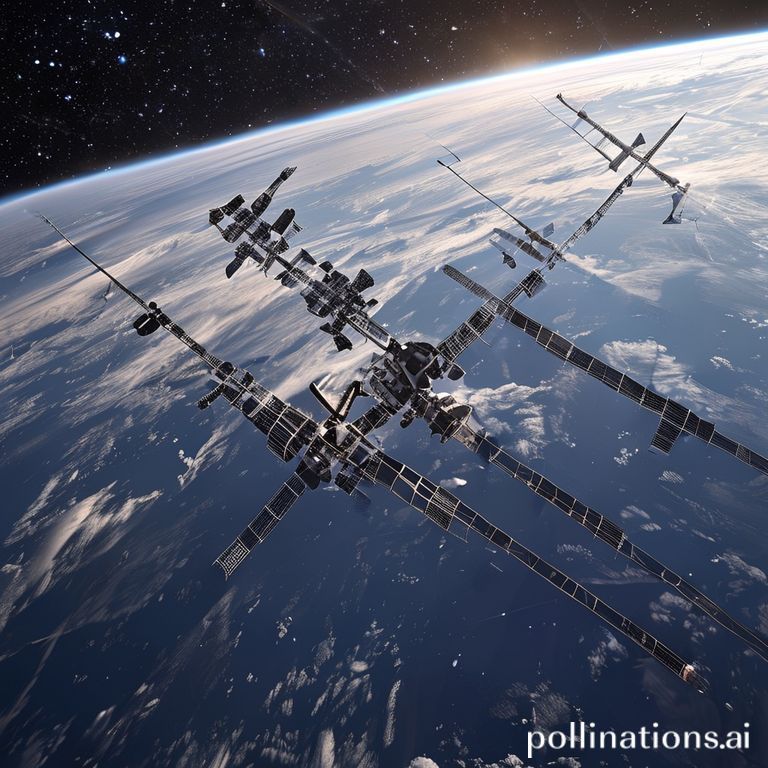
An artistic rendering of a large satellite mega-constellation, like Starlink, comprising numerous small satellites in Low Earth Orbit (LEO).
The Rise of Mega-Constellations: A New Chapter in Satellite History
This move towards smaller satellites has enabled the proliferation of large constellations, exemplified by SpaceX’s Starlink. These initiatives aim to deliver high-speed internet globally, especially to underserved regions. Such systems promise consistent, high-bandwidth internet access. The broader trend, encompassing CubeSats and nanosatellites, democratizes access to space and makes satellite technology more accessible to smaller companies, universities, and researchers.
A Future of International Collaboration in Space
While Cold War rivalry initially drove satellite development, the field has now become increasingly globalized. Many nations, including Canada, France, Japan, India, and China, have established robust space programs. As a result, this fosters international collaboration. Projects like the International Space Station (ISS), for example, exemplify the strength of international cooperation, conducting vital research that benefits all humanity. Looking ahead, satellites promise even more groundbreaking advancements. These include solar power satellites, in-orbit servicing, and the integration of Artificial Intelligence (AI) for increasingly autonomous and intelligent operations. Indeed, such innovations will continue to transform human life, strengthen our connection with the universe, and further shape the history of satellites. Clearly, innovation continues at a rapid pace. Therefore, the future promises even more novel developments in the history of satellites.
The Enduring Legacy: Key Milestones in the History of Satellites
From Tsiolkovsky’s nascent ideas to today’s vast satellite constellations, the history of satellites is a testament to human ingenuity. These remarkable machines, born from scientific curiosity and geopolitical rivalry, have evolved beyond their initial purposes to become indispensable tools. So, they have profoundly transformed communication, navigation, remote sensing, and our understanding of both our planet and the cosmos. Moreover, satellites have fundamentally altered our perspective, offering a unique vantage point from space. This provides crucial data to safeguard our fragile, interconnected planet. Furthermore, they connect us instantaneously across the globe, fostering global communities and economic growth. Their story is far from over; we are only beginning to fully realize their potential and understand how satellite technology will continue to evolve. In conclusion, the transformative impact of satellites will only continue to expand.