
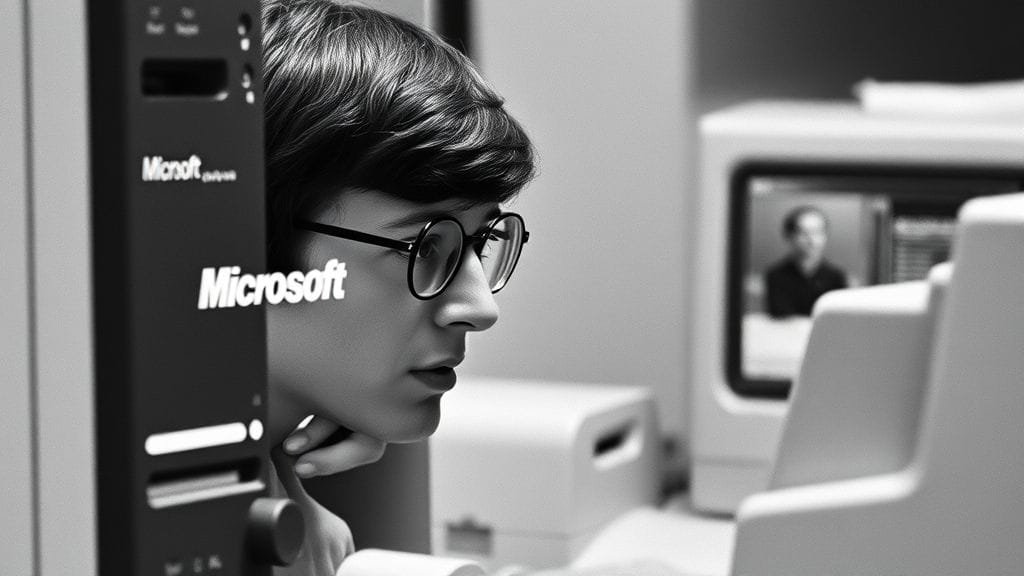
The name Bill Gates is synonymous with innovation, groundbreaking technology, and immense wealth. However, the history of Bill Gates is complex. Indeed, it’s more than simply a brilliant programmer’s story. Specifically, he co-founded Microsoft. Moreover, his journey traces the personal computer revolution, marking a dramatic shift towards global philanthropy. Consequently, it also sparks debate about private wealth’s influence on public good.
Delving into his past reveals a strategic mind. Furthermore, you uncover relentless drive and pivotal decisions. Evidently, these shaped his destiny and also shaped our digital world. Therefore, explore the trajectory of this tech titan to understand what propelled him. Ultimately, he went from a Seattle teenager and subsequently became one of humanity’s most influential figures.

The Genesis of a Digital Empire: Bill Gates’ Early Life and Microsoft’s Founding
William Henry Gates III was born on October 28, 1955, in Seattle, Washington. From an early age, he showed exceptional aptitude for math and science. Specifically, his intellectual curiosity was ignited at Lakeside School. This exclusive preparatory school indeed sparked his interest, particularly focusing on nascent computing. There, he encountered a teletype terminal and the BASIC programming language, thus sparking a lifelong passion.
At Lakeside, Gates forged a crucial friendship, namely with Paul Allen, a fellow student. Significantly, Allen shared his intense fascination with computers. Consequently, together they spent countless hours honing their programming skills, even developing a traffic-counting system called Traf-O-Data. This early entrepreneurial venture, although small, nevertheless foreshadowed the future partnership that would redefine an industry.
Harvard, BASIC, and a Bold Leap
Bill Gates enrolled at Harvard in 1973, having scored 1590 out of 1600 on his SATs. His academic career at Harvard, however, proved short-lived. Instead, a pivotal moment arrived in 1975 when Gates and Allen read an article on the Altair 8800. It appeared in Popular Electronics. The Altair 8800 was an early microcomputer, and consequently, they immediately recognized its immense potential, envisioning a world where personal computers would be commonplace.
This vision then spurred Gates to make a courageous decision: he dropped out of Harvard. Subsequently, he and Allen moved to Albuquerque, New Mexico, specifically to be closer to MITS, which created the Altair. For clarification, MITS stood for Micro Instrumentation and Telemetry Systems. Here, they officially co-founded “Micro-Soft,” which later became Microsoft. Their initial product was a BASIC adaptation for the Altair 8800, which was a groundbreaking achievement. Ultimately, it brought software to nascent hardware. For more context on early tech developments, therefore, consider reading about [the history of computing](/blog/thehistoryof_computing/).
Microsoft’s Unstoppable Rise to Global Dominance
Microsoft registered its trade name in 1976. Indeed, it quickly became a central force in the emerging personal computer landscape. However, it was a strategic move in 1980 that truly propelled the company into the stratosphere. At that point, Microsoft secured a contract with IBM, the undisputed giant of computing. Consequently, Microsoft would provide the operating system for IBM’s forthcoming personal computer.
This deal, which saw Microsoft develop MS-DOS, was revolutionary. Gates did not sell the OS outright to IBM; instead, he negotiated to license it. Significantly, this allowed Microsoft to sell MS-DOS to other hardware manufacturers. Therefore, this single decision laid the foundation for Microsoft’s future monopoly.
Key Milestones in Microsoft’s Expansion
The early 1980s witnessed an explosion in Microsoft’s growth and influence. For example, the company incorporated in 1981, at which point Bill Gates became president and chairman of the board. Indeed, the sheer pace of expansion was staggering.
Thus, consider these formative years:
- 1980: Microsoft partners with IBM, thereby securing the MS-DOS deal.
- 1981: Microsoft incorporates. Consequently, staff grew from 40 to 129, and subsequently, sales skyrocketed from $8 million to $17.3 million.
- 1985: Microsoft Windows launched. It featured a graphical user interface. Moreover, this democratized computing, making it accessible to a much broader audience.
- 1986: Microsoft went public with its initial public offering (IPO). As a result, Gates, then 31, became the youngest billionaire.
Windows rapidly became the global standard for personal computer operating systems. Therefore, it cemented Microsoft’s position as the world’s largest PC software company. Subsequently, Gates amassed unprecedented wealth in this era. Indeed, Forbes ranked him the world’s wealthiest person for 18 out of 24 years, specifically between 1995 and 2017. Furthermore, he even briefly attained centibillionaire status in 1999, with a net worth surpassing $100 billion. The sheer scale of this success undoubtedly reshaped the entire tech industry. For a deeper dive into how this impacted the market, therefore, explore [understanding software monopolies](/blog/understanding-software-monopolies/).
Bill Gates’ Pivot: From Software Architect to Philanthropic Visionary
As the new millennium dawned, Bill Gates began a pivot. It was gradual yet significant. Specifically, he moved away from Microsoft’s day-to-day operations. In 2000, he transitioned from CEO to chief software architect, a role he held until 2008. This change consequently marked a beginning where he made concerted efforts. Thus, he dedicated more time and resources to global philanthropy. Ultimately, he fully resigned from Microsoft’s board in 2020, thereby signaling a complete transition in his primary focus.
This shift wasn’t entirely sudden; instead, it evolved from earlier charitable initiatives. For instance, The William H. Gates Foundation (1994) started the groundwork. The Gates Library Foundation (1997) also helped. Collectively, these became his most impactful venture beyond Microsoft.
The Bill & Melinda Gates Foundation: A New Chapter
In 2000, Bill Gates and his then-wife, Melinda French Gates, co-founded the Bill & Melinda Gates Foundation. This new entity not only absorbed their previous charitable endeavors but also quickly became the world’s largest private charitable organization. Initially, the foundation had a $20 billion endowment. Consequently, it set ambitious goals, many of which were inspired by UN Millennium Development Goals.
Specifically, the foundation’s core focus areas include:
- Global Health: Targeting preventable diseases, vaccine development, and health infrastructure improvements.
- Global Development: Addressing poverty, hunger, and access to sanitation in developing nations.
- U.S. Education: Working to improve educational outcomes and opportunities across America.
Gates famously pledged to give away most of his wealth. Indeed, the foundation has donated billions. These funds therefore go towards its objectives. For instance, its efforts combat poverty and dramatically improve global health. Furthermore, initiatives eradicate diseases like polio, TB, and malaria. They also expand education access worldwide. By 2023, consequently, the foundation boasted assets of $76.9 billion, underscoring the immense scale of its operations.

Navigating the Scrutiny: Criticisms and Controversies
Bill Gates is celebrated for his tech prowess and also praised for philanthropic endeavors. However, his career faced criticism and controversy. Specifically, during Microsoft’s ascendancy in the late 1990s, the company faced intense scrutiny over its business practices. This period consequently led to many court rulings. It furthermore spurred a protracted antitrust lawsuit with the U.S. Department of Justice.
Critics argued Microsoft leveraged Windows. Specifically, this dominant OS stifled competition, undercut rivals, and unfairly bundled other products. Ultimately, this hindered innovation. Moreover, Gates acknowledged losing the mobile OS race, calling it his “biggest mistake.” He partly blamed distractions, but also limitations from antitrust litigation played a role.
Philanthropy Under the Microscope
Even Gates’ extensive philanthropic work has attracted different perspectives and critical analyses. For instance, some argue his wealth grants disproportionate influence. This consequently affects global health and policy, so much so that they liken it to an “oligarchy.” Critics furthermore worry about vast private power, arguing it could circumvent democratic processes or even dictate global priorities.
Furthermore, questions have arisen regarding the allocation of the Gates Foundation’s funding. For example, some analyses suggest funding goes to wealthier nations. Thus, it doesn’t always go directly to poor communities, which is where it aims to serve.
Key Points of Philanthropic Debate:
- Influence on Global Policy: The foundation’s significant funding therefore allows it to shape research agendas and policy debates.
- Funding Distribution: Concerns about the balance between direct aid to poorer countries versus funding intermediaries in richer nations.
- Patent Stance: Gates faced criticism in 2021. Specifically, he advocated pharma companies keep COVID-19 vaccine patents. Consequently, some argued this hindered global access for poorer nations.
- Notably, this stance echoes his historical views on legal monopolies in software.
- “Philanthrocapitalism”: Despite immense giving, Gates still accrues wealth, as some analyses suggest. Thus, questions arise about the model’s true impact and motivations.
Many commend Gates for revolutionizing philanthropy. Indeed, he brings a rigorous approach that is data-driven and uses systems thinking. This subsequently addresses complex global challenges. Furthermore, he can mobilize resources and galvanize action globally. This is undoubtedly undeniable. His impact on public health initiatives has therefore been profound.
The Enduring Legacy of Bill Gates
The history of Bill Gates shows extraordinary vision, relentless ambition, and a remarkable capacity for reinvention. As a programming prodigy, he spearheaded the PC revolution with Microsoft. Consequently, his efforts irrevocably altered how we work, communicate, and live. His strategic brilliance, though sometimes controversial, nevertheless undeniably shaped the modern digital landscape.
Beyond technology, he transitioned to global philanthropy. The Bill & Melinda Gates Foundation was indeed key, as it repositioned him as a leading humanitarian force. Moreover, he dedicated his post-Microsoft career to tackling what are arguably the world’s most intractable issues. These issues range from disease eradication to poverty, thereby showing his profound commitment to global good.
Bill Gates is a shrewd businessman and a philanthropic innovator. While some debate his global influence, his legacy is complex and multifaceted. Ultimately, his journey inspires conversations about technology’s future and wealth’s responsibilities. It also demonstrates how individuals can drive monumental societal change.
What aspects of Bill Gates’ career do you find most impactful, and why? Please share your thoughts in the comments below!