
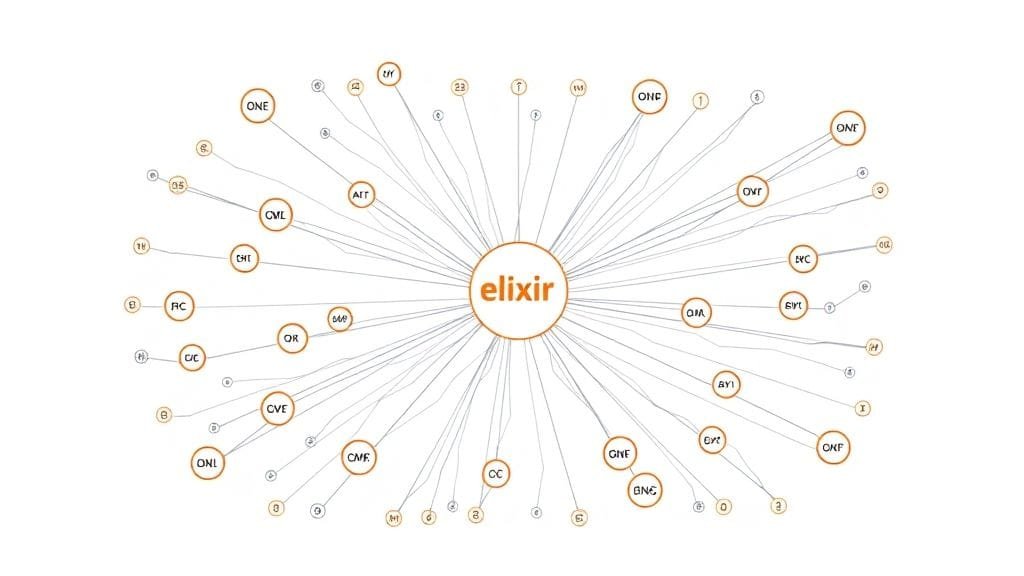
Have you ever wondered how some of the world’s most demanding applications stay online, even when things go wrong? Imagine a system handling millions of users at once, one that never crashes completely. Moreover, it recovers from errors almost instantly. While this might sound like a dream, it’s the reality for systems built with Elixir. Elixir is a dynamic, functional [programming language](https://codingdojo.com/blog/what-is-functional-programming) specifically designed to build robust Elixir distributed systems.
This article will explore Elixir distributed systems. You will discover how this technology solves critical problems in modern software development, managing massive user loads and ensuring constant availability, for example. We will then examine Elixir’s unique foundation, which empowers developers to create powerful and highly resilient applications. Get ready to explore a new approach to building software that truly lasts.
Unlocking Resilience: Why Elixir Shines for Distributed Computing
Building distributed systems today presents significant challenges. Many aspects require careful consideration. For instance, how do you handle numerous users? What happens if a part of the system fails? Furthermore, how can the system scale effectively? Traditional languages often struggle with these problems, leading to complicated code and fragile applications. In contrast, Elixir offers a distinct approach to distributed computing.
Elixir stands out because it was designed from the ground up with resilience in mind. This means it doesn’t just try to prevent errors; rather, it accepts that errors will occur. It provides robust tools to manage them gracefully. As a result, your Elixir distributed applications remain stable and highly available. This inherent focus on stability makes Elixir highly attractive to businesses that demand constant uptime.

The Erlang BEAM: Powering Elixir Distributed Systems
The Erlang Virtual Machine, known as the BEAM), is fundamental to Elixir’s power. It is not just any virtual machine; instead, it’s a proven engine. Ericsson developed it for the demanding telecom industry. Consider phone networks: they must always function perfectly for millions of calls. The BEAM was therefore designed to meet these precise needs for robust Elixir distributed systems.
Its design, for example, allows for exceptionally fast operations. This means operations are executed very quickly. It also excels at handling distributed tasks and maintaining continuous operation. The BEAM, therefore, offers several key features. These include lightweight concurrency, isolation between distinct parts of your program, and efficient garbage collection for each process. Ultimately, all of this creates a highly stable and fast foundation for your distributed Elixir applications.
A Legacy of Dependability and Speed
The BEAM’s history in telecom demonstrates its inherent dependability. It has powered vital systems for decades. It proves its ability to handle immense loads and maintain continuous uptime. Elixir directly inherits this strong history of resilience. Consequently, when you build with Elixir, you leverage decades of work focused on robust, distributed operations. This is a significant advantage for any Elixir distributed system.
The BEAM’s scheduler is exceptionally efficient. It manages countless concurrent tasks. This, in turn, ensures your application utilizes all CPU power effectively. This means a single machine can perform more work, faster, without performance degradation. It acts like a master conductor for an orchestra, essentially ensuring every instrument plays its part perfectly for Elixir distributed systems.
Lightweight Processes: Building Blocks of Concurrency
Elixir’s approach to handling many tasks concurrently is one of its standout features. It employs the Actor Model, where your entire application is built from tiny, isolated parts called lightweight processes. These are not like the heavy threads found in other languages; instead, they are incredibly small and quick to create. This makes them ideal for Elixir distributed systems.
Imagine hundreds of thousands, or even millions, of these processes executing on a single machine. Each acts like a worker, performing its own distinct job. Crucially, these processes do not share memory directly; rather, they communicate by sending messages. As a result, this design enables your application to utilize all CPU cores effectively. It also allows for vertical scaling on a single server. This is a key characteristic for distributed Elixir applications.
Isolation: The Key to Uninterrupted Service
A significant benefit of these lightweight processes is their inherent isolation. For instance, if one process encounters an error and crashes, it does not bring down the entire system. Consider a small cog breaking in a complex machine; the rest of the machine continues to run, and the broken cog is quickly replaced. This isolation is fundamental to Elixir’s fault tolerance, especially in Elixir distributed systems.
This approach, therefore, vastly simplifies error handling. You don’t need to write complex code to prevent every possible error. Instead, you focus on gracefully recovering when a process fails. The ‘let it crash’ philosophy is powerful. Ultimately, it ensures your Elixir distributed system remains robust. Moreover, it continues to provide service even when issues arise.
OTP: The Framework for Unstoppable Elixir Distributed Systems
Elixir runs on the BEAM and leverages the Open Telecom Platform (OTP). OTP is a comprehensive set of libraries and design principles, refined over decades within the Erlang ecosystem. It offers robust, proven tools that help build truly distributed and fault-tolerant applications. Therefore, consider OTP a complete toolkit for building industrial-strength Elixir distributed systems.
When utilizing OTP, you don’t have to build common solutions from scratch. These include managing data, handling failures, and distributing work across multiple machines. These components help ensure your applications are powerful and highly stable. Ultimately, OTP provides a blueprint for application development, which is invaluable for Elixir distributed systems.
Supervisors: Your Application’s Guardian Angels
Supervisors are essential components of OTP. These are special processes with one crucial task: to monitor other processes. If a monitored process crashes, the Supervisor swiftly steps in and restarts it. This occurs autonomously and is often so rapid that users don’t even perceive a disruption. In other words, this “let it crash” strategy is central to Elixir distributed systems.
Instead of attempting to catch every error, Elixir accepts that errors will occur. Supervisors then ensure that when a component fails, it’s quickly brought back online. Consequently, this minimizes downtime. This built-in self-healing capability makes a significant difference for systems requiring continuous uptime. Ultimately, it transforms potential system crashes into small, localized issues within an Elixir distributed system.

GenServers: Managing State and Behavior with Ease
The GenServer is another fundamental component of OTP. This is a general server behavior that provides a standard way to manage a process’s data and its behavior. A GenServer is a single lightweight process that holds data (its state) and responds to messages from other processes. Thus, this greatly simplifies handling complex data in applications that run many tasks concurrently, especially in Elixir distributed systems.
For instance, imagine you need to store settings, manage a database connection pool, or handle a user’s session. A GenServer is the ideal tool for these tasks. Indeed, it ensures changes to its state occur in a controlled, sequential manner. Therefore, this prevents common bugs that arise when multiple application components attempt to modify the same data concurrently. Ultimately, this enhances the stability of Elixir distributed systems.
Achieving True Scalability with Elixir Distributed Systems
Scalability is crucial for any modern application. If you anticipate a surge in users or your business expands, your system needs to keep pace. Elixir distributed systems are designed for natural scalability. They achieve this in two ways: by making a single machine work harder (vertical scaling) and by distributing work across multiple machines (horizontal scaling). This flexibility offers significant benefits for Elixir distributed applications. Specifically, thanks to its lightweight processes, a single Elixir application can utilize all available CPU cores on a machine. This allows you to serve many more users or process more data with the same hardware. However, Elixir doesn’t stop there; it also offers robust, built-in support for distributed computing, which simplifies horizontal scaling.
Scaling Up: Making the Most of One Machine
Vertical scaling in Elixir occurs with remarkable ease. Its processes are inherently small and efficient. You can pack hundreds of thousands, or even millions, onto a single server. Furthermore, the BEAM’s intelligent scheduler distributes these tasks across your CPU cores. This optimizes work completion. As a result, this means you derive more value from your existing hardware when building an Elixir distributed system.
For instance, imagine a real-time chat application where each user’s connection could be handled by its own lightweight process. A single server running Elixir can easily handle hundreds of thousands of chat sessions concurrently. Many other languages struggle with this level of concurrency. This efficiency is a key strength of Elixir’s design, especially for Elixir distributed systems.
Scaling Out: Distributing Work Across Many Servers
Additionally, when a single machine isn’t sufficient, Elixir shines even brighter with horizontal scaling. In such cases, it provides native, built-in mechanisms to form clusters of connected nodes. These nodes can communicate with each other seamlessly. This allows your application to function as a single unit even across multiple servers. This significantly simplifies building Elixir distributed systems.
You can easily add more servers to your Elixir cluster as your user base expands. The system automatically distributes the work and ensures application components communicate effectively. Consequently, Elixir’s built-in support for distribution reduces the time spent on complex networking setup. This allows you to focus more on building your application’s core features for Elixir distributed systems.

Fault Tolerance: Elixir Distributed Systems’ Core Promise
In software, failures are not a matter of “if,” but “when.” Hard drives fail, networks experience outages, and unexpected bugs emerge. For vital applications, continuous availability is not just a feature; it’s a necessity. Elixir’s design inherently addresses fault tolerance. This ensures your Elixir distributed systems continue functioning even when issues arise.
Its approach is practical and powerful. Specifically, Elixir accepts that failures will occur; instead, it provides mechanisms to quickly detect, isolate, and resolve them. This self-healing capability truly sets it apart. This means your system can withstand numerous failures without a complete collapse. In effect, this enhances the safety of your Elixir distributed systems.
The “Let It Crash” Philosophy in Action
Elixir’s fault tolerance is deeply embedded in its “let it crash” philosophy. It is combined with the power of Supervisors. When a lightweight process fails, it crashes. This crash is not a major problem for the entire application; instead, it serves as a signal. Its Supervisor detects the crash. Subsequently, based on its defined strategy, it automatically restarts the failed component. In essence, this is a cornerstone of robust Elixir distributed systems.
This approach, therefore, simplifies development. You don’t need to write endless `try-catch` blocks for every conceivable error. Instead, you focus on ensuring your Supervisors are correctly configured to handle failures. This design facilitates rapid recovery. Ultimately, it ensures your application remains stable, even amidst transient problems common in Elixir distributed systems.
Robustness Through Isolation and Supervision
Isolated lightweight processes and robust supervision trees together create a highly resilient system. For example, imagine a highly complex system, such as an online banking platform. If one small service for a user’s transaction temporarily fails, only that specific service is affected. The rest of the banking system, in fact, continues to operate normally. This is a clear advantage of Elixir distributed systems.
Consequently, the Supervisor swiftly restarts the failed transaction service. This potentially allows the user to try again. Thus, this level of isolation and automatic remediation is crucial for high-stakes applications. It means minor problems don’t escalate into system-wide failures. This protects your users and business from costly downtime in Elixir distributed systems.
The Functional Advantage: Simplicity for Elixir Distributed Systems
Elixir is a functional programming language, which might seem daunting if you’re accustomed to other programming styles. However, it brings significant benefits, especially in distributed systems and highly concurrent environments. Therefore, functional programming helps you write code that is easier to understand, test, and maintain. Ultimately, this is vital for complex Elixir distributed systems.
A core principle is the use of pure functions. These functions always yield the same output for the same input and have no side effects. This means they do not alter any external data. Moreover, another key aspect is immutable data structures. Once data is created, it cannot be modified. Consequently, this greatly reduces bugs in applications running many tasks concurrently, especially in Elixir distributed systems.
Immutability: Taming Shared State Complexity
In many concurrent programming approaches, handling shared data is exceptionally challenging. If many parts of your program attempt to modify the same data concurrently, you can encounter unexpected bugs. These are notoriously difficult to fix. Moreover, this is often referred to as a “race condition,” a common problem largely avoided by Elixir distributed systems.
Elixir’s immutable data structures effectively solve this problem. Since data cannot be modified after creation, you don’t have to worry about one process altering data another process is using. Consequently, this makes concurrent programming significantly simpler. Crucially, it makes your code more predictable. It also greatly reduces the likelihood of hard-to-find errors, which is key for Elixir distributed systems.
Pure Functions: Making Code Predictable and Testable
Pure functions are straightforward to use. They always behave in a predictable manner. They do not rely on external data. Therefore, they are considerably easier to test. You simply provide inputs and verify the outputs. Consequently, this leads to more reliable code and accelerates development. Additionally, this makes refactoring less risky. You know the function will continue to perform as expected in Elixir distributed systems.
For example, imagine a function that calculates a discount. If it’s a pure function, you can safely reuse it across your application. You know it will always yield the correct discount and won’t accidentally alter a customer’s total or affect anything else. This clarity is a significant advantage for building complex systems, including Elixir distributed systems.
Real-World Triumphs: Elixir Distributed Systems in Action
Elixir’s power, building on the Erlang ecosystem, isn’t just theoretical. It’s proven in some of the most demanding real-world applications. Companies worldwide leverage this technology to provide fast, always-on services. Services that handle immense traffic often utilize Elixir or Erlang, especially Elixir distributed systems. In summary, Elixir helps developers build advanced applications that meet demanding user needs. A key reason Elixir excels in distributed applications is its ability to safely handle real-time communication and vital data flows.
Powering Global Communication and Finance
Consider companies like WhatsApp, which famously utilized the Erlang ecosystem to handle billions of messages a day with remarkable reliability. Elixir builds on this foundation, offering similar capabilities but with a more modern syntax. Banks like Klarna also leverage these strengths for their critical tasks. Therefore, for these tasks, uptime and data integrity are paramount, especially for their Elixir distributed systems.
Elixir is a robust choice for any application requiring real-time interaction. This includes, for instance, online gaming backends, live chat applications, and collaboration tools. It handles numerous concurrent connections exceptionally well. This makes it ideal for these demanding situations. This demonstrates the strength of Elixir distributed systems.

The Phoenix Framework: Building Real-Time Web Applications
For web developers, Elixir offers the Phoenix framework. Essentially, Phoenix serves as Elixir’s powerful tool for building web applications that can scale and handle failures. It leverages all the core strengths of Elixir and the BEAM. It provides a powerful platform for real-time features. Consider live updates, instant messages, and interactive dashboards powered by Elixir distributed systems.
Phoenix Channels, a key part of the framework, make it easy to add real-time chat capabilities to your web applications. Consequently, this means users receive instant feedback and updates. They don’t need to constantly refresh their browser. Ultimately, it provides a highly interactive and engaging user experience. This is crucial for modern web applications built on Elixir distributed systems.
Elixir Distributed Systems: Comparisons and Considerations
Choosing a programming language is a significant decision. It depends on your project’s requirements, your team’s skills, and your long-term strategy. Understanding where Elixir fits into the broader landscape is key, especially for Elixir distributed systems. It offers clear advantages, but it also presents its own challenges that should be considered. Therefore, let’s compare Elixir to its cousin, Erlang, and other popular programming languages. Ultimately, this will help you discern Elixir’s unique value. Moreover, it will also help you identify when it’s the optimal tool for your next significant project. Every technology has its optimal application, and Elixir is no different when considering Elixir distributed systems.
Elixir vs. Erlang for Distributed Systems: A Modern Evolution
Elixir and Erlang both utilize the same powerful runtime, the BEAM, and OTP. However, Elixir is often the preferred choice for new Elixir distributed systems. Why? Elixir offers a more modern, developer-friendly syntax, along with an expanded set of tools and a lively, growing community.
While Erlang is very powerful, it can feel somewhat challenging for developers accustomed to conventional languages. In contrast, Elixir feels familiar, similar to Ruby, yet it still offers all of Erlang’s core strengths and concurrency benefits. This makes Elixir more accessible. Crucially, it doesn’t compromise any of the core power needed for robust Elixir distributed systems.
Elixir Compared: Other Languages for Distributed Systems
When comparing Elixir to other languages, its strengths become even more apparent for Elixir distributed systems:
- Ruby and Python: Ruby and Python are excellent for rapid development, but they often struggle with high concurrency due to their Global Interpreter Lock (GIL) limitations. Elixir’s lightweight processes and BEAM scheduler enable true parallel processing for concurrent tasks. Consequently, this significantly boosts performance, especially in distributed systems.
- Node.js: Node.js employs a single-threaded, event-driven design, which is effective for I/O-bound tasks. However, it lacks true parallel processing for CPU-heavy tasks. Elixir excels at both I/O and CPU-heavy tasks concurrently. This is thanks to the BEAM’s ability to run processes across multiple cores. Therefore, this makes it a more robust choice for many distributed systems.
- Go: Go can be faster on a single thread for some tasks, but Elixir offers built-in distributed computing capabilities that Go doesn’t provide by default. Elixir offers superior resilience and distribution; Go’s standard threading model doesn’t match this. Instead, Elixir achieves fault tolerance in its distributed systems through advanced scheduling for concurrent tasks and true process separation.

Potential Drawbacks and Learning Curve
Every powerful tool comes with a learning curve, and Elixir is no exception, especially for those new to Elixir distributed systems. For instance, developers new to functional programming or the Erlang ecosystem might find the concepts challenging at first. Concepts like immutability, pattern matching, and the Actor Model require a new way of thinking. Nonetheless, mastering these concepts pays dividends when building robust Elixir distributed systems.
Furthermore, compared to larger languages like Java or Python, Elixir has a smaller ecosystem and community. This means you might, at times, find fewer readily available libraries for very specific problems. Moreover, finding experienced Elixir developers can sometimes be more challenging. Nevertheless, the Elixir community is highly active, supportive, and rapidly growing. Many new libraries and tools are continually emerging to support Elixir distributed systems.
Embracing Elixir: A Vision for Future Distributed Systems
Elixir offers a robust platform for building highly scalable and fault-tolerant Elixir distributed systems. Its strength stems from being built on the proven Erlang BEAM and OTP. Moreover, it also leverages a novel actor-based concurrency model. Thus, it emphasizes functional programming and immutability. These features collectively address some of the most pressing problems in modern software development. This is particularly true for Elixir distributed systems.
You’ve learned about Elixir’s core capabilities. Specifically, it can build self-healing applications with lightweight processes and Supervisors. Furthermore, it also simplifies handling complex data using its functional approach. It scales with remarkable ease. Despite these benefits, Elixir distributed systems come with a learning curve and a smaller ecosystem. Nevertheless, their unmatched resilience and performance benefits often compensate for these initial difficulties. For applications that simply cannot fail, Elixir offers a highly attractive solution.
What aspect of Elixir’s capabilities for building Elixir distributed systems excites you the most? How do you plan to leverage it in your next project?