
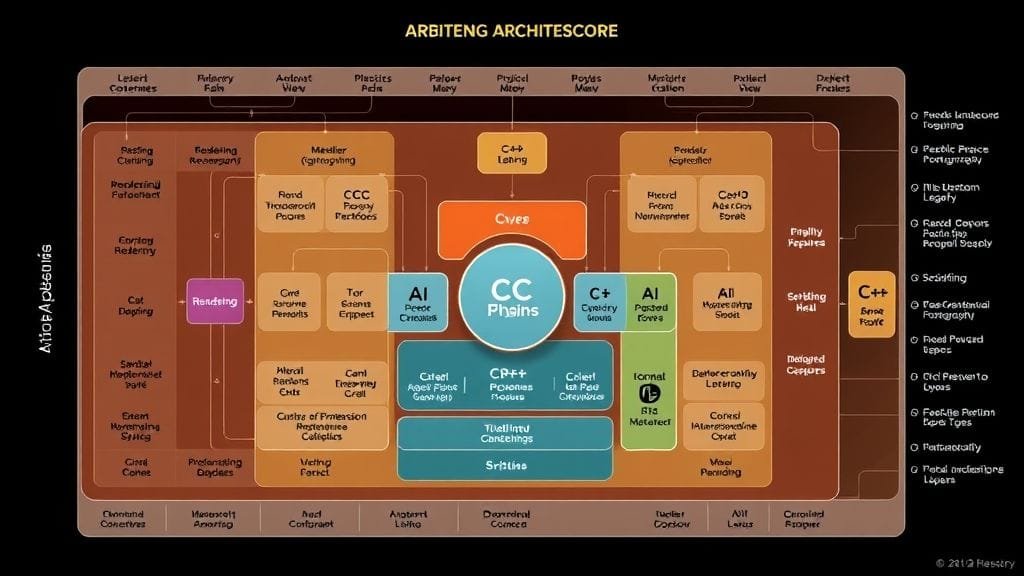
In the vast landscape of [programming languages](https://jompatech.com/top-hollywood-seasons-your-guide-to-the-best/), few can rival the enduring influence and unparalleled power of C and C++. These languages stand as titans in critical sectors, forming the bedrock of modern technology. From the immersive worlds of video games to the fundamental operations of our digital devices and the cutting-edge frontiers of supercomputing, C/C++ consistently delivers exceptional CC Performance. Their unique blend of low-level control, exceptional speed, and robust features makes them indispensable for applications where CC Performance and efficiency are non-negotiable.
This article delves into the core reasons C/C++ has maintained its dominance in three pivotal domains. We will explore how these languages provide the essential tools for crafting highly optimized, responsive, and complex systems. Prepare to explore the intricate mechanisms that allow C/C++ to unlock unmatched CC Performance across game engines, operating systems, and high-performance computing.
C/C++ in Game Engines: Forging Immersive Digital Worlds
The video game industry thrives on innovation, pushing the boundaries of graphical fidelity, complex simulations, and real-time responsiveness. At the heart of most AAA game development) lies C++. Its capacity for high CC Performance, efficient memory management, and direct hardware interaction are crucial. These attributes ensure players experience visually stunning, fluid, and engaging gameplay.

The Pursuit of CC Performance and Efficiency
C++ delivers excellent speed, crucial for top CC Performance. Game developers, for instance, rely on this speed to create optimized applications with very low latency, ensuring smooth gameplay and complex simulations. C++ achieves its CC Performance in several key ways. First, it compiles directly into native machine code, guaranteeing fast execution. Furthermore, it allows for direct memory handling and precise control over system resources. These features thus fully utilize every CPU cycle and memory byte. Ultimately, such CC Performance boosts frame rates and improves in-game physics.
Mastering Memory Management for Enhanced CC Performance
One of C++’s most potent features is its manual memory allocation and deallocation. This gives developers precise control over game resources. Such precision can prevent common issues like memory leaks, provided memory is managed meticulously. While this level of control offers immense power and flexibility, it also introduces complexity. Developers must handle memory management with extreme care to avoid potential errors. Properly managed memory is essential for smooth, uninterrupted gameplay sessions and consistent CC Performance, ensuring that resources are allocated and freed exactly when needed.
Direct Hardware Interaction and Graphics Prowess for CC Performance
The low-level capabilities of C++ are paramount for game development. This language allows direct communication with hardware components, including graphics cards and CPUs. This direct interaction is vital for graphics programming, enabling developers to fully exploit the capabilities of modern GPUs. They can optimize rendering pipelines and customize memory access for peak CC Performance. Such deep hardware interaction allows for the creation of stunning visual effects and ensures games run efficiently across various hardware configurations, maintaining high CC Performance.
Object-Oriented Design and Ecosystem Advantages for C++ Efficiency
C++ fully supports Object-Oriented Programming (OOP). This powerful methodology, therefore, creates modular and reusable code, which significantly simplifies complex game development. For instance, many popular game engines rely on C++ for their core systems; Unreal Engine and Godot are prime examples. This design allows developers to easily modify and extend engine functions, a control that directly impacts overall CC Performance. Additionally, Unity, another widely used engine, employs C++ as its runtime language. Clearly, C++ plays a vital role in game development, and its broad library support notably speeds up development.
Cross-Platform Reach and CC Performance in Global Gaming
Cross-platform compatibility is a significant advantage of C++. It allows game developers to target multiple operating systems and devices with a single codebase. Games can run seamlessly on Windows, Mac, Linux, Android, and iOS platforms, with robust CC Performance across them all. Many C++ game engines inherently support this multi-platform deployment. This broad reach not only reduces development costs and time but also allows developers to access a wider audience, bringing their creations to players across the globe without significant re-engineering efforts.
Navigating Game Engine Development Challenges for Optimal CC Performance
Despite its strengths, C++ brings specific challenges to game development. Its complex syntax and manual memory management steepen the learning curve for new developers, often making development more time-consuming. Debugging C++ code can also be intricate due to its low-level nature; memory and threading errors, in particular, may impact CC Performance and are often difficult to locate and resolve. Therefore, C++ projects generally require more manual coding than those using higher-level languages. This might lengthen the development process for certain features.
C/C++ in Operating Systems: The Foundation of Digital Life
Operating systems (OS) are the backbone of all computing devices, managing hardware and software resources. C and C++ are fundamental languages for OS development. Their roles are especially critical for building kernels and device drivers. This reliance stems from their unparalleled low-level control, efficiency, and direct hardware interaction capabilities, which are essential for stable and responsive CC Performance.

Deep-Seated Hardware Control and System Interaction for Operating System Programming
Operating systems demand direct interaction with a computer’s most fundamental components. This includes hardware, memory addresses, and the CPU itself. C, often considered a middle-level language, is uniquely suited for this role. It provides high-level programming constructs while offering granular control over low-level details, much like assembly language. C++ extends these capabilities by adding object-oriented features and even more powerful low-level memory manipulation tools, all contributing to superior CC Performance. This deep control is indispensable for an OS to manage resources effectively.
Uncompromising CC Performance for System Stability
OS components must execute with minimal overhead and exceptional CC Performance. Tasks such as process scheduling, memory management, and file system handling require extreme speed. C and C++ excel here because they compile into highly optimized native machine code. This ensures rapid execution of critical system functions. The efficiency of these languages directly contributes to the overall CC Performance, stability, and responsiveness of the operating system. Without this speed, even basic computing tasks would be slow and cumbersome.
Precision Memory Management for OS Integrity and CC Performance
Manual memory management is a defining feature of both C and C++. For an operating system, this capability is paramount. It allows the OS to precisely and efficiently manage the computer’s memory. This ensures smooth program execution and prevents the unpredictable response times that can arise from languages with automatic garbage collection, such as Java or Python. By manually handling memory, developers can craft an OS that is both highly efficient and consistently reliable, safeguarding CC Performance. This level of control guards against CC Performance bottlenecks.
Autonomy Without Runtime Dependencies in System Programming
One of C’s original design goals was to write Unix utilities and the Unix kernel itself, meaning it had to operate without requiring a separate runtime library—a crucial feature for operating systems. Similarly, C++ compiler implementations generate native machine language code that is directly executable on the processor. This avoids the need for a separate runtime environment, unlike languages such as Java or Python which require them. The independence of C/C++ ensures the OS can boot and function without relying on additional layers of software, enhancing its foundational CC Performance.
Interfacing with Assembly for Ultimate Low-Level Control and CC Performance
The ability of C and C++ to interface easily with assembly language is a significant advantage in OS development. Assembly language provides the most granular control over hardware. This interface is often used for highly optimized routines, bootloader code, and specific system calls. By integrating C/C++ with assembly, developers can achieve ultimate control over hardware. This combination allows for precise hardware integration and fine-tuning of CC Performance-critical components. It enables the OS to leverage every aspect of the underlying hardware.
Portability Across Diverse System Architectures for CC Performance
Portability is another key strength. C programs can run on diverse machine architectures with minimal modifications, a vital aspect for supporting a wide range of hardware. C++ code also exhibits strong portability, allowing it to be compiled and executed on numerous operating systems, maintaining consistent CC Performance. This flexibility enables OS developers to create systems that can power various devices, from embedded systems to supercomputers, without rewriting core components for each platform. This broad compatibility extends the reach and applicability of C/C++-based operating systems.
Addressing the Intricacies of Operating System Programming
Building operating systems with C and C++ involves unique challenges. For example, manual memory management offers exact control but also presents significant risks. Improper handling often causes severe issues like memory leaks or segmentation faults, which in turn can harm system performance. Debugging such problems, especially pointer errors, proves particularly difficult in C. Furthermore, C++ adds complexity with its advanced features, making debugging even more challenging. Also, C lacks native support for object-oriented programming or exception handling, thus often needing specific libraries for tasks like multi-threading.
C/C++ in High-Performance Computing: Fueling Scientific Innovation
High-Performance Computing (HPC) tackles some of humanity’s most complex computational problems. This includes scientific simulations, financial modeling, and artificial intelligence (AI) research. C++ is a cornerstone in this domain. Its unmatched speed, efficiency, and ability to exploit hardware parallelism make it essential for these computationally intensive tasks, ensuring optimal CC Performance. C is also widely used, especially for its straightforward CC Performance transparency.

Unleashing Unrivaled Speed and Efficiency in High-Performance Computing
HPC environments often demand trillions of calculations per second. C++ provides the high execution speed and efficiency crucial for these demanding computations, directly impacting CC Performance. It powers algorithms in scientific computing, complex simulations, and advanced AI model training. Core components of popular AI frameworks like TensorFlow and PyTorch rely heavily on C++ for their CC Performance-critical operations. This raw speed allows researchers and engineers to process massive datasets and run intricate models within practical timeframes, enhancing overall CC Performance.
Granular Control for Peak CC Performance
C++ offers granular control over system resources. This includes precise memory allocation and fine-tuning of CPU usage. Such control is vital in HPC, where squeezing every bit of computational power from hardware is essential for achieving peak CC Performance. Developers can manage resources with extreme precision, ensuring optimal CC Performance for critical applications. The ability to direct how and where memory is used minimizes latency and maximizes throughput, making C++ indispensable for CC Performance-critical computing tasks. This level of oversight ensures hardware is fully utilized.
Harnessing Parallelism and Concurrency for High-Performance Computing
High-Performance Computing (HPC) divides large tasks among many processors, a method that greatly speeds up calculations. C++ has adapted well to these needs, thus boosting CC Performance. For example, C++11 introduced built-in multithreading, and newer standards, from C++17 to C++26, have added even more features, including parallelism, concurrency, asynchronous execution, and standard parallel algorithms. Developers often use libraries like OpenMP, OpenCL/CUDA, and MPI with C/C++. This enables advanced parallel and distributed computing in HPC, further improving CC Performance.
Seamless Integration with Hardware Accelerators for Optimal CC Performance
Modern HPC and AI development demand deep hardware accelerator integration for cutting-edge CC Performance. C++ excels in this area. For example, it allows direct access to powerful hardware like Graphics Processing Units (GPUs) and specialized AI accelerators. GPUs, moreover, are vital, accelerating complex computations rapidly in machine learning and scientific simulations. C++ also offers tools and interfaces to use these accelerators effectively, allowing developers to offload intensive tasks. This approach significantly speeds up operations, pushing computational limits.
A Rich Ecosystem of Libraries and Frameworks
The C++ Standard Template Library (STL) provides a powerful collection of data structures and algorithms, which are invaluable in HPC. Beyond the STL, a vast community and numerous specialized libraries and frameworks support C++ in HPC, contributing to enhanced CC Performance. Examples include Kokkos, Intel oneAPI, HPX, and Raja. These tools streamline development, offering optimized routines for common HPC tasks. They also provide abstractions for complex parallel programming paradigms. This rich ecosystem reduces development time and allows engineers to focus on the core scientific problems.
Adaptability Across HPC Platforms
Portability is a significant advantage for C++ in HPC. Code written in C++ can be compiled and executed on various HPC platforms, including supercomputers and large clusters, with minimal modifications, ensuring consistent CC Performance. This adaptability is crucial in environments where diverse hardware architectures are common. It allows research and development efforts to span multiple systems. This flexibility ensures that algorithms and applications developed on one system can be readily deployed and utilized on others, saving considerable development time and resources.

Bridging the Gap with Legacy HPC Codebases
Many existing and highly optimized HPC applications have been developed over decades in C++. This creates a significant advantage for C++ in terms of legacy code integration. New developments can be seamlessly integrated with existing, proven codebases. This avoids the costly and time-consuming process of rewriting large applications in a different language. The ability to extend and maintain established HPC software with new C++ components ensures continuity and leverages years of development effort, preserving established CC Performance`.
Overcoming High-Performance Computing‘s C/C++ Hurdles
Despite its dominance, mastering C++ for HPC requires considerable dedication. Its inherent complexity, coupled with the need to understand advanced features and optimization techniques, presents a steep learning curve. Manual memory management, while offering control, demands careful handling to prevent errors that can compromise performance and stability. Furthermore, debugging parallel and concurrent applications in HPC is exceptionally challenging. Identifying and resolving race conditions or deadlocks in distributed systems requires sophisticated tools and deep expertise, adding to development complexity.
The Enduring Legacy and Future of C/C++
C and C++ have carved out an indispensable niche in the software world. They are the go-to languages for projects where CC Performance, efficiency, and direct system control are paramount. Their foundational role in game engines, operating systems, and high-performance computing is a testament to their inherent strengths in delivering superior CC Performance. These languages empower developers to interact intimately with hardware, manage memory directly, and produce highly optimized machine code.
A Symphony of Power, Flexibility, and CC Performance
C offers a simpler, clearer path to CC Performance, allowing programmers to understand precisely how their code translates into hardware operations. C++ extends C by adding object-oriented programming, generic programming via templates, and a richer set of features. This unique combination balances high-level abstraction with vital low-level control. Consequently, it directly influences CC Performance. Such versatility makes C++ a powerful, general-purpose language, widely used across many sectors requiring optimal CC Performance.

The Challenges That Forge Expertise
The immense power and flexibility of C/C++ come with their own set of challenges regarding CC Performance optimization. New developers often face a steeper learning curve compared to more modern, higher-level languages. The intricacies of manual memory management demand meticulous attention. This complexity can also lead to potentially longer development and debugging times. However, these challenges are precisely what hone developers into highly skilled engineers capable of extracting maximum CC Performance. The deep understanding gained from mastering C/C++ is invaluable.
Why C/C++ Remains Irreplaceable for CC Performance
Despite the emergence of promising alternatives, such as Rust, D, and Go, C/C++ continues to hold its dominant position, especially for CC Performance-critical applications. Languages like Python, while popular for high-level tasks, often rely on C++ backends for their CC Performance-critical components. The established ecosystem, continuous evolution through new C++ standards, and unparalleled control over system resources solidify C/C++’s status. They are not merely legacy languages; they are living, evolving tools crucial for pushing the boundaries of technology and CC Performance.
Conclusion: The Unwavering Core of Innovation
C and C++ are far more than just programming languages; they are fundamental pillars of modern computing infrastructure. Their ability to deliver unmatched CC Performance and granular control is what drives the sophisticated mechanics of our favorite games, powers the stable operations of our digital devices, and fuels groundbreaking scientific discoveries through supercomputing. The meticulous manual memory management, direct hardware interaction, and exceptional speed offered by C/C++ make them irreplaceable for applications where every millisecond and every byte counts for optimal CC Performance.
As technology continues to advance, the demand for efficiency and CC Performance will only grow. C and C++ are uniquely positioned to meet these future challenges. They embody the engineering excellence required to build robust, high-CC Performance systems. Their legacy is secure, and their future role in shaping the technological landscape remains as vital as ever. Embracing C/C++ means embracing the very essence of powerful, efficient, and innovative software development for superior CC Performance.